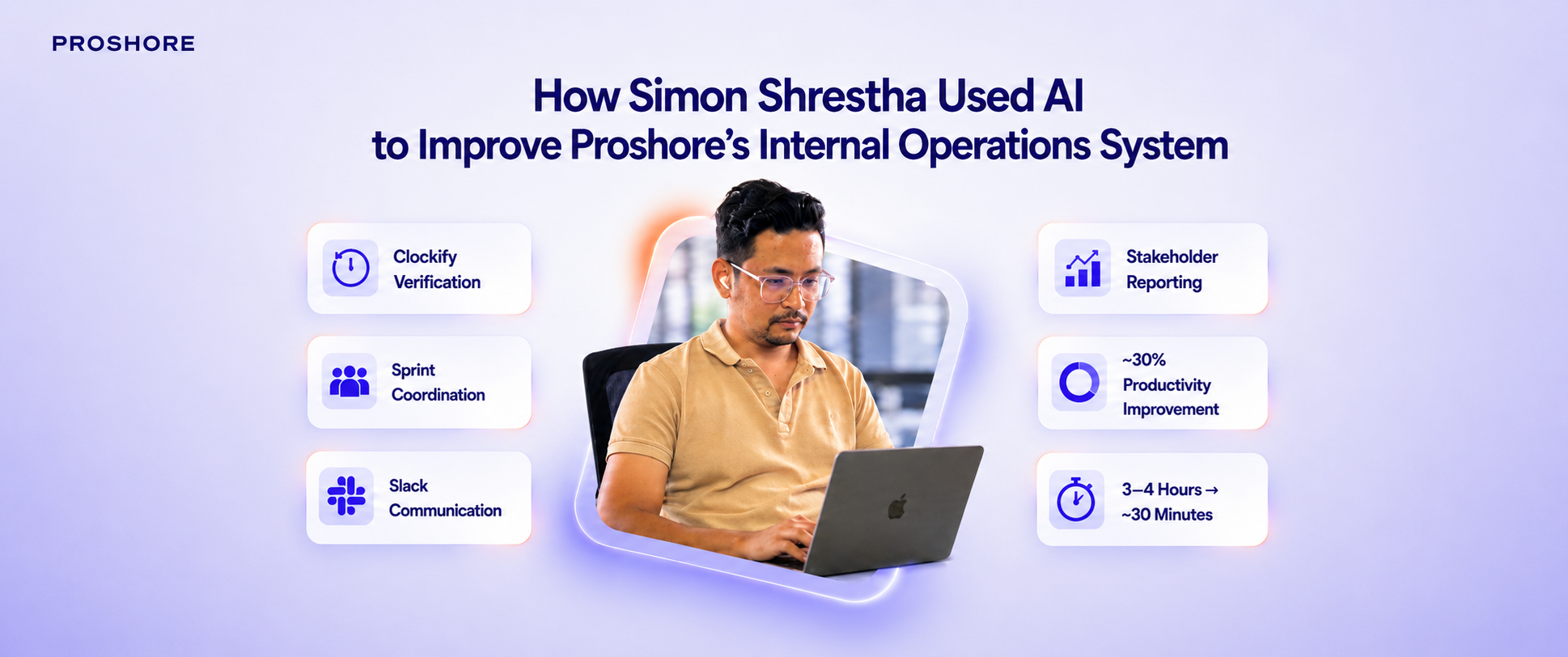
The Manual Work Simon Wanted AI to Remove
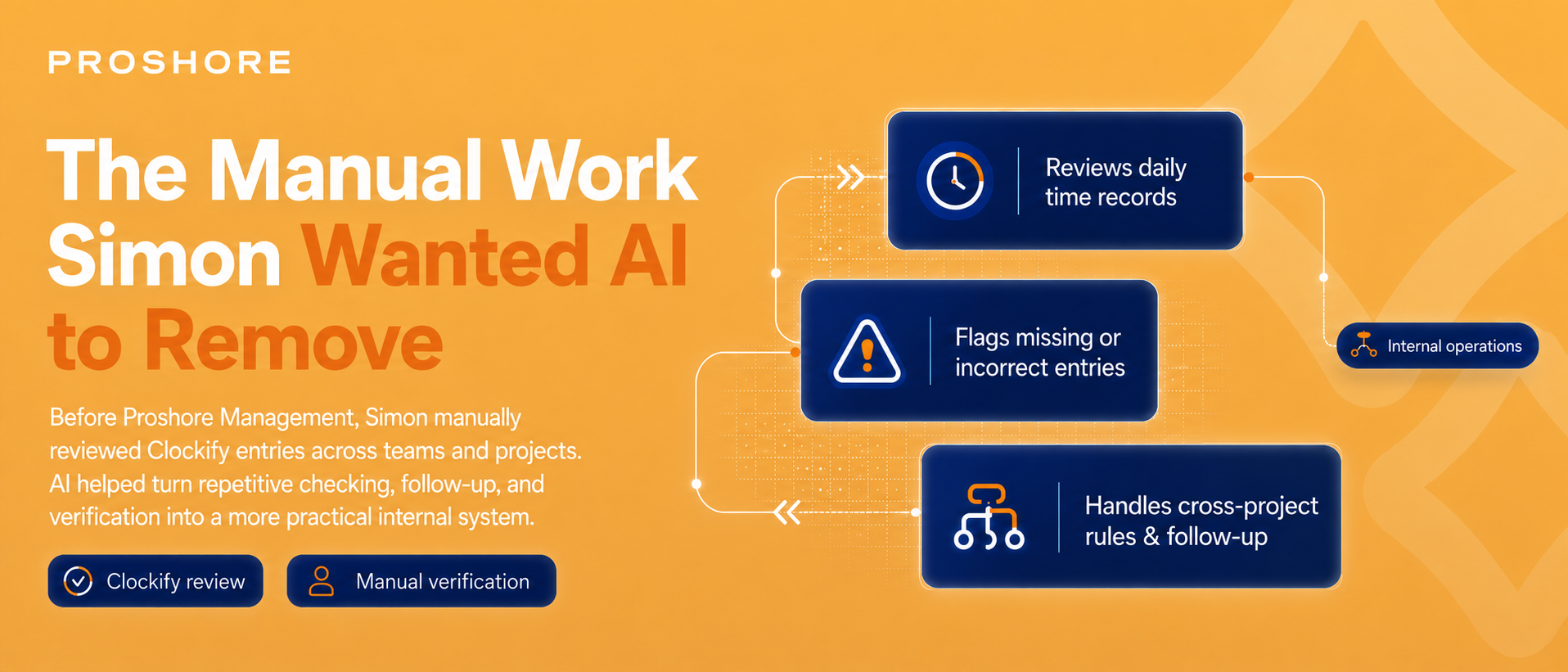
Before Proshore Management, Simon reviewed Clockify entries manually.
He had to review daily time records across every team and project, then identify missing hours or incorrect entries.
After finding an issue, Simon also had to contact the team member individually.
For a team of more than 10 people, the number of checks increased quickly. The work became even more demanding when Simon had to manage several teams with different project requirements.
The process also depended on team-specific rules, including different description requirements, cross-project time allocation, and role-based working patterns.
Simon wanted to reduce this repetitive work without creating an unreliable system that treated every unusual entry as an error.
Building the tool through the engineering team was not practical because developers were already focused on client delivery.
Simon understood the operational problem and had the technical foundation to solve it, even though development was no longer part of his primary role as scrum master.
But his technical background, combined with AI, helped him turn that experience into a working system without any pressure on other team members.
How Simon Used AI to Build Proshore Management
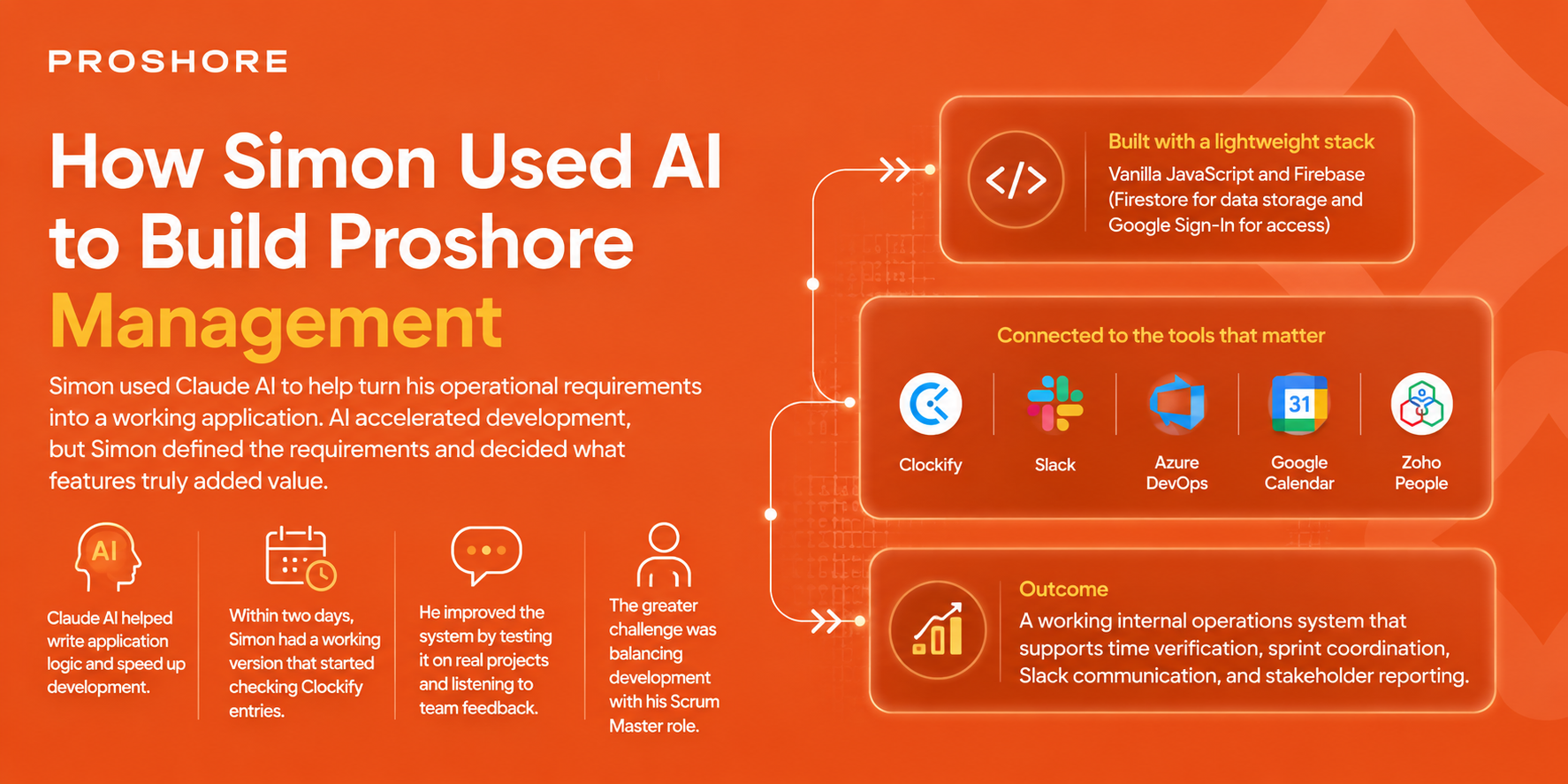
Simon used Claude AI to help turn his operational requirements into a working application.
He remained responsible for defining the problem, explaining the workflow, and deciding how the system should behave. Claude helped him write the application logic and move through development faster than he could have done alone.
This distinction shaped the project, and within two days, Simon had a working version that could begin checking Clockify entries.
He then continued to improve the system by testing it on real internal projects and listening to feedback from the teams using it.
The technical stack was kept lightweight. Simon built the tool with vanilla JavaScript and Firebase, using Firestore for data storage and Google Sign-In for access. He connected it with Clockify, Slack, Azure DevOps, Google Calendar, and Zoho People to support time verification and wider operational workflows.
The greater challenge was developing the system while continuing to manage multiple teams and complete his regular Scrum Master responsibilities.
AI sped up development, but Simon still had to define requirements and decide which features were valuable enough to add.
How the AI-Assisted System Works
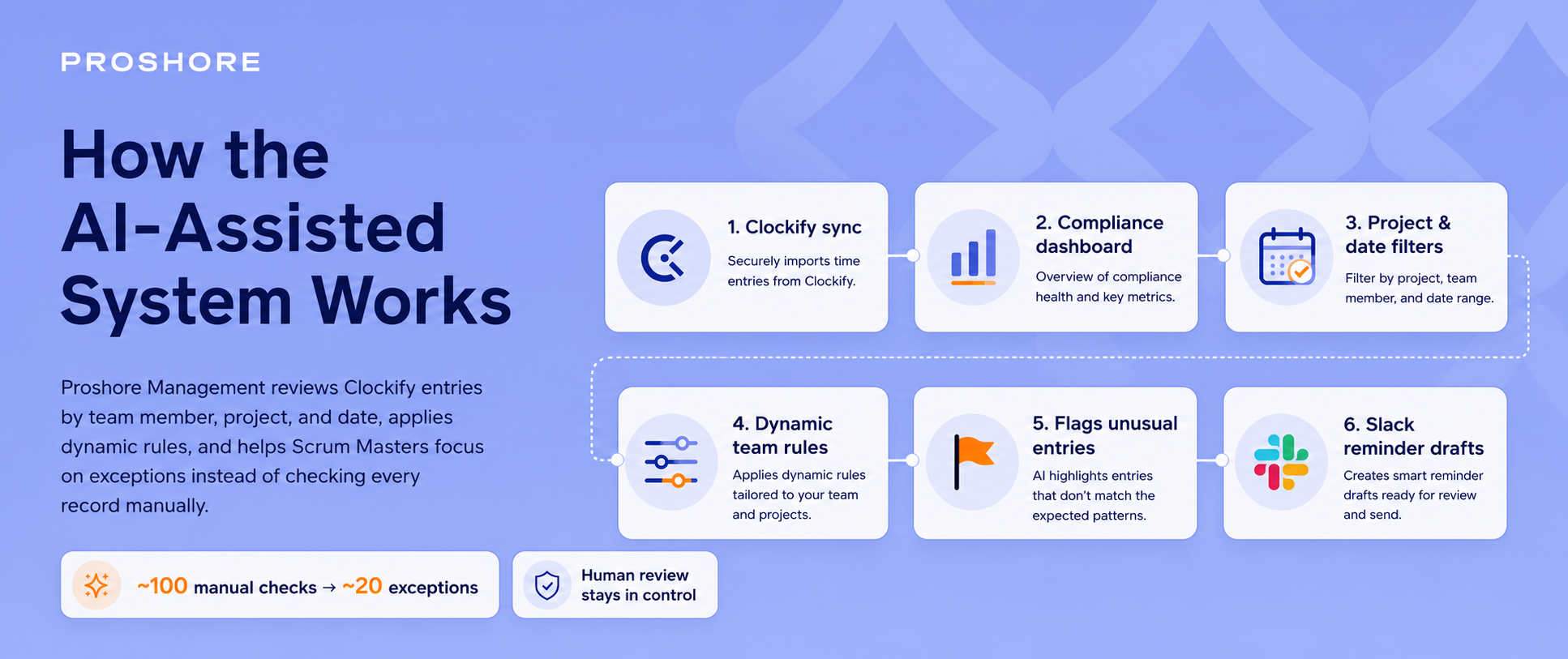
Proshore Management connects with Clockify and reviews time entries by team member, project, and date.
The system verifies time entries against project requirements and displays the results in a compliance dashboard for Scrum Masters and HR. Users can filter by project or date, while configurable rules adapt the checks to specific teams or working arrangements.
Simon made the rules dynamic because a single compliance standard would not work across every team.
A developer may be permitted to record time under multiple projects. A client may require a different description structure. One team may follow a working pattern that would appear unusual when compared with another.
Rather than allowing AI to guess whether those situations are acceptable, Simon defines the conditions inside the system.
The tool flags unusual entries for review instead of automatically treating them as errors.
Before Proshore Management, Simon might have needed to manually inspect around 100 entries. The system now performs the initial review and reduces the number requiring human attention to approximately 20.
Simon can focus on the exceptions instead of spending equal time on every record.
The system also supports Slack notifications. When someone has not logged their hours, it can prepare an individual direct message for that person. Simon can review and edit the message before it is sent. This keeps communication efficient without removing personal control from the process.
Expanding AI Across Simon’s Scrum Master Workflow
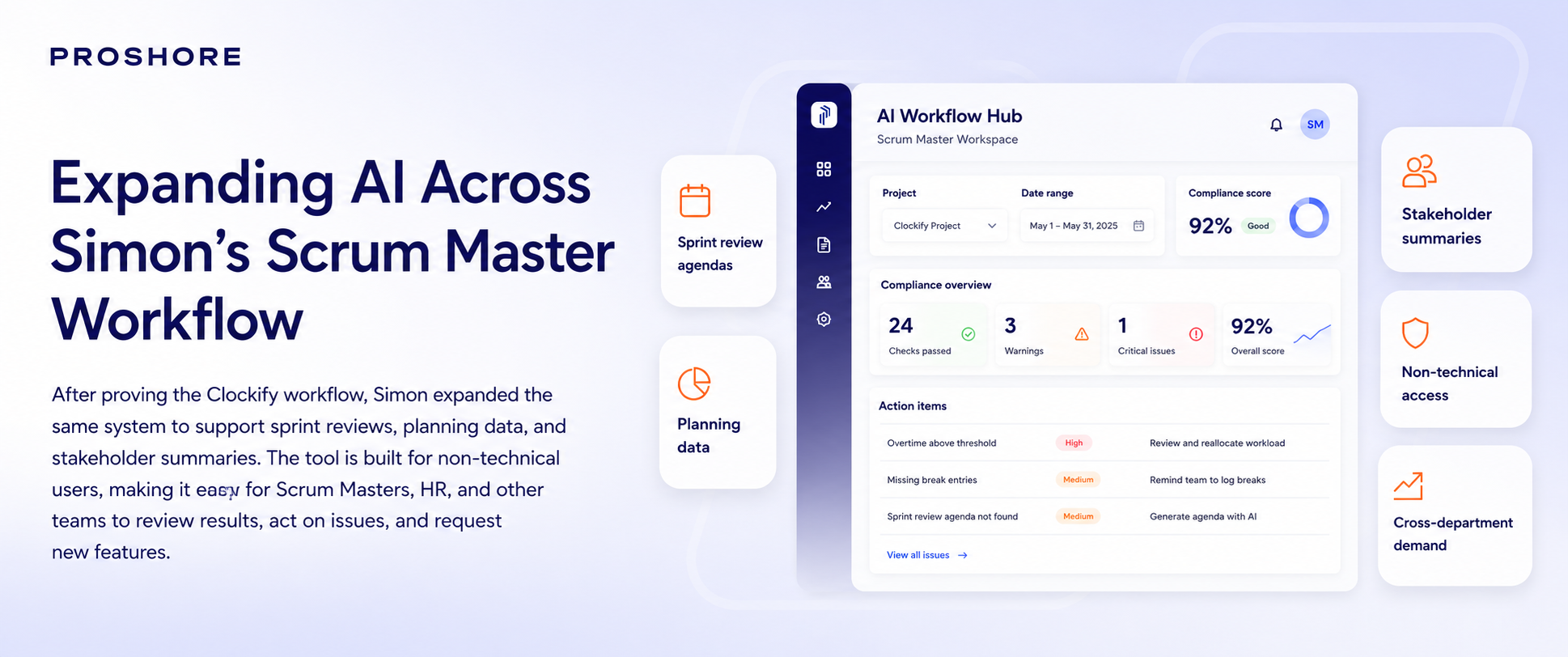
After proving the Clockify workflow, Simon began using the same system to solve other repetitive parts of his role.
The tool connects with JIRA or Azure DevOps to generate sprint review agendas, organize planning data, and prepare stakeholder summaries. This reduces the manual work Simon previously handled before and after each sprint review.
The tool was designed so Scrum Masters, HR employees, and other non-technical users could operate it without programming knowledge.
Users can select a project, choose a date range, review the compliance results, and act on the issues identified by the system. The APIs, databases, and application logic remain behind the interface.
That usability became increasingly important when other teams began asking Simon for access and additional features.
The first version had been built to solve Simon’s own operational problem. Internal demand indicated that the same approach could support cross-departmental work.
The Operational Impact of Simon’s AI Tool
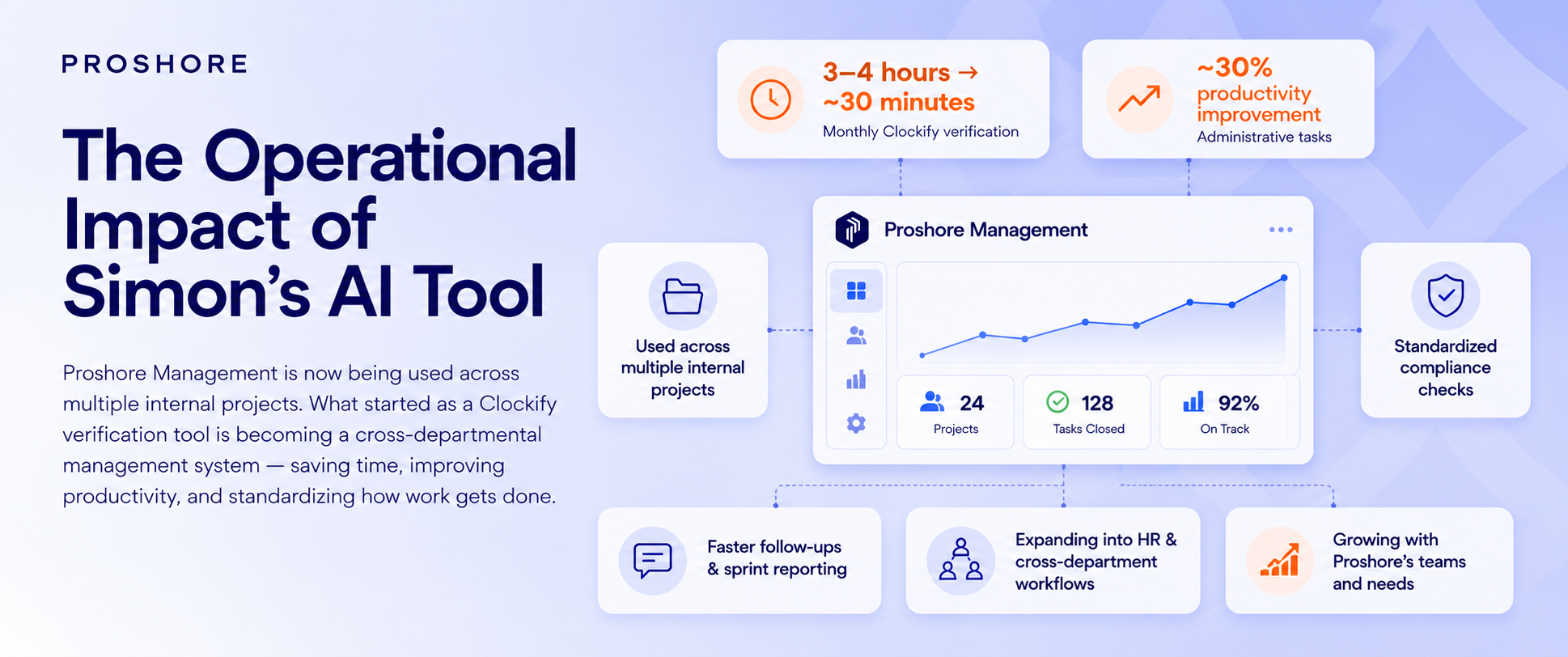
Proshore Management is now being used across multiple internal projects.
Before Simon built it, monthly Clockify verification could take around three to four hours. The process can now be completed in approximately 30 minutes.
The system has also contributed to an estimated 30 % productivity improvement across the repetitive administrative tasks it supports.
Beyond saving time, the tool standardizes compliance checks, speeds up follow-ups and automates sprint reporting. Continued feature requests from its users became the clearest proof that the MVP had succeeded.
Other teams began requesting new features. HR saw that the same platform could support its own internal processes. What started as a Clockify verification tool was becoming a cross-departmental system.
That response changed the direction of the product.
Simon chose the name Proshore Management because he did not want the system to remain limited to time tracking. He saw the potential for it to become a management platform that supports the company as its teams and operational requirements grow.
More people create more time entries, sprint records, performance reviews, leave requests, and communication requirements. Without a shared system, that work remains divided across spreadsheets, messages and separate tools.
Simon wants Proshore Management to become part of the foundation connecting those workflows.
What Simon Plans to Build Next With AI
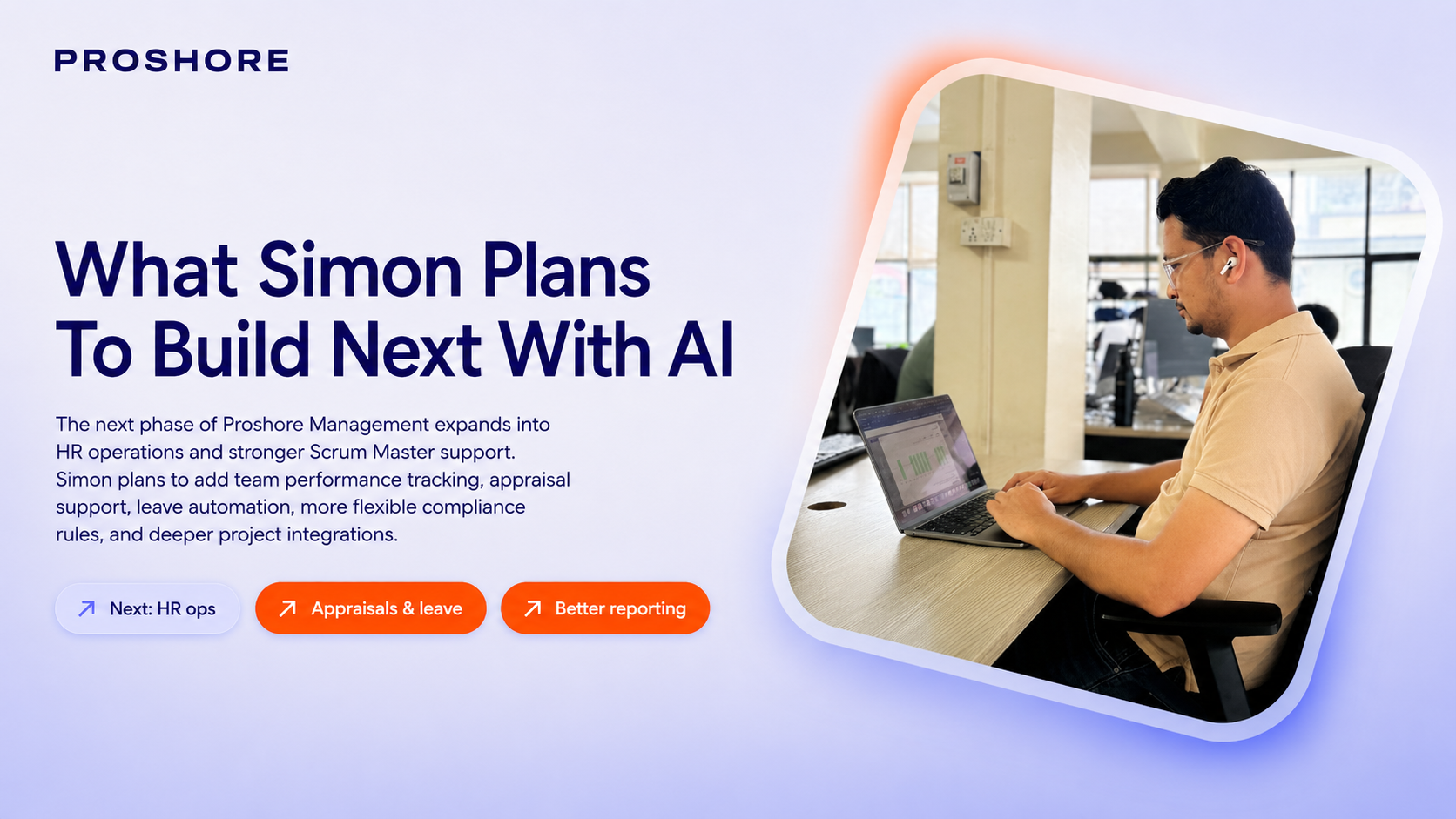
The next phase of Proshore Management will expand further into HR operations.
Requested features include team performance tracking, appraisal support, and leave automation. Simon plans to apply the same principle that shaped Clockify verification.
AI should handle repeated information collection and initial checks. The system should surface the cases that require attention. Final decisions should remain with the person responsible for the team or process.
Simon also plans to improve the existing Scrum Master features through more flexible compliance rules and deeper project integrations to strengthen reporting.
The goal is to remove the repetitive work around those decisions so Scrum Masters, HR teams and operational leaders can spend more time supporting people and improving delivery.
For Simon, the project has also been a return to his technical roots.
His Scrum Master role had taken him away from regular development, but AI gave him a way to use that background again.
He could identify an operational problem, design a product around it, and build the first version without depending on an available developer.
That independence expanded his role inside Proshore, where it became an example of how someone close to an operational problem can use AI to move beyond the limits of their formal role and create a capability that grows with the company.

The Workflow Problem Behind the Agent
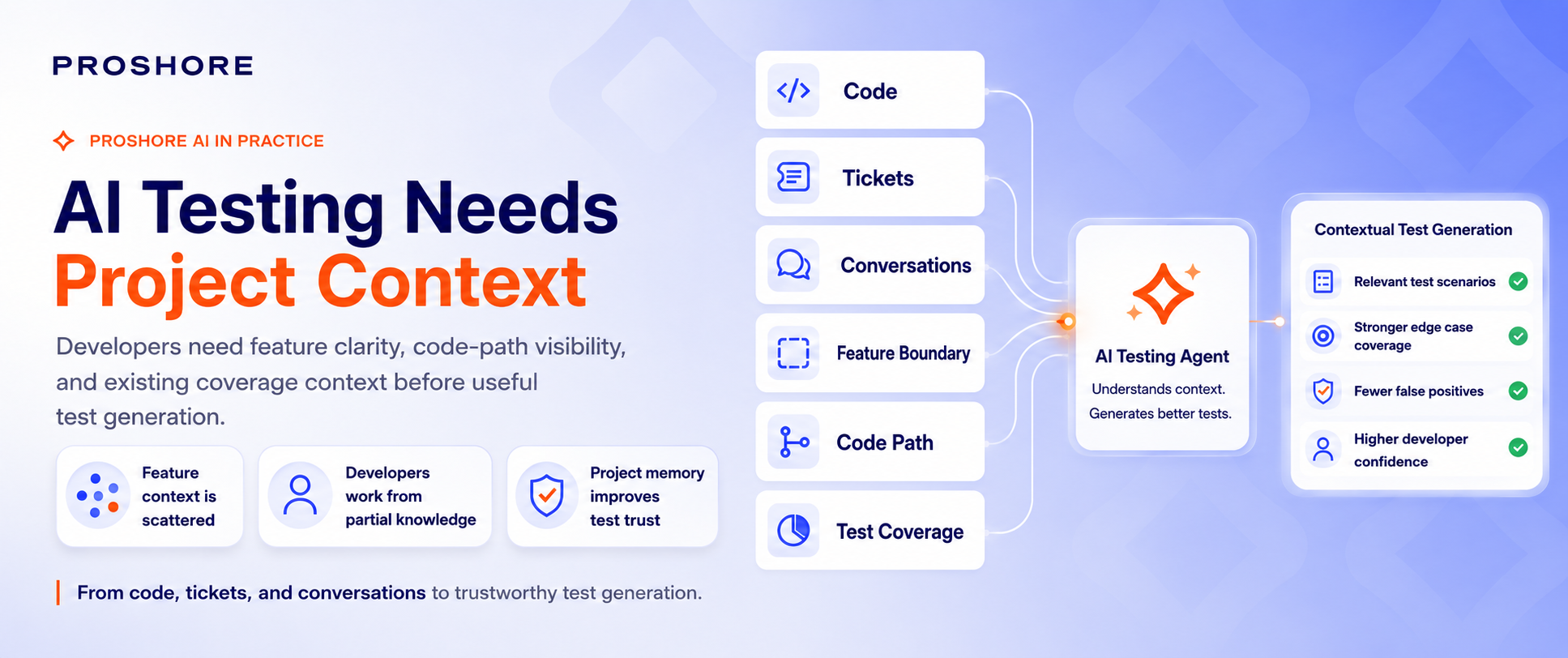
The idea came from the kind of delivery friction developers often feel before it becomes visible to the wider team.
Requirements rarely move cleanly from discussion to development, and sprint work can change while the code is already moving.
Feature context often arrives through meetings and messages, which means one developer may understand the full picture while others work from partial knowledge.
That uneven understanding makes testing harder to trust.
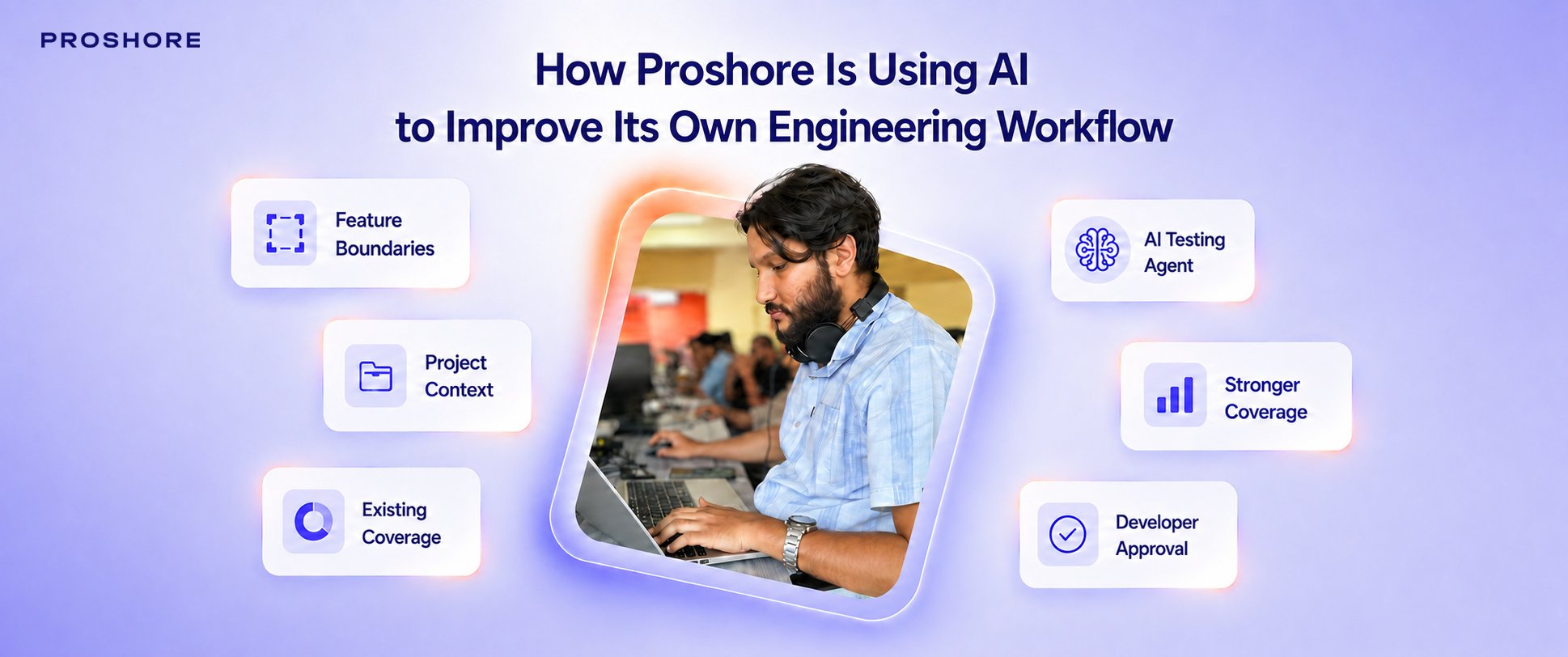
Saiman wanted to solve the context problem that appears before test writing begins. Strong tests need feature clarity.
The developer needs to understand the feature boundary, the relevant code path and the existing coverage before adding more tests to the suite.
That became the core insight behind the agent.
AI needed project context before test generation could become useful.
Any coding assistant can produce a test from a prompt, but a useful testing agent needs project memory before it touches the test suite. That principle shaped the agent from the ground up.
Why the Agent Learns the Project Before It Writes Tests
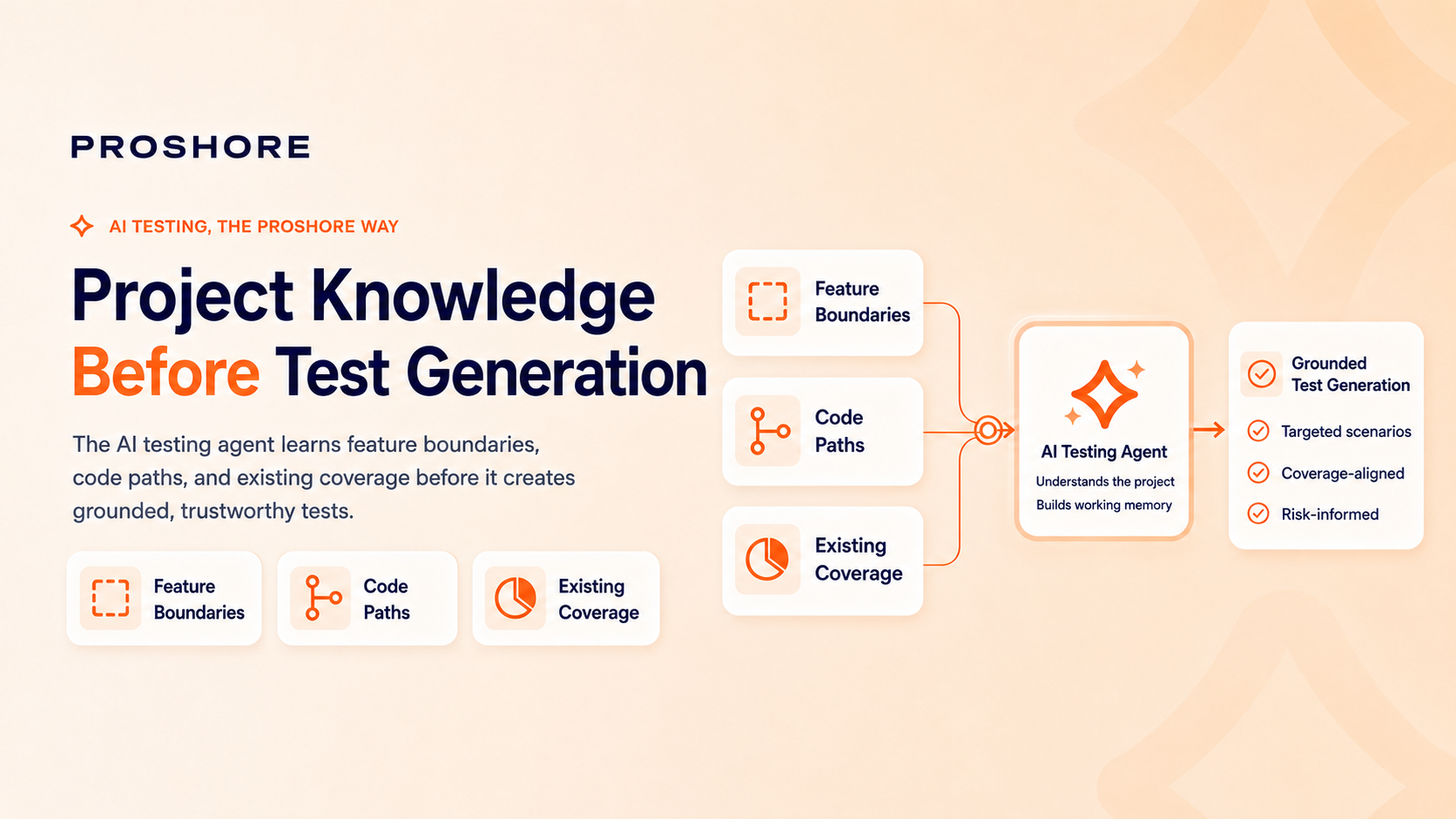
The agent starts with codebase discovery.
It reads the application through feature boundaries and builds a working memory for each feature. That memory connects the feature to the code that supports it and the coverage that already exists around it.
This gives the agent a usable map of the project before test generation begins.
When a developer selects a feature, the agent already understands the scope it needs to work inside.
It can create a test plan from the right project context rather than treating the codebase as one large surface.
That control matters because AI-generated tests become harder to trust when the model has too much room to guess.
It may invent behavior the application never had. It may bring unrelated files into the testing path. It may produce clean-looking tests that misunderstand the feature.
Saiman reduced that risk by making project knowledge the guardrail.
The feature-based knowledge base gives the agent a controlled working area before it plans or validates tests. That makes the output more grounded and easier for developers to trust.
Making the Agent Usable in Real Project Work
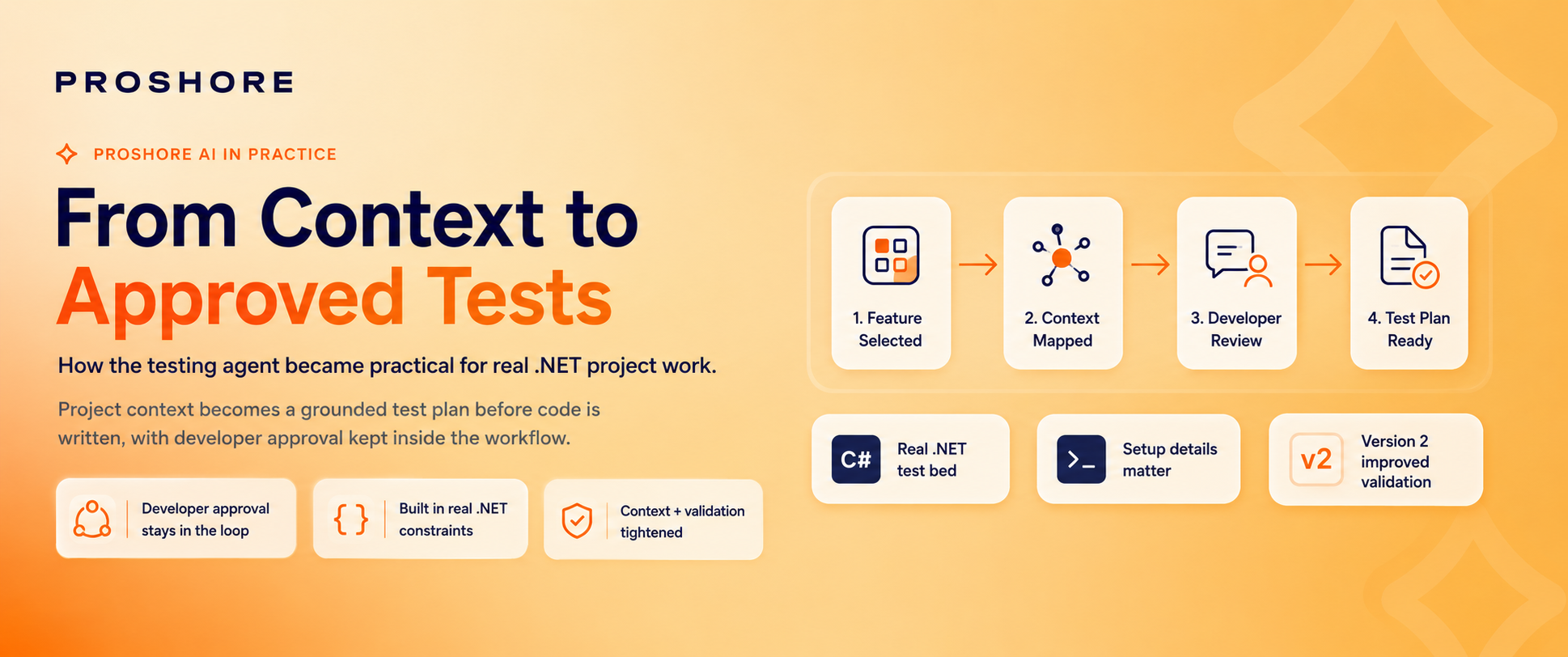
Once a feature is selected, the agent turns project context into a test plan before writing any test code.
Saiman kept developer approval inside the workflow because AI-generated tests still need engineering judgment before they become part of the suite.
C# became the first test bed because it gave the agent a real Proshore environment to prove itself.
Saiman’s .NET background made that starting point practical, while real project constraints exposed details a clean demo would miss.
In .NET projects, small setup differences can decide whether the workflow works at all. Version differences, xUnit behavior and command setup all shaped how reliable the agent had to become.
The first version proved the core pipeline. Version two made it more usable by tightening the connection between project context and validation.
Turning AI From Experiment Into Delivery Output
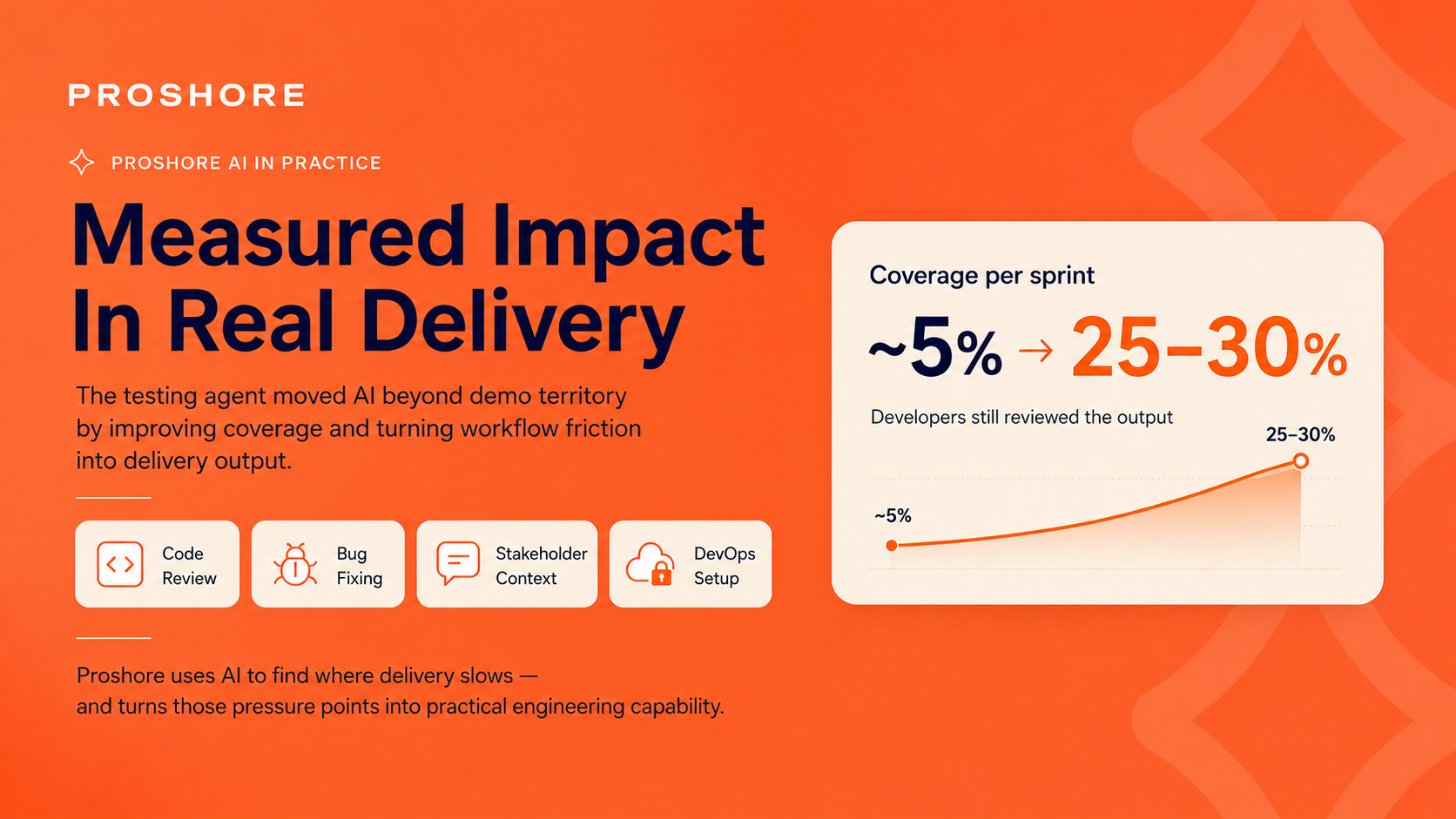
The first measurable impact showed up in test coverage.
In one project, coverage moved from about 5% to 25–30% per sprint while developers still reviewed the work. That took the agent out of demo territory and tied AI directly to delivery output.
The larger value is what the result signals for Proshore. Saiman’s agent shows how internal AI can strengthen the engineering system by removing the context work that slows delivery.
Testing became the first strong use case because the friction was visible and the progress could be measured.
The same principle now extends into code review and bug fixing. It also applies to stakeholder communication where project context often breaks before it reaches development.
DevOps fits the same pattern through setup work and secret management.
Proshore is using AI to find the points where delivery slows, then turning those pressure points into practical engineering capability.
What Comes Next for AI at Proshore
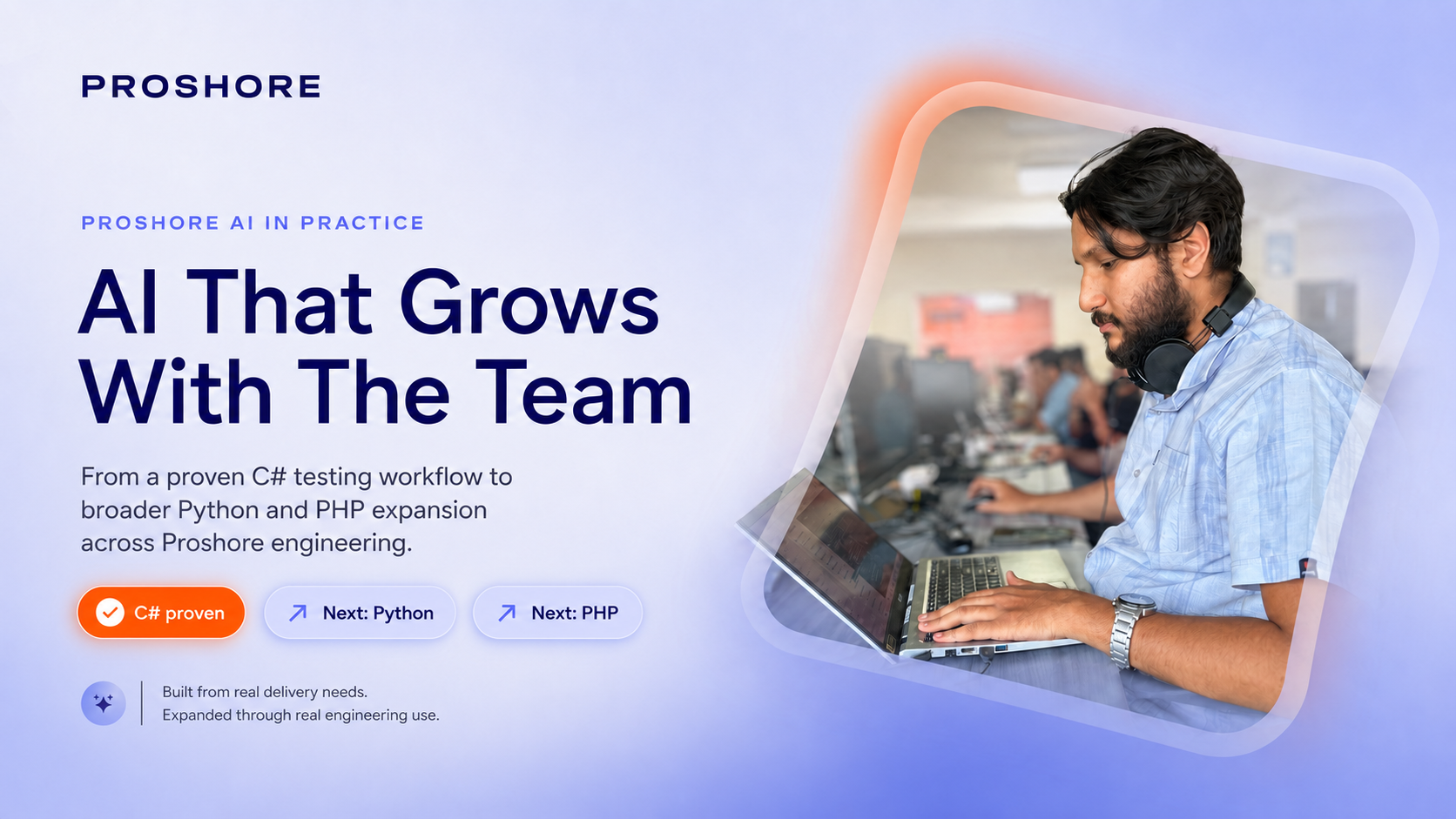
The strongest part of Saiman’s agent is where it came from. It was built from the developer side of the workflow, where the testing problem was already visible in real project work.
Saiman focused on a specific engineering problem. Testing is needed for a stronger project context before it can become faster and more reliable.
That makes the agent valuable as more than an AI experiment. It behaves like a workflow layer. It understands the project before planning tests.
It keeps developer approval inside the process. It feeds validated results back into project memory.
The current build lives in C# because that was the clearest place to prove the approach.
The next step is expansion into Python and PHP, which would make the same testing flow useful across more Proshore teams.
This is the larger value of the project. Proshore is using AI to improve its own engineering system from the inside, and Saiman’s testing agent is one concrete proof point of that direction.


November 10–13 Lisbon, Portugal
Tech Conference
Proshore Joins Global Innovators at Web Summit Lisbon 2025
From November 10 to 13, Proshore will take part in Web Summit Lisbon 2025, one of the world’s most influential technology conferences.
Book a call Talk to our Accounts director, Jeroen, to see if our ready-to-code offshore teams are a fit for you.
The event brings together entrepreneurs, leaders, and technologists from across the globe to explore emerging technologies, the impact of AI, and the future of the digital economy.
Representing Proshore are Roshan Bhattarai (Operational Director), Jeroen van der Horst (Account Director), Babish Shrestha (Technology Director), and Haico Duisters (Managing Director).
They will join thousands of industry experts to discuss how organizations build and scale technology teams, implement new digital strategies, and strengthen global IT capabilities.
What We’re Excited About
This year’s Web Summit focuses on how digital transformation, AI, and cloud innovation are reshaping the way IT departments and global teams collaborate.
Proshore’s team looks forward to connecting with innovators, learning from new perspectives, and sharing experiences from working with distributed tech teams that drive scalability and long-term growth.
From cloud-native development to data-driven digital transformation, Proshore remains committed to helping organizations succeed at the intersection of people, process, and technology.
Web Summit Lisbon provides the perfect setting to continue that mission and engage with the ideas shaping tomorrow’s digital landscape.
Meet us at Web Summit 2025—let’s talk tech and innovation!
by Krishma Shrestha HR Manager, Proshore

Careers
15 years in UX: Ashish’s Journey from Nepal to Global Design Excellence
How does a graphic designer from Nepal become a global UI/UX expert? For Ashish Tamrakar, the answer lies in 15 years of relentless adaptation, curiosity, and a partnership with Proshore—a company he helped shape from its infancy.
Career at Proshore Discover our current openings and resources on starting a career in offshore software development.
From wrestling with Internet Explorer 6 in 2008 to designing AI-powered interfaces today, Ashish’s journey is a masterclass in turning limitations into opportunities. For aspiring Nepali designers eyeing international careers, his story proves that talent, not geography, defines success.
From Pixels to Problems: The Evolution of a Designer
When Ashish joined Proshore as a graphic designer in 2008, “UI/UX” wasn’t even a buzzword in Nepal. His toolkit? CorelDraw and a creative eye. However the web design world was shifting, and clients demanded more than static visuals. “I had zero coding experience,” Ashish recalls. “Suddenly, I was debugging layouts in IE6 (Internet Explorer 6) and pleading with browsers to render CSS consistently.”
Enter Roshan, Proshore’s co-founder and one of Ashish’s first mentors. “Roshan sir handed me WordPress tutorials and said, ‘Learn to think like a developer.’ That changed everything.” Ashish began designing with functionality in mind, not just aesthetics. He mastered HTML, embraced frameworks like Tailwind CSS, and rode the tsunami of design trends—from skeuomorphism’s 3D buttons to flat design’s minimalist revolt.
But survival in tech requires foresight. “Every two years, the rules change,” Ashish warns. “If you stop learning, you become obsolete.” Today, he’s tackling AI tools like Figma’s AI-powered prototypes, proving that adaptability isn’t optional—it’s existential.
🥡 Takeaway
Trends fade, but problem-solving is timeless. Design for usability first, then beauty.
Building a Career Without Borders: Remote Work & Global Mindsets
Early Proshore was a startup in every sense: open desks, Saturday hikes, and a flat hierarchy that blurred lines between interns and founders. This culture of collaboration fueled creativity. “We weren’t just coworkers—we were pioneers,” Ashish reflects.
Then came the pandemic. Remote work erased commutes but also casual coffee breaks. For Ashish, a new father, flexibility was a double-edged sword. “I saved hours by working from home, but missed the spontaneous brainstorming that sparks innovation.”
Yet, remote work unlocked global opportunities. Ashish’s designs now serve clients from Amsterdam to Sydney. One standout project? A “Choose Your Shoes” configurator built with Tailwind. “International clients demand precision. Their feedback pushed me to think beyond Nepal’s design norms,” he says. Another example, a Dutch AgriTech client, De Heus, taught him the power of brand consistency. “Their strict guidelines forced me to innovate within constraints.”
Proshore’s “no monotonous work” ethos kept him hooked. “Every project felt like a puzzle. I’d switch from e-commerce layouts to AI dashboards, always learning.”
✈️ Takeaway
Remote work isn’t just about convenience—it’s a gateway to global standards. Treat every client as a teacher.
Ashish’s Blueprint: Advice for Aspiring Nepali Designers
Proudest Milestones
While Ashish has been part of nearly all client projects since he's been with us, here are some professional milestones that stand out to him.
1
Designing the “Honey” logo for a client during my first years – and getting it approved.
2
Leading Proshore’s WordPress migration, slashing load times by 40%.
3
Cracking Tailwind CSS to build responsive interfaces in record time.
Common Pitfalls to Avoid
🗣️ Ignoring Client Communication
“A beautiful design is useless if it doesn’t solve the client’s problem. Ask why before how.”
🤖 Fearing AI
“AI won’t replace designers—it’ll replace those who ignore it. Use tools like i for wireframe ideas, not final drafts.”
😵💫 Tutorial Overload
“Don’t just copy code. Break it, tweak it, make it yours.”
Actionable Tips
🖼️ Design Portfolios That Tell Stories
“Showcase projects where your design moved metrics. Did your i boost conversions? Simplify navigation? That’s what clients care about.”
🫂 Embrace Cultural Fluency
“Study color psychology. Red means passion in the West but luck in Nepal. Design for your audience, not your portfolio.”
🧐 Stay Curious, Not Complacent
“Follow designers like Chris Coyier (thanks to Roshan’s mentorship!) or Aarron Walter. Reverse-engineer their work.”
https://www.youtube.com/watch?v=HZhAFHmdX1k
The Future is Fearless
Ashish’s journey—from Kathmandu to global projects—debunks the myth that Nepal’s tech scene is “too small” to compete. “Our humility and hunger are advantages,” he insists. “Nepali designers understand diverse user needs because we’ve navigated resource constraints ourselves.”
As AI reshapes design, Ashish’s advice is simple: Adapt or pivot. “Learn AI tools, but protect your creative voice. Let machines handle grids; humans handle empathy.”
Design has no borders. All you need is curiosity and a browser.
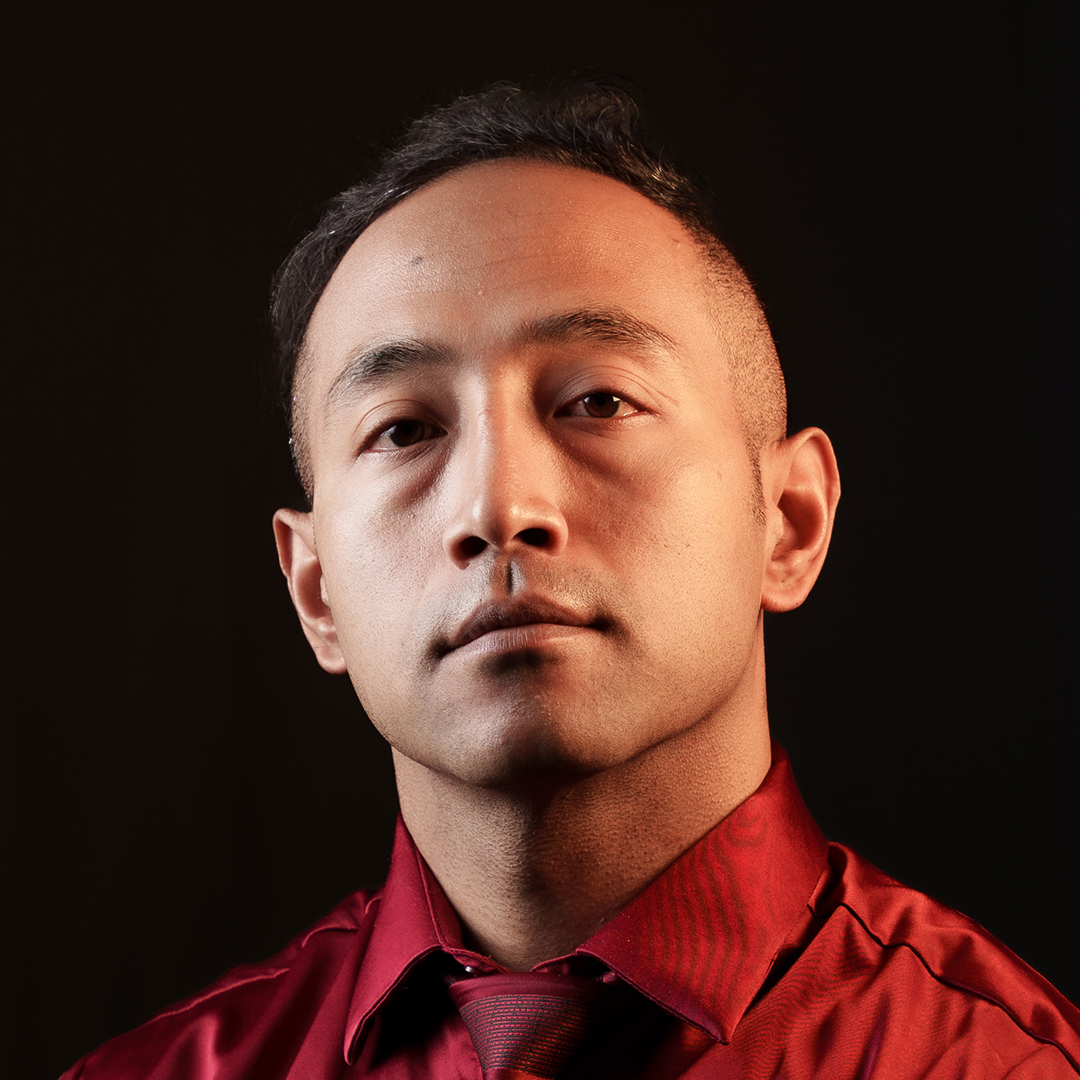
Ashish Tamrakar Senior UIUX Designer, Proshore

The next 15 years of tech won’t be ruled by Silicon Valley alone. They’ll belong to designers who merge cultural insight with technical grit. For Nepali talent, the world isn’t just a market—it’s your canvas.
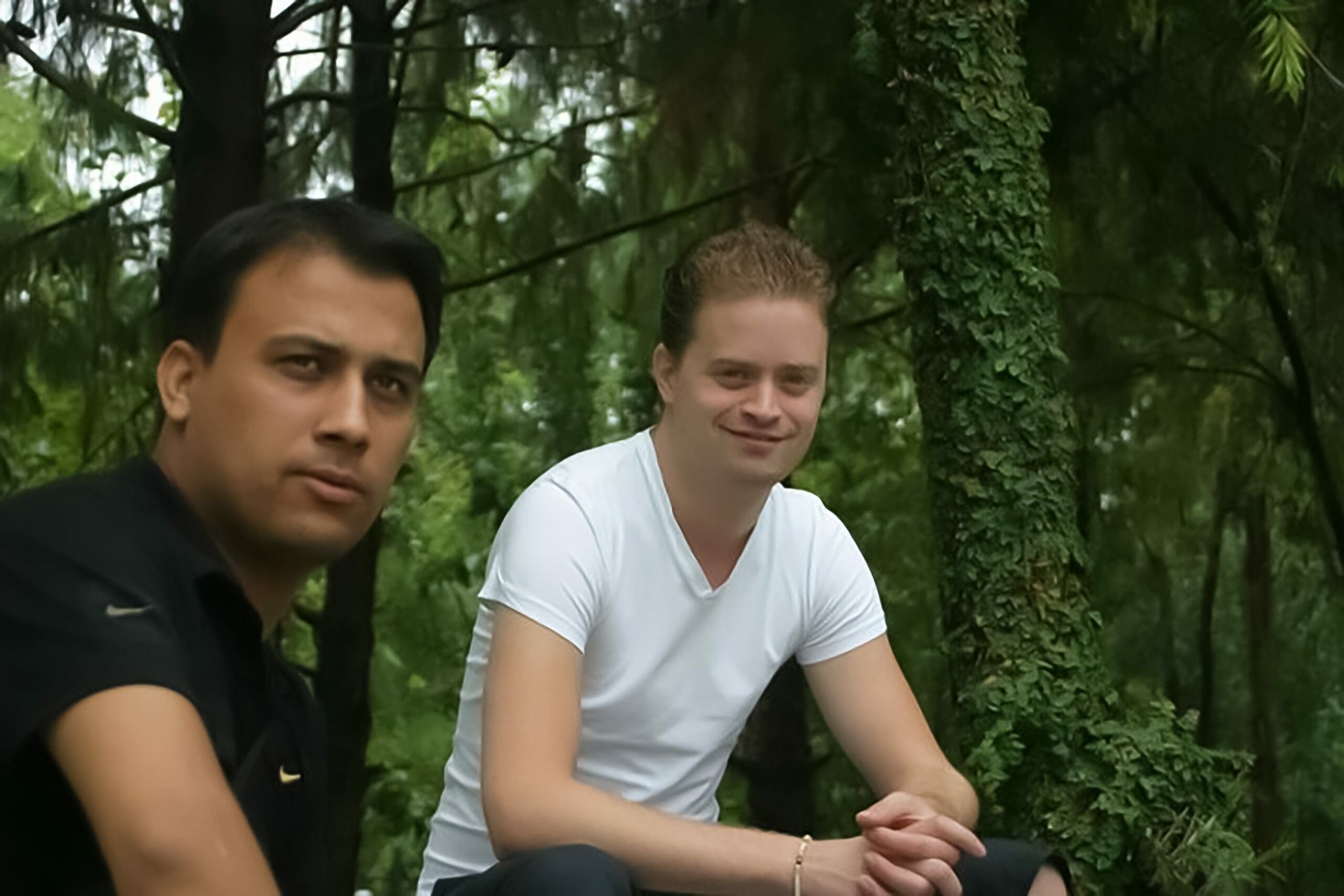
Co-located in the Netherlands and Nepal, Proshore was founded in 2009. Its mission is to create sustainable and highly skilled jobs for people in Nepal by offering managed development teams as a service to Software as a Service (SaaS) companies.
But how did it grow from a two-person start-up to an international team with over 70 employees?
This is the story of Proshore.
Selling Wine Online
Co-founder Haico’s first online business grew out of a student project in the form of a shop selling wine and gift boxes. With the rest of his team dismissive of the idea of selling online, Haico ran with the project himself, leveraging the potential of online paid advertising at a time when it was still a relatively new concept.
Business boomed. With many companies traditionally sending wine gifts at the end of the year, by 2006 Haico was working exceptionally long hours, and ready for his next challenge – a Customer Relationship Management platform. So he sold his wine business and went looking for an international development team to help build his software.
International Entrepreneurs
Haico’s search led him to Nepal, where he had made contact with a company that seemed like they might be able to help. Unfortunately, it was clear from early on that they lacked the process and quality needed to bring the project up to standard. However, Haico was impressed by one of their technical project managers called Roshan.
The owner was also just about to relocate to India, but undeterred, Haico pitched a joint venture, with the requirement that someone like Roshan was in place. For the business owner, it was a non-starter. But Roshan and Haico stayed in touch. They soon agreed that they wanted to entrepreneur the idea together.
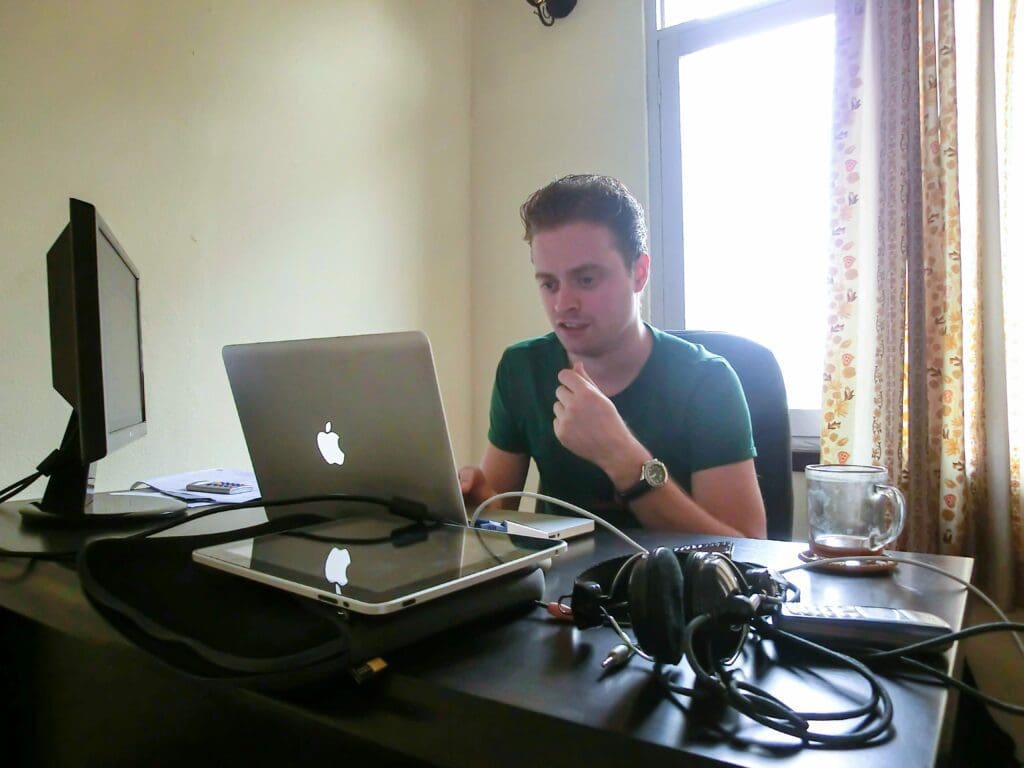
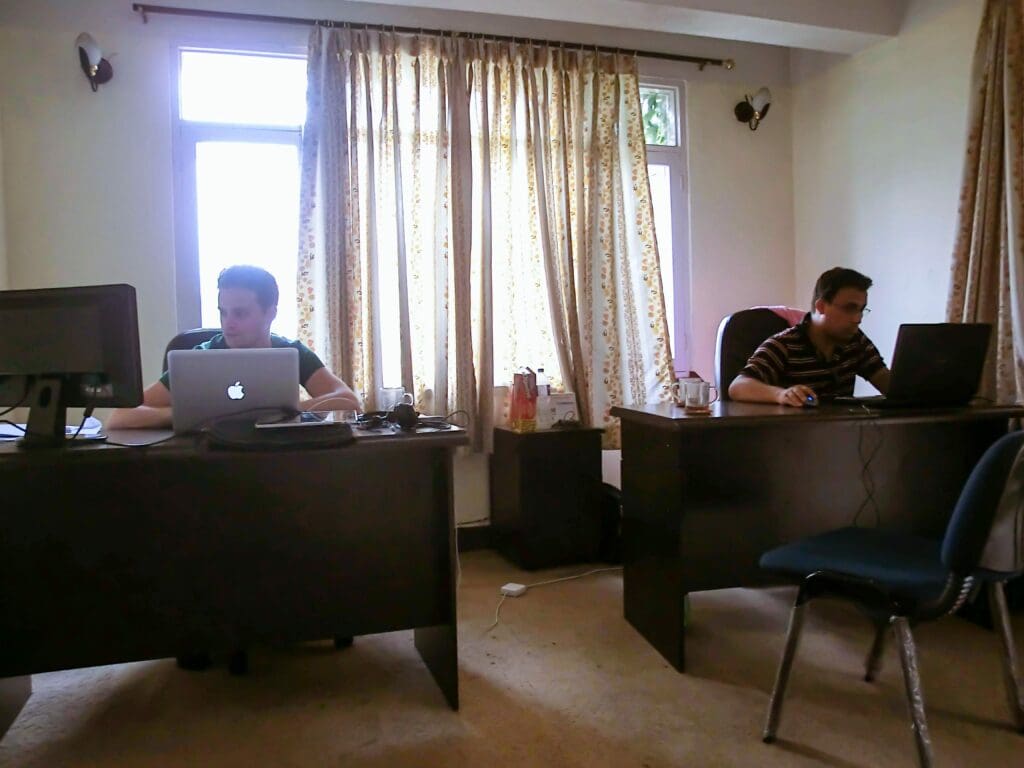
With a bit of capital to invest from the sale of his wine business and Roshan onboard, Haico decided to set up an office in Nepal, finding office space and listing vacancies for a new venture. After working for two years as a business advisor at a larger company in the Netherlands, Haico had the simple objective of becoming an international entrepreneur
Selling Designs To Life
Back in 2009, there were a lot of graphic designers and marketers looking to create websites, but without the technical knowledge to do so. So, Haico and Roshan realized there was an opportunity to serve as a technical partner by offering their programming capabilities.
However, after working on a number of projects, the pair soon realized that as a technical partner, they were not able to influence the design or offer advice, even when they saw huge potential for improvement. So they started to develop web applications alongside consulting, where they offered some design, development, and support. This second business model yielded more growth for their company, so they started to optimize their processes in Nepal. They were then able to attract bigger clients, such as the grocery chain Ekoplaza.
The Start Of Teams As A Service
With the consulting side of the business really starting to expand, Haico looked to find hire project managers in the Netherlands. They even set up an office on a technology campus. However, it became increasingly difficult to scale their model there, compared with Nepal.
They also started to feel that their efforts in the Netherlands were distracting them from the potential scalability of the Nepal operation. So Proshore decided to pivot to a new model, offering software development teams as a service.
“So now, we're delivering a team, and this team is being integrated directly with the customer’s team. This is a much more scalable model, and it's also a durable model because we try to partner with companies who are growing, and have clear ambitions.”
Haico Duisters, Proshore, Co-Founder
With a renewed focus on supporting startups, scale-ups, and companies looking to grow their software, Proshore began to capitalize on a gap in the market for technical teams who could work alongside in-house teams for a given purpose. Their services also grew to include other technical roles, such as quality analysts, and scrum masters.
Bridging Eindhoven And Kathmandu
Looking ahead, Proshore has ambitions to scale its Nepalese organization. That’s where they want to build and develop. It’s where they have their HR. Meanwhile, back in the Netherlands, their sales and consulting team works to secure clients and manage the integrations.
Discover how integration with Proshore can help your SaaS scale sustainably by booking a call with us today.
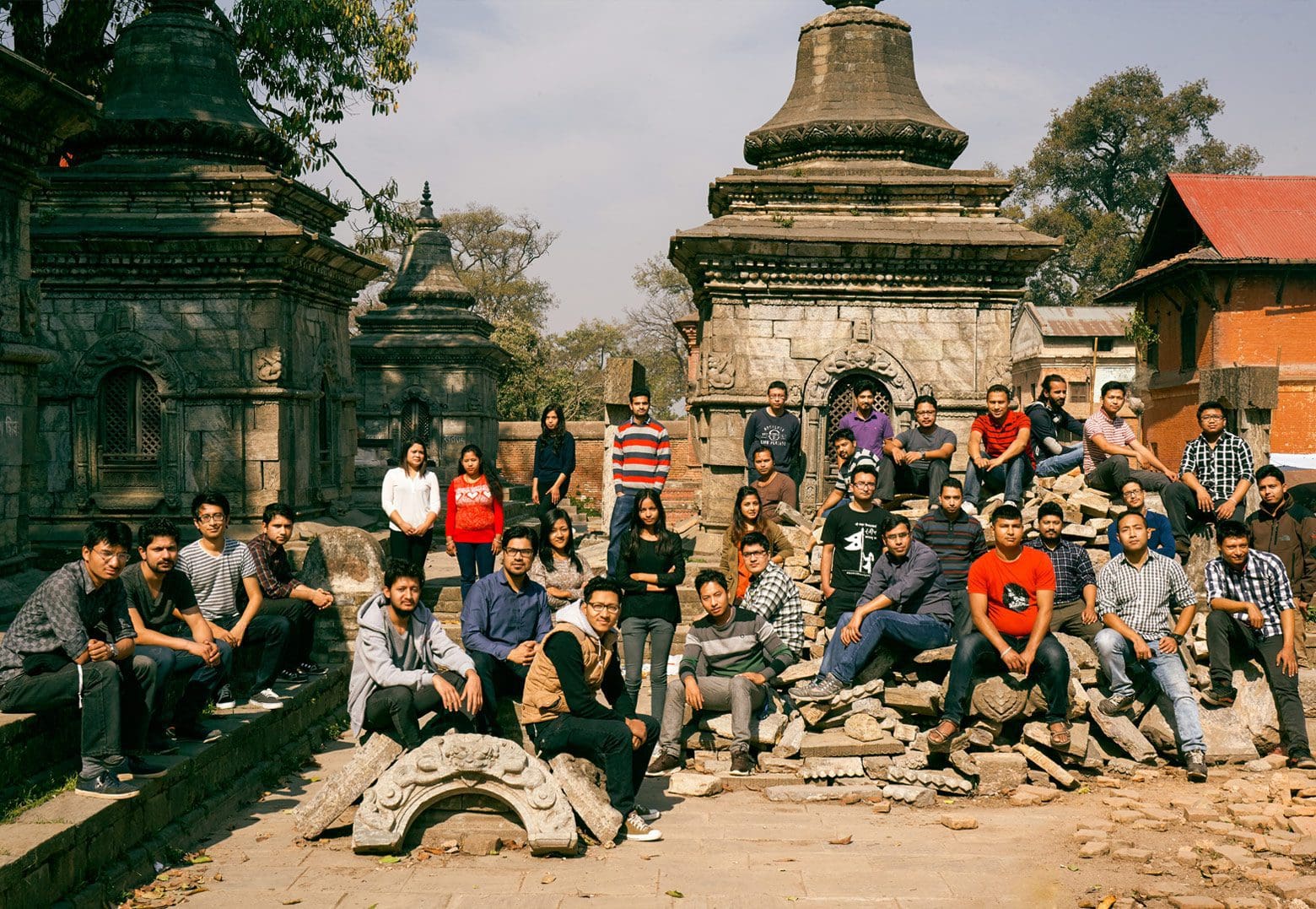
Why is Proshore based in Nepal? Why do our developers stay there, instead of us bringing Nepalese talent back to the Netherlands? After all, there are plenty of jobs for the taking in our country. These are both sensible questions that I am happy to answer in this article.
How did Proshore end up in Nepal?
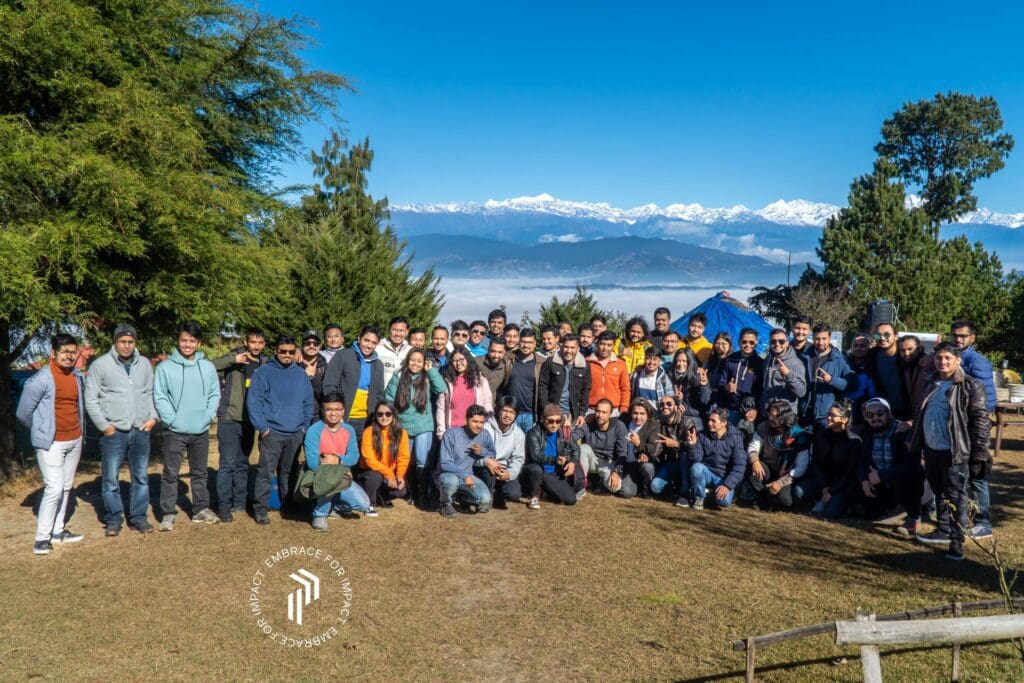
Let's start at the beginning. In 2008, my business partner Haico happened to find himself in Nepal. Inspired by his interest in international entrepreneurship, he wanted to outsource some of the software development activities to a foreign country. Haico and his Nepalese contact Roshan therefore formed a cooperative alliance with a local partner. Unfortunately, that partnership didn't last very long. Nevertheless, Haico and Roshan kept in touch afterwards and in 2009, the two decided to set up an international business together; one with offices in the Netherlands and in Nepal. You guessed it: Proshore was born. We started out fairly small with just five FTEs. Today, our team is made up of more than sixty people - and counting, since we continue to grow rapidly!
Why are we not bringing Nepalese talent back to the Netherlands?
The question remains why we choose to stay in Nepal. As you undoubtedly now, a full-on war on talent is raging in the Western world. Technical talent in particular is incredibly scarce and therefore precious. At the moment, that is not the case in Nepal and other Asian countries. Contrary to many other recruitment parties, we nevertheless made a conscious decision not to bring Nepalese developers to the Netherlands permanently. I want to take a moment to explain why that is.
Nepal is dependent and susceptible to outside influence
The country's infrastructure leaves a lot to be desired. The political situation has been unstable for years. Although investments are being made in the country's economy, hardly any of that money comes from the national government. Instead, most of the money comes from the two rapidly growing economies that Nepal is caught between: India and China (since the earthquake in 2015). As a result, the country is extremely dependent in an economic sense. Since the country cannot properly support itself, it is highly susceptible to outside influence. At the moment, Nepal's import outweighs its export by a factor of thirteen. Although the country certainly has the potential to create its own industry, not enough is currently being done to facilitate that. Here’s an example: Nepal has the tallest mountains in the world and the most water. In theory, those natural resources could help the country become the largest international provider of green energy. At the moment, however, Nepal regularly imports more than fifty percent of the power it needs from India.
Talented youths seek their fortunes elsewhere
Another major problem that Nepal faces is unemployment, which sits at about forty percent. That should come as no great surprise. The country does not have a strong economy of its own and jobs are therefore hard to come by. That is especially true for highly educated people. As a result, around 1,600 people leave Nepal every day in search of a job elsewhere. Countries such as Australia, Japan and the United States are popular destinations for Nepalese professionals. The working population in these countries is ageing and they face a shortage of new employees. In addition to recruiting employees in Nepal, they also actively offer student visas to talented students. With job guarantees and other lofty promises, they hope to entice the Nepalese youths to stick around once they have finished their studies. In other words: the talented youths whose job it should be to build up Nepal are all leaving the country. If we were to go over there to recruit talented professionals and bring them back to the Netherlands, the situation would only exacerbate.
Creating an export product and top talent
That is not what we want. On the contrary; we would much rather invest in the country itself. First of all, we do so by creating an export product: Nepalese software that is being sold in the Netherlands. Secondly, we help to create top talent. When we form development teams for our clients, we always make sure to include a couple of training positions. As part of every team, we train several new people to become software developers. Many of them are fresh out of university. If not for the job we offer them, they would not have had many career opportunities in their own country and might therefore have sought their fortunes elsewhere. In other words, we do not search for the one percent of top talent for our clients. We would much rather create these talents ourselves. If you ask me, that is a far more sustainable approach and one that will surely help the country in the long run. We are truly grateful to Nepal Although we ended up there by happenstance, Nepal has won our hearts these past few years. We are truly grateful to her. I hope - as do my colleagues in the Netherlands and Nepal - that many other companies will follow our example.
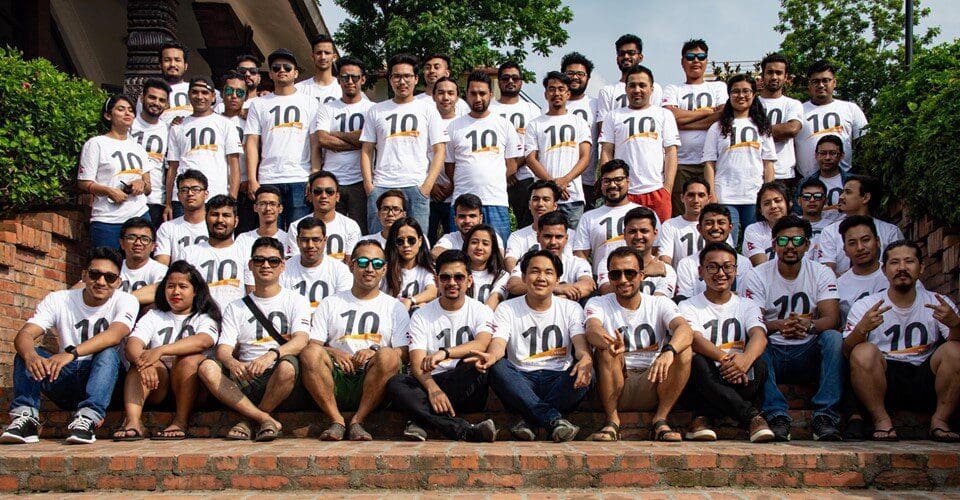
It was a normal day in the office: busy and fun. People were busy on their own project. In the meantime, a notification pops up in the slack channel “Proshore’s 10th anniversary”. It was not surprising though. The amazing thing was how time flew. It was just a few months ago when we celebrated the 9th Anniversary.
“I was sure there is going to be fun. I have recently been a member of Proshore and it will be the right time for me to know each other and build a strong bond with them”, says Atul who has joined us a week before. On the other hand, Sakar was not happy, as he was going to miss this celebration due to his exams. We missed you there.
Prakash dai was busy responding to the forms about the anniversary. The forms included the preferences of the people. “It’s the only time when all the members of Proshore family are together and not divided by some projects. So, we want everyone to participate so that they can relax and have a nice gateway from their day to day work”, says Prakash when asked about the importance of participation. Everyone was planning their outing in a different way.
https://www.youtube.com/watch?v=67qVWOvTqdUWe moved towards outing venue after having lunch in our office. It was 15:00 on the clock when we reached there. When we reached the venue, we had cold juice offered by the resort. It was a sunny day and cold juice turned out to be a good addition to this summer.

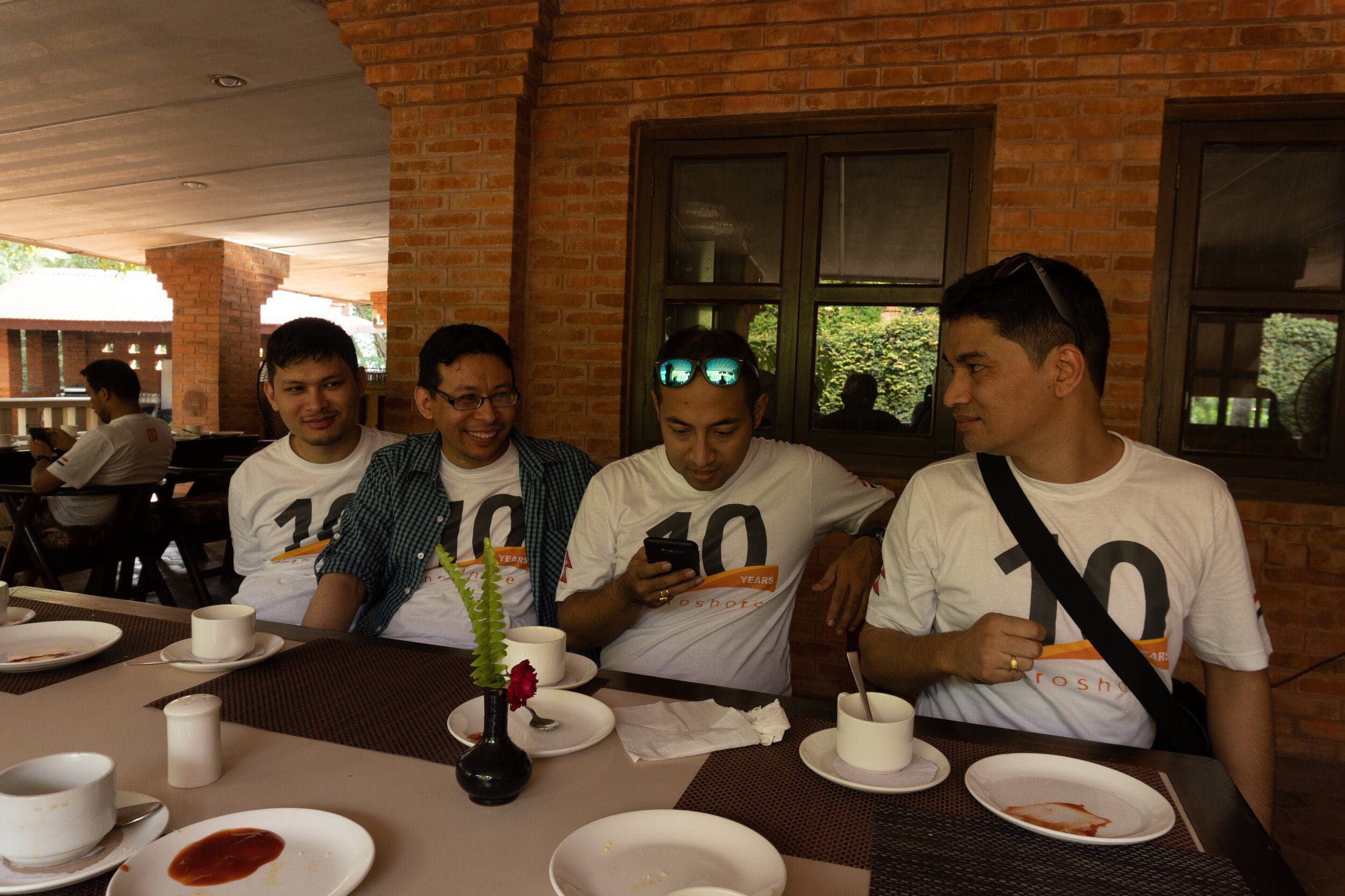
We went to our respective room to get fresh. We went to the garden restaurant for snacks. “When I first saw snacks, I was not sure how good it was. There was a sandwich and I am not a fan of bread. Although, I took one as I was feeling hungry. It was amazing. The taste of cheese made it tastier than I expected”, said Babish when asked about the snacks.
Previous Next
Before the game, the first thing to do was to celebrate Proshore’s 10 years of success. Thanks to Ashish dai, who brought delicious muffins from mollie.

After this, we were expecting a great time ahead and we had it. It was time for team building game named “Scavenger Hunt”. There were four members for conducting this game: Prakash, Manoj, Shikha, and Babish. We were divided into 5 teams: Team1, Team2, Team3, Team4, Team 5.
Everyone thought the game would be easy, but it was not. Let me explain the game.
There were 5 tasks in this game and the one who has more correct answers would win the game. The questions were not easy to find as we thought initially. The questions were hidden in a QR code, which was stuck in different parts of the resort. There were a total of 13 QR codes pasted. Each group had 2 QR codes assigned to them. The difficult task was to find the correct QR code for the respective team. And when you find them, the questions were tricky.
I remember the first question: “What is long and hard and has cum in it?” It was difficult to think positive for every one of us. Don’t wonder, the correct answer is “Cucumber”. I am quite sure that the question was designed by Manoj. God bless him!

So, it wasn’t easy to find those questions for the teams. The surface was never flat, that’s why we had to climb stairs many times. It was challenging. The main theme of this game was team building. It taught us how a team should work together to achieve a goal. It helped to know each team member.
Later, we all headed towards the swimming pool.
“Run …splash!”. This is the story of every swimming pool.
The interesting thing here is, who didn’t know to swim were more excited. They were excited to click the photos rather than swimming 😂. Bikram was eager to click photos with his new Samsung GALAXY S10. The level of drama was increasing as they were posing underwater 😂. I was holding “go pro” because I don’t know to swim. That’s why I was in poolside clicking the photos. Rajan, Karan, Guru, and Bidur were swimming well. It was 6 in the evening and it was snack time.
Everyone was tired after swimming. In the meantime, snacks would really refresh everyone’s mood. People were sitting with own “gang” in different tables 😄. Talks with your friends with a chilled beer in hand is always an amazing feeling. Addition to that, BBQ is always good with beer. After having enough beer, some people were having a healthy discussion with each other whereas another group was dancing.

After hours of dancing and discussion, it was time for dinner.
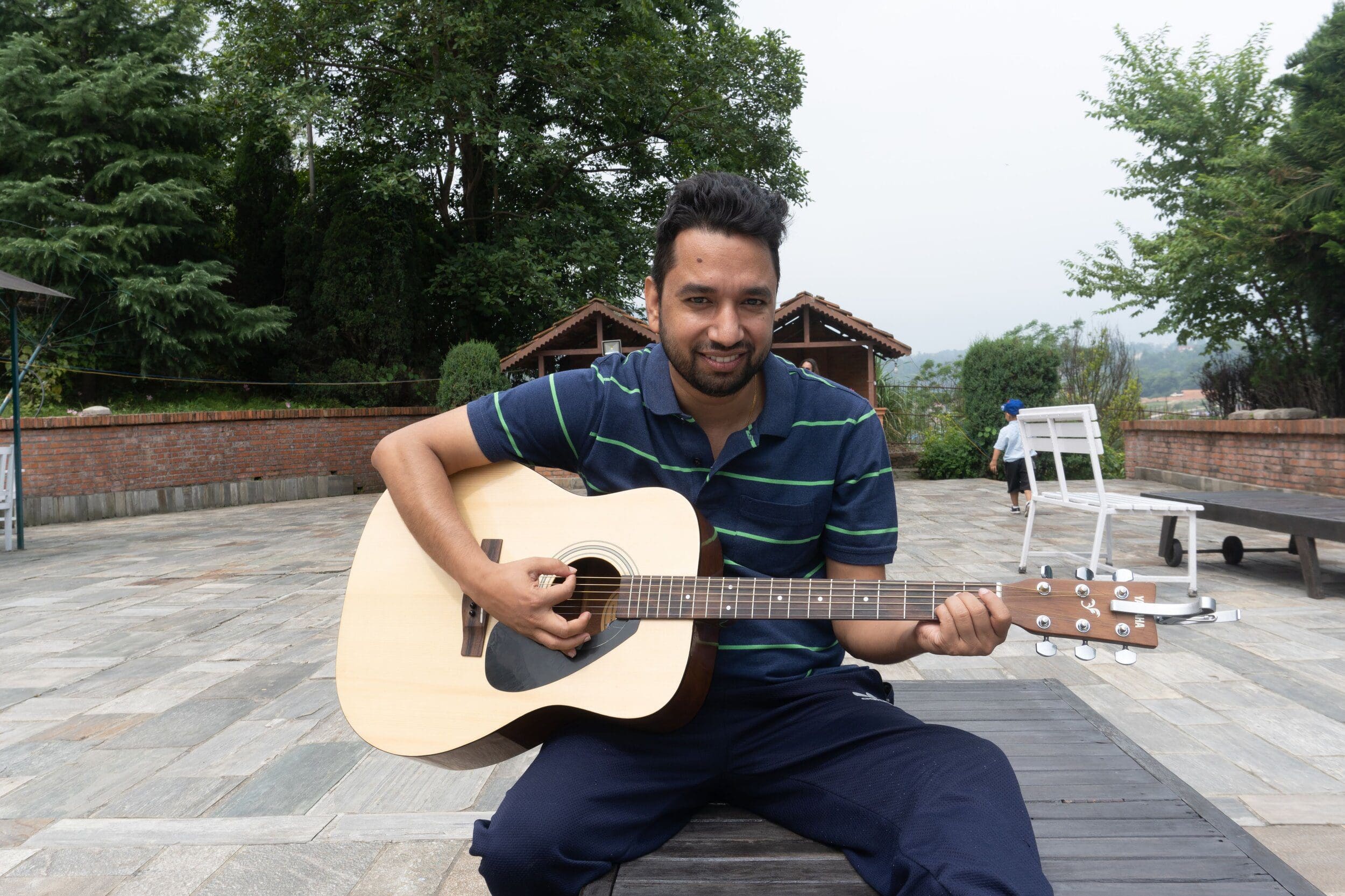
After dinner, most of the people went to their respective room. Some people were even discussing with some “tequilas”(called whiskey). The topic of discussion this time was again football. Babish, a Chelsea fan was alone discussing with the other two Liverpool fans(Sameer and Arpan). Other two interesting guys: Rudra and Tek were having another discussion, guess the topic? It was “Messi vs Ronaldo”. Let me tell you, Rudra is a fan of Ronaldo whereas Tek is of Messi’s. As usual, the discussion ended with no conclusion 😂. Babish was playing guitar whereas others were singing along with him. It was already midnight, and we headed towards our own rooms.

Next day was a hangover for most of the guys. Some of the guys (who didn’t drink well last night 😛)visited “Santaneshwor Mahadev” temple which was twenty minutes walk far from the resort. We had a heavy breakfast before swimming. Finally, we packed off and checked out at 12:00 noon.
It was an amazing experience. In my opinion, such an outing helps us know each other very well. People can’t be frank to other people in the workplace due to the role assigned to them. That’s why outing is important to know each other as they are franker here than in the workplace. This is how you build your team strong.
At last, thanks to our organizing members for making this anniversary activities successful.
You can watch the video of our Anniversary on our YouTube channel.