

AI has made code generation dramatically faster. Writing code still represents only part of the time required to move an engineering task into production.
Across Proshore’s engineering work, teams spend significant time understanding a change before implementation and validating it before delivery.
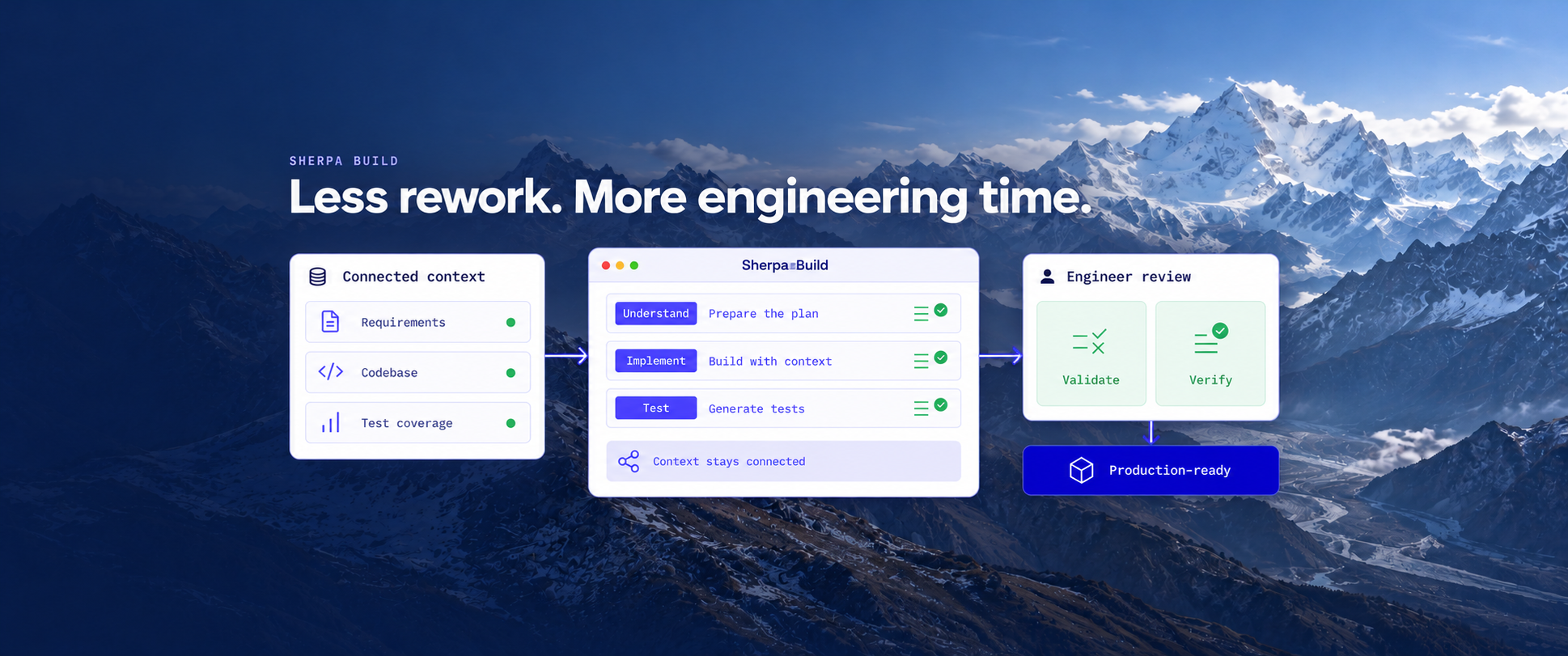
Sherpa Build applies AI across that surrounding work while keeping engineering judgment with experienced engineers.
The useful question is broader than how quickly AI can generate code:
How much engineering time can be removed from the path between a problem and a production-ready change?
Where Does AI Actually Save Engineering Time?
A development ticket can appear simple because the visible output may be a relatively small code change. The work required to reach that change can be much larger.
Before implementation begins, an engineer needs enough context to understand where the request fits within the existing system. Missing context can turn a straightforward ticket into hours of investigation.
The same issue appears later during testing and review. Each person involved needs enough understanding of the change to judge whether it works correctly within the existing product.
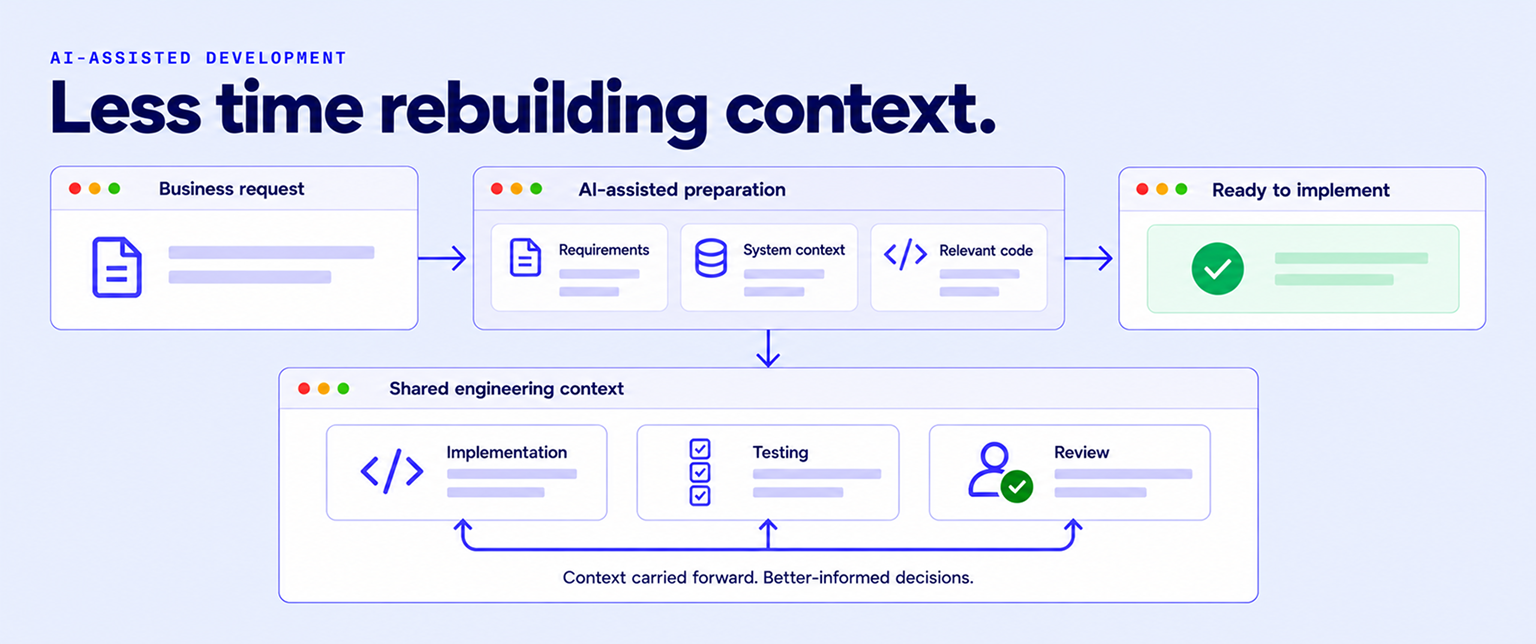
A bigger opportunity lies in reducing the context engineers repeatedly rebuild as work moves through delivery.
A meaningful amount of effort also sits between a business request and work that is ready for implementation. A requirement may describe the desired outcome while leaving the technical path unclear.
AI can reduce some of that preparation by bringing relevant engineering context closer to the task earlier in the process.
The strongest productivity gain comes from shortening the path to a good engineering decision.
What Did Proshore Learn From AI-Assisted Testing?
Proshore’s Senior .NET Developer Saiman Khatiwada began developing an AI testing agent after seeing how much effort could be spent before useful testing even started.
Requirements were sometimes fragmented across the project, which meant the developer responsible for testing first had to understand what the feature was supposed to do and how the existing code supported it.
That investigation shaped a simple principle for the experiment:
The AI needed to understand the project before it generated tests.
Without enough project knowledge, technically valid tests could still protect the wrong behavior or miss the scenarios that mattered most.
Saiman’s agent began building working memory around a defined feature so the system clearly understood the area it was supporting.
That memory connected the feature with its supporting code and existing test coverage.
With that foundation in place, the agent could prepare a test plan that reflected the feature more accurately. The developer reviewed that plan before the agent generated tests.
How Does Sherpa Build Turn AI Productivity Into Engineering Capacity?
Faster coding alone does not create more delivery capacity.
Google Cloud’s 2025 DORA research makes the same distinction. Its research on AI-assisted software development found that individual productivity gains create more value when the surrounding engineering system can turn that saved effort into greater delivery capacity.
Proshore engineers work within the client’s existing engineering environment, with Sherpa reducing the effort around work that can be accelerated reliably. The engineering time recovered can then move toward work that needs deeper technical judgment.
Sherpa Build applies that principle across delivery at a broader scale. Proshore adds experienced engineering capacity, while AI helps that capacity go further within the client’s existing roadmap.
For teams already constrained by available engineering time, the result is practical: more of the roadmap can move forward with the capacity already around the product.
What Happens When AI-Assisted Development Scales?
DPL shows what this approach looks like at scale.
Since 14 April 2026, Sherpa has taken 652 DPL tickets through to pull requests without engineers manually writing the code.
Based on the manual effort those tickets would otherwise have required, Proshore estimates that Sherpa saved approximately 2,500 engineering hours, equal to about 3.8 hours per ticket across the reported work.
Saving several hours on an individual ticket creates a small productivity improvement. Repeating that reduction across hundreds of tickets creates engineering capacity that can materially affect delivery.
As AI reduces implementation time, more engineering work can reach review within the same period. Validation therefore has to support the faster flow of changes.
Experienced engineers remain responsible for deciding whether a change is ready for production.
This makes engineering throughput a more useful measure than generated code volume.
The real question is how much validated work a team can move through delivery with the capacity available. The gain becomes meaningful when the full path to a production-ready change becomes shorter.
That is where AI-assisted development begins to affect the economics of software delivery across the team.
Where Could Sherpa Build Add Capacity?
For engineering teams, the useful question becomes:
Where is your team spending engineering hours on work that AI could help reduce?
Sherpa Build helps turn repeated engineering effort into usable delivery capacity.
Want to explore where Sherpa Build could give your engineering team more usable capacity?