

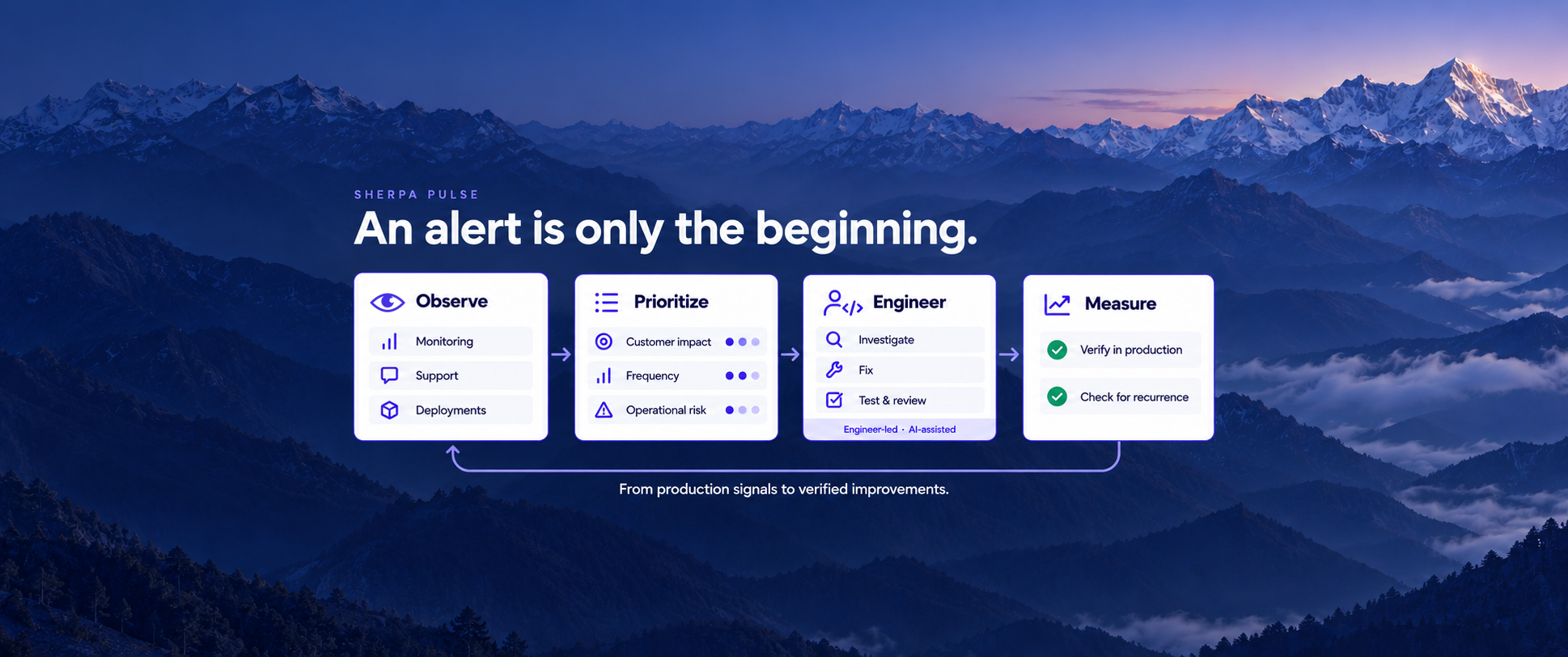
Monitoring tools expose application errors, slow requests, and infrastructure problems, while support and product teams surface issues that dashboards may miss.
Those signals show where to look, but they do not establish the cause or which issue deserves attention first.
A spike in API errors may originate in a recent deployment, a failing dependency, or an upstream service. Engineers need to connect those clues before deciding whether to roll back a release, apply a fix, or investigate further.
Sherpa Pulse combines production intelligence with Proshore engineers to investigate issues, prioritize engineering work, and implement and verify improvements to live software.
Why Does Investigating a Production Issue Take So Much Time?
The evidence needed to investigate a production issue is often scattered across monitoring tools, support tickets, deployment histories, and previous code changes.
A trace might identify a failing request, while deployment history reveals a recent change and a support ticket establishes how customers are affected. Connecting those findings requires engineers to understand the system's dependencies, identify the likely cause, and assess the risks of changing the affected component.
Sherpa Pulse works with existing monitoring and observability tools rather than introducing another dashboard for teams to manage.
What Gets Fixed Now, and What Can Wait?
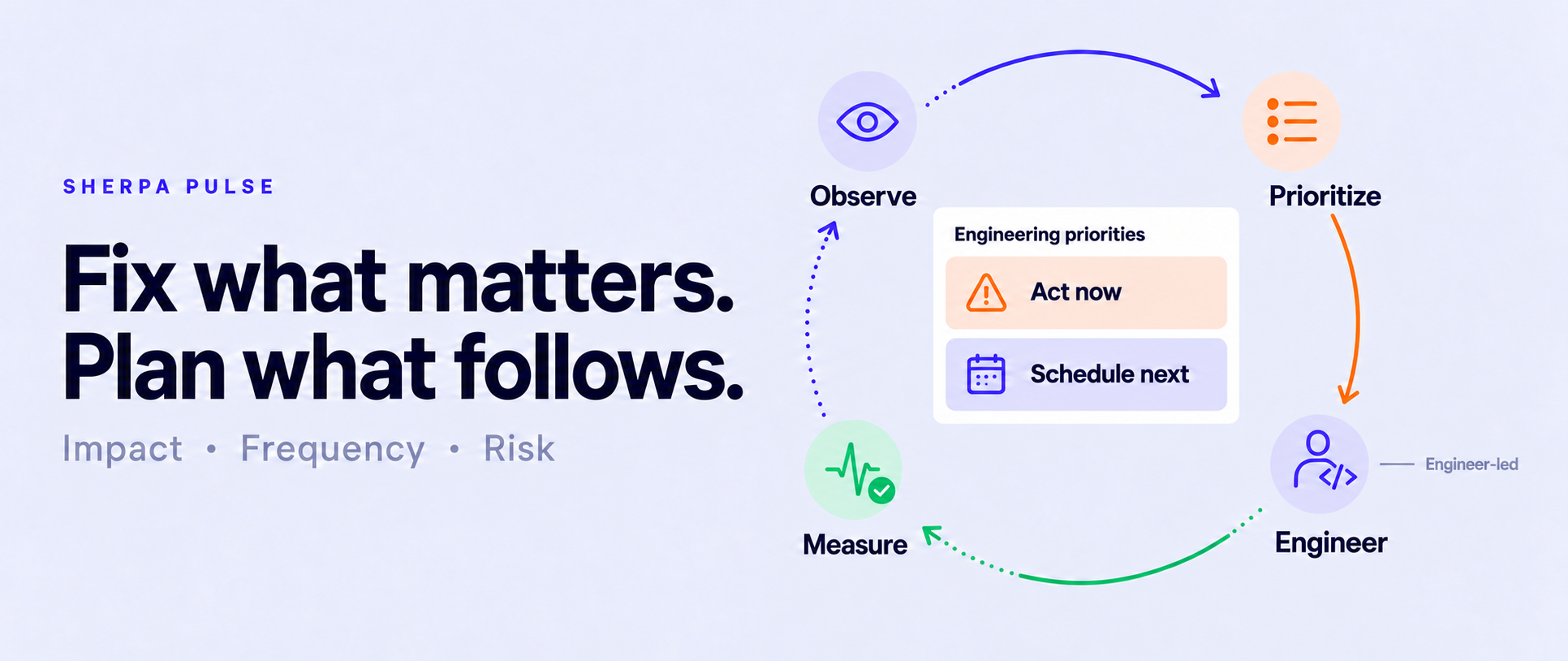
An error disrupting payments or user authentication may demand immediate action, while an isolated failure with little customer impact may not. Recurring failures may point to an underlying reliability problem, while dependency vulnerabilities can require attention even when the application appears to be running normally.
Sherpa Pulse structures this work around four connected stages: Observe, Prioritize, Engineer, and Measure.
Observe examines production errors, performance patterns, incidents, and application context using the monitoring tools already in place.
Prioritize evaluates customer impact, frequency, and operational risk to distinguish urgent fixes from issues that can be scheduled for later.
Engineer investigates the selected issues, implements fixes or preventive changes, and verifies them through testing before release. AI assists with code investigation, dependency tracing, test preparation, and repetitive implementation tasks, while Proshore engineers make the technical decisions, review changes, and remain accountable for quality and production readiness.
Measure tracks production behavior after release to confirm whether the issue is resolved, detect recurring failures, and assess improvements in reliability.
The Incident Is Resolved. Why Does It Keep Coming Back?
Restoring service during an incident does not always address the underlying problem, leaving teams to investigate the same failure again when it returns.
An API timeout might disappear after restarting a service, only to return during the next traffic spike because the underlying connection-handling problem was never corrected. The immediate incident is closed, but the conditions responsible for it remain.
Sherpa Pulse addresses recurring incidents as engineering problems that may require changes beyond the immediate recovery. For a recurring timeout, that could mean investigating connection limits, changing retry behavior, or adding regression tests instead of repeatedly restarting the affected service.
Who Keeps Your Software Improving While Your Team Builds What's Next?
Sherpa Pulse brings Proshore engineers supported by AI agents into the ongoing maintenance and improvement of live software, helping address production issues, recurring failures, and reliability concerns while your team retains ownership of product priorities and architecture.
Talk to Proshore about Sherpa Pulse