




The Manual Work Simon Wanted AI to Remove
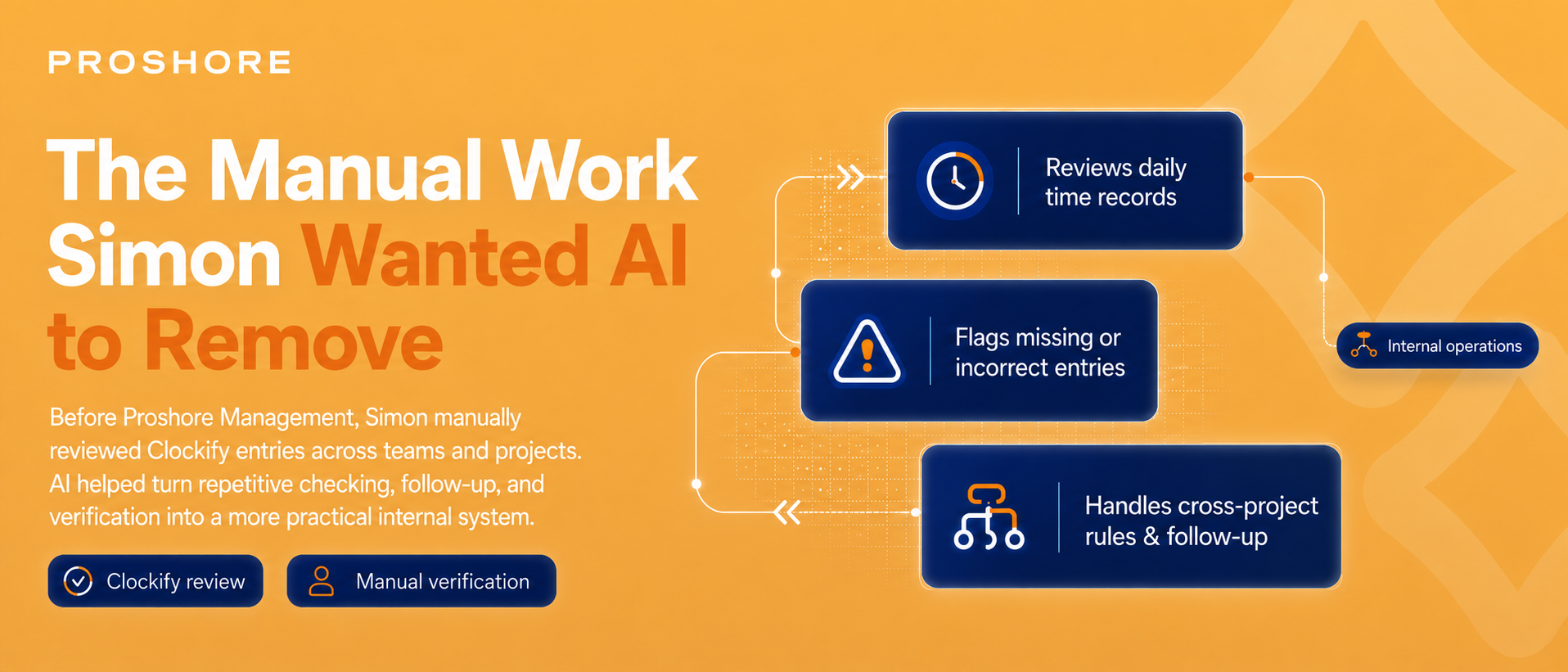
Before Proshore Management, Simon reviewed Clockify entries manually.
He had to review daily time records across every team and project, then identify missing hours or incorrect entries.
After finding an issue, Simon also had to contact the team member individually.
For a team of more than 10 people, the number of checks increased quickly. The work became even more demanding when Simon had to manage several teams with different project requirements.
The process also depended on team-specific rules, including different description requirements, cross-project time allocation, and role-based working patterns.
Simon wanted to reduce this repetitive work without creating an unreliable system that treated every unusual entry as an error.
Building the tool through the engineering team was not practical because developers were already focused on client delivery.
Simon understood the operational problem and had the technical foundation to solve it, even though development was no longer part of his primary role as scrum master.
But his technical background, combined with AI, helped him turn that experience into a working system without any pressure on other team members.
How Simon Used AI to Build Proshore Management
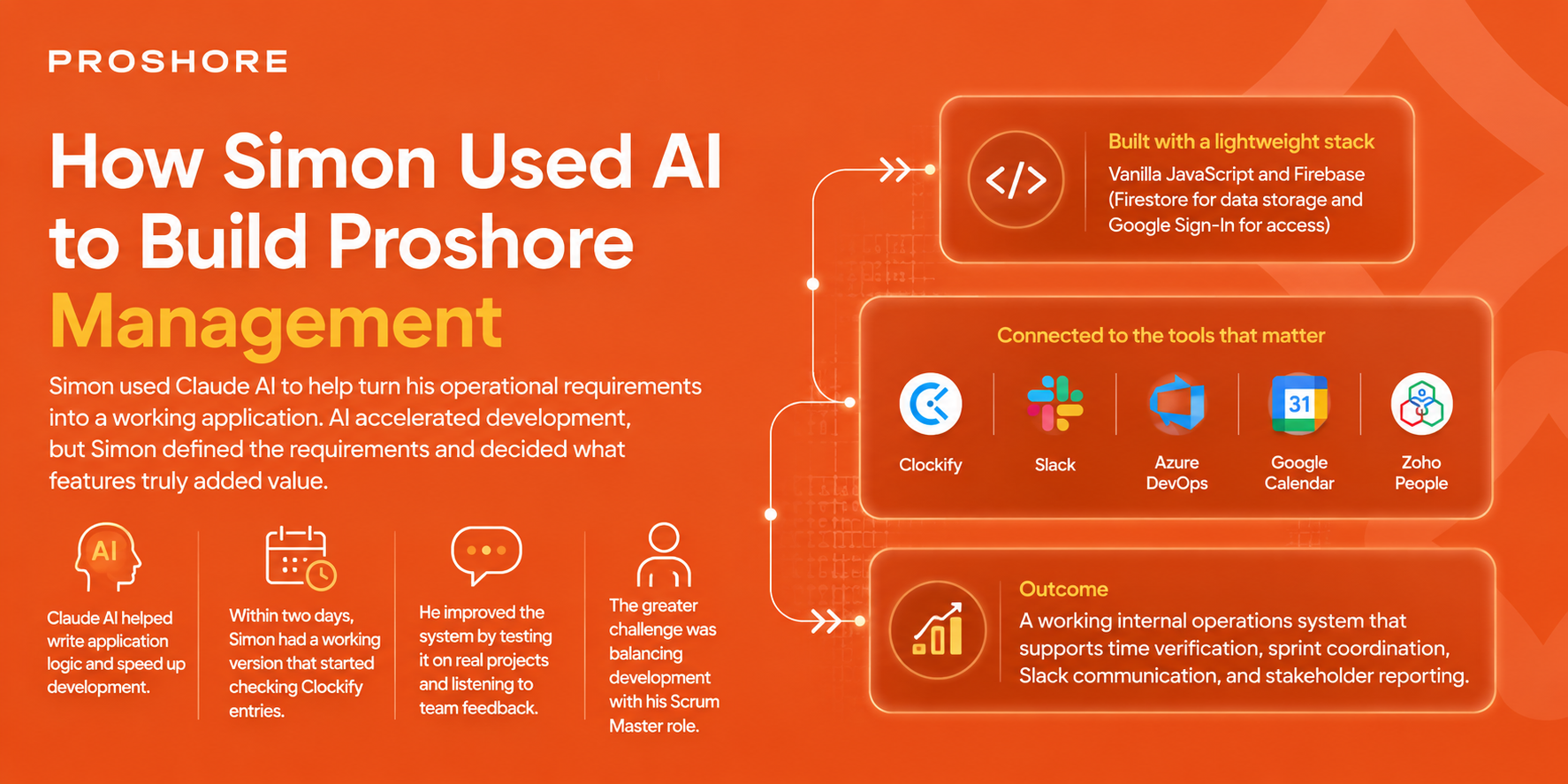
Simon used Claude AI to help turn his operational requirements into a working application.
He remained responsible for defining the problem, explaining the workflow, and deciding how the system should behave. Claude helped him write the application logic and move through development faster than he could have done alone.
This distinction shaped the project, and within two days, Simon had a working version that could begin checking Clockify entries.
He then continued to improve the system by testing it on real internal projects and listening to feedback from the teams using it.
The technical stack was kept lightweight. Simon built the tool with vanilla JavaScript and Firebase, using Firestore for data storage and Google Sign-In for access. He connected it with Clockify, Slack, Azure DevOps, Google Calendar, and Zoho People to support time verification and wider operational workflows.
The greater challenge was developing the system while continuing to manage multiple teams and complete his regular Scrum Master responsibilities.
AI sped up development, but Simon still had to define requirements and decide which features were valuable enough to add.
How the AI-Assisted System Works
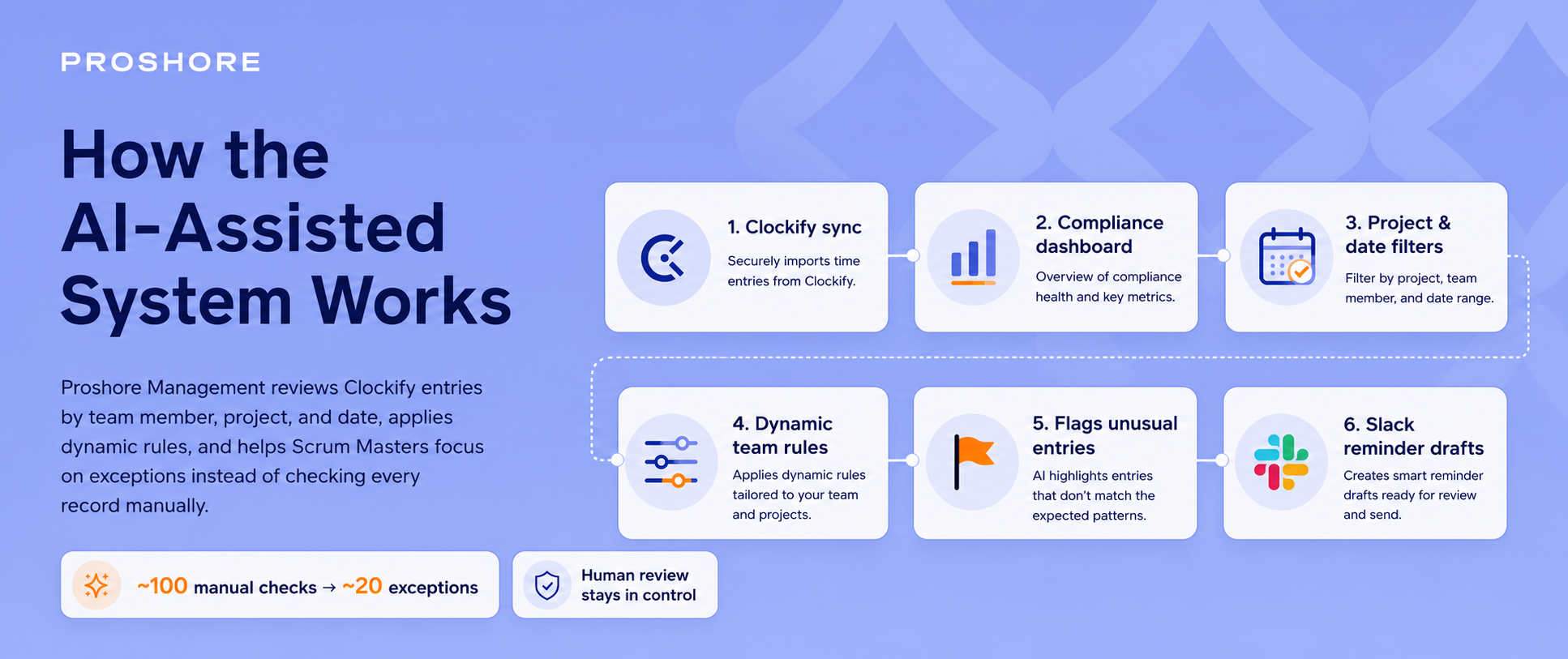
Proshore Management connects with Clockify and reviews time entries by team member, project, and date.
The system verifies time entries against project requirements and displays the results in a compliance dashboard for Scrum Masters and HR. Users can filter by project or date, while configurable rules adapt the checks to specific teams or working arrangements.
Simon made the rules dynamic because a single compliance standard would not work across every team.
A developer may be permitted to record time under multiple projects. A client may require a different description structure. One team may follow a working pattern that would appear unusual when compared with another.
Rather than allowing AI to guess whether those situations are acceptable, Simon defines the conditions inside the system.
The tool flags unusual entries for review instead of automatically treating them as errors.
Before Proshore Management, Simon might have needed to manually inspect around 100 entries. The system now performs the initial review and reduces the number requiring human attention to approximately 20.
Simon can focus on the exceptions instead of spending equal time on every record.
The system also supports Slack notifications. When someone has not logged their hours, it can prepare an individual direct message for that person. Simon can review and edit the message before it is sent. This keeps communication efficient without removing personal control from the process.
Expanding AI Across Simon’s Scrum Master Workflow
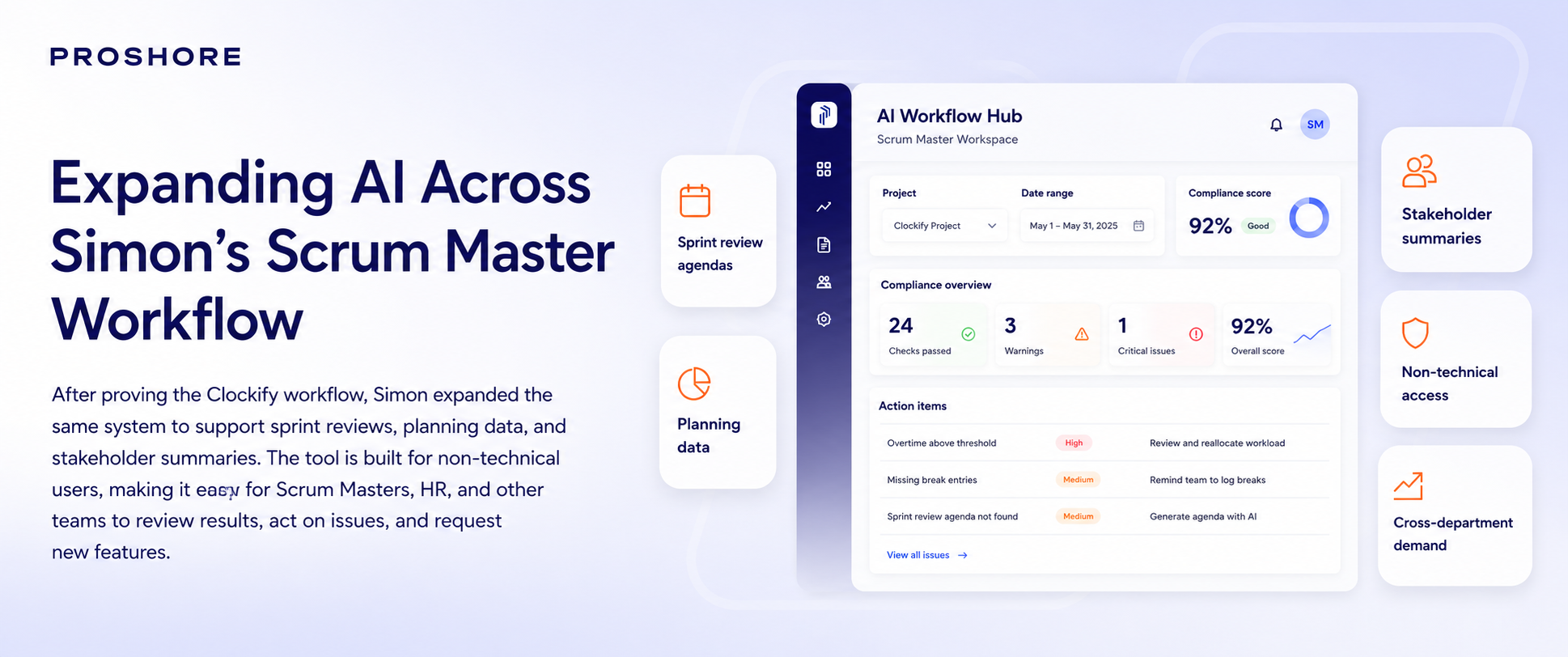
After proving the Clockify workflow, Simon began using the same system to solve other repetitive parts of his role.
The tool connects with JIRA or Azure DevOps to generate sprint review agendas, organize planning data, and prepare stakeholder summaries. This reduces the manual work Simon previously handled before and after each sprint review.
The tool was designed so Scrum Masters, HR employees, and other non-technical users could operate it without programming knowledge.
Users can select a project, choose a date range, review the compliance results, and act on the issues identified by the system. The APIs, databases, and application logic remain behind the interface.
That usability became increasingly important when other teams began asking Simon for access and additional features.
The first version had been built to solve Simon’s own operational problem. Internal demand indicated that the same approach could support cross-departmental work.
The Operational Impact of Simon’s AI Tool
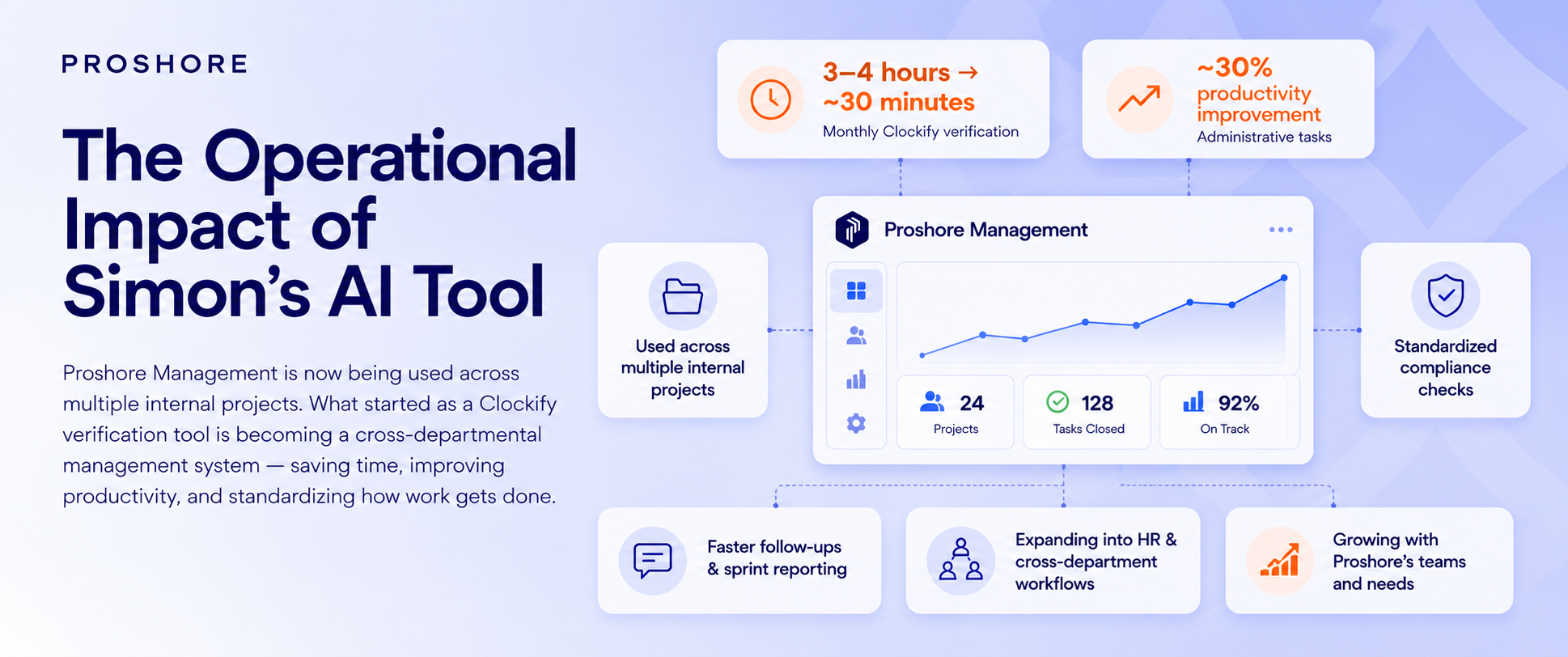
Proshore Management is now being used across multiple internal projects.
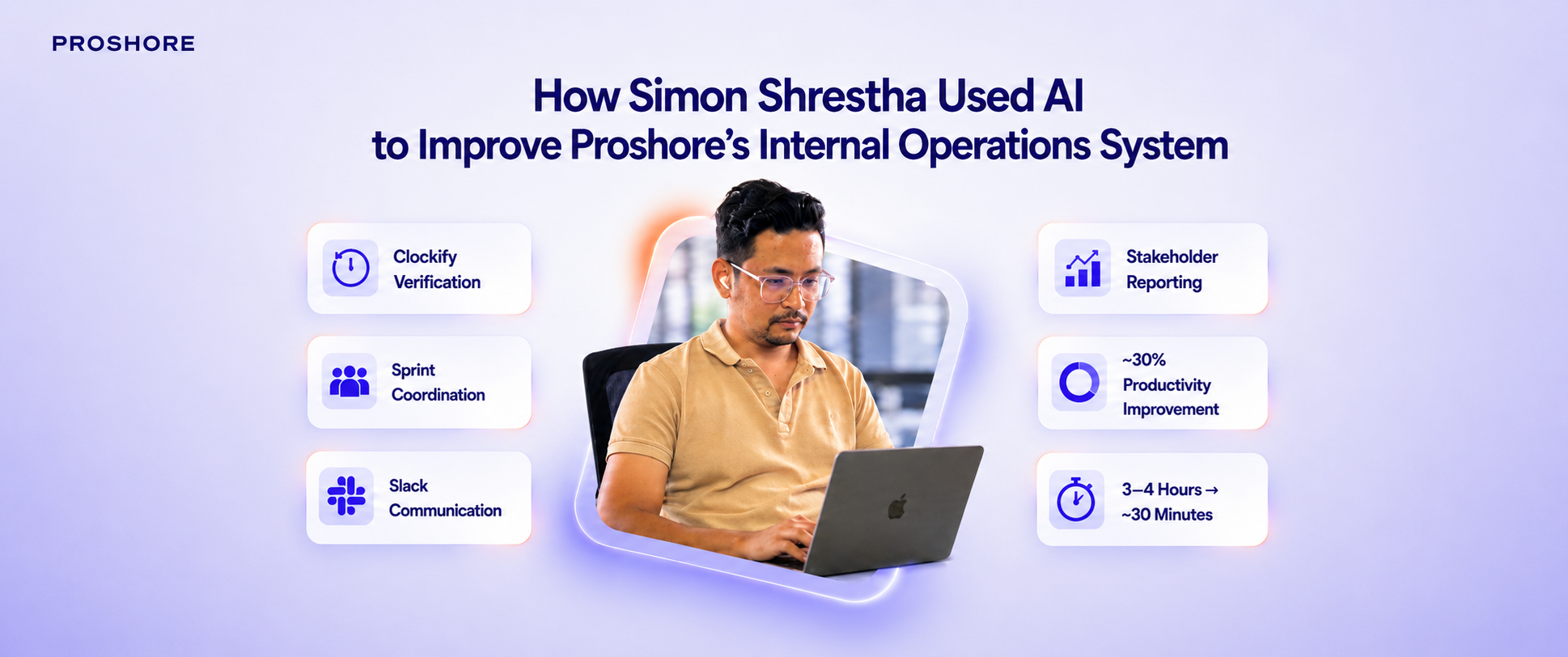
Before Simon built it, monthly Clockify verification could take around three to four hours. The process can now be completed in approximately 30 minutes.
The system has also contributed to an estimated 30 % productivity improvement across the repetitive administrative tasks it supports.
Beyond saving time, the tool standardizes compliance checks, speeds up follow-ups and automates sprint reporting. Continued feature requests from its users became the clearest proof that the MVP had succeeded.
Other teams began requesting new features. HR saw that the same platform could support its own internal processes. What started as a Clockify verification tool was becoming a cross-departmental system.
That response changed the direction of the product.
Simon chose the name Proshore Management because he did not want the system to remain limited to time tracking. He saw the potential for it to become a management platform that supports the company as its teams and operational requirements grow.
More people create more time entries, sprint records, performance reviews, leave requests, and communication requirements. Without a shared system, that work remains divided across spreadsheets, messages and separate tools.
Simon wants Proshore Management to become part of the foundation connecting those workflows.
What Simon Plans to Build Next With AI
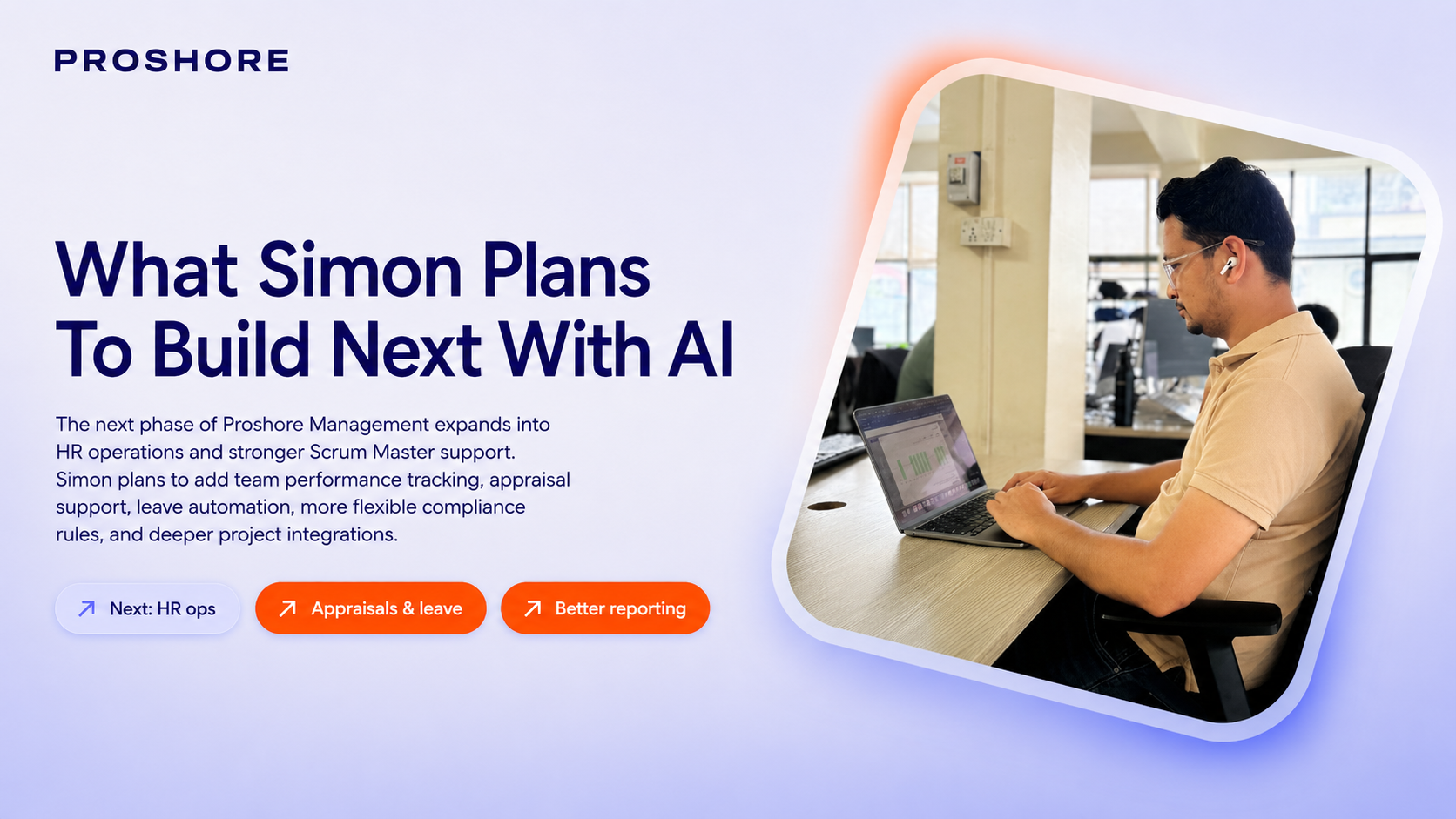
The next phase of Proshore Management will expand further into HR operations.
Requested features include team performance tracking, appraisal support, and leave automation. Simon plans to apply the same principle that shaped Clockify verification.
AI should handle repeated information collection and initial checks. The system should surface the cases that require attention. Final decisions should remain with the person responsible for the team or process.
Simon also plans to improve the existing Scrum Master features through more flexible compliance rules and deeper project integrations to strengthen reporting.
The goal is to remove the repetitive work around those decisions so Scrum Masters, HR teams and operational leaders can spend more time supporting people and improving delivery.
For Simon, the project has also been a return to his technical roots.
His Scrum Master role had taken him away from regular development, but AI gave him a way to use that background again.
He could identify an operational problem, design a product around it, and build the first version without depending on an available developer.
That independence expanded his role inside Proshore, where it became an example of how someone close to an operational problem can use AI to move beyond the limits of their formal role and create a capability that grows with the company.

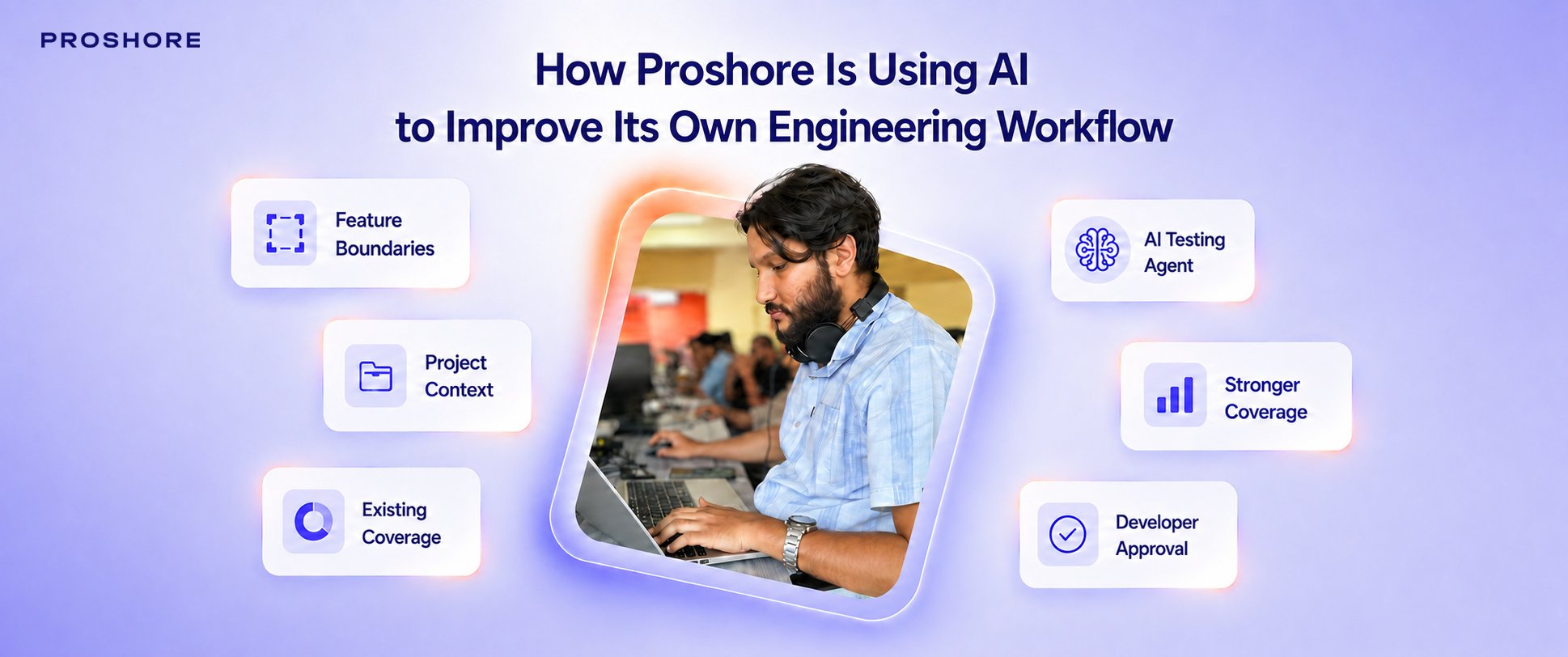
The Workflow Problem Behind the Agent
The idea came from the kind of delivery friction developers often feel before it becomes visible to the wider team.
Requirements rarely move cleanly from discussion to development, and sprint work can change while the code is already moving.
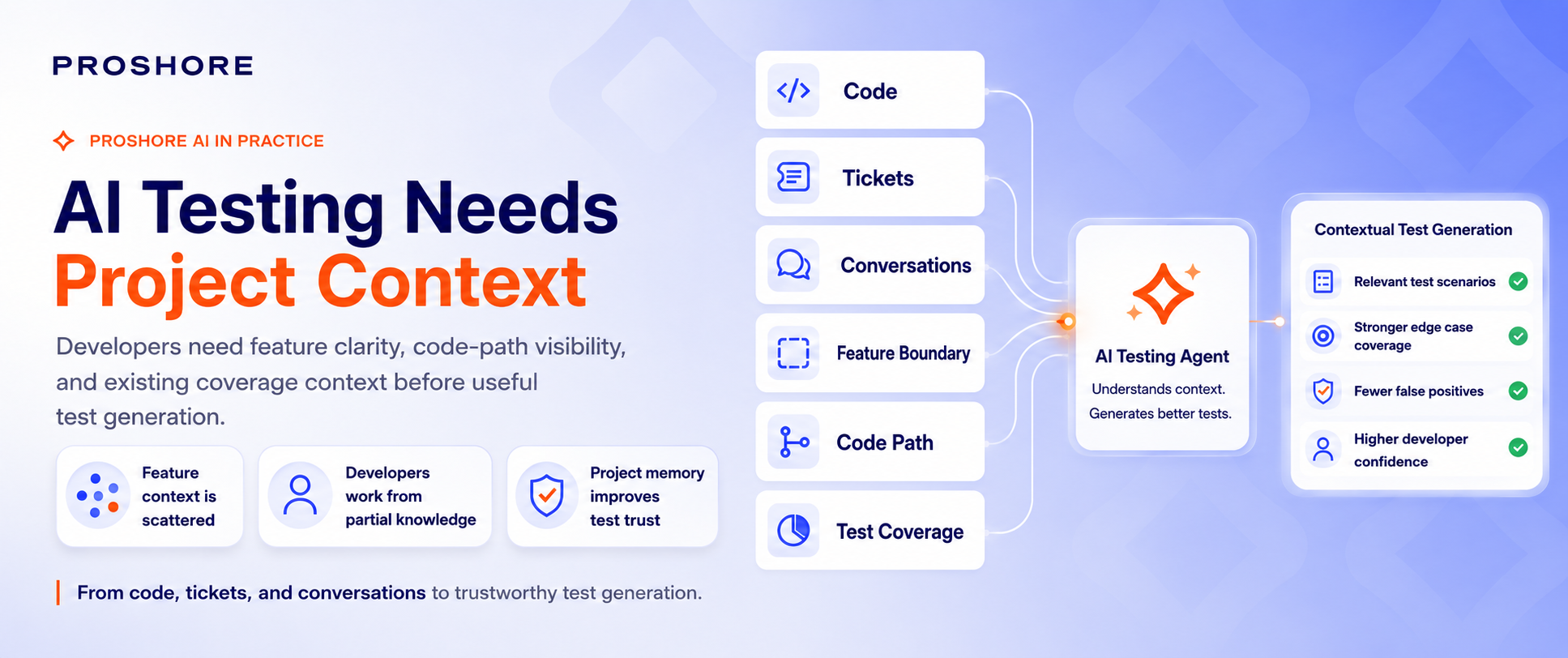
Feature context often arrives through meetings and messages, which means one developer may understand the full picture while others work from partial knowledge.
That uneven understanding makes testing harder to trust.
Saiman wanted to solve the context problem that appears before test writing begins. Strong tests need feature clarity.
The developer needs to understand the feature boundary, the relevant code path and the existing coverage before adding more tests to the suite.
That became the core insight behind the agent.
AI needed project context before test generation could become useful.
Any coding assistant can produce a test from a prompt, but a useful testing agent needs project memory before it touches the test suite. That principle shaped the agent from the ground up.
Why the Agent Learns the Project Before It Writes Tests
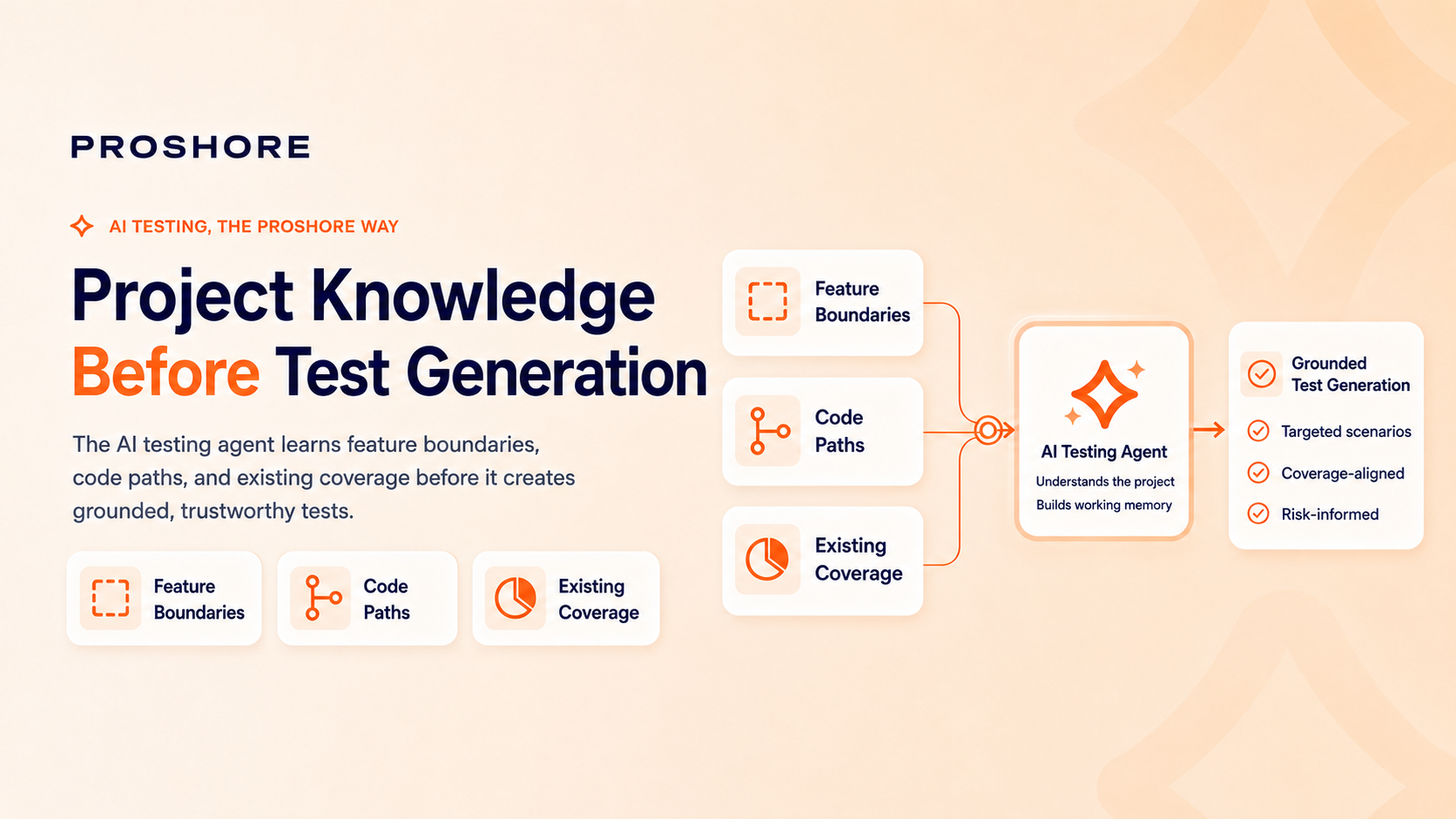
The agent starts with codebase discovery.
It reads the application through feature boundaries and builds a working memory for each feature. That memory connects the feature to the code that supports it and the coverage that already exists around it.
This gives the agent a usable map of the project before test generation begins.
When a developer selects a feature, the agent already understands the scope it needs to work inside.
It can create a test plan from the right project context rather than treating the codebase as one large surface.
That control matters because AI-generated tests become harder to trust when the model has too much room to guess.
It may invent behavior the application never had. It may bring unrelated files into the testing path. It may produce clean-looking tests that misunderstand the feature.
Saiman reduced that risk by making project knowledge the guardrail.
The feature-based knowledge base gives the agent a controlled working area before it plans or validates tests. That makes the output more grounded and easier for developers to trust.
Making the Agent Usable in Real Project Work
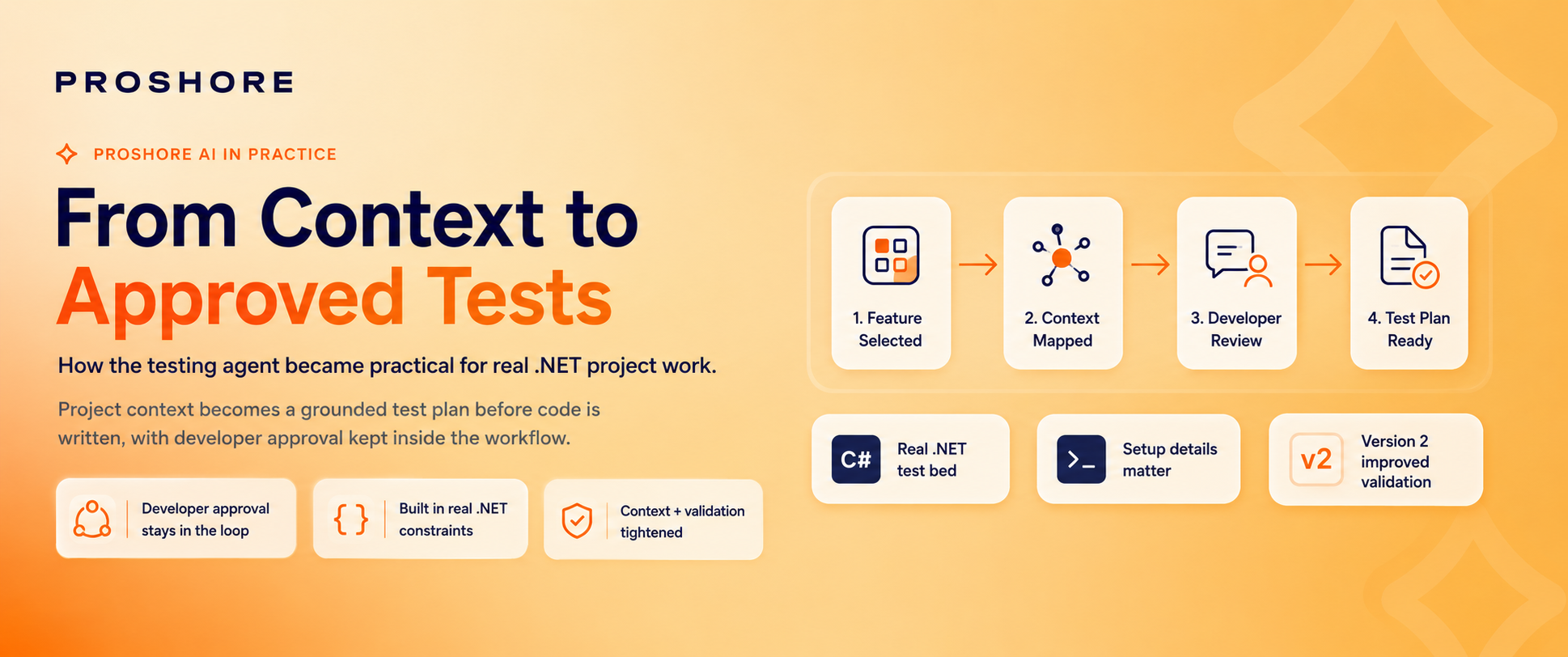
Once a feature is selected, the agent turns project context into a test plan before writing any test code.
Saiman kept developer approval inside the workflow because AI-generated tests still need engineering judgment before they become part of the suite.
C# became the first test bed because it gave the agent a real Proshore environment to prove itself.
Saiman’s .NET background made that starting point practical, while real project constraints exposed details a clean demo would miss.
In .NET projects, small setup differences can decide whether the workflow works at all. Version differences, xUnit behavior and command setup all shaped how reliable the agent had to become.
The first version proved the core pipeline. Version two made it more usable by tightening the connection between project context and validation.
Turning AI From Experiment Into Delivery Output
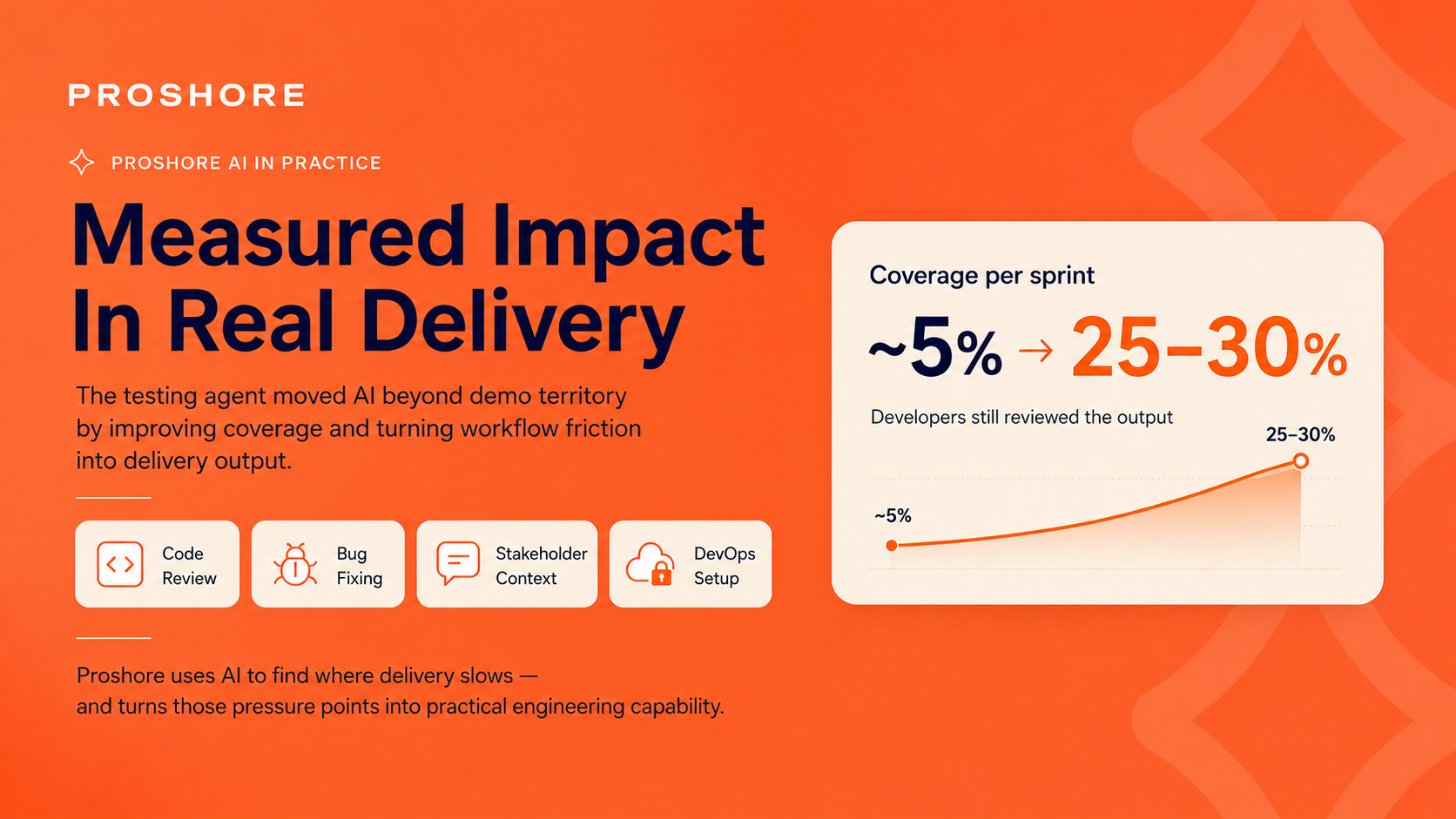
The first measurable impact showed up in test coverage.
In one project, coverage moved from about 5% to 25–30% per sprint while developers still reviewed the work. That took the agent out of demo territory and tied AI directly to delivery output.
The larger value is what the result signals for Proshore. Saiman’s agent shows how internal AI can strengthen the engineering system by removing the context work that slows delivery.
Testing became the first strong use case because the friction was visible and the progress could be measured.
The same principle now extends into code review and bug fixing. It also applies to stakeholder communication where project context often breaks before it reaches development.
DevOps fits the same pattern through setup work and secret management.
Proshore is using AI to find the points where delivery slows, then turning those pressure points into practical engineering capability.
What Comes Next for AI at Proshore

The strongest part of Saiman’s agent is where it came from. It was built from the developer side of the workflow, where the testing problem was already visible in real project work.
Saiman focused on a specific engineering problem. Testing is needed for a stronger project context before it can become faster and more reliable.
That makes the agent valuable as more than an AI experiment. It behaves like a workflow layer. It understands the project before planning tests.
It keeps developer approval inside the process. It feeds validated results back into project memory.
The current build lives in C# because that was the clearest place to prove the approach.
The next step is expansion into Python and PHP, which would make the same testing flow useful across more Proshore teams.
This is the larger value of the project. Proshore is using AI to improve its own engineering system from the inside, and Saiman’s testing agent is one concrete proof point of that direction.


November 10–13 Lisbon, Portugal
Tech Conference
Proshore Joins Global Innovators at Web Summit Lisbon 2025
From November 10 to 13, Proshore will take part in Web Summit Lisbon 2025, one of the world’s most influential technology conferences.
Book a call Talk to our Accounts director, Jeroen, to see if our ready-to-code offshore teams are a fit for you.
The event brings together entrepreneurs, leaders, and technologists from across the globe to explore emerging technologies, the impact of AI, and the future of the digital economy.
Representing Proshore are Roshan Bhattarai (Operational Director), Jeroen van der Horst (Account Director), Babish Shrestha (Technology Director), and Haico Duisters (Managing Director).
They will join thousands of industry experts to discuss how organizations build and scale technology teams, implement new digital strategies, and strengthen global IT capabilities.
What We’re Excited About
This year’s Web Summit focuses on how digital transformation, AI, and cloud innovation are reshaping the way IT departments and global teams collaborate.
Proshore’s team looks forward to connecting with innovators, learning from new perspectives, and sharing experiences from working with distributed tech teams that drive scalability and long-term growth.
From cloud-native development to data-driven digital transformation, Proshore remains committed to helping organizations succeed at the intersection of people, process, and technology.
Web Summit Lisbon provides the perfect setting to continue that mission and engage with the ideas shaping tomorrow’s digital landscape.
Meet us at Web Summit 2025—let’s talk tech and innovation!


HR Manager, Proshore
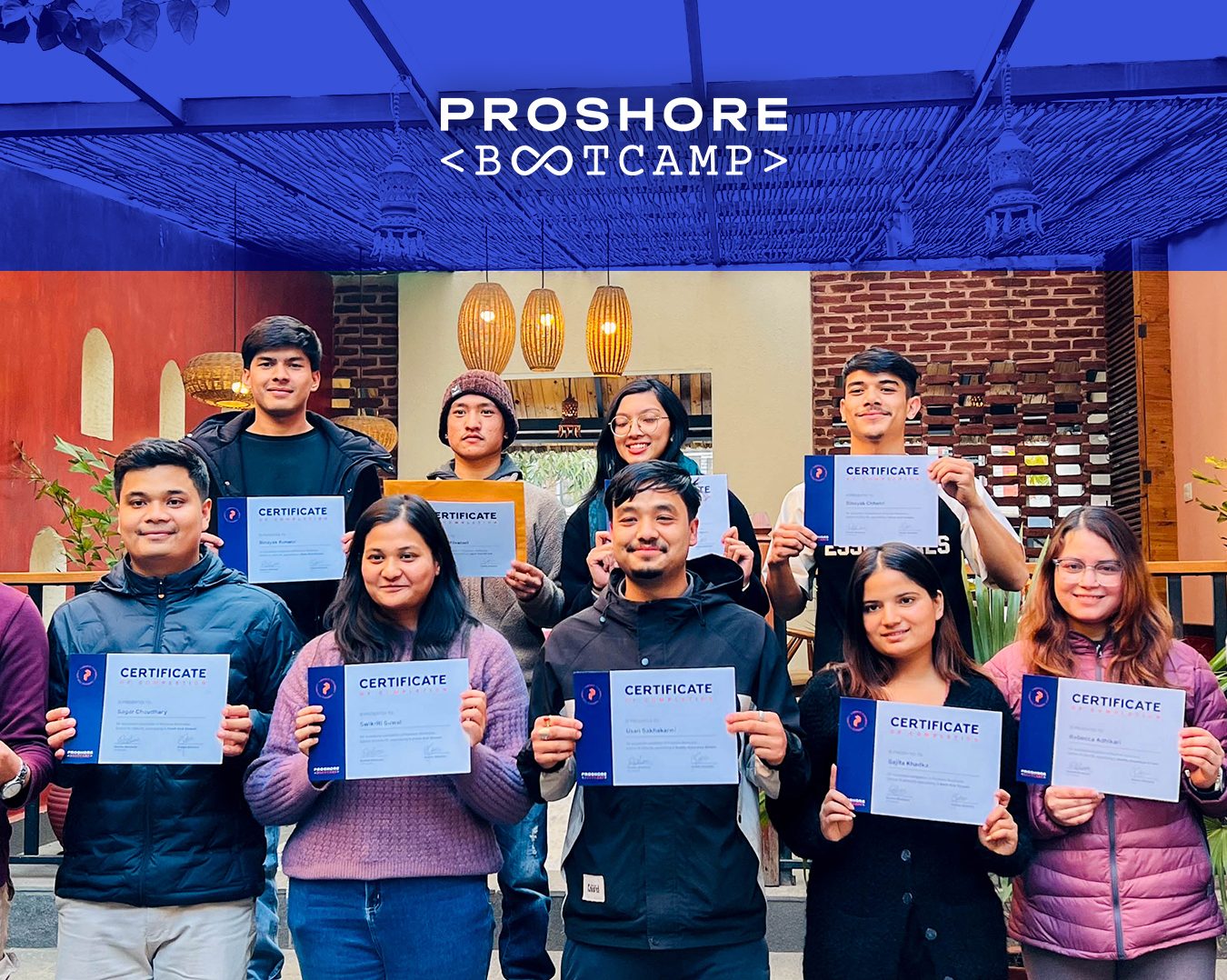
Proshore Bootcamp 6th Edition
A transformative journey into Real-World Software Development
For aspiring software developers in Nepal, gaining hands-on experience in real-world projects is often a challenge. Proshore Bootcamp, a mentorship-driven coding program, has been bridging this gap by offering immersive learning opportunities to talented individuals twice a year.
Learn more Explore our mentroship program, find out if its for you, and put your hat in the basket.
The recently concluded 6th edition of the Proshore Bootcamp proved to be yet another impactful experience, equipping participants with essential technical and soft skills while fostering a strong sense of collaboration and problem-solving.
A Bootcamp Built on Experience and Mentorship
The heart of Proshore Bootcamp lies in its mentors—seasoned professionals who dedicate their time to nurturing the next generation of developers. For the 6th edition, mentors like Sanket, Kundan, and Binaya, among others, brought years of experience, empathy, and leadership to the table.
Sanket Upreti, the Frontend Stream Mentor Lead and former bootcamper, emphasized the cyclical nature of growth: “Once being a bootcamper myself, that is enough motivation to help others grow.” His approach focused on breaking down complex tasks into manageable steps, guiding participants to “solve smaller components first before tackling the bigger picture.”
Kundan Karna, the Backend Stream Mentor Lead, highlighted the importance of foundational skills. Many bootcampers initially struggled with programming basics, so he conducted targeted sessions on research techniques and documentation. His proudest moment? Seeing three past bootcampers evolve into full-time Proshore developers—proof of the program’s career-launching impact.
Meanwhile, Binaya Dhungana, a six-time mentor and QA Stream Mentor Lead, tackled challenges like impostor syndrome and communication gaps. He shared, “Many felt overwhelmed, doubting their abilities. We emphasized progress over perfection and celebrated small wins.” His team-building exercises and focus on “clear, concise communication” helped bootcampers thrive in collaborative settings.
Overcoming Challenges, One Step at a Time
Like any rigorous program, Bootcamp #6 came with its share of challenges. Participants faced:
👩💻 Technical Complexity
Newcomers often froze when starting features. Mentors like Sanket encouraged iterative problem-solving.
🎭 Imposter Syndrome
Binaya’s candid sharing of his own learning curves normalized struggles, fostering resilience.
⏳ Time Management
With tight deadlines, bootcampers learned to prioritize tasks using tools like time-blocking.
🗓️ Communication Gaps
Remote collaboration demanded clarity. Regular stand-ups and feedback sessions turned hesitant speakers into proactive team players.
A standout example was Usan Sakhakarmi, who transformed from a nervous presenter to a confident problem-solver. His team’s late-night brainstorming sessions to resolve a critical project blocker showcased the program’s emphasis on ownership and collaboration.
Transformations That Speak Volumes
The impact of the bootcamp was evident in the transformations observed among the bootcampers. Sanket recalled how a group of bootcampers resolved a major project blocker by collaborating in online meetings, researching, and brainstorming solutions.
Their ability to take responsibility and work as a team showcased their growth in both technical skills and career prospects.
<> Skill Development
Bootcampers mastered Laravel, API optimization, and agile workflows.
🚀 Career Launchpads
Multiple participants, including Binayak and Usan, transitioned to full-time roles.
📢 Confidence Boosts
Graduation day—where teams presented projects to a live audience—was a pinnacle moment. As Sanket recalled, “Seeing them receive applause for months of hard work was unforgettable.”
For Kundan, one of the most rewarding experiences was seeing past bootcampers transition into full-time roles at Proshore. Three backend developers who started as bootcamp participants are now part of the company—a testament to the program’s effectiveness in nurturing talent.
A Bootcamper’s Journey: From Classroom to Career
For the bootcampers, this was more than just a training program—it was an exciting journey that pushed them beyond their comfort zones. The amalgamation of which could lead to a career kickstart!
Binayak, a bootcamper who discovered the bootcamp through a YouTube video, was able to secure a trainee position at Proshore’s sister company, Digital Product Labs (DPL).
✈️ Key Takeaways from Binayak’s Experience
⚖️ Balancing Act
Juggling college exams and bootcamp tasks required discipline. A hybrid schedule—technical work by day, studies by night—kept him on track.
🗣️ Beyond Code
Non-technical sessions on presentation skills (led by me, Krishma Shrestha) and soft skills boosted his confidence, essential for the modern developer.
<> Technical Wins
Kundan’s lessons on optimizing Laravel APIs left a lasting impact, equipping him with industry-relevant expertise.
Looking Ahead: Refining the Bootcamp Experience
While Bootcamp #6 was a success, with the development of ‘Vision Board’, mentors also identified areas for improvement:
- Binaya noted that some QA candidates had fewer tasks, highlighting the need for better project planning in future editions. For example, integration of QA testing modules ensures even more holistic preparation.
- Ensuring that all participants have ample learning opportunities should and will remain a priority for the program.
As the Proshore Bootcamp continues to evolve, its mission remains the same: to provide aspiring developers with the skills, experience, and mentorship needed to thrive in the industry. With every edition, it reinforces the belief that learning by doing, coupled with the right guidance, can unlock immense potential in Nepal’s tech talent.
The bootcamp was an incredible learning experience. It felt more like an exciting journey rather than just office work. I particularly enjoyed the non-technical sessions, as they helped me build confidence and improve my communication skills
Binayak Kunwor,
Backend Trainee & Bootcamp #6 Graduate
Are You Ready to Join the Next Edition?
For those looking to kickstart their careers in software development, the Proshore Bootcamp is more than just a learning experience—it’s a launchpad for success.
If you’re eager to gain real-world project experience, collaborate with experienced mentors, and develop skills that set you apart, the next edition awaits you. Stay tuned and take the leap toward your future in tech!
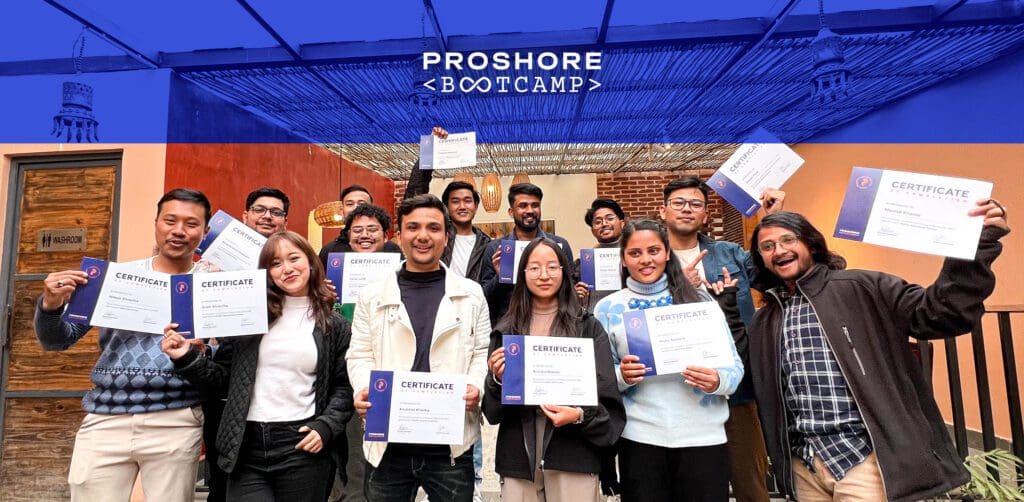
How a mentorship program can kickstart software development careers
Many aspiring developers lack the practical experience employers crave. Here's where mentorship programs like Proshore Bootcamp can bridge the gap.
Proshore Bootcamp #4: Kickstarting careers In software development
Proshore Bootcamp once again gives aspiring IT professionals in Nepal the chance to gain valuable experience of working in software development.

Proshore Bootcamp #3: More than a mentorship program
Read our 3rd editon's recap to learn why Proshore Bootcamp improves on regular coding bootcamps, IT training, and programming courses.
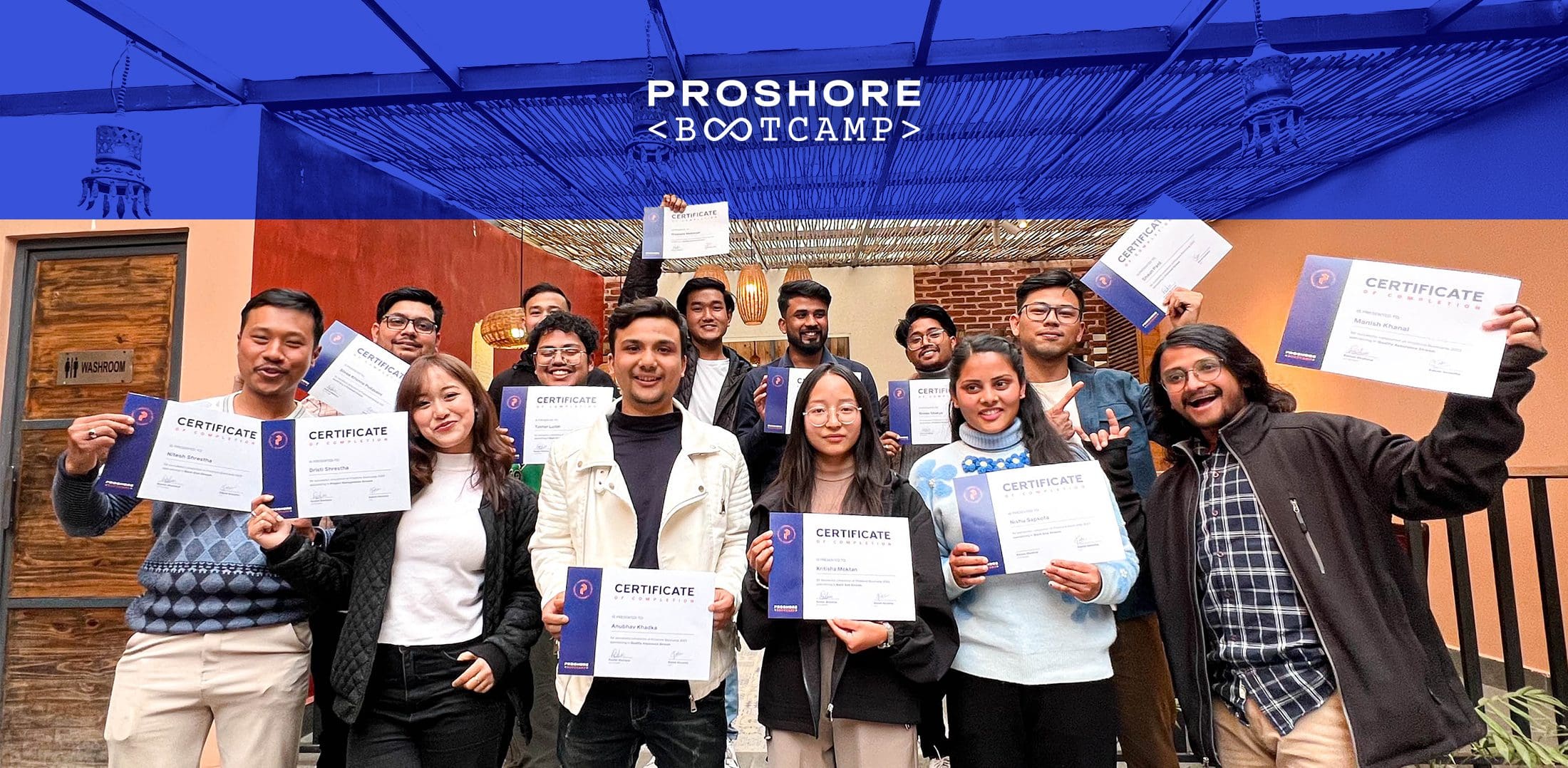
Proshore Bootcamp 5th edition
How a mentorship program can kickstart software development careers
Struggling to break into the exciting world of software development? You're not alone. Many aspiring developers lack the practical experience employers crave. Here's where mentorship programs like Proshore Bootcamp can bridge the gap.
Learn more
about Proshore Bootcamp
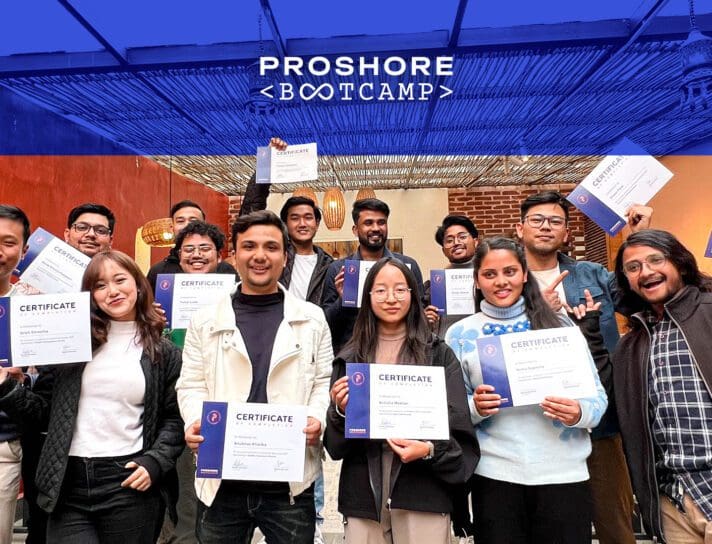
A mentorship program pairs aspiring professionals with experienced individuals who act as guides and advisors. Mentors offer valuable insights, share their expertise, and provide support and encouragement throughout the learning journey.
While traditional coding bootcamps and IT training courses offer valuable foundational knowledge, they often lack the real-world experience that’s crucial for landing a job in the software development industry. Mentorship programs are essentially shortcuts as they provide guided application of theory and a cheat sheet of mistakes to avoid.
Proshore’s premier mentorship program takes it a step further.
Proshore Bootcamp: Our vision
Since our inception in 2009, Proshore’s social mission has been to create sustainable and highly skilled jobs for the talented people in Nepal within Nepal. We strongly believe that the “war on talent” – the scarcity of highly skilled developers in the West and the abundant brain drain in Nepal, can be fought sustainably.
When repurposing our social mission to the grassroots level, Proshore Bootcamp was formed. The mentorship program aims to empower future IT talents of Nepal to kickstart successful IT careers. Helping promising talents enter the booming sector creates a ripple effect that in the long term contributes to creating “sustainable and highly-skilled jobs in Nepal”.
Proshore Bootcamp was born from our developers' struggles entering the industry. They lacked guidance, clarity on career paths, and understanding of how organizations work. We created the program to ensure this generation has a smoother journey.
Krishma Shrestha, Lead Mentor
Soft Skills - Proshore Bootcamp 5th edition
Why Proshore Bootcamp?
Why should starting IT professionals consider mentorship programs for their software development journey? Let's delve into the benefits of Proshore’s mentorship program and explore its impact.
Benefits of our mentorship program
Traditional learning methods often leave a gap between theory and practice. Proshore Bootcamp bridges that gap by providing a unique and intensive mentorship experience. Here's what sets us apart:
1. Real-world project focus
Gain hands-on experience by working collaboratively on a real-world software development project alongside experienced professionals.
2. Expert mentorship
Learn from industry experts who will guide you through every step of the development process, answer your questions, and provide valuable feedback.
3. Agile methodology
Immerse yourself in Agile methodologies used by top tech companies, giving you a significant advantage in the job market.
4. Multiple streams
Choose from various streams like backend development (BE), frontend development (FE), quality assurance (QA), and project management (PM) to tailor your learning to your specific interests.
5. Well-paced
Each edition of Proshore Bootcamp is designed for 60 days of hybrid working. The program is especially paced taking job and academic commitments into consideration.
6. No charge
Proshore Bootcamp is free of cost. Selected candidates are, in turn, welcome to work from Proshore’s workspace in Nepal where breakfast, lunch, and other available amenities are provided.
Proshore Bootcamp: The impact
Started in 2021, Proshore Bootcamp is 5 editions old. Each edition has had a different set of promising IT talent across BE, FE, PM, and QA streams working on road-mapping, time-tracking, asset management, or skill assessment tools development projects.
However, given our vision of ultimately “creating sustainable and highly-skilled jobs in Nepal”, we measure each edition's success in the careers we have helped kickstart with each edition of Proshore Bootcamp. Here’s where we stand after 5 editions,
75
bootcampers enrolled across 5 editions
1:1
average mentor per bootcamper ratio
80%
program completion or graduation rate
25%
of bootcampers received jobs when graduating
In today's AI-driven world, having a mentor who can share thoughtful insights and experiences is invaluable, particularly during their early stages of growth. This leaves a lasting impact, ultimately contributing to a stronger tech community in Nepal.
Sanket Upreti, Lead Mentor
Frontend Development - Proshore Bootcamp 5th edition
Proshore Bootcamp: The 5th edition
After its fifth edition, Proshore Bootcamp continues to uphold its reputation as a premier mentorship program in Nepal. Here’s a brief recap of the mentorship program,
1. Well over 250 applications were received for the 15 seats allocated for the program. Since the 4th edition, we’ve realized that 15 seats provide the optimal output as per Proshore Bootcamp’s current capacity.
2. 2 of the mentors for the program, Sahaj and Sanket, were Bootcamp alums. Sanket was even the Lead Mentor for Backend Development Stream
3. Over 30 sessions were conducted across all streams by 16 different mentors, again ensuring that an average of 1:1 ratio was maintained for mentor per bootcamper ratio.
4. Bootcampers built an MVP of a skill assessment tool, aptly named ‘Skillshore’, which they pitched to a mock audience following business pitching and go-to-market sessions.
5. 13 bootcampers graduated from the 5th edition of Proshore Bootcamp. 4 bootcampers were hired by our sister company, Digital Product Labs. 1 bootcamper was hired by a leading Nepali FinTech company.
Preview of the skill asssessment tool developed during the program:
Updated dashboard - Skillshore
Hear from some of the Bootcampers about their experience on the 5th edition of Proshore Bootcamp:
Grateful for the invaluable mentorship program at Proshore, where mentors guided me through the intricacies of Laravel development. With their expert guidance, I mastered the art of writing clean code, explored Laravel's multifaceted features, and prioritized personal growth. As I embark on this next chapter, I carry with me the wisdom imparted by my mentors, alongside passion and determination.
Nishu Sapkota, Bootcamper
Backend Stream - Proshore Bootcamp 5th edition

The Proshore Bootcamp was a rewarding journey. Under a mentor's guidance, I explored new testing tools and honed my skills, becoming a proficient tester with improved soft skills. The comprehensive program covered both manual and automation testing. I'm grateful for this opportunity and to Proshore Nepal for granting me a job in QA, allowing me to gain real-world experience.
Prashant Maharjan, Bootcamper
QA Stream - Proshore Bootcamp 5th edition

Proshore Bootcamp connected me with incredible mentors who generously shared their knowledge and guided us through any obstacles we faced. It wasn't just a first step; Proshore propelled me into the world of frontend development. I must say, within the span of three months, it feels like we underwent an UPDATE ourselves.
Shaun Pant, Bootcamper
Frontend Stream - Proshore Bootcamp 5th edition

A remarkable experience! Working alongside my team and mentors, I discovered the power of collaboration and problem-solving. Learning Agile project management methods equipped me with valuable skills, and the connections I made have opened doors for opportunities. Proshore Bootcamp wasn't just about knowledge; it was a transformative journey.
Dristi Shrestha, Bootcamper
PM Stream - Proshore Bootcamp 5th edition

Curious to learn more about Proshore Bootcamp?
Dive into our past Bootcamp recaps for insights into our previous editions and our impact on Nepal's software development landscape.
Proshore Bootcamp #4: Kickstarting careers In software development
Proshore Bootcamp once again gives aspiring IT professionals in Nepal the chance to gain valuable experience of working in software development.
Proshore Bootcamp #3: More than a mentorship program
Read our 3rd editon's recap to learn why Proshore Bootcamp improves on regular coding bootcamps, IT training, and programming courses.

Proshore Bootcamp #2: A premier IT mentorship program in Nepal
The 2nd edition of Proshore Bootcamp continued our mission to create better job opportunities for IT professionals in Nepal. Read about how it went.

In its fourth edition, Proshore Bootcamp once again gave aspiring IT professionals in Nepal the chance to gain valuable experience working in software development.
Building on the success of our third bootcamp, it enabled some of our more experienced team members to become mentors, sharing their expert knowledge and experience. This time around, 15 successful applicants got the chance to join our free, 60-day program working across different roles within a development team. This included backend development, frontend development plus UI/UX, QA, and project management. Here’s how they got on.
Proshore Bootcamp #4
The fourth edition of Proshore Bootcamp – a mentorship program designed to prepare participants for the real working environment – took place between March and June 2023. The 60-day program centered around the collaborative development of a Minimum Viable Product (MVP) – a time-tracking tool – later named Ticker Pro.
Earlier in 2023, prospective bootcampers were invited to apply for the program to fill one of 15 available seats in four key areas or ‘streams’ as we call them: frontend, backend, quality assurance (QA), and project management. Proshore mentors took part in the selection process, which included a submitted assessment. From this, the candidates were shortlisted and then interviewed virtually.
The time tracking project actually began in our second bootcamp. This meant our most recent cohort of bootcampers had a basic backend MVP that could be used to track time. As a result, their main challenges were to design the frontend using React, and improve the back end by adding report and chart functionality to the MVP.
This was the first time that Proshore Scrum Master, Shruti Bhattarai, had mentored on the program. Not only did Shruti mentor the bootcampers in the project management stream, she also took responsibility for managing the entire program as a project. It was a QA-driven bootcamp – something that is hard to achieve even in real-life teams.
The mentors’ perspective
Here’s what Shruti and some of our other Proshore mentors had to say about the fourth bootcamp:
Shruti: “The overall experience was very fulfilling. Some of the campers have already gone on to secure jobs in their respective streams outside and inside Proshore. One of my mentees even landed a job as a project manager!”
Rikesh: “When I started in this industry, I wish I’d had a mentor to guide me and make my learning faster. That's why I became a mentor myself. Sharing my knowledge with others not only helps them, but also allows me to learn and grow. It's a fulfilling experience that motivates me to continue mentoring others.”
Krishma: “Each bootcamp has given a new experience and insights on how people learn, how they communicate and what they value – which is a good insight given my line of work – HR! It helps me understand the talent pool better.”
Sanket: “The most rewarding thing about being a mentor was seeing bootcampers apply the ideas, and packages we taught, using them to complete the project. The demo they put out on their graduation day remains a standout for me. Seeing their output gave me a sense of accomplishment!”
Kritika: “Being a mentor, I was there to share my knowledge and experience with bootcampers, but I also got to learn new things whenever we encountered new problems. For me, these were the most pleasing things about being a mentor.”
The view from bootcamp
Our bootcampers from this edition also had lots of positive things to say about their experience:
Chunan: “The bootcamp has been an opportunity to grow and improve as a person rather than just a learning opportunity. I also appreciate the time and effort of our mentors. They were always there to help us, even during late hours or through weekends.”
Piyush: “My overall experience in the bootcamp was incredibly enriching. The online and offline sessions, hands-on project working, team collaboration, resolving issues, and great learning environment helped me to not only become a good programmer but also a confident individual with better soft skills.”
Sanjeev: “This bootcamp helped me get better at frontend development and also increased my collaboration skills. My future goals and aspirations are to explore the Javascript world, which might involve getting better at React or learning backend technologies like Nest.”
View this post on Instagram
A post shared by Proshore 🚀 Remote ready-to-code teams (@proshore.official)
Are you ready for Bootcamp #5?
Are you looking to gain experience in the software development industry in Nepal? Thinking about applying to the next Proshore Bootcamp? Discover more about the Proshore Bootcamp in our blog post on the first edition.
In our next installment of the Proshore Bootcamp, we’re looking forward to creating more opportunities that contribute to the promising future of Nepal as a tech hub. The fifth Proshore Bootcamp gets underway sometime around the 4th quarter of 2023.
If you’re interested and don't want to miss out, get notified via email. In the meantime, you can follow us on socials to keep updated with exciting career opportunities.
View this post on Instagram
A post shared by Proshore 🚀 Remote ready-to-code teams (@proshore.official)
View this post on Instagram
A post shared by Proshore 🚀 Remote ready-to-code teams (@proshore.official)

Why AI Pilots Are Easy, but Production AI Is Difficult
AI pilot success is routinely misinterpreted as enterprise readiness, with working models and proofs of concept treated as indicators of success.
In practice, experimentation outcomes do not translate into operational capability, as model accuracy does not ensure business integration, and prototypes do not function as production systems.
Most pilots produce isolated models, while enterprise value is realized only when AI is embedded into business decisions within live workflows.
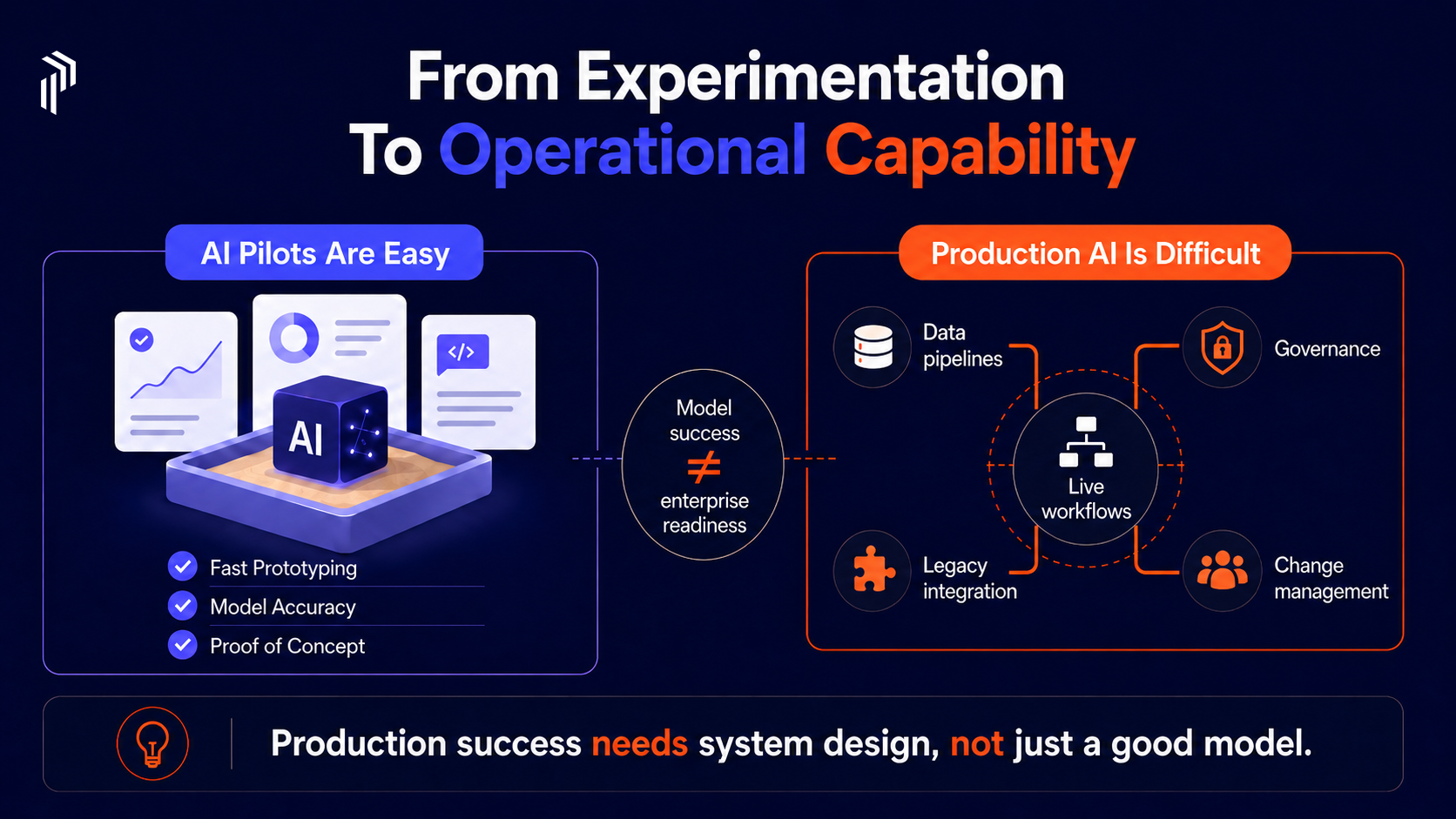
Production success depends on production-ready data pipelines, governance controls, change management processes, and repeatable execution mechanisms that extend beyond the model itself.
While rapid experimentation tools and cloud environments accelerate development, integration with legacy systems and cross-functional operations and data exposes underlying misalignment.
The limitation is rooted in a missing production system design rather than model development.
Structural Challenges Preventing AI Scaling
AI stalls reflect recurring patterns of systemic misalignment rather than technical failure.
Innovation teams operate in isolation, with ownership fragmented across data, IT, and business units.
Alignment with broader transformation programs is limited, and enterprise architecture does not support AI integration at scale.
Legacy systems impose structural constraints, and data pipelines lack production readiness.
Security and governance reviews introduce deployment bottlenecks due to late integration.
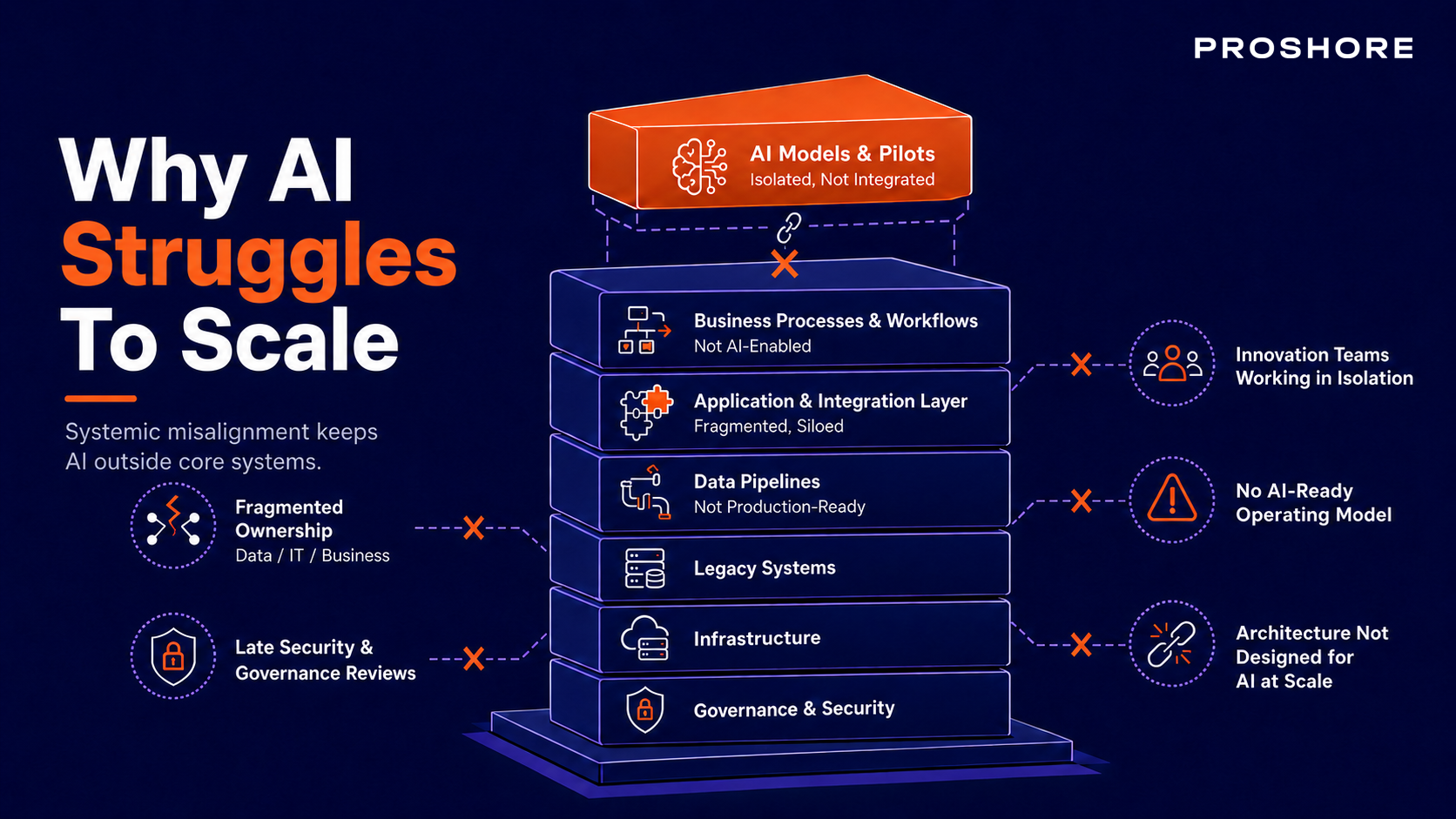
AI remains outside core systems instead of being embedded within them.
Scaling is constrained by the absence of an operating model and architecture that treats AI as a capability layer.
Organizations continue to equate capability creation in controlled environments with enterprise deployment.
These structural issues typically show up in four recurring patterns:
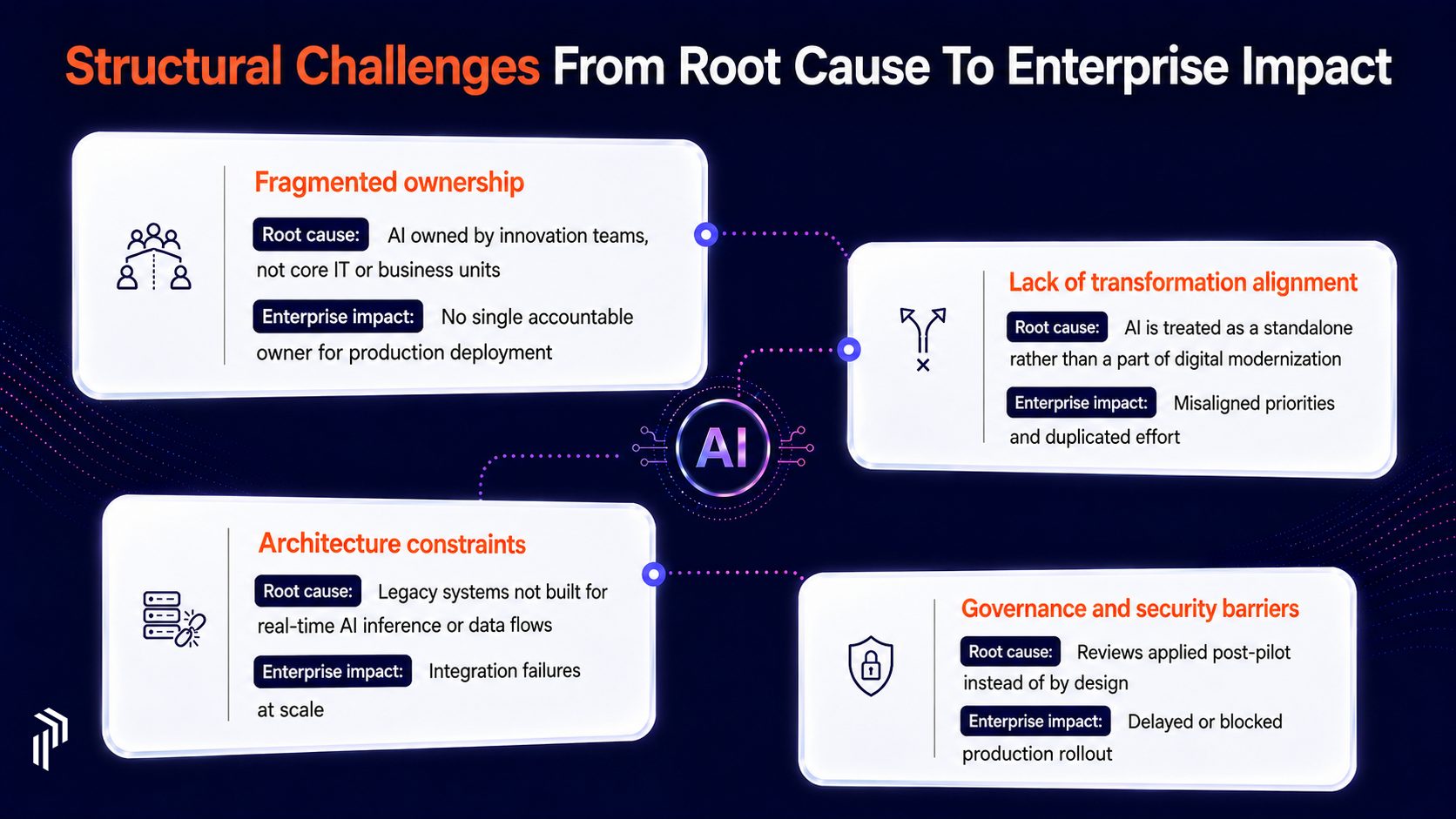
(Based on patterns in MIT’s GenAI Divide: State of AI in Business 2025 | McKinsey’s State of AI 2025, and related Gartner analysis)
The Cost of Fragmented AI Adoption
The disconnect between pilot optics and execution reality introduces compounding hidden costs.
Teams repeat similar experiments across business units without sharing learning or reusing them.
Investments are duplicated across functions.
Executive confidence declines as expected transformation value does not materialize.
This fragmentation manifests in the following hidden costs:
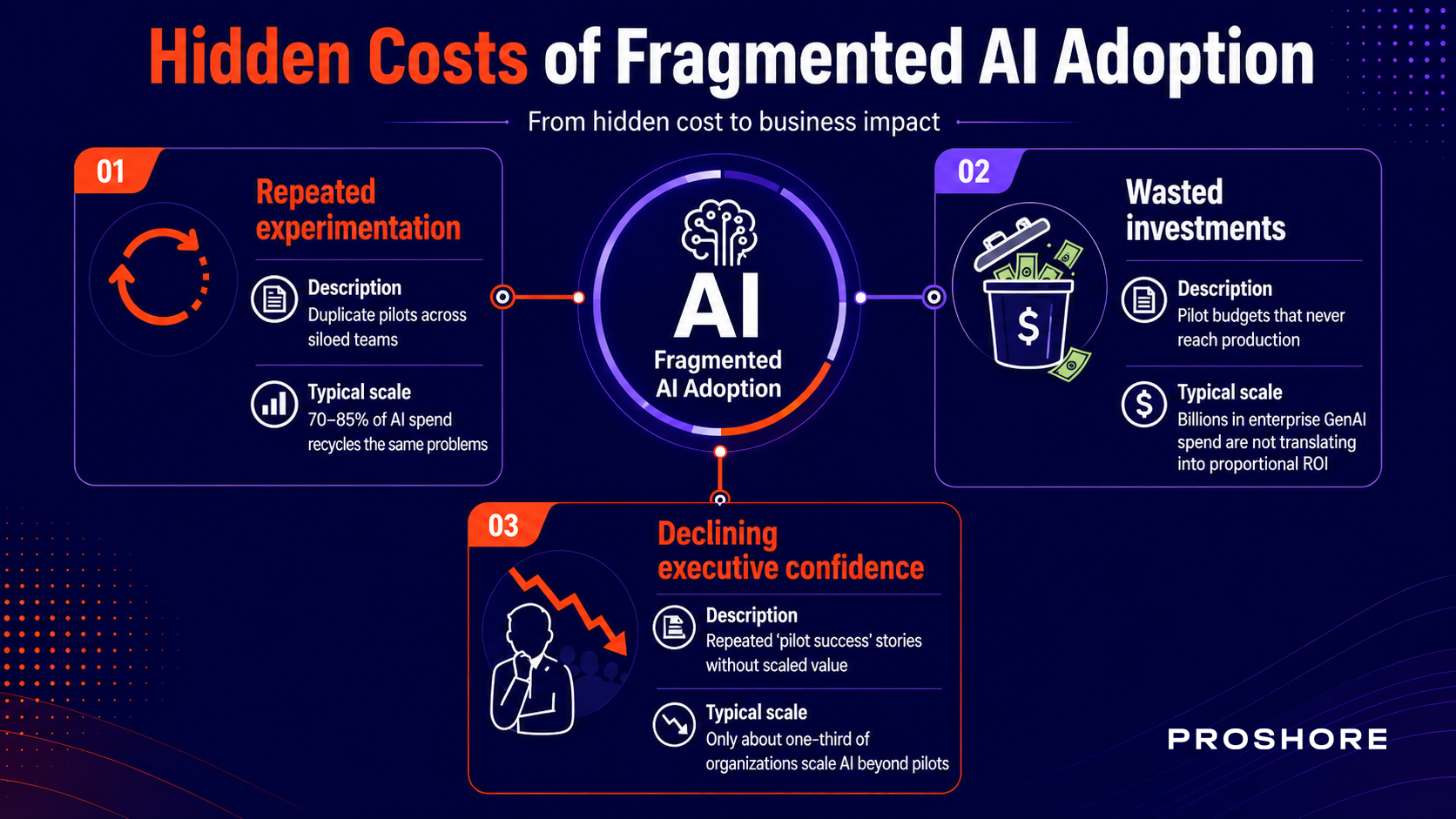
(Source: MIT’s GenAI Divide: State of AI in Business 2025 and McKinsey State of AI 2025)
A Better Approach to AI Adoption
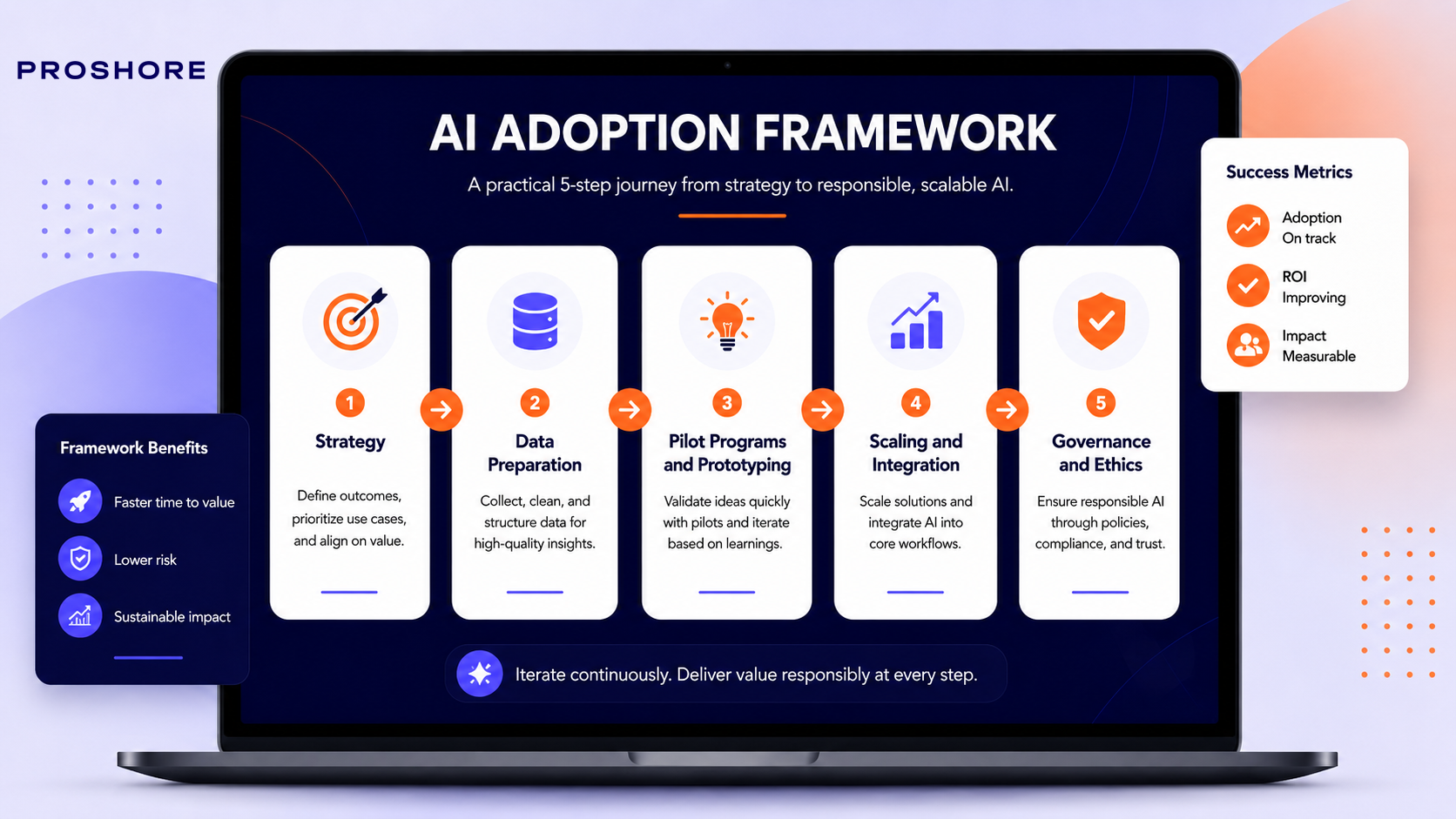
AI delivers value when positioned as a capability layer within existing transformation programs.
The operating model aligns AI with digital transformation, integrates it with cloud modernization and data architecture, and embeds it into core systems and workflows from the outset.
In this approach, architecture enables integration and scale, transformation programs drive delivery, and governance enables controlled execution.
This structure enables the transition from pilot activity to operational deployment.
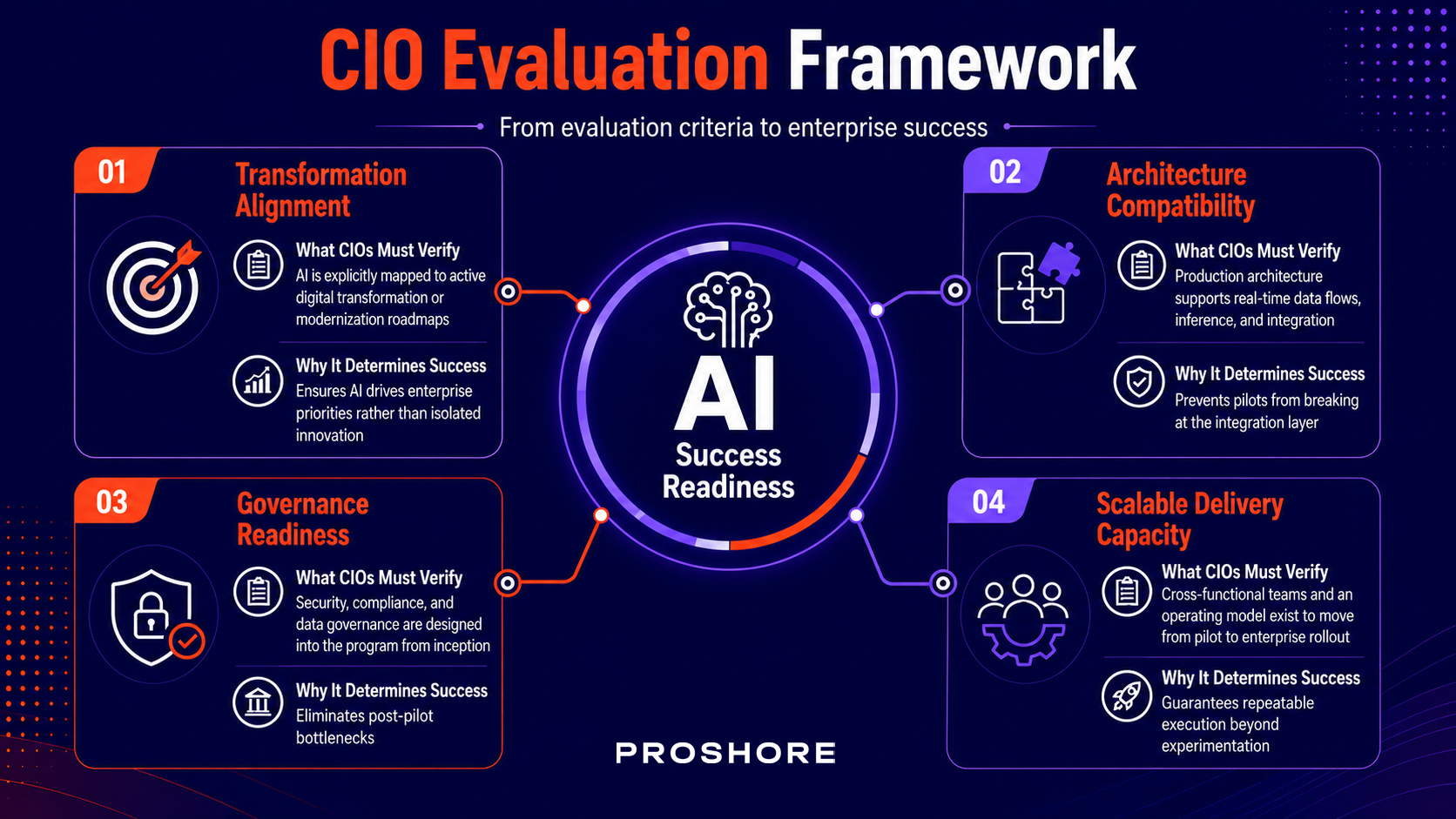
What CIOs Should Look for in AI Programs
CIOs must evaluate AI programs through systems and governance alongside technology considerations.
The central question should often not be “Should we invest in AI?” but “Can our enterprise systems support AI at scale?”
Proshore’s Role in Enterprise AI Execution
Proshore addresses the structural causes that prevent AI pilots from scaling by designing every implementation as a production system from the outset.
Instead of developing isolated models, Proshore integrates AI directly into enterprise workflows, data pipelines, and governance frameworks, ensuring alignment with transformation programs and core architecture.
At the same time, in Proshore AI is not only deployed within products but leveraged across the entire software development lifecycle.
Requirements are defined faster using AI-assisted interpretation and clear acceptance criteria. Prototyping and refinement cycles move quickly through rapid iteration and visualization, reducing back-and-forth and helping teams reach workable solutions sooner.
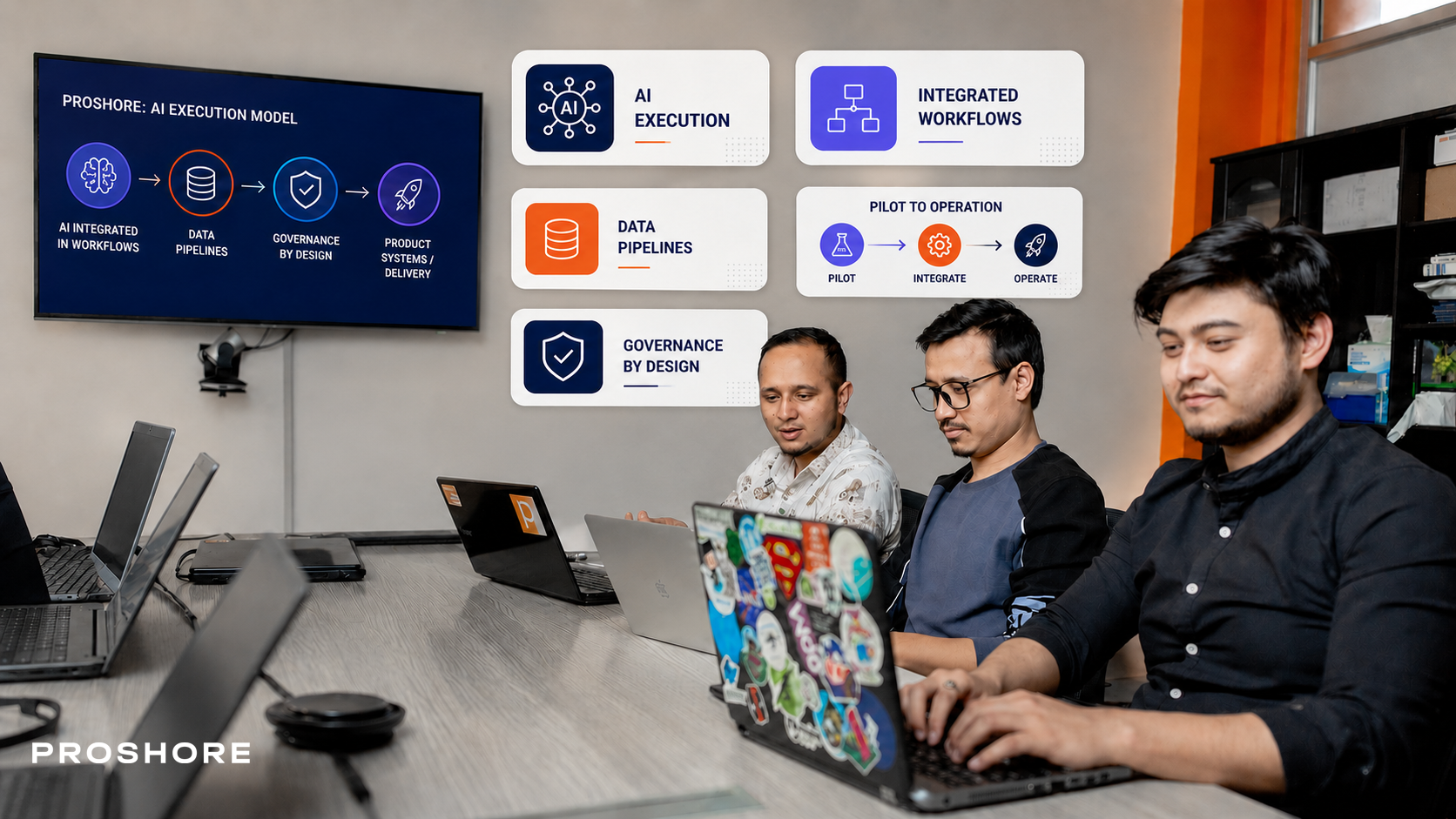
Crucially,Proshore operates within enterprise constraints. Private AI environments, DORA-aligned practices, and internal data standards are built into delivery from the start, ensuring compliance and consistency.
Prompt and context optimization keep costs predictable while maintaining performance across managed AI systems.
In practice, this approach is reflected in projects such as MerchPIM, where AI is embedded into product data workflows.
This enables enterprises to scale data quality and consistency across systems without creating parallel processes or manual dependencies.
Proshore aligns ownership, integrates with existing systems, and embeds governance in execution from the outset, preventing fragmentation and deployment bottlenecks that stall AI initiatives.
Conclusion
AI becomes valuable when it transitions from experimentation into operational capability.
The organizations that succeed are those that stop celebrating isolated pilots and start treating AI as an enterprise systems problem.
By aligning AI with transformation programs, addressing architecture and governance as first principles, and building repeatable execution models, CIOs can move beyond pilot purgatory and deliver the enterprise value their investments were always intended to create.
The technology is not the constraint. The operating model is.


Product development takeaways
How Proshore brought AI assistance into interviewstream
When interviewstream saw a chance to use AI to enhance the interview process in a positive and ethical way, they turned to our remote dev team.
Book a call
Talk to Jeroen, our Accounts director, to see if our ready-to-code dev teams are a fit for you.
Recruitment platform, interviewstream, has a strong suite of tools to simplify the hiring process and optimize the candidate experience. They also have a pre-existing partnership with Proshore.
So when interviewstream’s forward-thinking CTO, Ryan Royal, saw an opportunity to use AI to enhance the interview process in a positive and ethical way, he turned to Proshore to help ideate, iterate, and launch new functionality – in a matter of weeks. Here’s how it happened.
Proshore had a quality approach and a good philosophy about development, and about providing development services. We felt they were really trying to understand our needs, and expressed that back to us.
Faith Peterson, interviewstream
Principal Product Manager

How to introduce AI in recruitment without enforcing bias?
Right now, almost everyone in the tech world and beyond is talking about ChatGPT and the use of AI in general. There’s no question that it’s going to be a game-changer. The question is: how are companies going to use it ethically, and to their advantage?
This dilemma is especially true in the recruitment industry, where legislation introduced in the state of New York in 2023 prohibits the use of automated employment decision tools (AEDTs) unless a bias audit has been conducted. That’s to avoid unintended bias as a result of machine learning (ML).
At the same time, recruitment is first and foremost a people business. Technology needs to support and enhance human expertise, and not diminish or try to replace it. For these reasons, introducing AI into the recruitment process requires careful consideration and execution.
Ryan Royal and the team at interviewstream had been looking at the potential of AI for some time. However, due to their product’s focus on the screening and evaluation of candidates, they wanted to ensure that any new AI feature did not introduce or reinforce bias in that process.
What they needed was AI-driven functionality that could add value for recruiters but avoid some of the pitfalls associated with its use in recruitment. That’s when Ryan pitched the idea of AI-generated interview questions.
Playing around with ChatGPT, Ryan and Principal Product Manager, Faith Peterson, sketched out an idea for the new feature. All they need was a highly-skilled and experienced development team to build it.
Proshore had a quality approach and a good philosophy about development, and about providing development services. We felt they were really trying to understand our needs, and expressed that back to us.
Faith Peterson, interviewstream
Principal Product Manager
AI interview question assist feature
It was important for interviewstream that when they brought in AI functionality it had an obvious benefit to their customers, it was aligned with their company values, and also met the highest ethical standards. And this use case fitted the bill.
At the time, Proshore’s development team as a service was the only one working on enhancements to interviewstream’s core platform. It’s a role that gave them total responsibility for the new capabilities of interviewstream’s customers. That naturally grew to encompass the new AI Interview Question Assist feature.
When the partnership first began, the Proshore team was used to quickly adapting to changing priorities and business needs. And they were genuinely excited to get started on the new AI feature. Right away, they conducted an initial evaluation and started experimenting with the OpenAI API.
When Faith said interviewstream wanted to add AI functionality, the whole team were really excited. The enthusiasm level was high!
Viraj K. Shrestha, Proshore
Scrum Master

To make innovative use of AI within interviewstream the Proshore development team needed to learn new skills and knowledge – which they did. In fact, every person on the development team – Santosh, Anand, Madhusudhan and Shyam – put time into the research, going through the documentation to discover the best ways to build out the functionality. This gave everyone on the team their own perspective, so they could help each other and quickly generate solutions to any issues that arose.
During the development phase, there was a strong collaboration between interviewstream’s Product Owner and the Proshore team. Within a couple of days, Proshore had a proof of concept. From there, it was a case of working on how to best express the functionality. Working alongside interviewstream, the Proshore team iterated on the fundamental idea of giving users guidance on prompt construction for the AI in order to generate usable, targeted interview questions. The output was ten targeted questions for recruiters to add to a question bank, or include in their next interview.
Thanks to Proshore, it took just three weeks to go from ideation to production. That’s largely because the team were able to quickly adapt, quickly understand the tech, quickly implement the proof of concept, then quickly establish and iterate on user interface (UI) ideas.

How Proshore's dedicated team, with PHP experts, handled the UI improvements and UX enhancements required by interviewstream's product – a feature-rich platform operating since 2002.
Read case study
Our CEO and Sales team were thrilled. They made a big announcement and included AI Interview Question Suggest in our new feature round-up. Proshore followed up in just one more sprint to release a feature update with more cues and improved functionality around results. It was all the iteration and partnering I hope for when working in classic ‘big A’ Agile style.
Faith Peterson, interviewstream
Principal Product Manager
Continually improving the AI feature
As a result of their partnership with Proshore, interviewstream has a new AI-driven feature that’s available to customers. As interviewstream continues to iterate on the functionality, Proshore team members, including Web Developer, Santosh Pandey, bring new ideas to the table.
One of those ideas was to add ‘request history’ so that recruiters can make use of previous requests – without having to save or download AI-generated content. The team has also added download and clipboard functionality, making it easier for recruiters to incorporate the content into their interview processes.
As the partnership continues, there’s strength in collaboration. Together, interviewstream and Proshore are taking the business problem and combining ideas from the product management, and the developers to create the best possible solution.
Off the back of the success of AI Interview Question Assist, interviewstream is looking for further opportunities to ethically incorporate other AI functions into its offering, with the expertise of a Proshore development team as a service.
Something I’ve really come to value about the Proshore team is that they really bring creativity to the table.
Faith Peterson, interviewstream
Principal Product Manager
Looking for a highly skilled and cost-effective offshore software development team? Book a call.


Mobile App Development
Streamlining Flutter iOS Deployment: A Guide to CI/CD with Azure Pipelines
In today’s fast-paced mobile app landscape, delivering high-quality software quickly is non-negotiable. For Flutter developers, Continuous Integration and Continuous Deployment (CI/CD) is a game-changer that automates builds, tests, and deployments to ensure seamless releases.
Book a call Talk to our Accounts director, Jeroen, to see if our ready-to-code offshore teams are a fit for you.
At Proshore, a leading offshore software development firm in Nepal, we’ve seen firsthand how CI/CD transforms workflows—thanks to experts like Rajendra Shrestha, a senior Flutter developer on our team.
Rajendra recently shared his technical insights in a detailed article on Medium, breaking down how to deploy Flutter iOS apps to TestFlight using Azure Pipelines.
In this guide, we’ll expand on Rajendra’s expertise, blending his hands-on experience with Proshore’s proven strategies to help you master CI/CD—whether you’re a developer refining your craft or a business seeking scalable solutions.
Why CI/CD for Flutter?
Flutter’s cross-platform prowess is undeniable, but as Rajendra emphasizes, “even the most elegant codebase can falter without a reliable release process.” Here’s why CI/CD matters:
- Automation: Eliminate manual build/test/deploy tasks.
- Consistency: Reduce human error with standardized workflows.
- Speed: Release updates faster to stay ahead of competitors.
- Collaboration: Enable smoother teamwork with integrated feedback loops.
For businesses, CI/CD isn’t just a technical nicety—it’s a strategic advantage. Offshore teams like Proshore use these pipelines to deliver predictable, high-quality results across time zones. As Rajendra puts it, “Automation isn’t just about speed—it’s about trust. Clients know their releases will happen like clockwork.”
Azure Pipelines: A Perfect Match for Flutter
Microsoft’s Azure Pipelines offers a flexible, cloud-native solution for CI/CD. Rajendra, who has configured dozens of pipelines for Proshore clients, highlights the key benefits:
1
Cross-Platform Support
Build iOS, Android, and web apps from a single pipeline.
2
Scalability
Handle projects of any size with parallel jobs.
3
Integration
Works seamlessly with GitHub, Azure Repos, and other tools.
4
Cost-Effectiveness
Free tiers for small projects and pay-as-you-go pricing.
1
Cross-Platform Support
Build iOS, Android, and web apps from a single pipeline.
2
Scalability
Handle projects of any size with parallel jobs.
3
Integration
Works seamlessly with GitHub, Azure Repos, and other tools.
4
Cost-Effectiveness
Free tiers for small projects and pay-as-you-go pricing.
“Azure’s flexibility lets us tailor pipelines to each project’s unique needs,” Rajendra notes. At Proshore, we’ve leveraged Azure Pipelines to streamline deployments for startups and enterprises alike.
Step-by-Step: Deploying Flutter iOS Apps to TestFlight
Let’s break down how Azure pipelines work for Flutter iOS apps with insights from Rajendra’s playbook.
1️⃣ Prepare Your Environment
a
Apple Developer Account
Ensure you have an active account and App Store Connect access.
b
Code Signing
Generate an Apple Distribution Certificate and Provisioning Profile. Let’s break down how it works for Flutter iOS apps.
c
Repository Setup
Host your Flutter project on Azure Repos, GitHub, or Bitbucket.
2️⃣ Configure Azure Pipeline
a
Create an azure-pipelines.yml file
b
Define your pipeline stages
Here’s a simplified snippet:
trigger:<br> - main<br>variables:<br> - iosVmImage: 'macos-latest'<br> - flutterVersion: '3.24.0'<br> - archivepath: 'build/ios/archive/Runner.xcarchive'<br> - runnerAppPath: 'build/ios/archive/Runner.xcarchive/Products/Applications/Runner.app'<br> - builtAppPath: 'build/ios/ipa'<br> - exportPlistPath: 'exportOptions.plist'<br> - PROVISIONING_PROFILE_UUID: 'xxxxxxxx-xxxx-xxxx-xxxx-xxxxxxxxxxxx'<br> - SIGNING_IDENTITY: 'Apple Distribution: account_name (team_id)'<br> - appIdentifier: 'com.xxxxxx.xxxxx'<br> - teamId: 'xxxxxxxxx'<br> - artifactName: 'release_artifact_name'<br> - appStoreServiceConnectionName: 'apple_service_connection_name'<br> - appSpecificAppleId: 'xxxxxxxxxx'<br> - buildFlavor: 'Production' #Optional<br> - entryPoint: 'lib/main_prod.dart' #Optional<br>steps:<br> - task: InstallAppleCertificate@2<br> inputs:<br> certSecureFile: 'your-certificate.p12'<br> certPwd: $(certificate_password)<br> - task: InstallAppleProvisioningProfile@1<br> displayName: Install provisioning file<br> inputs:<br> provisioningProfileLocation: 'secureFiles'<br> provProfileSecureFile: 'your-provision.mobileprovision'<br> - task: FlutterInstall@0<br> inputs:<br> mode: 'auto'<br> channel: 'stable'<br> version: 'custom'<br> customVersion: $(flutterVersion)<br> - task: FlutterCommand@0<br> displayName: 'Run Flutter diagnostics'<br> inputs:<br> projectDirectory: '.'<br> arguments: 'doctor -v'<br> - task: FlutterBuild@0<br> inputs:<br> target: 'ipa'<br> buildFlavour: $(buildFlavor)<br> entryPoint: $(entryPoint)<br> extraArgs: '--no-codesign'<br> - script: |<br> security cms -D -i ~/Library/MobileDevice/Provisioning Profiles/$(PROVISIONING_PROFILE_UUID).mobileprovision > decoded.plist<br> plutil -extract Entitlements xml1 -o Runner.entitlements decoded.plist<br> chmod +x generate_export_plist.sh<br> ./generate_export_plist.sh $(PROVISIONING_PROFILE_UUID)<br> codesign --entitlements Runner.entitlements -f -s "$(SIGNING_IDENTITY)" $(runnerAppPath)<br> xcodebuild -exportArchive -archivePath $(archivepath) -exportPath $(builtAppPath) -exportOptionsPlist $(exportPlistPath)<br> displayName: "Sign ipa"<br> - task: CopyFiles@2<br> displayName: 'Copy app to staging directory'<br> inputs:<br> sourceFolder: '$(Agent.BuildDirectory)'<br> contents: '**/ipa/*.ipa'<br> targetFolder: '$(Build.StagingDirectory)'<br> flattenFolders: true<br> - task: PublishBuildArtifacts@1<br> displayName: 'Publish IPA file'<br> inputs:<br> PathtoPublish: '$(Build.ArtifactStagingDirectory)'<br> artifactName: $(artifactName)<br> publishLocation: 'Container'<br> - task: AppStoreRelease@1<br> inputs:<br> serviceEndpoint: 'Deheus App Store Connect Key'<br> releaseTrack: 'TestFlight'<br> appIdentifier: $(appIdentifier)<br> appType: 'iOS'<br> ipaPath: '$(Build.ArtifactStagingDirectory)/**/*.ipa'<br> appSpecificId: $(appSpecificAppleId)<br>
3️⃣ Handle Code Signing Securely
Azure’s secure file storage and variable groups keep sensitive data (like certificates) encrypted. Rajendra’s advice: “Automate certificate installation with the <InstallAppleCertificate> task—it’s saved us hours of debugging.”
4️⃣ Deploy to TestFlight
The AppStoreRelease task uploads the .ipa file to App Store Connect. “Monitor builds in Azure’s dashboard,” Rajendra suggests. “Clients love it when they can track progress on a dashboard without touching Xcode.”

Meet the Expert
Rajendra Shrestha, Senior Flutter Developer
With over 5 years of experience in cross-platform development, Rajendra specializes in CI/CD pipelines and DevOps automation. When he’s not streamlining deployments, he mentors junior developers and writes technical guides for the Flutter community.
Want more detailed steps on deploying iOS apps?
Common Challenges & How We Solve Them
Even with automation, pitfalls can arise. Here’s how Rajendra and his team tackle them:
- Certificate Issues: “Mismatched profiles halt pipelines,” Rajendra fix, “Implement monthly audits and use Azure’s secret rotation to avoid expiry surprises.”
- Flutter Version Conflicts: “Sync pipeline and local SDKs religiously,” he advises.
- Long Build Times: Optimize with dependency caching. Rajendra’s hack: “Cache the .pub-cache folder—it cuts a client’s build time by half.”
As an offshore partner, we help clients navigate these hurdles through offshore development teams with experts like Rajendra who know the ins and outs of mobile app development and deployment.
Why Partner with an Offshore Flutter Team in Nepal?
Choosing a Nepalese offshore team like Proshore offers unique advantages:
- Cost Efficiency: High-quality output at competitive rates.
- Skilled Talent: Nepal’s growing tech ecosystem produces top-tier Flutter developers.
- Time Zone Synergy: Overlap with European and Asian markets for real-time collaboration.
Implementing CI/CD for Flutter with Azure Pipelines isn’t just about automation—it’s about building a foundation for scalable, stress-free app development. Whether you’re a solo developer looking to optimize your workflow or a business seeking a reliable offshore partner, Proshore is here to help.
Save big on development costs with our end-to-end Flutter & CI/CD solutions. Let’s build your next app!

Like any construction project, coding platforms need a blueprint and a structure – an architecture – that enables projects to take shape. Microservices are a popular style of architecture for web apps. Here at Proshore our web developers are experts in using the open source, web app framework Laravel to build microservices.
Why microservices?
Before we dive into what makes Laravel and Proshore a great combination for building microservices, let’s explore why microservices might be a good fit for your software product.
In the microservices approach to software architecture, an application is built from a number of small, independent services that communicate with each other through Application Programming Interfaces (APIs). With microservices, each individual service is designed to perform a specific business function. When you think about it, the structure of microservices reflects the structure of most modern businesses.
Take online retailers as an example. They’re formed of separate services – sign-up, order processing, picking and packing, payment processing, delivery, and so on. From a business perspective, if one person tried to handle all of those things it would become slow, inefficient, and error-prone. As the numbers increase, it also becomes unscalable.
What works much better is when certain tasks are handled by Person A and others by Person B, and so on. It’s the same with microservices. Small independent tasks are handled by different services. For instance, authentication is handled by one different service, and language translations by another.
Microservices can work for web apps of all sizes. Discover how smaller dev teams can implement microservices without a container orchestration system – such as Kubernetes – in our blog on how to scale microservices.
Why not monolith?
The alternative to microservices is monolith architecture. That’s when developers build everything in a single codebase.
Think of a monolith as a single building housing everything. That works for some business models – a grocery store, for example. Different product departments can be comfortably housed under the same roof – it’s a one-stop shop.
But imagine if you tried to build a house that accommodated all of your family’s needs in one building. You’d need a living space, a workspace, a school, a hospital, a grocery store… the list goes on. It would be almost impossible. The solution? Divide the building.
When you need medical attention, you visit a doctor’s surgery or hospital rather than have those things in your own home. It’s the same for microservices. Large-scale development projects can grow too large for a single codebase. So we divide and conquer.
Discover more reasons for choosing microservices over monolith in our blog on what we’ve learned from helping clients make that journey.
Why we use Laravel PHP framework?
Laravel is a popular PHP web application framework. There are many reasons why our developers choose to work in Laravel:
How Proshore developers use Laravel
Here at Proshore, we have over 9 years of experience in working with Laravel. We’ve even established our own in-house team of Laravel experts. Here’s how we use it:
- In our case, most communication to and fro from microservices is done through API. Laravel makes it much easier and faster to build Rest API.
- On the development side, the Laravel container and dependency injection make it way easier to work with repositories. We use the repository pattern for ease of switching and better coding standards.
- With huge volumes of interrelated data, relationships start to become complicated, Laravel’s ORM makes database interaction and data manipulation much more streamlined.
- We prefer to create independent features which are easier to develop and test. Laravel by itself allows us to separate features i.e. make them independent.
- Laravel has a modular structure that is well-suited to building microservices. Using a repository pattern requires a module to be independent which is well suited as Laravel has an built-in modular structure.
- Laravel is well-documented and that enables better coding standards. Any functionality added can be documented easily based on the standards stated in the documentation that includes the tests that we write or the feature that we add.
Looking for a more specific Laravel service? Proshore can help
Tell us more about your project requirements and receive customized recommendations via email or over a 15-minute consultation call.
Contact us
When to use microservices?
Microservices won’t suit every development project. A common use case is when software has a lot of separate yet related services. Imagine a scenario where you have multiple user types logging into multiple services, each with a different role and responsibilities.
Each of those services might then have language translations. Plus, each of those services might belong to a different role – some managed internally, some externally. To manage all of these things in one codebase would be quite chaotic, and disruptive to services.
Here are some other scenarios where microservices architecture might make sense:
You need scalability
Microservices enable individual services to be scaled independently, optimizing resource allocation and ensuring efficient performance based on specific service requirements.
You need agility and flexibility
Microservices architecture allows for independent development, deployment, and updates of services, providing agility and flexibility in responding to changing business needs.
You need a range of technologies
Microservices permit the use of diverse technologies for different services, allowing teams to select the most appropriate tools for each specific business function.
You need to separate out functionality
Microservices promote the segregation of functionalities, with each service focused on a specific business capability, leading to clearer architectural boundaries and easier maintenance.
You need faster testing and feedback loops
Microservices support improved testing by enabling isolated testing of individual services, facilitating quicker feedback loops, and enhancing the overall reliability of a system.
Build better microservices with Proshore
With thousands of ready-to-code developers, Proshore has the tech talent you need in multiple front-end and back-end programming languages, including Laravel.
Need an entire self-managed dedicated development team? Looking to augment your existing capabilities with highly-skilled IT professionals? Here at Proshore, we can put together the right solution for you – whether you’re working with microservices or monolith architecture.
Discover how much you could save by hiring PHP developers from Proshore without compromising on coding quality. Book a call for a free consultation with our Accounts Director and a customized proposal along with quotation.

The benefits of deploying microservices over traditional monolith architecture are well known – they’re much easier to scale, and more resilient if one service fails. This begs the question: is there still a place for monolith architecture?
The short answer is ‘yes’. As we mentioned in our previous post on migrating clients from monolith to microservices – for some companies, microservices are not always the best fit for their needs. In fact, a ready-to-code development team from Proshore recently helped a client, Psyflix, migrate a set of microservices to a single server to optimize their streaming platform.
Here are 5 reasons why companies might choose monolith architecture over microservices.
1️⃣ Keep development costs down
With microservices, you need a full-stack team to manage them effectively – something unfeasible for many startups. Without a dedicated team, microservices can easily spiral out of control, whereas monolith architecture can be easily handled by a single developer.
Building out microservices in a system like Kubernetes is expensive, and an unnecessary outlay when a product doesn’t yet have high volumes of users. With one or two thousand users, a single server is a viable option. A single codebase is also much easier to develop without the need to bring in a range of coding expertise. That makes monolith architecture ideal for early-stage startups with limited resources.
2️⃣ Faster development and testing
Running different microservices at the same time automatically makes them more complex to manage and maintain. Without proper management, having multiple teams responsible for different microservices, development and debugging can slow down.
As monolith architecture uses a single executable file, it’s much quicker to test and deploy. That makes end-to-end testing much faster, and because it’s a single codebase, development, and debugging are also much more straightforward.
3️⃣ Minimize disruption to services
With microservices, if there are issues with one part of the system, then other features can usually still run unaffected. One drawback of monolith architecture is that if something goes wrong – a single error might impact other parts of the system. However, there is a robust workaround.
Developers working in monolith architecture can overcome disruptions to a service by deploying a technique known as Server Side Generation (SSG). This hybrid approach is a combination of Server Side Rendering (SSR) and Client Side Rendering (CSR).
What it effectively does is generate static HTML pages that incorporate client-side JavaScript, so a page can be updated as and when needed. This means that, for example, if a user has begun watching a video and there’s an issue elsewhere – their viewing stream continues uninterrupted.
4️⃣ Scalability is still a possibility
Microservices are great for scaling businesses that need the ability to scale specific components up or down based on user demand. But to a certain extent, this is also possible with monolith architecture.
For example, you might initially combine 4 or 5 core microservices onto a single server in a monolith architecture. Additional microservices could be added and connected to it and scaled as needed by adding more containers.
5️⃣ Optimize resources to meet demand
What a software product offers users, the features used most frequently, and the frequency of use all impact what’s needed to ensure a smooth and seamless user experience.
If you’re dealing with a few thousand users who use a limited number of features – such as watching videos or downloading materials – for short periods of time, monolith architecture might be the best match for your needs. This will also save you unnecessary costs associated with building and maintaining multiple microservices.
Further down the line, when you’re running into millions of users around the world, splitting your product into microservices makes more sense, as famously demonstrated by the streaming giant Netflix. The beauty of monolith architecture is that both user capacity and cost are good indicators of when the time is right for microservices.
Making the case for monolith
It’s tempting for startups to jump straight into microservices without fully appreciating the potential advantages – including cost-savings – of monolith architecture. Development, deployment, and debugging can all be much more straightforward and easy to manage in monolith. On top of that, fewer APIs are needed to connect particular functionality.
For companies with a rapidly growing user base – from tens to hundreds of thousands of users in a short space of time, monolith probably isn’t the right choice. But for early-stage startups with limited resources and uncertainty about their rate of expansion, monolith gives them a solid starting point.
The good news for companies starting on the wrong path, the migration back from microservices to monolith architecture is not as painful as you might think. In our experience, there’s around a day of downtime.
With a ready-to-code development team from Proshore, you can also rest assured that when it’s the right time to make the move to microservices – we have the skills and experience to ensure a smooth transition.
In fact, we make it easy to switch back to microservices should you need to scale up in the future. For more on this, see our posts on making the move from monolith to microservices and how to scale microservices without using Kubernetes.

From monolith to microservices: What we’ve learned from helping clients make that journey
How to scale microservices without using Kubernetes
Discover how Proshore’s dedicated teams can support your migration to and from monolith and microservices – book a call.


Development services on-demand
The pros and cons of IT offshore outsourcing
Let's take a look at IT offshore outsourcing pros and cons to help you make an informed business decision about outsourcing offshore.
Talk to Jeroen, our Accounts director, to see if our outsourcing services are a fit for you.
IT offshore outsourcing is a cost-effective option for companies looking to access specialized skills and improve operational efficiency. The alternatives are to hire people in-house or outsource work to an onshore company.
Both of these can be expensive, especially for early-stage startups looking to scale. In this blog, we define offshore outsourcing and explain its pros and cons to help you make an informed business decision.
What is offshore outsourcing in IT?
IT offshore outsourcing is when a company or organization contracts out various technology functions, tasks, or services to external service providers located in different countries or regions. These service providers can be individual freelancers, specialized IT firms, or large outsourcing companies.
Offshore outsourcing has clear benefits – such as cost reduction and access to a broader talent pool – but it also comes with its own challenges – like communication barriers due to language and timezone. Here’s our list of offshore outsourcing pros and cons.
The pros of offshore outsourcing
Choosing the right partner for IT offshore outsourcing can help you minimize the risks, and maximize the benefits. Get it right, and you can enjoy the following benefits:
1
Reduced labor costs
One of the primary benefits of offshore outsourcing is the potential for significant cost savings. Labor costs are often lower in countries with lower living expenses, allowing companies to achieve similar or better results at a fraction of the cost compared to hiring locally.
2
A skilled workforce
Offshore locations often have a large pool of skilled and qualified IT professionals, including software developers, designers, and QA engineers. This provides businesses access to a diverse range of specialized talents that may not be available locally.
3
24/7 operations
Offshore outsourcing can enable round-the-clock operations. With teams working in different time zones, this can lead to faster project completion, reduced time-to-market, and enhanced customer support services.
4
Optimized resource allocation
By outsourcing non-core IT functions offshore, companies can redirect their resources, time, and attention to core business activities, strategic planning, and innovation to help gain a competitive advantage over the rest of their market.
5
Scalability and flexibility
Outsourcing IT operations offshore allows businesses to scale up or down in response to changing market conditions or project requirements without the need for extensive internal hiring or layoffs.
6
Reduced exposure to risk
By dispersing IT operations across different geographic locations, companies can mitigate talent shortages or changes in technology. Diversification helps protect businesses from localized disruptions.
7
Technological advancements
Offshore IT companies usually invest in the latest technologies and infrastructure to stay competitive. So partnering with a reputable provider gives you access to cutting-edge tools and expertise without significant upfront costs.
8
Accelerated timelines
A larger workforce working in different time zones can expedite project delivery, reduce development cycles, and bring products and services to market faster.
9
Global regulatory knowledge
Reputable providers of IT outsourcing are familiar with local and international regulations. This expertise can be invaluable in ensuring compliance with data protection laws and industry-specific regulations.
10
More room for innovation
Offloading routine tasks to offshore IT teams means employees can focus on creative and strategic tasks that drive the innovation that is crucial for long-term business growth.
11
Improved service levels
Offshore providers are motivated to maintain high service levels to secure long-term partnerships. This can lead to improved service quality and customer satisfaction.
The cons of offshore outsourcing
There are risks associated with every form of outsourcing. With IT offshore outsourcing, those risks are often very manageable compared with the benefits, as you can see from this list:
1
Differences in language and culture
One of the primary benefits of offshore outsourcing is the potential for significant cost savings. Labor costs are often lower in countries with lower living expenses, allowing companies to achieve similar or better results at a fraction of the cost compared to hiring locally.
2
Quality concerns
Maintaining consistent quality levels can be a challenge when overseeing outsourced offshore teams. Variations in standards and a lack of direct control might result in subpar deliverables.
3
Coordinating schedules
Operating in different time zones can lead to delays in response times and project management. Synchronizing work schedules and meetings might be tricky, impacting project timelines.
4
Data protection risks
Offshoring IT tasks may involve sharing sensitive data and Intellectual Property with third-party providers. It’s important to take extra precautions to safeguard proprietary information.
5
Reduced oversight
You may have limited visibility over the day-to-day activities of offshore teams. This lack of transparency can make it challenging to monitor progress and address issues promptly.
6
Unforeseen expenses
While IT offshore outsourcing can seem cost-effective, hidden expenses – such as additional project management costs, legal fees, or travel expenses for on-site visits – can arise.
7
Overdependence on one vendor
Over-reliance on an IT offshore outsourcing vendor can pose a risk if the vendor encounters financial troubles, changes business strategies, or experiences disruptions.
8
Legal and regulatory obligations
Varying legal and regulatory landscapes across countries can create complications and compliance issues, especially in industries or regions with strict regulations.
9
Reduced internal knowledge
Outsourcing core IT functions can result in a loss of in-house expertise. Over time, this may limit a company's ability to innovate and respond to changing business needs.
10
Initial transition complexity
The transition phase of outsourcing can be complex, requiring significant time and resources to establish effective working relationships and processes with offshore teams.
Reduce costs and increase tech talent
IT offshore outsourcing is the default choice for companies located in countries with a high cost of living and a lack of local tech talent. Offshoring enables these businesses to reduce their labor costs – a financial benefit that directly boosts profitability.
Offshore outsourcing also gives companies access to a global talent pool, and specialized IT expertise that may be in high demand or simply unavailable in some regions. It also mitigates localized risks and accelerates time-to-market, helping to increase competitiveness and customer satisfaction.
However, it’s important to evaluate and mitigate potential disadvantages to ensure IT offshore outsourcing adds value to your business. Developing a thorough outsourcing strategy, selecting the right offshore partners, and maintaining open communication are crucial steps to achieve successful outsourcing outcomes.
Co-located in the Netherlands and Nepal, Proshore is a trusted provider of IT offshore outsourcing solutions to companies all over the world. Consult how much you could save – compared with hiring in-house or outsourcing onshore – by getting on a call with our outsourcing expert.

With the rise of nearshore vs. offshore outsourcing, choosing the correct option for your needs can be a challenge. Making the right choice depends on a number of factors, including budget, timezone, and the technical requirements of your software build.
In this blog, we will explore the key differences between nearshore and offshore outsourcing, examining the advantages and challenges of each approach.
Nearshore Outsourcing
Nearshore outsourcing means a company contracts software development to a service provider in a neighboring or nearby country in the same time zone.
For example, if a small tech company in the United States needs help building an app, contracting a service provider from Mexico is nearshore development.
You might be wondering why companies choose nearshore development when there are other options like onshore and offshore outsourcing.
The primary reason is to leverage geographical proximity, cultural alignment, and time zone compatibility while reducing operational costs.
Let's look into these benefits of nearshore outsourcing.
Benefits of Nearshore Outsourcing
1. Time zone alignment
Most nearshore locations operate within 0-3 hour time differences. This means when a US-based project manager starts their day at 9 AM, their nearshore team in Mexico is already engaged or just beginning their workday.
This synchronization enables real-time collaboration, immediate problem-solving, and seamless communication that feels as natural as working with a team in a neighboring city rather than a different country.
2. Cultural and Geographical Proximity
Cultural proximity creates an environment where true collaboration can flourish. Teams share similar business values, communication styles, and professional expectations.
Geographical proximity offers reduced travel costs and short flight times, meaning companies can maintain closer relationships with their development teams. The face-to-face meetings become a viable regular occurrence rather than an annual event.
3. Cost-effectiveness
While nearshore outsourcing commands higher rates than their offshore counterparts, they still offer significant cost advantages compared to domestic hiring.
A senior developer in cities like Mexico or Buenos Aires typically commands a 40-60% lower salary than their US counterpart.
4. Regulatory compliance
Many nearshore countries have aligned their legal frameworks with US and European standards, offering robust intellectual property protection and data privacy regulations.
Working with nearshore partners means operating within familiar legal frameworks and a shared understanding of compliance requirements.
This regulatory alignment is valuable for highly regulated industries like healthcare, finance, and technology companies.
5. Quick travel access
The ability to reach your development team within hours rather than days transforms the nature of the nearshore partnership.
The ease of travel, simpler visa processes, and reasonable costs mean companies can maintain closer oversight of their projects without the logistical complexity associated with offshore outsourcing.
When a critical situation arises, project managers can be on-site, maintaining project momentum and addressing challenges face-to-face.
The challenges of nearshore outsourcing
While nearshore outsourcing offers various advantages, it's essential to understand its limitations and challenges.
1. Higher costs
When compared to offshore, nearshore outsourcing commands higher rates. For example, a senior developer in Mexicy or Argentina costs around $35000 - $55,000; however, their counterpart in Nepal or India costs $20,000 - $30,000.
This price difference can be crucial for large-scale projects building extensive teams.
2. Limited talent pool
Unlike massive offshore hubs like India, China, and Nepal, nearshore destinations have smaller talent pools.
This limitation becomes particularly challenging when companies need specialized skills or want to scale rapidly, often leading to increased competition for top talent.
3. Growing but immature market
The nearshore outsourcing market, especially in Latin America, is relatively young compared to traditional offshore destinations, lacking decades of experience and refined processes.
This can manifest in less standardized project management approaches and fewer established best practices.
4. Retention challenges
Proximity to the US market means nearshore developers have easier access to US job opportunities.
Companies often find themselves competing not just with local firms but with US employers offering remote positions, leading to higher turnover rates and increased salary pressures.
Offshore Software Outsourcing
Offshore outsourcing means a company hires another company or individual to do software work in a different part of the world. This is done in different ways:
- Contracting a single developer based overseas.
- Hiring an offshore software development team.
- Employing an offshore software company that provides individual developers or a team with relevant skills.
Recommended reading: Everything you need to know about offshore software development.
The benefits of offshore outsourcing
1. Cost savings
Offshore teams in regions with lower living costs can offer significantly lower labor costs.
2. Broader talent pool
Offshore outsourcing taps into the global talent market, providing companies with a much larger pool of software developers. This allows companies to find teams with specialized skills.
3. Faster development
Locating offshore teams in different time zones can enable "24-hour" work models. Get it right, and you will drastically reduce your time to market.
4. Flexibility in scaling
Offshore providers can more easily scale their teams up or down to accommodate changing project needs. This can benefit companies with seasonal spikes in development needs.
5. Mature business processes
With decades of expertise in global outsourcing, offshore destinations like India and Nepal have developed sophisticated business processes and delivery models. This translates to more predictable outcomes and fewer operational hiccups.
6. Specialzied expertise
Many offshore companies have developed strong specializations in certain technologies. For example, Proshore's offshore team specializes in Laravel development, offering companies the best in the business of Laravel developers.
Recommended reading: Hiring benefits of offshore software development company.
Challenges of Offshore Outsourcing
With all those benefits, it seems like offshore outsourcing can be a clear choice over nearshore. However, offshore outsourcing also has some challenges.
1. Time zone differences
The time zone gap is the biggest challenge in offshore outsourcing. With typical differences of 8-12 hours between the US and offshore destinations like India or Nepal, real-time collaboration becomes a challenge.
2. Cultural and communication barriers
Cultural and language differences can make communication and collaboration more challenging. Different work styles, subtle humor, and cultural references often get lost in translation, making it harder to build strong team relationships.
3. Quality control challenges
The physical distance makes it difficult to monitor development processes. Issues might not be caught until later in the development cycle, leading to costly fixes.
Also, keeping costs low can lead to juniors being assigned to tasks requiring more experience.
4. Intellectual property risks
Offshore locations may have a less robust legal system for intellectual property protection. This may invite risks like IP theft or unauthorized use.
5. Travel and face-to-face meetings
The logistics of in-person meetings become significantly more challenging with offshore teams. One visit typically requires 15-20 hours of travel time, $2000 - $3000 travel cost, extensive jet lag, and complex visa processes.
5. Regulatory compliance concerns
Ensuring compliance with local laws can be more complex when dealing with offshore teams.
Nearshore vs offshore outsourcing: Which one is for you?
Choosing between nearshore or offshore outsourcing depends on your business needs and strategic priorities.
Nearshore outsourcing is best for those who want regular visits to their team, more control over their outsourcing, and don't want to worry about regulatory compliance.
Offshore development is best for those who want specialized skills at an affordable price to bring their product to the market faster.

Hiring top tech talent is tough and expensive. That’s why more companies are choosing offshore software development companies to accelerate growth and deliver exceptional results faster and smarter.
Working with the right offshore software team can truly make a difference. You gain skilled developers, modern technology, and flexible work methods at a lower cost.
However, it’s not only about saving money. A good offshore partner becomes part of your team. They understand your vision, work in a similar way, and help you create software that pushes your business forward.
Offshore Software Development Company
Skyrocketing developer salaries and endless recruitment cycles are pushing more companies to explore offshore software development as a strategic solution.
By partnering with offshore development companies, organizations can access skilled tech talent worldwide at competitive rates.
In this article, we will dive into our carefully curated list of the top 10 offshore development companies changing how businesses build software in 2025. But first, let's understand how to choose the right offshore company that fits your needs.
New to offshore development? Check out our guides on
How to choose the right Offshore Company?
A right offshore partner will treat your dream project as their own, ensuring it reaches the market promptly and successfully. With so many offshore companies on the market, each offering similar services, it's not an easy task to choose the right one.
Here are a few things you should ask while analyzing your offshore partner:
- Past experiences of the company working on similar projects.
- Customer Ratings and Testimonials.
- Case Studies.
- Communication, Cultural, and Time Zone Compatibility
- Project Management Tools and Techniques
- Legal, Compliance, and IP Protection
- Customer Support and Maintenance
10 Best Offshore Development Companies
Below are the top 10 offshore development companies from all around the world.
1. Proshore
With a decade of experience, Proshore provides ready-to-code remote development teams based in Nepal. Our employees are trained in leading frameworks and methodologies, such as Scrum and Kanban.
- Location: Nepal & Netherlands
- Technical Expertise: Front-end, Back-end, Mobile App Development, Data Analytics, Serverless, Automated Testing, DevOps, Agile Approach
- Technologies: Laravel, Microsoft .NET, Python, PHP, C++, JavaScript, Java, Flutter, React, Cypress
- Number of Developers: 80+
Services provided by the company:
- Roadmapping - transforming business ideas into requirements
- Software Development - creating solutions that empower the business
- DevOps & Cloud - ensuring high availability in the client's infrastructures
- Software Architecture-providing future-proof solutions that are easily scalable
- Agile Transformation - allowing teams to adapt and scale quickly
Proshore operates using a 'ready-to-code dev teams' model, where they first understand the client's needs, allowing them to manage the developers, process, and output, allowing the client to focus more on business strategies.
2. N-iX
- Location: Delivery centers in Poland, Sweden, USA, Malta, Ukraine, and Bulgaria
- Pricing: TBD pending pricing call
- Technical expertise: Cloud-native Computing, Data Analytics, DevOps, Digital Platforms, IoT, Virtual Reality
- Number of developers: 2,000+
Their services include:
- Adding to an existing team
- Identifying the needs for a product
- Developing custom software
- Providing technology-related advice
N-iX specializes in creating custom software and providing consulting services. They collaborate with global organizations to provide software solutions for businesses in the finance, retail, manufacturing, and telecom sectors.
3. Eleks
- Location: USA, UK, Canada, Saudi Arabia, UAE, Japan, Estonia, Ukraine, Poland, Germany, Croatia
- Pricing: TBD pending pricing call
- Technical expertise: DevOps, IoT, Blockchain, UX consulting, VR, Market Research, Nearshore Development, Digital Enterprise
- Number of developers: 2,000+
Eleks splits its services across three categories:
- Advisory: product design, data science, cybersecurity, and technical feasibility study
- Engineering: PoC development, application development, application re-engineering, cloud migration, smart team
- Optimization: Software audit, support, quality assurance
With 18 offices worldwide, Eleks has an extensive network of developers that it uses to support companies as they grow their businesses. They are particularly focused on helping teams adopt digital transformation and unifying the digital enterprise.
4. Rikkeisoft
- Location: Vietnam, Japan, Singapore, New Zealand, Australia, Europe, USA
- Pricing: TBD pending pricing call
- Technical expertise: Business process management, web development, eCommerce site development, mobile application, UX/UI design, managed services, IoT, artificial intelligence, blockchain, cloud
- Number of developers: 1,500+
Rikkeisoft’s services include:
- Software development outsourcing
- Innovative technology builds
- Software engineers for hire
- Talent incubator
Rikkeisoft is an offshore software development company that was started in Vietnam by a group of six students. Since then, it has grown to 1,500+ employees and operates out of multiple global locations. The company primarily serves retail, finance, media, manufacturing, and automotive clients.
5. Dev.Pro
- Location: Headquartered in Las Vegas, and presence across 50 countries
- Pricing: TBD pending pricing call
- Technical expertise: Cloud Development, Blockchain, DevOps, System Integration, QA & testing, reporting, UX/UI design, IT support, AppSec
- Number of developers: 900+
Dev.Pro’s services include solutions for any part of the software development lifecycle for the following industries:
- Blockchain
- Digital commerce
- Digital transformation
- Fintech
- Technology
- Hospitality
- Healthcare
- Enterprise
Dev.Pro describes itself as a software development partner that helps companies grow faster and shorten their time to market. To this end, the company’s primary offering is custom outsourced software development, with the support of ready-made teams for each client.
6. Cegeka
- Location: Austria, Belgium, Czech Republic, Italy, Luxembourg, Moldova, Netherlands, Romania, Slovakia, Sweden
- Pricing: TBD pending pricing call
- Technical expertise: Microsoft Dynamics, 5G, Cloud, Application Management, Cybersecurity, Agile Systems
- Number of developers: 5,000+
The company delivers projects in the following areas:
- Cloud services
- Software services
- Software platforms
- Outsourcing
- Business Solutions
- Digital experiences
- Data & Automation
- 5G and mobile
- IT team extension
Cegeka is a European, family-owned company. What started as a data center has since become a company that supports other businesses with technical expertise across various industries.
7. NEORIS
- Location: USA, Argentina, Brazil, Chile, Colombia, Mexico, Peru, Spain, Czech Republic, Hungary, India
- Pricing: TBD pending pricing call
- Technical expertise: AI, Data Analytics, Cloud, Microsoft Azure, Automation
- Number of developers: 4,000+
Their services include:
- Digital strategy
- Digital architecture
- Enterprise application services
- Innovation labs
- Data & analytics
- Cloud services
- Interactive user experiences
- Smart e-commerce
NEORIS is a digital accelerator that works with companies to future-proof their products and infrastructure. The company is based largely across Latin America and Europe and serves customers in the telco, financial services, education, and agribusiness sectors, among others.
8. Knowit
- Location: Sweden, Finland, Poland, Germany, Denmark, Norway
- Pricing: TBD pending pricing call
- Technical expertise: Agile systems, Testing, Application Management, Bluetooth Application Development, Artificial Intelligence, IoT, Web Development, Cybersecurity, Data & Analytics
- Number of developers: 3,500+
Knowit classifies its services under the following categories:
- System solutions
- Experience
- Connectivity
- Management consulting
Knowit is a Nordic company based in Finland, offering digital solutions for companies that want to be better prepared for the future. They focus on creating sustainable and humane systems through innovation and digital transformation.
9. QBurst
- Location: USA, Canada, UK, UAE, India, Japan, Singapore, Australia
- Pricing: TBD pending pricing call
- Technical expertise: Cloud computing, AWS, Microsoft Azure, Data, Microservice architecture, DevOps, Cybersecurity, Blockchain, Web development, and much more
- Number of developers: 2,000+
QBurst’s services include:
- Digital transformation
- Cloud enablement
- Data & AI
- End-to-end digital services
- Digital marketing
- SaaS
QBurst is a full-service software development company that works closely with its customers to deliver software solutions. Since its founding in 2004, the company has worked on thousands of projects with brands in various sectors.
10. STXNext
- Location: Poland, The Netherlands
- Pricing: TBD pending pricing call
- Technical expertise: Python, Javascript, Node.js, Agile methodology, Product design, Web development, Mobile development, DevOps, Testing, Machine learning
- Number of developers: 450+
The company’s services include:
- Team extension
- End-to-end product development
- Consulting
STXNext is one of Europe’s largest Python software development houses, focused exclusively on delivering projects in Python. Over the last 17 years, STXNext has built deep expertise in this space, supporting customers in various industries, including retail and media.
Hire an Offshore Development Company
Located in the Netherlands and Nepal, Proshore offers highly skilled software development teams that can work as an extension of your company.
Scale at your convenience and avoid expensive hiring overheads. Get an offshore development company to look after your business needs so you can focus on building your business.
Want to explore Proshore's offerings more? Visit Build Offshore Team with Proshore.
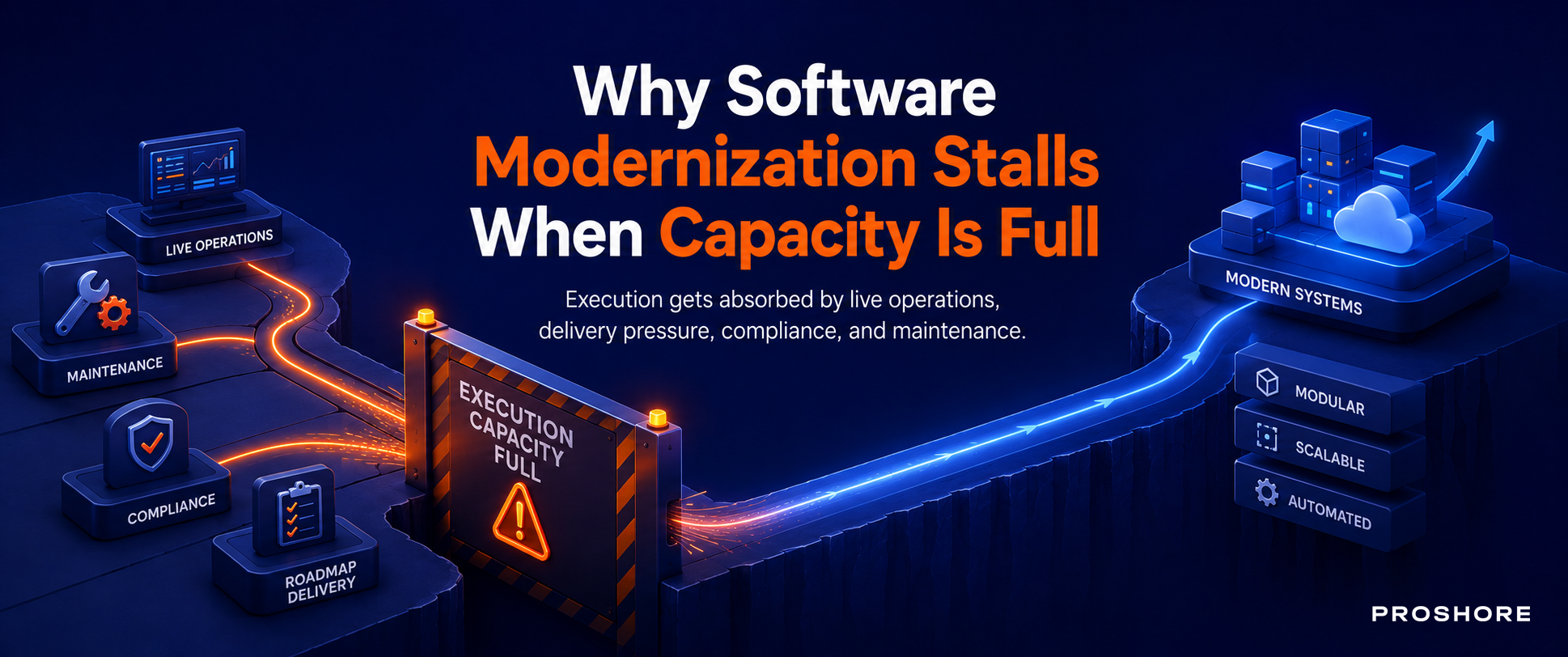
Most organizations do not struggle to identify what requires modernization. They struggle to execute it without disrupting core systems and ongoing operations.
Deloitte’s 2026 Global Technology Leadership Study estimates that technical debt consumes 21 to 40 % of IT spending and that a majority of legacy modernization initiatives fail or underdeliver.
This reinforces the cost and execution risk associated with large-scale change.
The need for modernization is clear, yet execution remains constrained by existing systems and operational risk.
The limitation lies not in vision or technology but in the ability to deliver change within live enterprise environments without compromising stability or continuity.
These challenges typically show up in the following patterns:
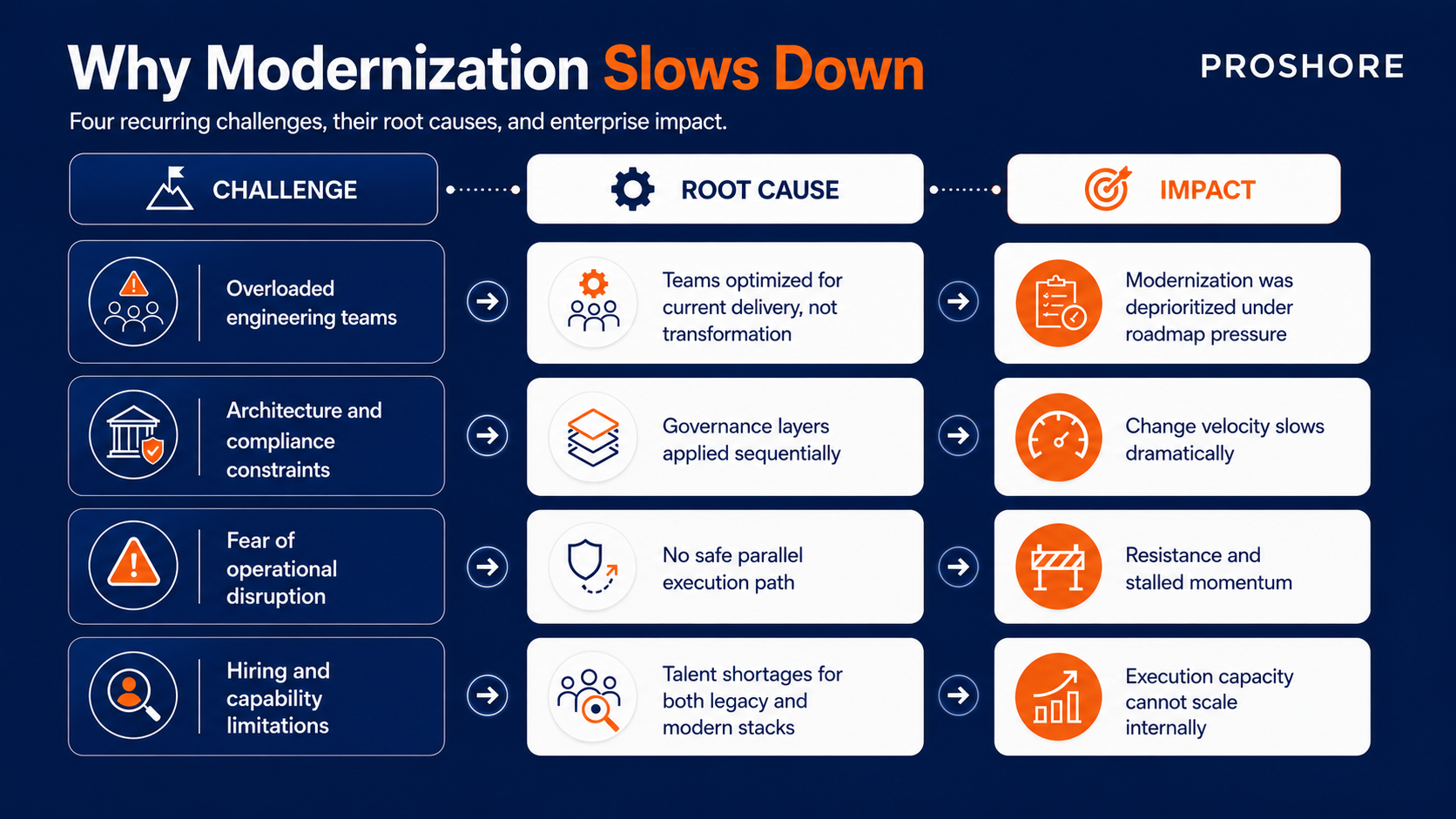
(Based on Saritasa Legacy Software Modernization Survey 2025 and Deloitte 2026 Global Technology Leadership Study)
The Real Constraint: Execution Capacity
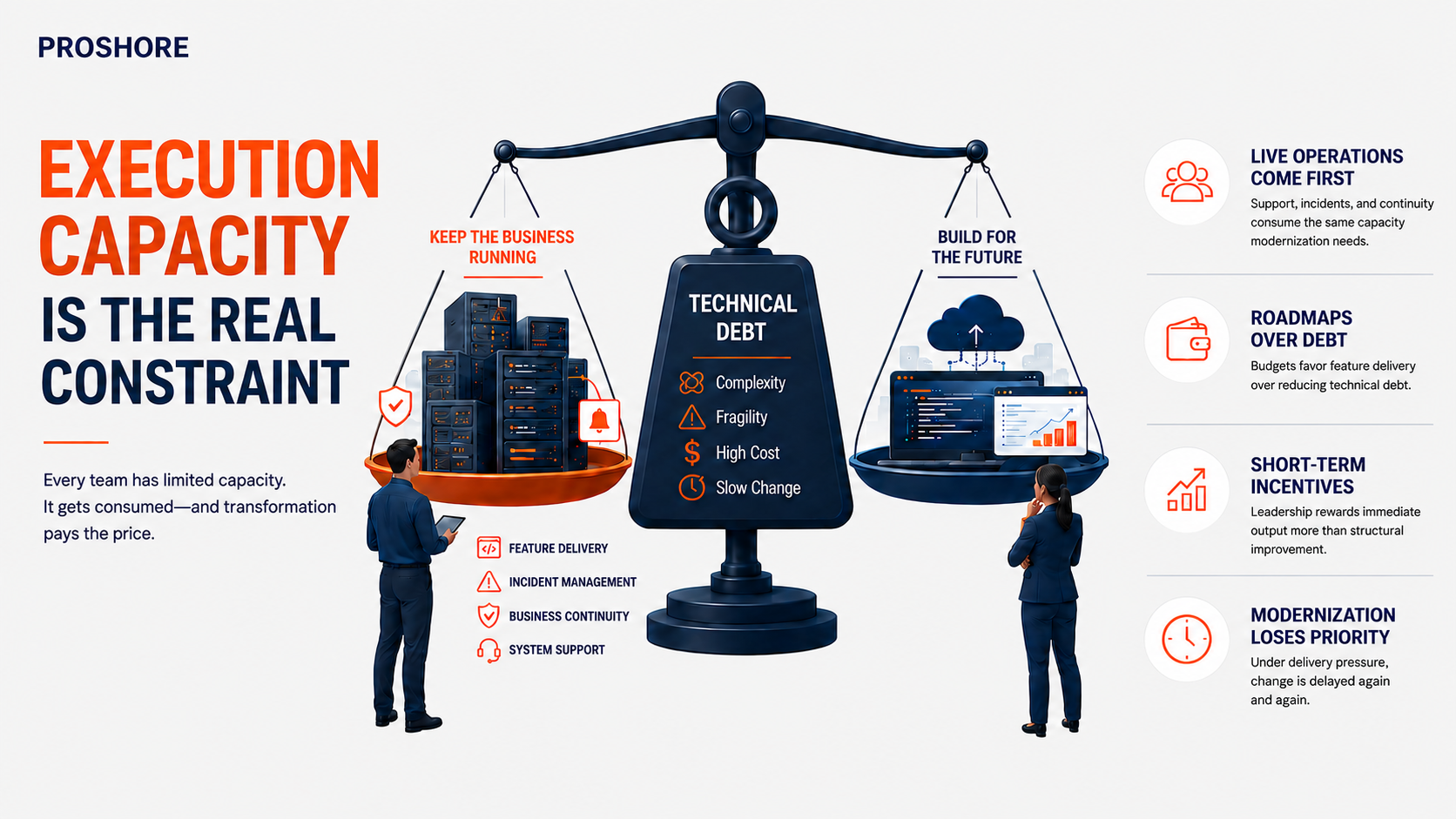
Modernization requires dedicated capacity and structured sequencing. It must be executed alongside live operations and ongoing system support.
Teams are organized and incentivized for delivery continuity rather than structural evolution. Budgets prioritize roadmap commitments over reducing technical debt.
Leadership incentives emphasize short-term output over long-term system improvement.
This creates a resource-allocation trade-off in which modernization competes with feature delivery, incident management, and business continuity. It consistently loses priority under delivery pressure.
This reflects a systems design failure where execution capacity is not established as a continuous capability alongside live operations.
Why Full System Replacement Often Fails
Full system replacement is attractive at the strategy level. It promises a clean slate and a future-ready architecture with simplified operations.
In execution, it introduces long delivery timelines, high operational risk, delayed value realization, and large upfront investment.
It also creates significant organizational resistance.
These programs assume uninterrupted focus, sustained capacity, and tolerance for disruption that do not exist in live enterprise environments.
Strategic intent collides with operational feasibility. Most full replacements stall because the delivery model cannot sustain execution alongside day-to-day operations.
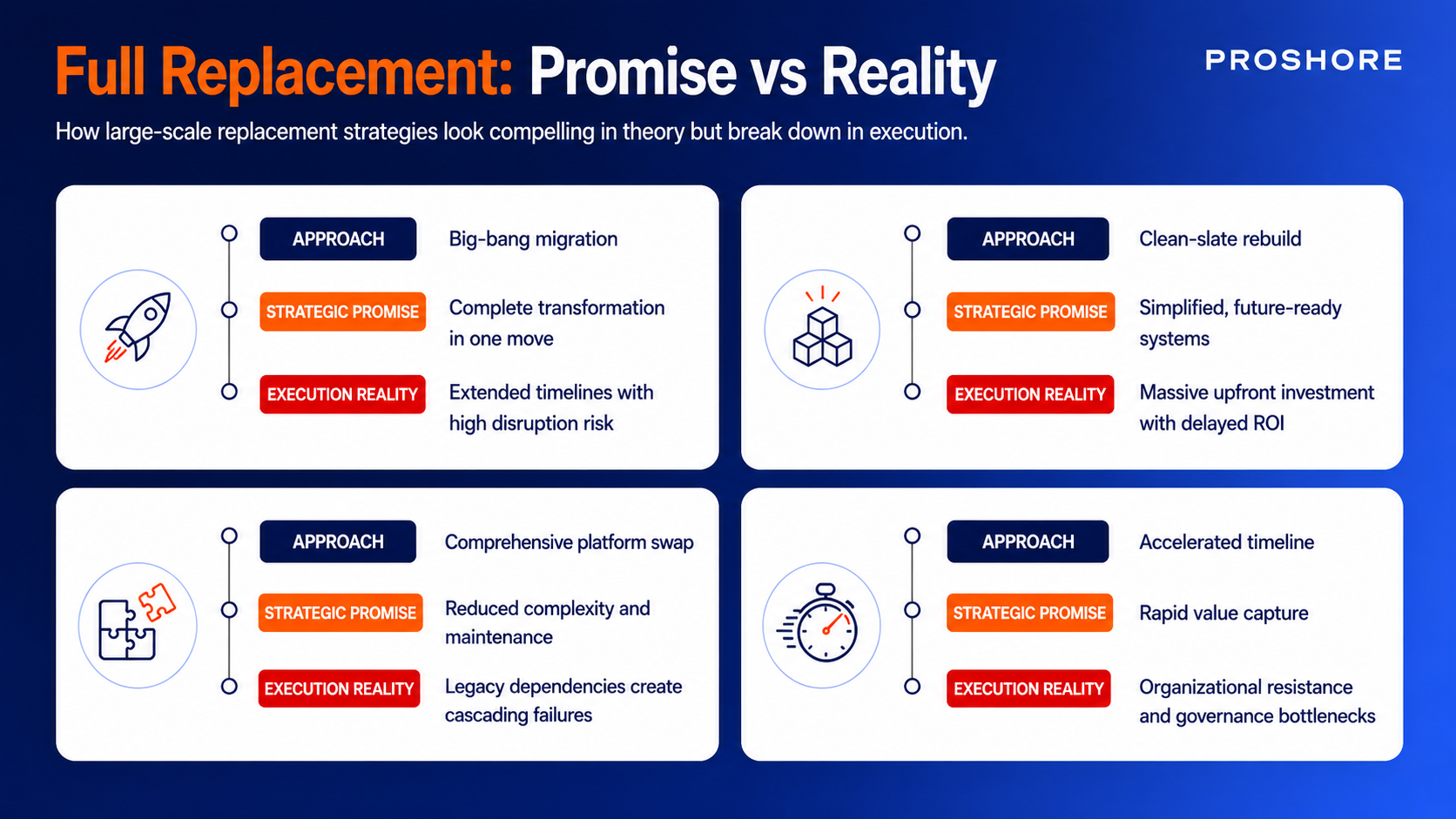
A Lower-Risk Modernization Model
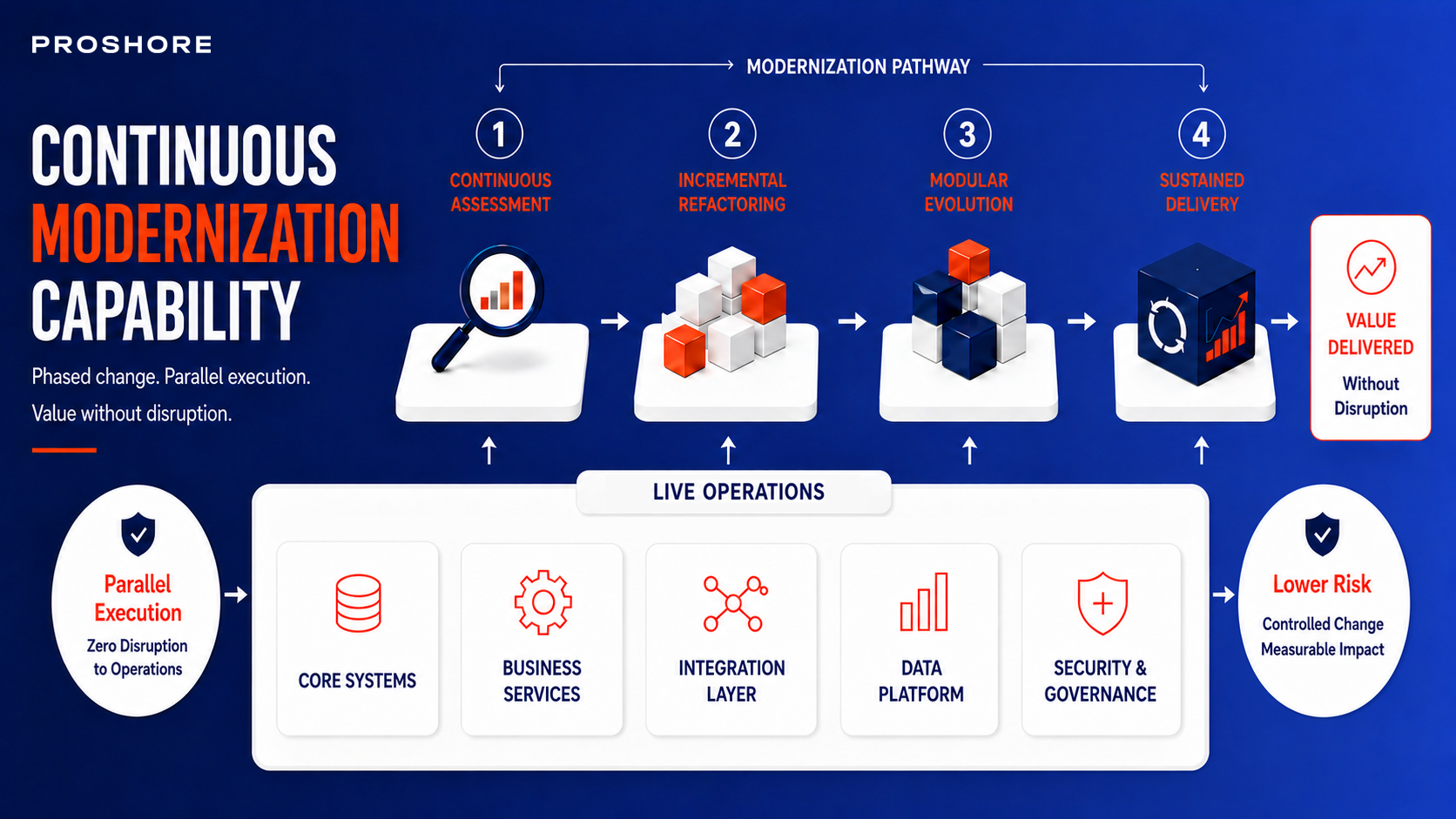
Modernization succeeds when it is treated as a continuous capability within the delivery system.
It runs in parallel with live operations through phased assessment and incremental refactoring. Modular architecture evolves over time with dedicated execution support.
Continuous assessment identifies priorities. Incremental refactoring delivers value without disruption.
Modular evolution reduces system dependencies over time. This approach converts technical debt into a structured backlog.
It enables controlled system evolution and sustained delivery progress.
Evaluating Modernization Within Enterprise Constraints
CIOs are not selecting technology in isolation. They are selecting execution initiatives that align with governance structures. These models must sustain operational continuity and deliver measurable improvement within the broader roadmap.
The central question then often shifts from “Is this the right architecture?” to “Can this modernization approach align with our governance realities and execution capacity?”
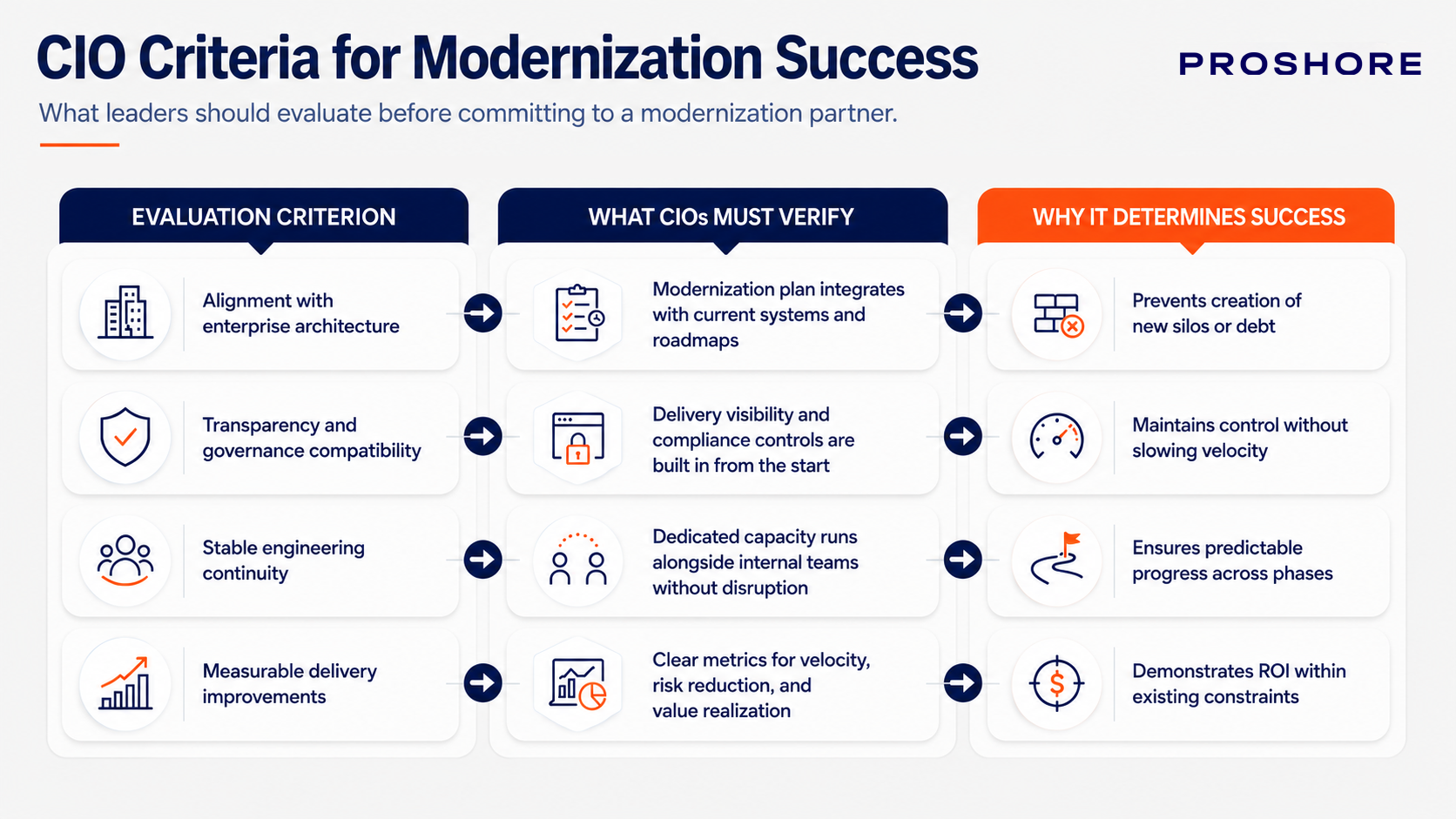
Proshore as an Execution Layer for Continuous Modernization

Proshore supports internal teams by providing dedicated modernization capacity that does not compete with roadmap delivery.
It operates within existing governance structures and delivery systems as an embedded execution layer.
This approach enables incremental modernization while maintaining operational continuity and delivery stability.
Organizations modernize without disrupting core operations. Systems evolve while business commitments continue. Progress is delivered in controlled increments with predictable outcomes.
Since 2018, Proshore has supported De Hues in modernizing operations by replacing spreadsheet-driven workflows with scalable cloud-based systems integrated across business units, improving operational visibility and reducing manual dependency.
Proshore also modernized SiteGuru by transitioning a monolithic application to a microservices architecture, increasing system flexibility and enabling continuous delivery without service disruption.
Conclusion
Modernization breaks down under delivery pressure as capacity shifts to live operations, and systems resist parallel change.
This forces a trade-off. Feature delivery is often prioritized over stability, and incident response and modernization are delayed or fragmented.
Sustained modernization requires a different execution model. Capacity must be allocated alongside ongoing delivery. System change must be incremental and integrated into existing workflows.
Organizations that achieve this do not rely on large-scale programs. They modernize through controlled increments that maintain stability and improve systems over time.
As execution becomes consistent, change becomes manageable, and outcomes become more visible.


by Roshan Bhattarai Co-Founder & Operations Director, Proshore

Remote Development
TypeScript for Startups: Building a Solid Foundation for the Future
Tired of battling bugs and debugging endless lines of JavaScript? Ready to level up your startup's tech stack? Dive into the world of TypeScript and discover how it can revolutionize your development process.
Book a call Talk to our Accounts director, Jeroen, to see if our ready-to-code offshore teams are a fit for you.
As a tech company founder, I know firsthand how chaotic and exhilarating it is to build a tech startup. Although I started 15 years ago – the pressure to move fast, the constant pivots, and the endless to-do list can be overwhelming. Amidst all the hustle, investing in building a solid foundation for your tech stack becomes crucial. That's where TypeScript comes in.
In recent years, TypeScript has emerged as a powerful tool that can address many challenges tech companies face in building complex web applications. In this blog post, we'll discuss TypeScript – highlighting its key benefits, potential drawbacks, and how it can specifically impact startups.
Why TypeScript Matters for Startups
Startups operate in a dynamic environment where speed and agility are crucial. We need to be able to move quickly to validate ideas, build prototypes, and iterate on our products. However, this rapid development pace can often come at the expense of code quality. Traditional JavaScript, while versatile, can be prone to errors due to its loose typing. This can lead to bugs that are difficult to detect and fix, ultimately slowing down development and impacting the user experience.
TypeScript offers a compelling solution to this problem. By adding static typing to JavaScript, TypeScript helps to catch errors early in the development process, before they can cause major issues. Hence TypeScript over JavaScript can significantly improve code quality, reduce debugging time, and make your codebase more maintainable in the long run.
Here's a breakdown of why TypeScript is a game-changer for startups:
1. Catch Errors Early:
Type Safety
TypeScript forces you to define the types of your variables, functions, and objects. This might seem like overkill at first, but it pays off big time. You'll catch potential errors during development, saving you countless hours of debugging later.
Improved Code Quality
With TypeScript, you'll write cleaner, more maintainable code. Your team will thank you when they're not scratching their heads trying to figure out why a function is behaving unexpectedly.
2. Enhanced Developer Productivity:
IntelliSense
Your IDE becomes a superpowered code assistant. It suggests code completions, highlights potential issues, and auto-generates boilerplate code.
Faster Development
By catching errors early, you'll spend less time debugging and more time building new features.
3. Scalability and Maintainability:
Long-Term Vision
As your startup grows, your codebase will become more complex. TypeScript helps you manage this complexity by providing a strong type system that ensures consistency and prevents unintended side effects.
Easier Onboarding
New developers can quickly get up to speed with your codebase thanks to TypeScript's clear type annotations and documentation.
Get a detailed breakdown of all the benefits of TypeScript Development in our past blog by my colleague and JS Dev, Atul Shrestha.
Potential Drawbacks of TypeScript
While TypeScript offers a number of advantages, it's important to be aware of some potential drawbacks as well:
1
Learning Curve
TypeScript introduces a new layer of complexity to JavaScript development. If your developers are not familiar with static typing will need to invest some time in learning the TypeScript syntax and best practices.
2
Potential for Boilerplate
In some cases, TypeScript can lead to an increase in boilerplate code, especially for simple projects. It’s important to strike a balance between the benefits of static typing and the need to write concise code.
3
Tooling Integration
While TypeScript leverages existing JavaScript tooling, there may be some initial setup required to integrate it into your team’s development workflow.
1
Learning Curve
TypeScript introduces a new layer of complexity to JavaScript development. If your developers are not familiar with static typing will need to invest some time in learning the TypeScript syntax and best practices.
2
Potential for Boilerplate
In some cases, TypeScript can lead to an increase in boilerplate code, especially for simple projects. It's important to strike a balance between the benefits of static typing and the need to write concise code.
3
Tooling Integration
While TypeScript leverages existing JavaScript tooling, there may be some initial setup required to integrate it into your team’s development workflow.
Is TypeScript Right for Your Startup?
The decision of whether or not to adopt TypeScript will depend on the specific needs of your startup. Here are some factors to consider:
1
The size and complexity of your codebase
If you’re working on a small, relatively simple project, the benefits of TypeScript may be outweighed by the learning curve. However, as your codebase grows and becomes more complex, TypeScript can become a valuable asset.
2
The experience of your development team
If your team is already familiar with statically typed languages, the transition to TypeScript will be smoother. However, even if your team is primarily experienced with JavaScript, the benefits of TypeScript can outweigh the initial learning curve.
3
Your project's long-term goals
If you’re building a product that you expect to scale significantly in the future, TypeScript can be a wise investment. The upfront time spent learning TypeScript will pay off in the long run as your codebase becomes more complex.
1
The size and complexity of your codebase
If you're working on a small, relatively simple project, the benefits of TypeScript may be outweighed by the learning curve. However, as your codebase grows and becomes more complex, TypeScript can become a valuable asset.
2
The experience of your development team
If your team is already familiar with statically typed languages, the transition to TypeScript will be smoother. However, even if your team is primarily experienced with JavaScript, the benefits of TypeScript can outweigh the initial learning curve.
3
Your project's long-term goals
If you're building a product that you expect to scale significantly in the future, TypeScript can be a wise investment. The upfront time spent learning TypeScript will pay off in the long run as your codebase becomes more complex.
Build a strong codebase with TypeScript
While TypeScript might require an initial learning curve, the long-term benefits are substantial. By investing in TypeScript, you're not just writing code; you're building a solid foundation for your startup's future. So, take the leap, embrace TypeScript, and watch your productivity soar!
If this blog has made you convinced to adopt TypeScript for your tech startup, here are some practical tips:
Start Small
Introduce TypeScript gradually to your existing projects. Begin with small, self-contained modules and gradually migrate larger parts of your codebase
Leverage Strong Tooling
Use a modern IDE like Visual Studio Code with TypeScript extensions. It'll provide you with powerful features like code completion, refactoring, and debugging.
Embrace the Community
The TypeScript community is vibrant and supportive. Don't hesitate to ask questions on forums like Stack Overflow or join online communities.
Don't Be Afraid to Experiment
TypeScript is a flexible tool. You can customize it to fit your team's preferences and project requirements.
If you are looking to hire a TypeScript Development team that is ready-to-code and scalable as per your budget – book a call with us to explore our remote experts from Nepal.

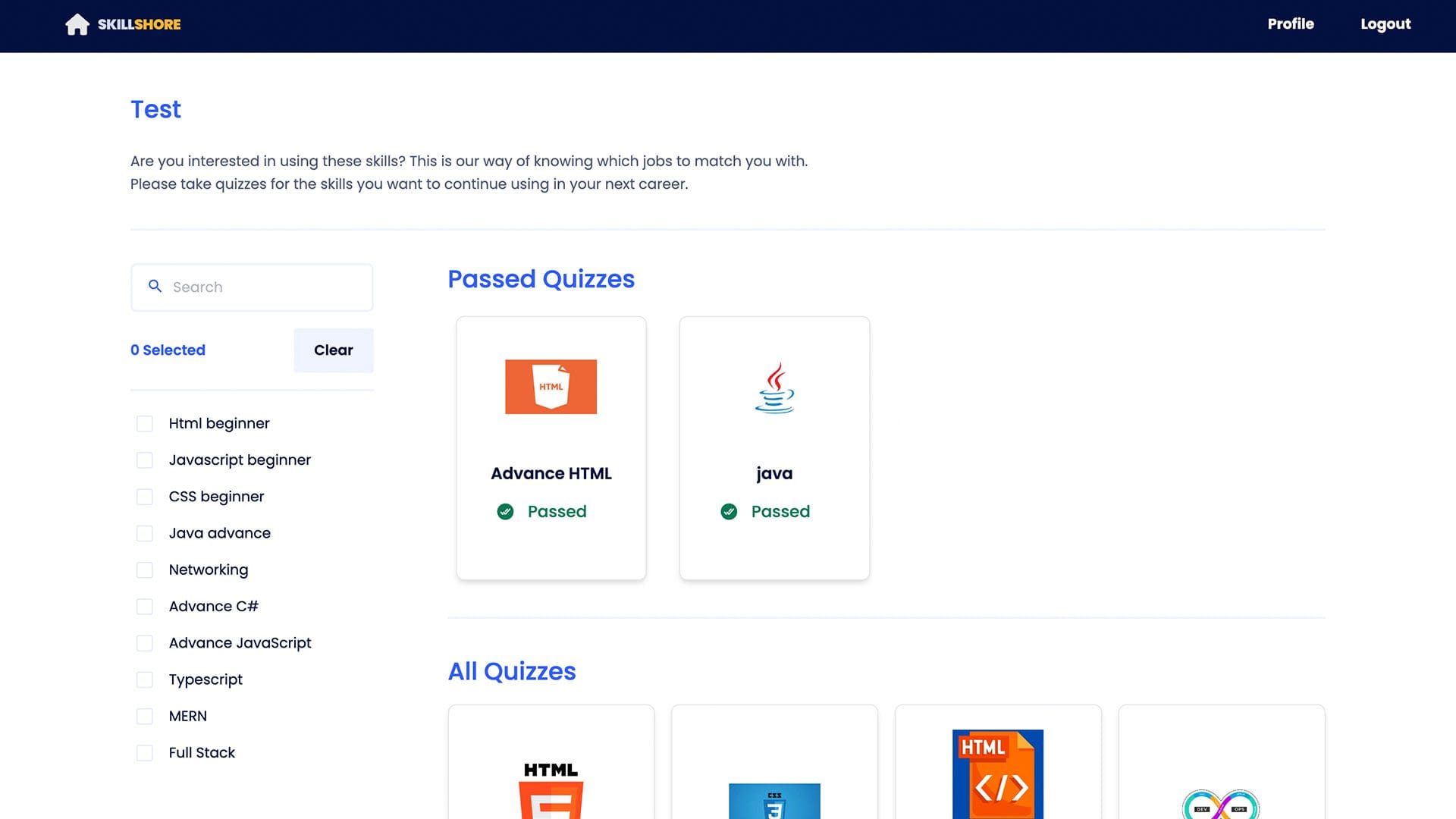
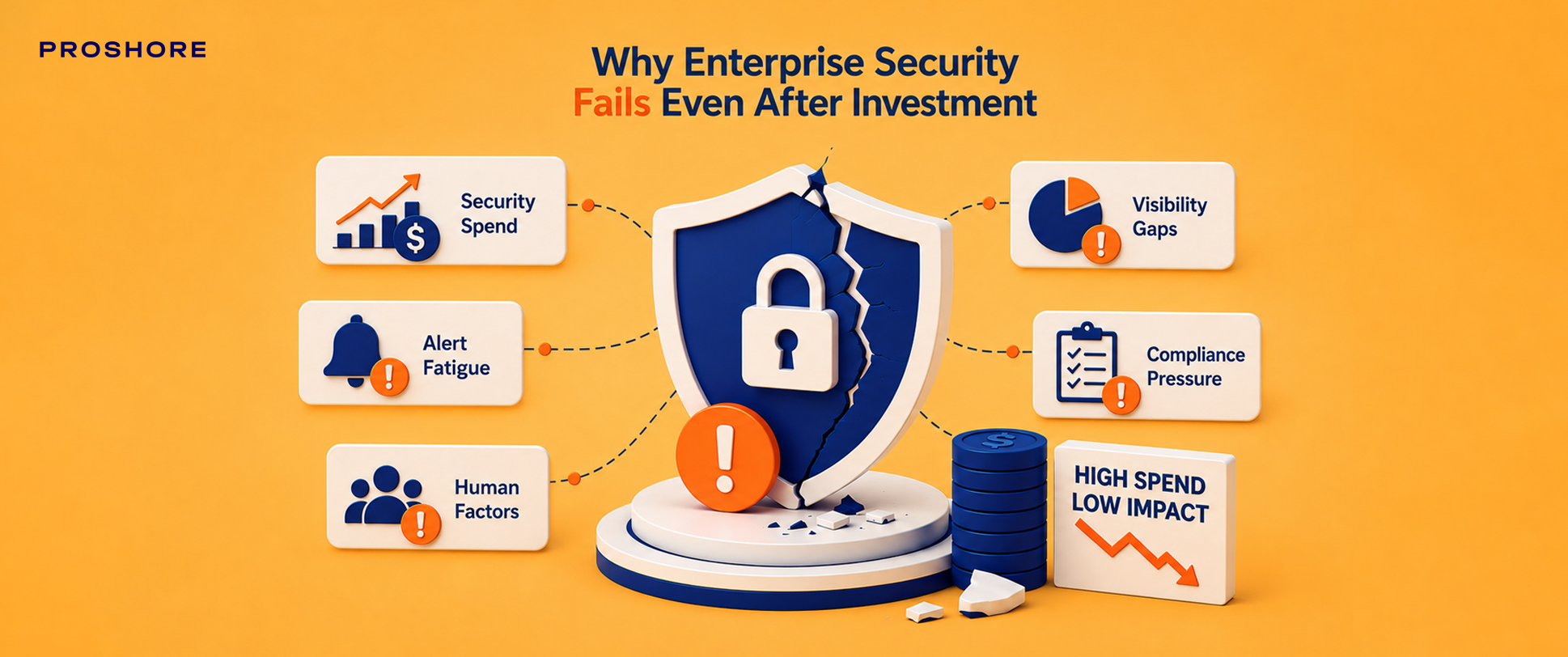
Security Maturity Does Not Translate to Real-World Protection
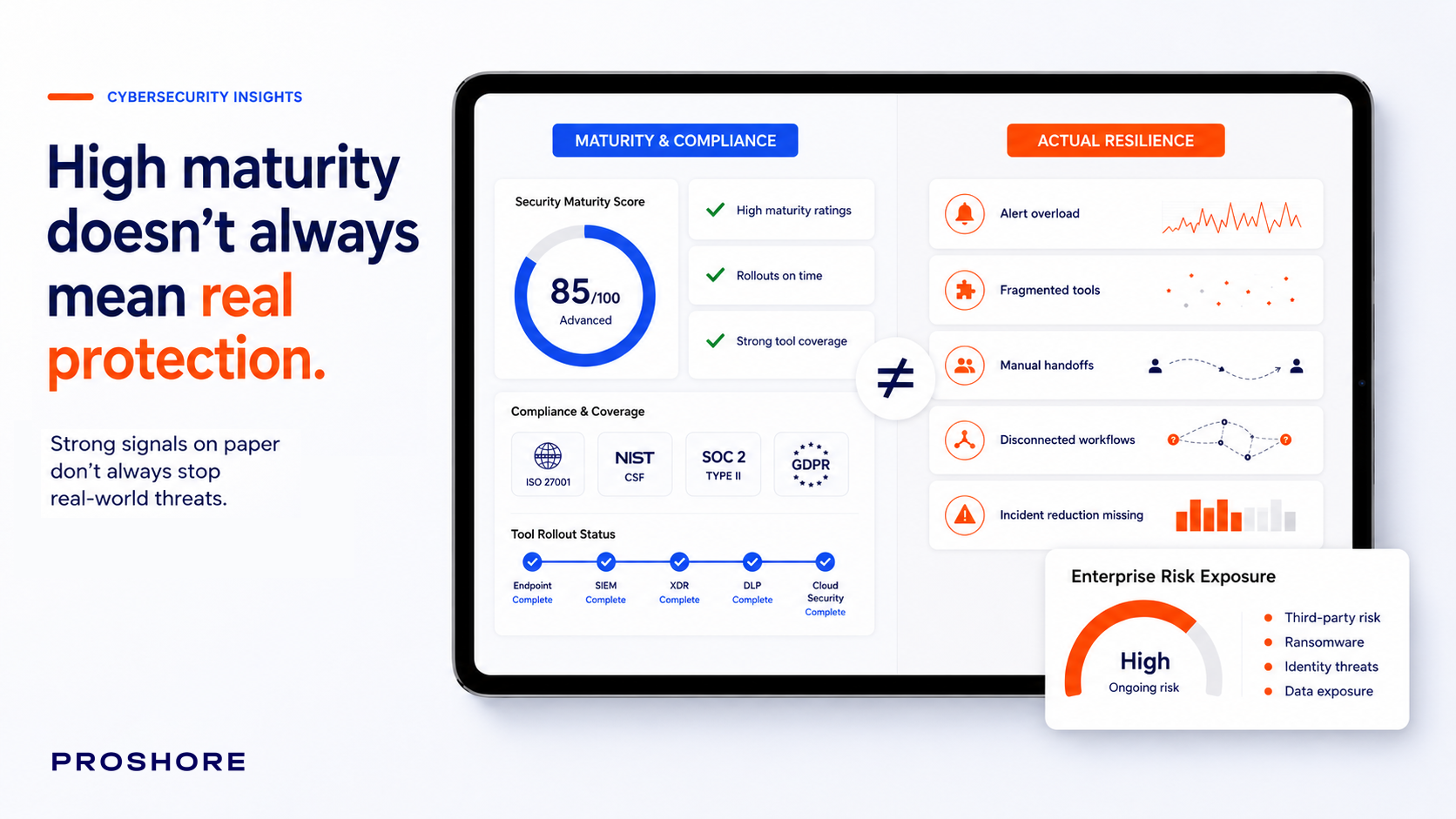
Security initiatives regularly achieve strong maturity ratings and complete major rollouts within planned timelines, but the expected drops in incident rates, faster response times, and lower financial exposure seldom appear across the enterprise.
In practice, layering on new tools creates coverage without the fundamental redesign required to weave security into daily operations.
Controls activate in the environment, but they inherit the same fragmentation, overwhelming alerts, and manual handoffs that predated the latest investment cycle.
Lasting resilience appears only when security capabilities support redesigned workflows, continuous threat intelligence, automated remediation, and tight coordination between teams.
This demands mature risk ownership, shifts in organizational behavior, and an architecture that treats security as a business enabler instead of a standalone compliance checkbox.
Advanced security platforms and automation accelerate initial setup, yet they cannot fix tool proliferation, missing cross-system linkages, or the absence of ongoing risk-tuning processes.
The real barrier lies not in the availability of technology but in the lack of a bridge between control deployment and measurable reductions in enterprise risk.
Structural Issues Behind Enterprise Security Failures
Shortfalls like these arise from recurring organizational patterns rather than isolated technological shortcomings.
Security efforts often advance independently of business strategy groups, while architecture, operations, and compliance teams step in only after key choices are finalized.
Outdated assumptions linger, and complex multi-vendor or hybrid setups quickly generate concealed complexity.
Rising geopolitical demands and data-sovereignty rules now trigger expensive last-minute adjustments that should have guided early design decisions.
Effective protection at scale remains out of reach when security is treated as a specialized compliance task rather than a foundational element of enterprise performance.
In 2026, as AI agents expand their attack surfaces and third-party risks double, enterprises that rely on checklist-driven programs rather than integrated risk strategies keep falling short.
Four patterns surface consistently:
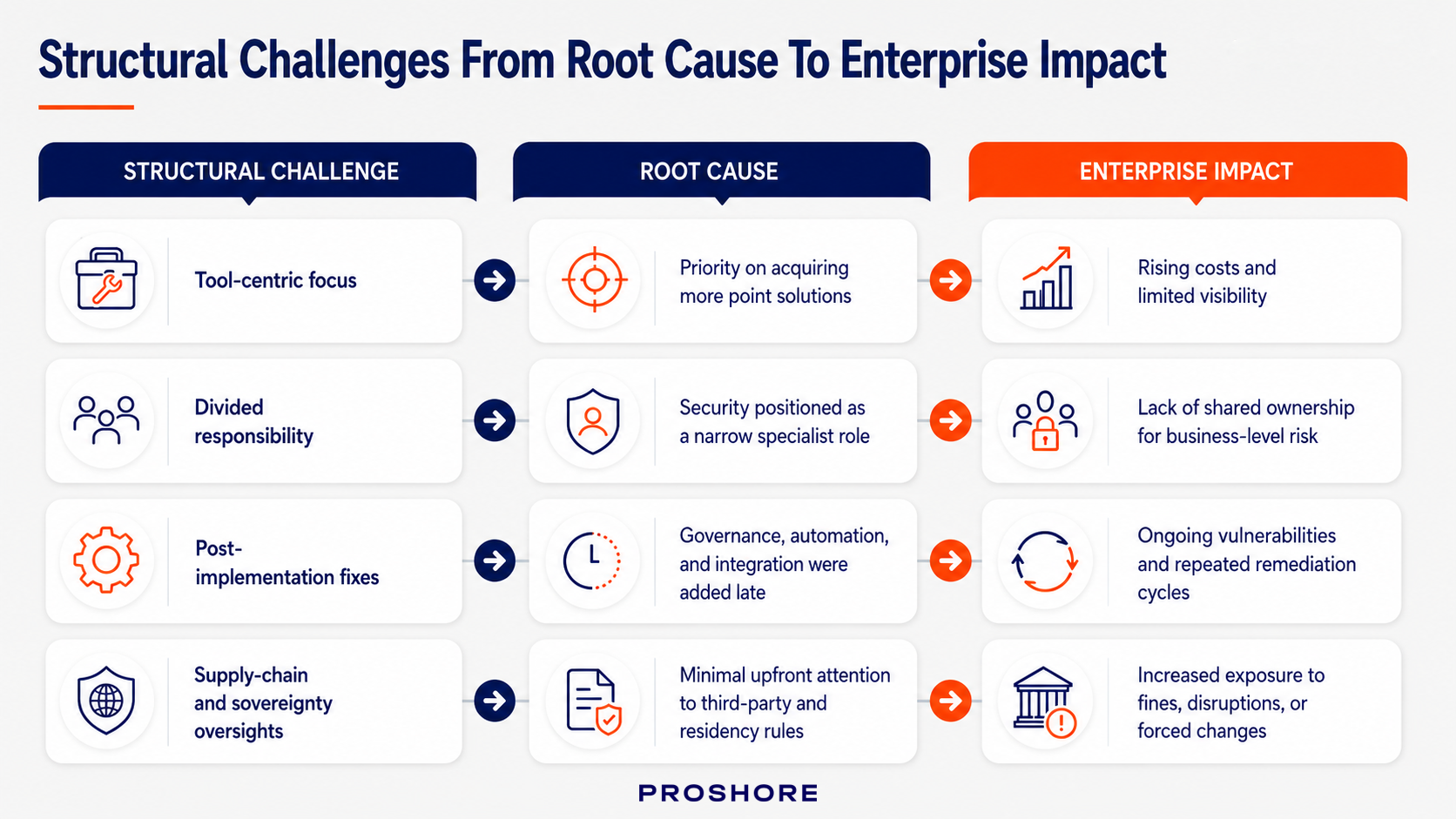
(Based on patterns in IBM Cost of a Data Breach Report 2025 and Gartner cybersecurity trends for 2026)
Security Spend Without Risk Reduction and Its Impact
When programs wrap up without a built-in risk framework, inefficiencies spread throughout the organization. Tool selection and integration work get repeated across departments.
Live environments accumulate alert fatigue, and expanding AI threats magnify noise and overlook signals.
Executive belief weakens as expected gains in resilience, regulatory standing, and cost protection deliver only partial results.
These pressures appear in several consistent ways:
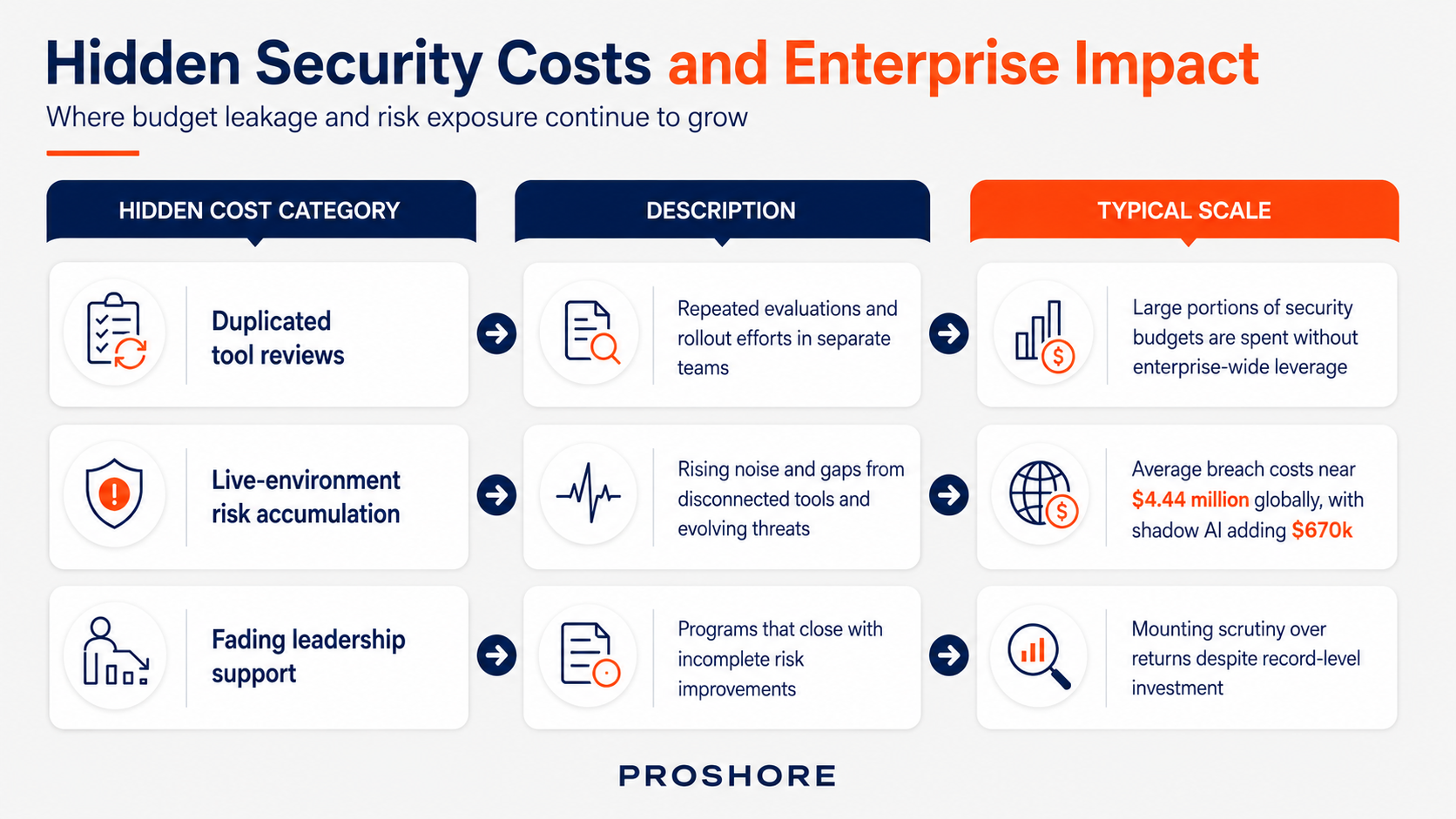
(Source: IBM Cost of a Data Breach Report 2025)
A More Effective Path to Security-Driven Resilience
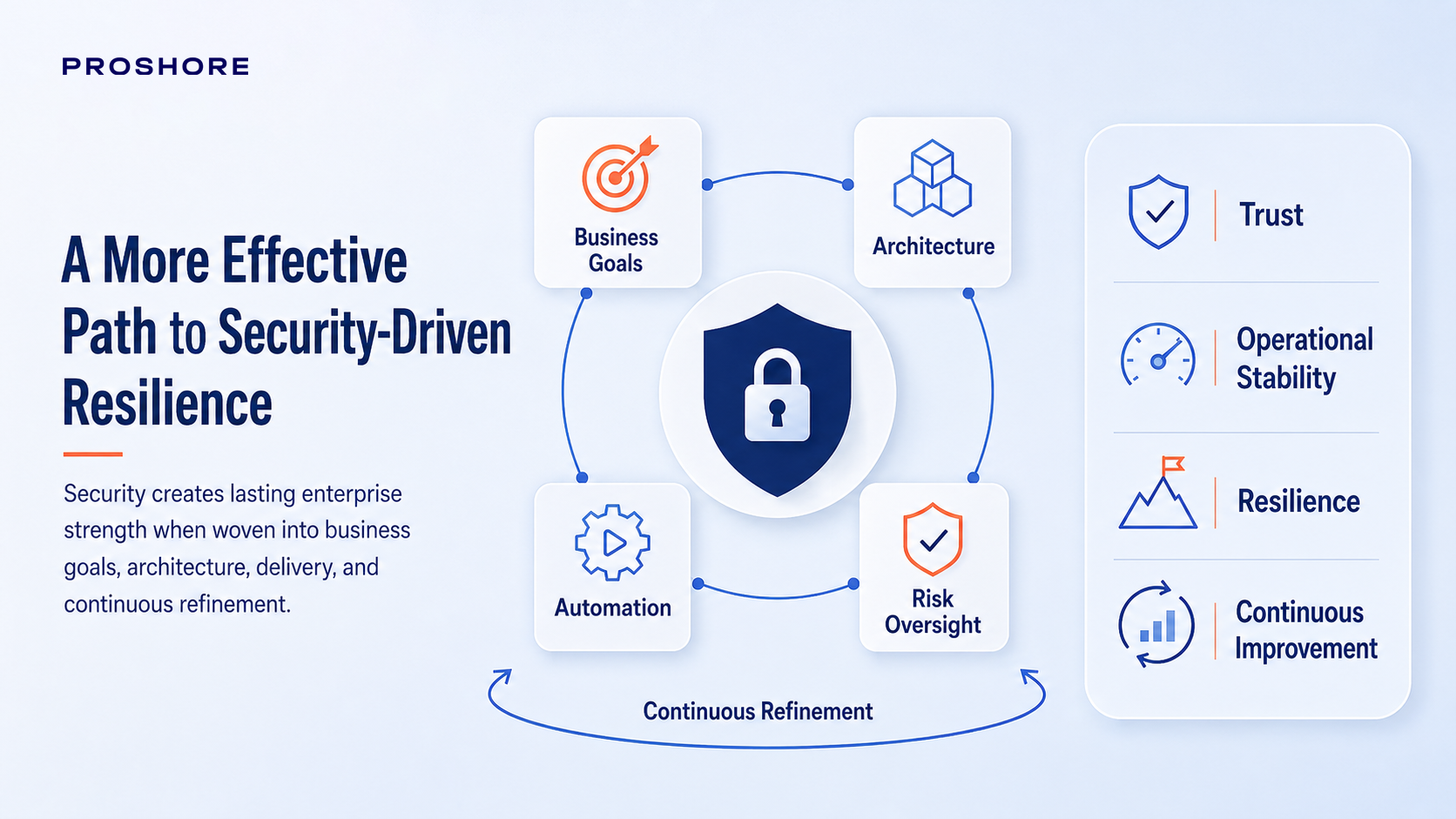
Security creates lasting enterprise strength when it operates as a core layer woven into wider digital and operational change programs.
The operating model ties security work directly to business goals, updates controls alongside infrastructure and application changes, and builds risk oversight, automation, and refinement into the foundation instead of adding them later.
Design choices, delivery flows, and performance habits support each other from the start.
This approach shifts security from a periodic compliance exercise into a continuous source of trust and operational stability.
Key Elements That Shape Security Success
Enterprise security efforts are judged by strategic fit, implementation strength, and ongoing results, not simply by tool rollout progress.
The pivotal question shifts from whether protections are in place to whether the organization has the frameworks needed to sustain meaningful risk reduction at scale.
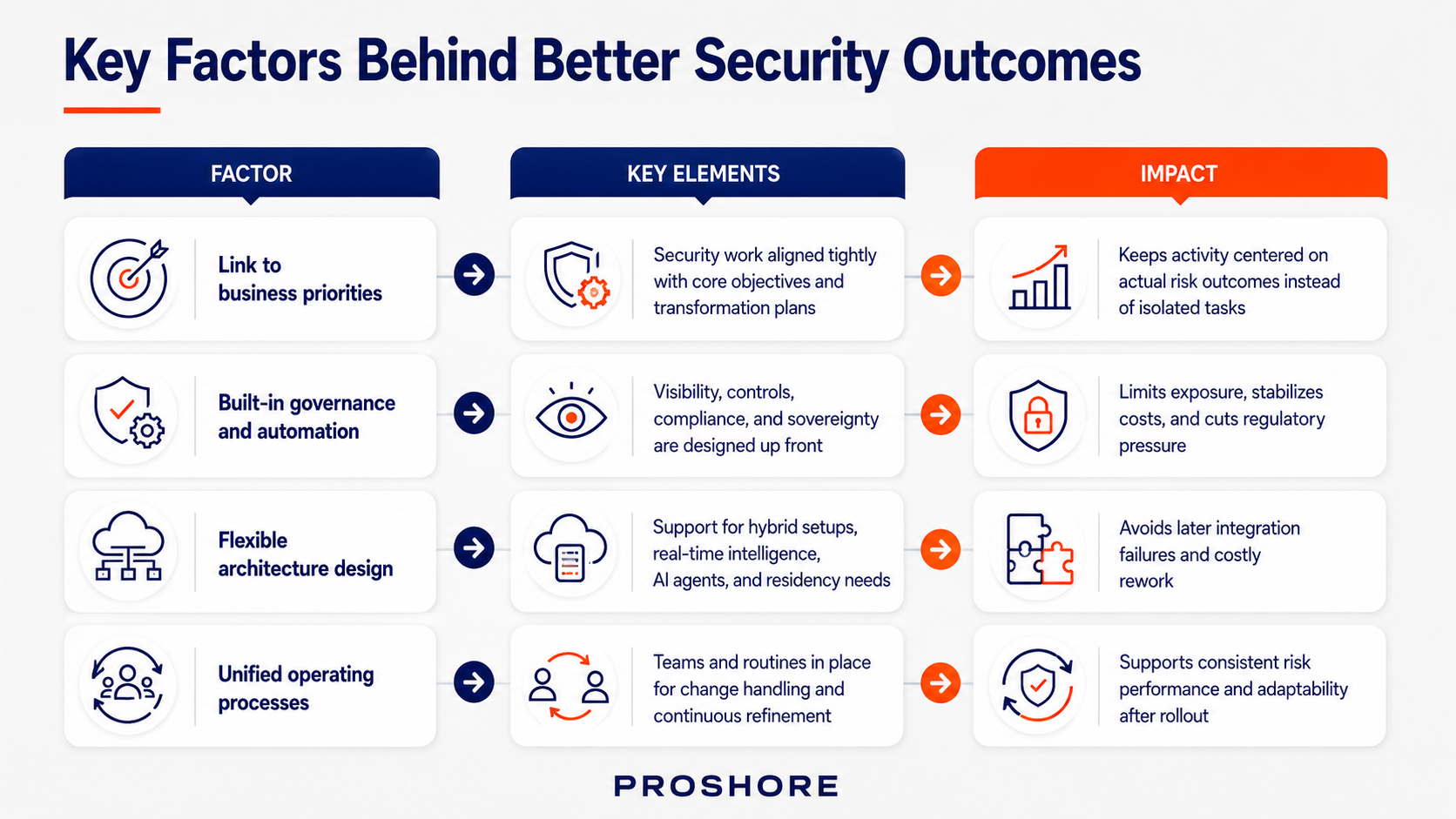
Proshore Enterprise Security Approach and Outcomes
Proshore addresses the structural issues that prevent security investments from delivering sustained risk reduction.
Security is embedded into business processes and system design rather than added after deployment.
At Altec, Proshore implemented a multi-layered cloud security architecture across network, application, and subnet levels. Secure access was enforced through VPN authentication and IP whitelisting. Test and production environments were clearly separated.
This reduced risk and improved reliability, and created a secure foundation for scaling operations.
With Health Catalyst (Upfront Healthcare), Proshore delivered security-focused platform enhancements aligned with enterprise standards. Automated testing and DevOps practices strengthened platform stability and improved reliability. The platform performs consistently in a secure environment.
Across these engagements, security is built into system design and delivery rather than added after deployment. The result is stronger protection and controlled access. Platforms scale without introducing additional risk.
Improving Enterprise Security Outcomes and Risk Reduction
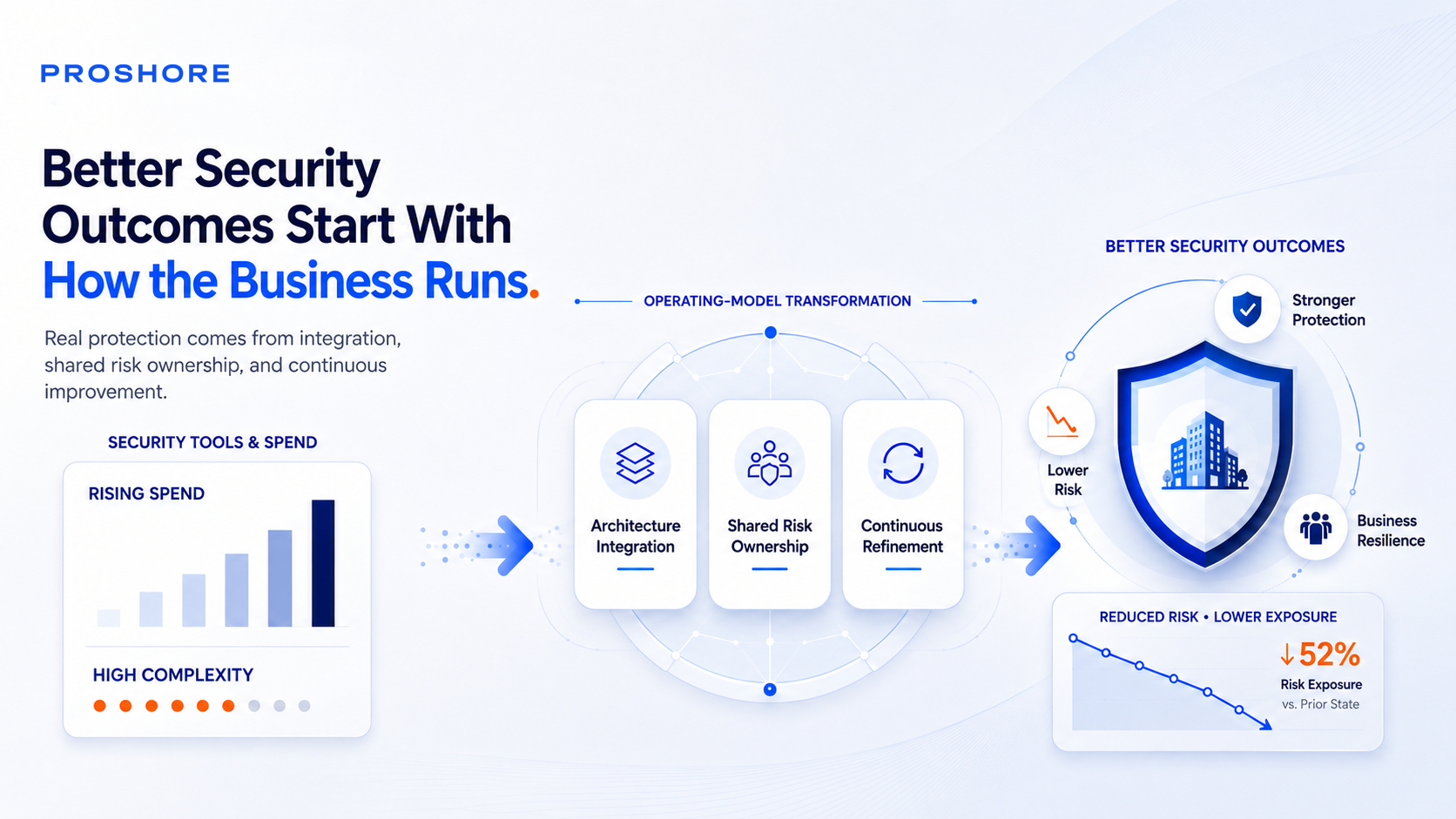
Security capabilities deliver genuine enterprise protection only when spending leads to full operating-model transformation.
Enterprises that look past deployment numbers and treat security as a strategic business discipline, focusing on architecture integration, shared risk ownership, and continuous refinement, achieve noticeably better protection.
By folding security thinking into broader modernization programs, creating habits of ongoing improvement, and building resilience by design, organizations can escape the cycle of heavy outlays paired with stubborn exposure.
The tools are available. What matters is how they become part of the way the business actually runs.

In today’s digital-first world, software isn’t just supporting the business—it is the business. From internal tools to customer-facing platforms, companies are under constant pressure to ship faster, scale reliably, and still maintain quality. So how do modern software teams pull it off?
Let’s break it down.

1. Clear Problems Before Clever Solutions
High-performing software teams don’t start with technology—they start with problems.
Instead of asking “Which framework should we use?”, they ask:
- What pain point are we solving?
- Who is affected by it?
- How will we measure success?
This problem-first mindset prevents overengineering and ensures the final product actually delivers value.
2. Modular, Scalable Architecture
Modern applications are built to evolve. That’s why many teams rely on:
- Modular codebases
- API-driven architectures
- Cloud-native infrastructure
This approach allows teams to scale specific features independently, reduce risk during updates, and adapt quickly as requirements change.
3. Automation Everywhere
Speed without automation doesn’t scale.
Successful teams automate:
- Testing (unit, integration, end-to-end)
- Deployments (CI/CD pipelines)
- Monitoring and alerts
Automation reduces human error, shortens release cycles, and frees developers to focus on solving real problems—not repetitive tasks.
4. Collaboration Beats Silos
Modern software development is a team sport.
Designers, developers, QA engineers, and product managers work closely together—often in short feedback loops. Tools like shared design systems, issue trackers, and real-time communication platforms help keep everyone aligned.
The result? Fewer surprises and better products.
5. Continuous Improvement
Great software is never truly “done.”
High-performing teams regularly:
- Review what worked (and what didn’t)
- Gather user feedback
- Refactor and optimize
This culture of continuous improvement ensures the software stays relevant, performant, and easy to maintain.
Final Thoughts
Building software faster doesn’t mean cutting corners. It means making smarter decisions—about architecture, processes, and collaboration.
At its core, modern software development is about clarity, consistency, and care. When teams get those right, speed naturally follows.
Want to learn how your software team can improve delivery without sacrificing quality? Get in touch with us or explore more insights on our blog.


AI Development
AI Agents Guide: Build smarter solutions without complexity
Learn how to leverage effective AI agents and their architectures and how Proshore’s offshore expertise accelerates growth through enterprise-grade solutions.
Book a call Talk to our CTO, Babish, to talk AI and see if our future-ready offshore teams are a fit for you.
In 2024, AI agents were the buzzword across industries, not just tech. Today, they are slowly becoming a business necessity. But for tech firms racing to build MVPs or scale operations, complexity remains the enemy. At Proshore, we too have started helping our clients implement AI agents, and one truth stands out: success lies in simplicity.
This guide strips away the jargon to explain:
- What AI agents actually are (and aren’t).
- When startups should use them (and when to avoid overengineering).
- How to build agents that deliver value fast, using patterns that work.
Plus, learn how Proshore’s offshore development teams in Nepal help startups launch smarter AI-integrated products without blowing budgets.
What Are AI Agents? (No, They’re Not ChatGPT)
AI agents are autonomous systems that perceive, reason, act, and learn with minimal human intervention. Unlike basic automation or LLM-powered chatbots, AI agents can:
- Perceive their environment (via data, APIs, or user inputs).
- Reason using LLMs or machine learning.
- Act through tools like code execution or API calls.
- Learn from feedback loops.
Here are the key distinctions between:
Traditional Automation
Follows fixed rules.
Handles repetitive tasks.
Requires manual updates.
AI Agents
Adapts to new data.
Solves open-ended problems.
Learns autonomously.
Example: A Proshore-built e-commerce agent that analyzes real-time sales data → predicts demand spikes → adjusts pricing without human input.
When to Use Agents (and When to Avoid Them)
AI agents, despite being cutting-edge, are not always necessary. Any new tech comes with its own set of problems, so sometimes proven methods could be better (for now).
Use Agents When
✅ Tasks require adaptability, like customer support resolving unique complaints.
✅ Decisions rely on real-time data. E.g., fraud detection.
✅ You need human-like reasoning at scale. E.g., personalized marketing.
Avoid Agents When
❌ Tasks are repetitive and predictable – traditional automation suffices.
❌ Latency is critical – agents add processing steps.
❌ Budgets are tight – start with single LLM calls + retrieval.
Rule of thumb
If a human needs less than 5 minutes to decide, use automation. If the situation requires reasoning, use agents.

[gravityform id="20" title="true" ]
Building Blocks: Keep It Lean, Keep It Functional
Forget complex frameworks. Effective agents need just three components:
1
Augmented LLM Core
Base Model: Claude 3.5 Sonnet, GPT-4, or open-source alternatives.
Add:
- Tools (APIs, databases).
- Memory (short-term context retention).
- Retrieval (company-specific data).
Pro Tip: Use pre-built modules to skip 80% of setup time.
2
Workflows Over Frameworks
Pattern Best For Proshore Example Prompt Chaining Multi-step tasks like write → edit Marketing copy generation to localization Routing Classifying inputs Sorting customer queries into sales/support pipelines Orchestrator Complex problem-solving Coding agents that edit multiple files 3
Transparent Tool Design
Agents fail when tools are poorly documented. Follow our ACI (Agent-Computer Interface) rules:
Clarity: Describe tools like teaching a junior developer.
Poka-Yoke: Design error-proof parameters, e.g. require absolute file paths.
Test Relentlessly: Run 50+ scenarios before deployment.
Why Proshore? Offshore AI Expertise Without Compromise
Agents aren’t about replacing humans—they’re about augmenting your team’s capabilities. With Proshore as your offshore partner, you gain the technical depth to deploy AI strategically, ensuring every agent solves real business problems.
For tech firms and scaleups, Proshore delivers:
- Cost Efficiency: 50-60% savings vs. in-house European/North-American/Australian teams.
- Breadth of Experience: Over 15 years in offshore software development + multiple AI deployments across eCommerce, healthcare, fintech and SaaS.
- Speed: Launch MVP agents within time-to-market using our pre-built modules.


Product Development
The MVP Development Process – From Idea to Launch
Let’s go through the process of successfully launching a Minimum Viable Product (MVP) for your tech idea – along with actionable insights and best practices at each stage of the journey.
Book a call Talk to our Accounts director, Jeroen, to see if our ready-to-code offshore teams are a fit for you.
In today’s fast-paced tech landscape, businesses face immense pressure to innovate quickly while minimizing risk.
Enter the Minimum Viable Product (MVP), a strategic approach to validating ideas, gathering user insights, and accelerating time to market. For startups and enterprises alike, MVP development isn’t just a trend; it’s a necessity.
At Proshore, your offshore software development partner, we’ve helped multiple businesses transform raw ideas into market-ready MVPs for over 15 years.
Whether you’re a founder with a disruptive concept or an enterprise seeking agile innovation, this guide breaks down the MVP journey from pre-development to scaling, providing actionable insights tailored for service providers.
Why do businesses seek MVP development services?
Building an MVP requires expertise in lean development, user-centric design, and rapid iteration—areas where specialized service providers like Proshore excel.
Here’s why businesses partner with us:
- Risk Mitigation: Avoid costly full-scale failures by testing core assumptions first.
- Cost Efficiency: Leverage offshore talent to reduce development costs by up to 60%.
- Speed: Launch in weeks, not months, with agile workflows.
- Focus: Free up internal teams to strategize while experts handle execution.
Key Benefits of MVP Development
Let's dive deeper into the various benefits of investing to develop a MVP first;
1
Quick Validation with Minimal Risk
Test your idea’s viability without overcommitting resources. Upon success, MVPs can validate the potential of your product to investors, making it easier to secure funding for further development.
2
Cost-Effective Market Entry
Build only what’s essential, reducing upfront investment. By launching a minimal version first, you minimize the risk of investing heavily in a product that may not resonate with the market.
3
Early Market Access
Outpace competitors by launching faster, and gaining insights into user behavior, market trends, and the feasibility of your product idea. Iterate based on feedback.
4
Real-World Data & Feedback
Use actionable insights to refine your product and business model, providing a better fit for the needs and desires of your target audience.
1
Quick Validation with Minimal Risk
Test your idea’s viability without overcommitting resources. Upon success, MVPs can validate the potential of your product to investors, making it easier to secure funding for further development.
2
Cost-Effective Market Entry
Build only what’s essential, reducing upfront investment. By launching a minimal version first, you minimize the risk of investing heavily in a product that may not resonate with the market.
3
Early Market Access
Outpace competitors by launching faster, and gaining insights into user behavior, market trends, and the feasibility of your product idea. Iterate based on feedback.
4
Real-World Data & Feedback
Use actionable insights to refine your product and business model, providing a better fit for the needs and desires of your target audience.
10 steps of the MVP development process
Now that we've gone through what a MVP is and its benefits, let's walk through the steps involved in building your MVP.
To make it easier to digest, we have divided the process into 3 phases consisting of 10 steps in total.
Pre-Development Phase: Laying the Groundwork
When you are building anything whether it be a tech product or your furniture at home – having a strong foundation is crucial.
1
Market Research & Ideation
First, identify gaps in the market by analyzing your competitors. Ask yourself,
- Who are your competitors?
- What are their strengths and weaknesses?
- What is their market share?
Next, understand the pain points of your future users through surveys or focus groups. Find out who are your ideal customers by listing down their demographics, interests, and pain points.
Lastly, align your MVP with business goals using SWOT analysis.
2
Define Clear Objectives
Set SMART goals that you want to achieve with your MVP. For example,
- “Acquire 1,000 beta users in 3 months”,
- Validate a core assumption of the product idea, or
- Generate a specific level of revenue.
Prioritize KPIs like user retention, conversion rates, or feedback volume.
3
Feature Prioritization
Remember, an MVP is not about having all the bells and whistles; it's about validating your core concept. Here are some tips from our past experiences,
- Use the MoSCoW Method: Categorize features as Must-have, Should-have, Could-have, or Won’t-have.
- Apply the 80/20 Rule: Deliver 80% of value with 20% of features.
MVP Development Process: Agile Execution
After laying the groundwork, comes the actual development of your MVP. Remember, speed and prioritizing are key.
4
Rapid Prototyping
- Build clickable prototypes to visualize workflows. Use tools like Figma.
- Validate UX with stakeholders before coding.
5
Agile Development
- Break the project into 2-week sprints for continuous delivery.
- Use modern and compatible tech stacks for speed and scalability, e.g., React for frontend and Node.js for backend.
6
Quality Assurance
Automate testing from the get-go to ensure core functionalities work flawlessly. Use tools like Cypress.
7
Launch & Feedback Collection
- Deploy MVP to a controlled audience.
- Embed feedback tools, e.g., in-app surveys and Hotjar.
Post-Launch Phase: Iterate, Pivot, or Scale
Once your MVP is out being used by your ideal customers, you need to focus on what to do next to get to your desired product stage.
8
Analyze Feedback
- Identify trends by listening to your users. Are they
- struggling with onboarding?
- requesting a missing feature?
- Use tools like Mixpanel for analytics and Zendesk for support tickets.
9
Iterate or Pivot
Depending on your user adoption and feedback, move towards either,
- Iteration: Refine features based on feedback and actionable insights. For example, you might gotten feedback that the checkout process has a lot of friction, hence you focus on simplifying the checkout flow.
- Pivot: Shift product strategy if needed. For example, high focus group reception but low user engagement could mean you need to change the target audience.
10
Scaling Strategically
Once you've validated your MVP, you start scaling your product. Here are three strategies you can start with one at a time or together,
- Technical Scalability: Ensure your technology stack can handle increased traffic, data storage, and processing demands.
- For example, you could future-proof by migrating to cloud infrastructure like AWS and Azure.
- Remember, team size and expertise will also scale with tech infrastructure.
- Feature Expansion: Based on user feedback and market analysis, prioritize new features that provide the most value and address key pain points.
- For example, you could add premium tiers, or integrations with popular services like PayPal or Slack.
- Remember, use A/B testing to optimize for conversions and user engagement.
- Geographic Growth: Localize for new markets. You could do so via strategic partnerships to share risk or leverage digital channels to reach your target audience and build a community around your product.
Common challenges in MVP development
With a decade-plus of MVP development under our belt, we have these challenges recur in many clients. Here are the simple yet best practices we suggest,
Aspect Challenge proshore's solution Scope creep Strict adherence to mutually agreed upon prioritized feature lists. Budget overruns Fixed-term contracts with fixed transparent costs with the option to scale. Poor user adoption Pre-launch beta testing and A/B optimization.
Cost of offshore MVP Development
The cost of outsourcing MVP development can vary significantly depending on factors such as:
- Complexity of the product: The number of features, the level of customization, and the complexity of the technology involved.
- Development team location: The cost of development can vary significantly depending on the location of the development team (e.g., onshore, offshore, nearshore).
- Development methodology: The chosen development methodology (e.g., Agile, Waterfall) can impact the overall cost.
You can also take your budget as the deciding factor;
High budget + long TTM + high expertise needed = In-house development
Limited budget + short TTM + high expertise needed = Offshore development
Low budget + flexible TTM + low expertise needed = No/low-code platforms

Why Offshore with Proshore?
- Access to Nepal’s top 1% of developers at competitive rates.
- Hire from a talent pool of 5k+ devs from Nepal with Proshore.
- Flexible outsourcing models.
Proshore: Your End-to-End MVP Partner
MVP development is more than a checklist—it’s a strategic partnership. At Proshore, we have 15 years of experience combining technical expertise with business acumen to turn your vision into a scalable reality.
From concept to scale, Proshore powers your MVP journey. Explore how we’ve done so in the past.

Agriculture Built with Azure & .NET
“Our challenge was bridging the gap between evolving requirements and long development cycles. By embracing shorter sprints, we could stay aligned with progress and adapt to changes in real-time.”

Floris van Haaren, De Heus
— Project Manager (Software Development)
De Heus: Leading global experts in animal nutrition supporting farmers, dealers, and industries in the sector.
With a passion for progress, and to meet the changing needs of customers, animal feed experts De Heus digitally transformed. Here’s how Proshore helped.

B2B Ecommerce Built with Node.js
“We started out with one ‘extra employee’ via Proshore, and a year and a half later we’ve expanded to a team of four… The people and the teams are really dedicated to being part of the company.”

Bart Nijssen, OrderXL
— Co-Owner & Platform Strategist
OrderXL: An innovative solution that allows hospitality entrepreneurs and suppliers to do business through an app.
How Proshore took full ownership of developing OrderXL, formerly Blinqed's, business concept from paper to an app, allowing the co-founders to focus on business development and partnerships.

Ecommerce Built with Laravel
“Right now, our app is being used by more than 7000 merchants… Our growth is led by our tech team and our top-notch support team.”

Roshan Bhattarai, DPL
— Co-Founder
Digital Product Labs: API that integrates and sync products over Etsy and Shopify in real-time
Find out how Proshore and Digital Product Labs partnered to connect the popularity of Etsy with the power of Shopify through a new API.
Agriculture Built with Azure & .NET
“Our challenge was bridging the gap between evolving requirements and long development cycles. By embracing shorter sprints, we could stay aligned with progress and adapt to changes in real-time.”
Floris van Haaren, De Heus
— Project Manager (Software Development)
De Heus: Leading global experts in animal nutrition supporting farmers, dealers, and industries in the sector.
With a passion for progress, and to meet the changing needs of customers, animal feed experts De Heus digitally transformed. Here’s how Proshore helped.
Read case study
B2B Ecommerce Built with Node.js
“We started out with one ‘extra employee’ via Proshore, and a year and a half later we’ve expanded to a team of four… The people and the teams are really dedicated to being part of the company.”
Bart Nijssen, OrderXL
— Co-Owner & Platform Strategist
OrderXL: An innovative solution that allows hospitality entrepreneurs and suppliers to do business through an app.
How Proshore took full ownership of developing OrderXL, formerly Blinqed's, business concept from paper to an app, allowing the co-founders to focus on business development and partnerships.
Read case study
Ecommerce Built with Laravel
“Right now, our app is being used by more than 7000 merchants… Our growth is led by our tech team and our top-notch support team.”
Roshan Bhattarai, DPL
— Co-Founder
Digital Product Labs: API that integrates and sync products over Etsy and Shopify in real-time
Find out how Proshore and Digital Product Labs partnered to connect the popularity of Etsy with the power of Shopify through a new API.
Read case study
FAQs
How long does MVP development take?
Time to market varies great from project to project and mostly depends on the projest’s complexity. However, we estimate and suggest to get it done between 6–12 weeks.
What technologies are best for MVPs?
Again, the tech stack varies from projct to project and depends on the nature of your products. We suggest React, Flutter, Laravel, and Node.js for rapid development.
Can I scale with the same offshore team?
Yes! Your ready-to-code Proshore dev team grows with you. Add expertise and talents as we help you scale from MVP to enterprise-grade solutions.
Time to market varies great from project to project and mostly depends on the projest's complexity. However, we estimate and suggest to get it done between 6–12 weeks.
Again, the tech stack varies from projct to project and depends on the nature of your products. We suggest React, Flutter, Laravel, and Node.js for rapid development.
Yes! Your ready-to-code Proshore dev team grows with you. Add expertise and talents as we help you scale from MVP to enterprise-grade solutions.
by Babish Shrestha Tech Director, Proshore

Remote Development
The Ultimate Guide to TypeScript Development for Modern Web & Apps
Tired of JavaScript headaches? Enter TypeScript, the superhero of web development. Dive into this guide and unlock the power of TypeScript!
Book a call Talk to our Accounts director, Jeroen, to see if our ready-to-code offshore teams are a fit for you.
TypeScript has become a cornerstone of modern web and app development. This powerful superset of JavaScript offers several compelling advantages, including improved code quality, enhanced developer productivity, and better scalability.
This comprehensive guide serves as a one-stop shop for everything TypeScript, equipping you with the resources and knowledge to leverage its full potential.
Understanding TypeScript
Before diving into specific applications, let's establish a solid foundation. TypeScript builds upon JavaScript by introducing static typing. This means you explicitly define the data types of variables, functions, and objects. This seemingly simple addition unlocks a world of benefits, as we'll explore further.
For a detailed breakdown of TypeScript's core concepts, check out this insightful blog:
Benefits of TypeScript Development
Delve into the key advantages of adopting TypeScript, including improved code quality, enhanced developer productivity, and better scalability.
TypeScript in Action
Once you grasp the fundamental concepts, it's valuable to see TypeScript in action for real-world projects. This section showcases the practical application of TypeScript in various scenarios:
How TypeScript Optimized Our Zendesk App Server
A practical example of how Proshore utilized TypeScript to optimize a Zendesk app server. This case highlights the tangible benefits of improved performance, maintainability, and developer experience.
TypeScript vs. JavaScript: Making the Right Choice
While TypeScript offers exciting possibilities, some developers may wonder if it's the right fit for their specific needs. This blog post equips you with a clear comparison between TypeScript and JavaScript:
JavaScript vs. TypeScript Development
A comprehensive comparison of both languages. Explore the strengths and weaknesses of each, to make an informed decision based on your project requirements and team expertise.
TypeScript for Startups: Building a Robust Foundation
Whether you're a seasoned developer or starting with a tech startup, consider this valuable resource:

TypeScript for Startups
A relatable analysis from the perspective of a tech leader, highlighting the benefits of improved code quality, developer productivity, and scalability in a startup environment for solid foundation and smoother development workflow.
Beyond the Basics: Resources for Further Exploration
TypeScript is vast, and numerous resources are available to deepen your knowledge:
Official TypeScript Documentation
The official TypeScript documentation serves as your definitive source for all things TypeScript. Explore tutorials, language references, and in-depth guides to become a TypeScript expert.
TypeScript Blogs and Communities
Immerse yourself in the thriving TypeScript community. Explore blogs, forums, and online communities to stay updated on the latest best practices, trends, and solutions.
Get started with TypeScript Development
TypeScript is a powerful tool that can significantly enhance your development process. Embrace this guide as a starting point for your TypeScript journey. With dedication and the right resources, you can leverage TypeScript to build robust, scalable, and maintainable web applications that empower your business.
At Proshore, we have embraced TypeScript and implemented it across many client projects, old and new. If you are looking for expertise to implement TypeScript in one of your projects why not hire a TypeScript development team from Proshore? Book a call to get started with a ready-to-code team tailored to your budget and time-to-market.
Remember, this guide will continue to grow as we discover valuable resources and insights within the TypeScript development community.