

The Manual Work Simon Wanted AI to Remove
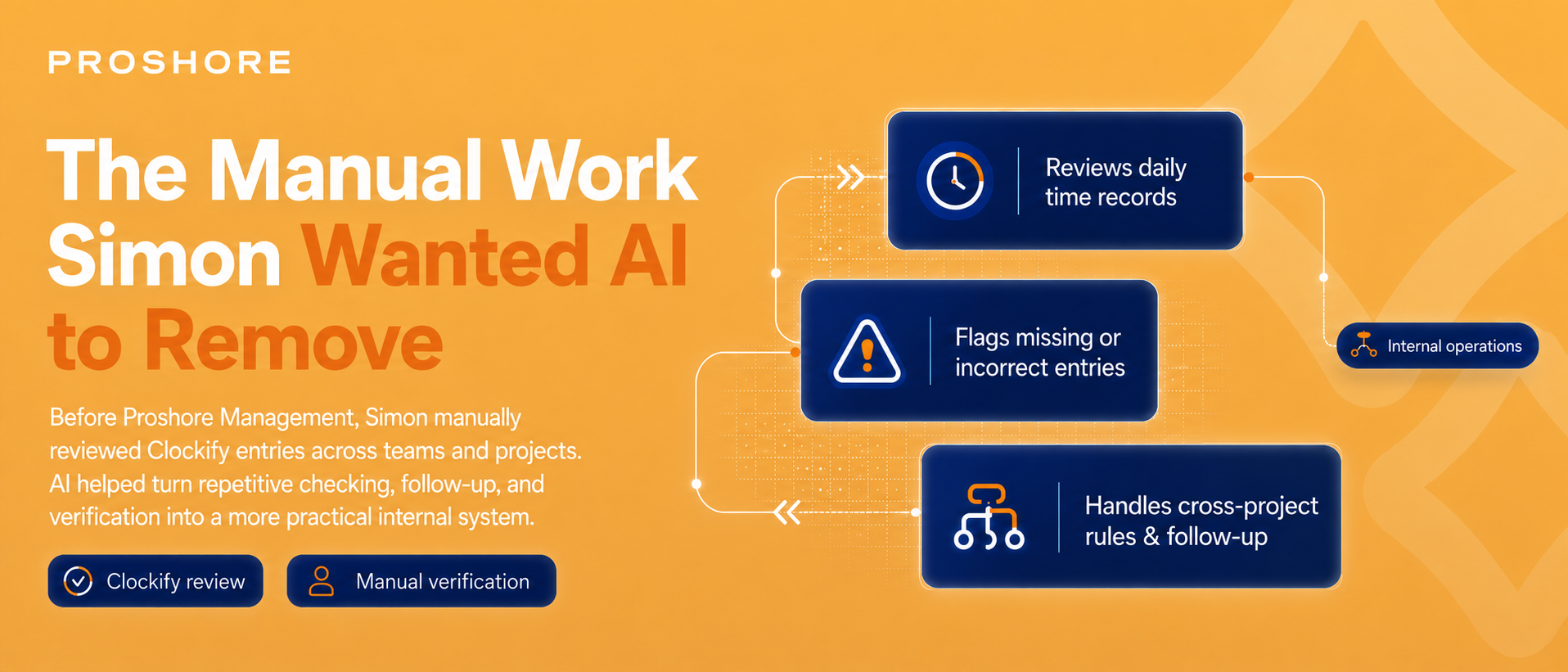
Before Proshore Management, Simon reviewed Clockify entries manually.
He had to review daily time records across every team and project, then identify missing hours or incorrect entries.
After finding an issue, Simon also had to contact the team member individually.
For a team of more than 10 people, the number of checks increased quickly. The work became even more demanding when Simon had to manage several teams with different project requirements.
The process also depended on team-specific rules, including different description requirements, cross-project time allocation, and role-based working patterns.
Simon wanted to reduce this repetitive work without creating an unreliable system that treated every unusual entry as an error.
Building the tool through the engineering team was not practical because developers were already focused on client delivery.
Simon understood the operational problem and had the technical foundation to solve it, even though development was no longer part of his primary role as scrum master.
But his technical background, combined with AI, helped him turn that experience into a working system without any pressure on other team members.
How Simon Used AI to Build Proshore Management
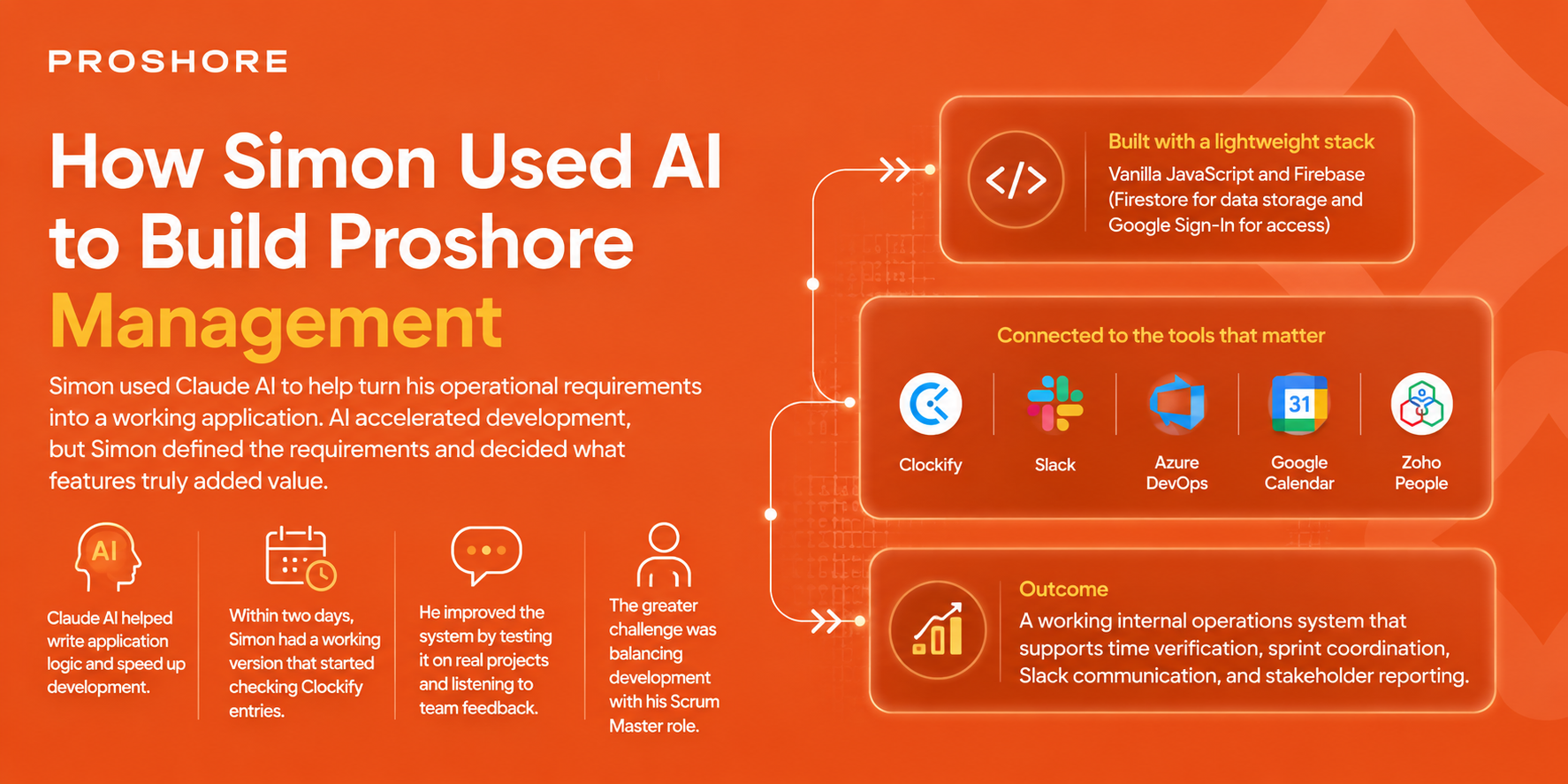
Simon used Claude AI to help turn his operational requirements into a working application.
He remained responsible for defining the problem, explaining the workflow, and deciding how the system should behave. Claude helped him write the application logic and move through development faster than he could have done alone.
This distinction shaped the project, and within two days, Simon had a working version that could begin checking Clockify entries.
He then continued to improve the system by testing it on real internal projects and listening to feedback from the teams using it.
The technical stack was kept lightweight. Simon built the tool with vanilla JavaScript and Firebase, using Firestore for data storage and Google Sign-In for access. He connected it with Clockify, Slack, Azure DevOps, Google Calendar, and Zoho People to support time verification and wider operational workflows.
The greater challenge was developing the system while continuing to manage multiple teams and complete his regular Scrum Master responsibilities.
AI sped up development, but Simon still had to define requirements and decide which features were valuable enough to add.
How the AI-Assisted System Works
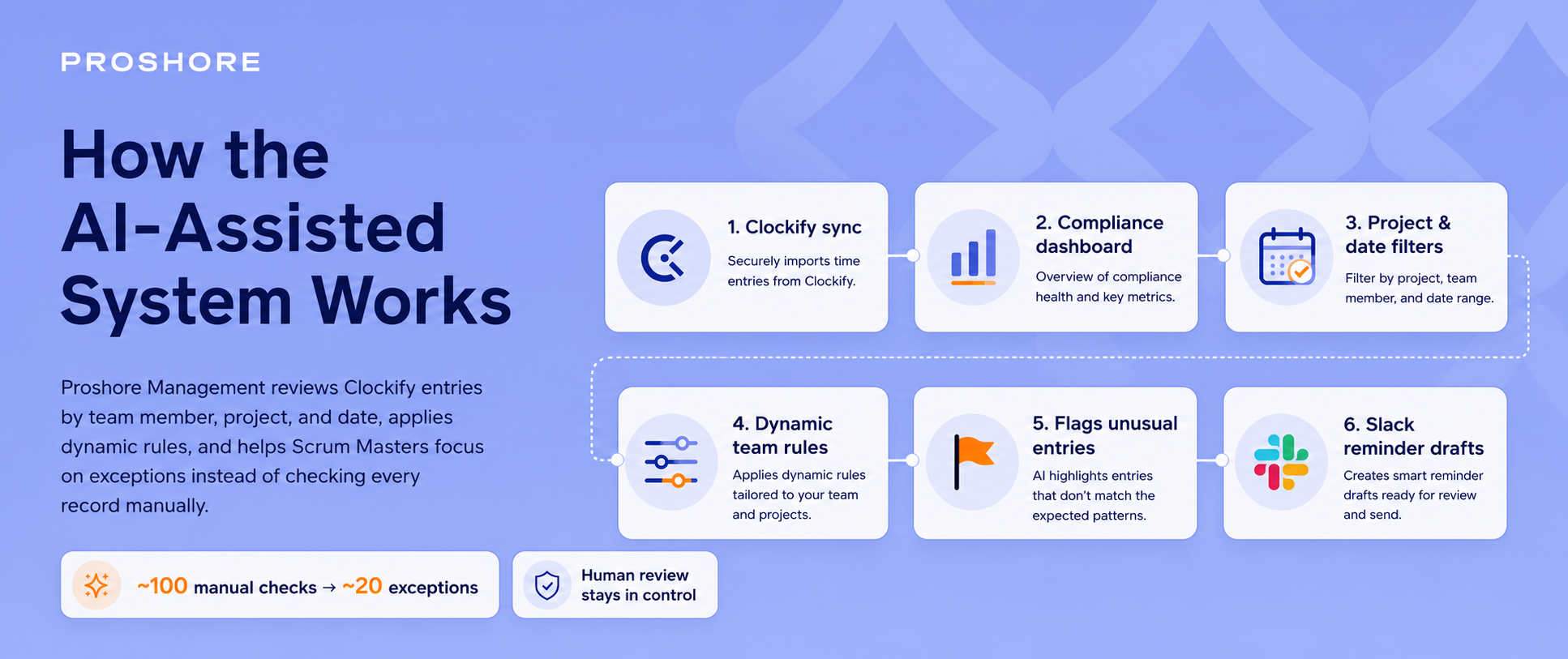
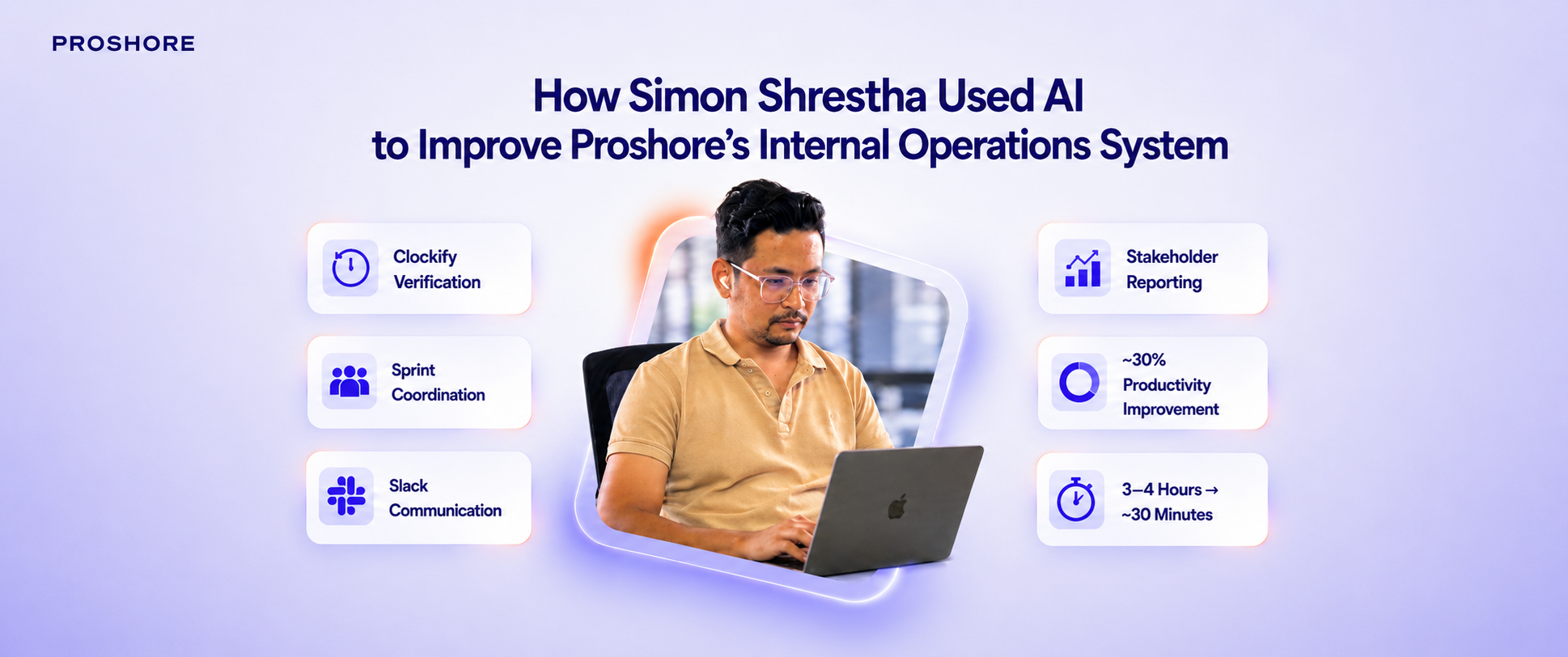
Proshore Management connects with Clockify and reviews time entries by team member, project, and date.
The system verifies time entries against project requirements and displays the results in a compliance dashboard for Scrum Masters and HR. Users can filter by project or date, while configurable rules adapt the checks to specific teams or working arrangements.
Simon made the rules dynamic because a single compliance standard would not work across every team.
A developer may be permitted to record time under multiple projects. A client may require a different description structure. One team may follow a working pattern that would appear unusual when compared with another.
Rather than allowing AI to guess whether those situations are acceptable, Simon defines the conditions inside the system.
The tool flags unusual entries for review instead of automatically treating them as errors.
Before Proshore Management, Simon might have needed to manually inspect around 100 entries. The system now performs the initial review and reduces the number requiring human attention to approximately 20.
Simon can focus on the exceptions instead of spending equal time on every record.
The system also supports Slack notifications. When someone has not logged their hours, it can prepare an individual direct message for that person. Simon can review and edit the message before it is sent. This keeps communication efficient without removing personal control from the process.
Expanding AI Across Simon’s Scrum Master Workflow
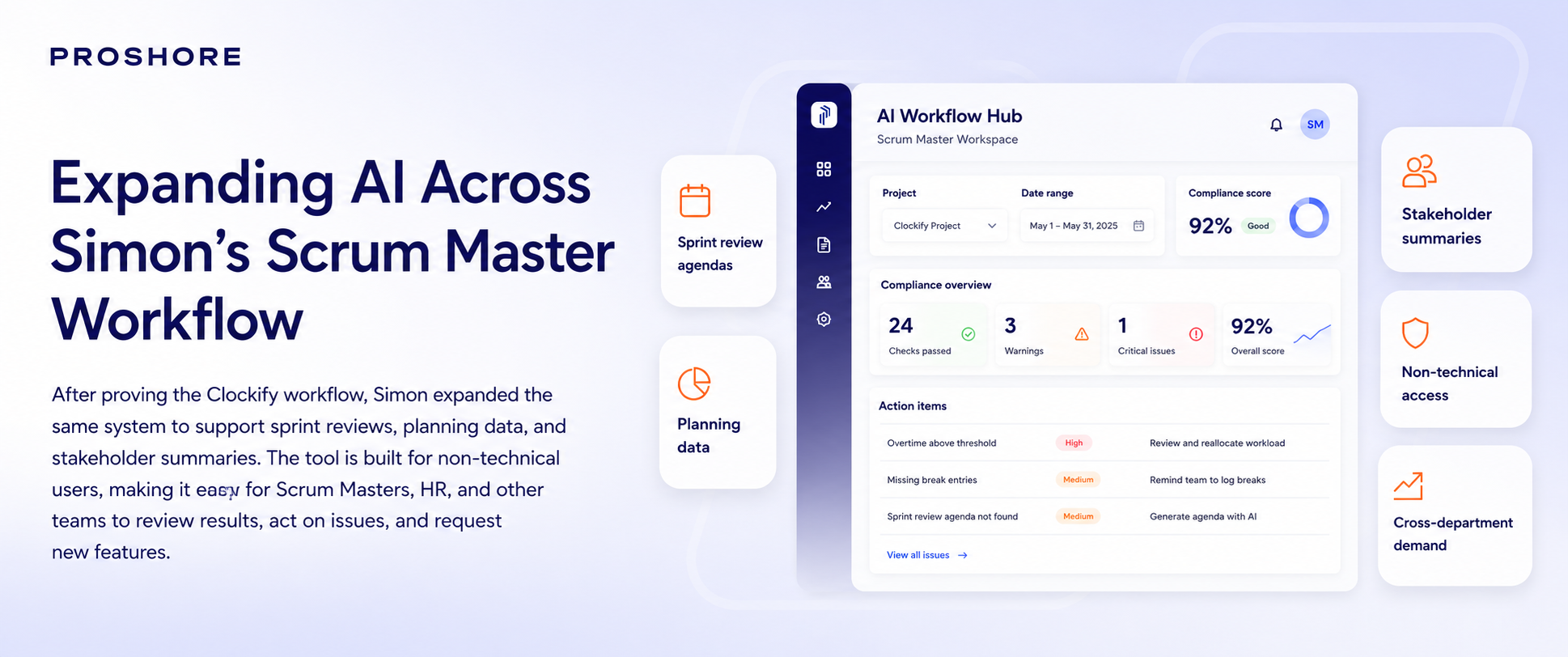
After proving the Clockify workflow, Simon began using the same system to solve other repetitive parts of his role.
The tool connects with JIRA or Azure DevOps to generate sprint review agendas, organize planning data, and prepare stakeholder summaries. This reduces the manual work Simon previously handled before and after each sprint review.
The tool was designed so Scrum Masters, HR employees, and other non-technical users could operate it without programming knowledge.
Users can select a project, choose a date range, review the compliance results, and act on the issues identified by the system. The APIs, databases, and application logic remain behind the interface.
That usability became increasingly important when other teams began asking Simon for access and additional features.
The first version had been built to solve Simon’s own operational problem. Internal demand indicated that the same approach could support cross-departmental work.
The Operational Impact of Simon’s AI Tool
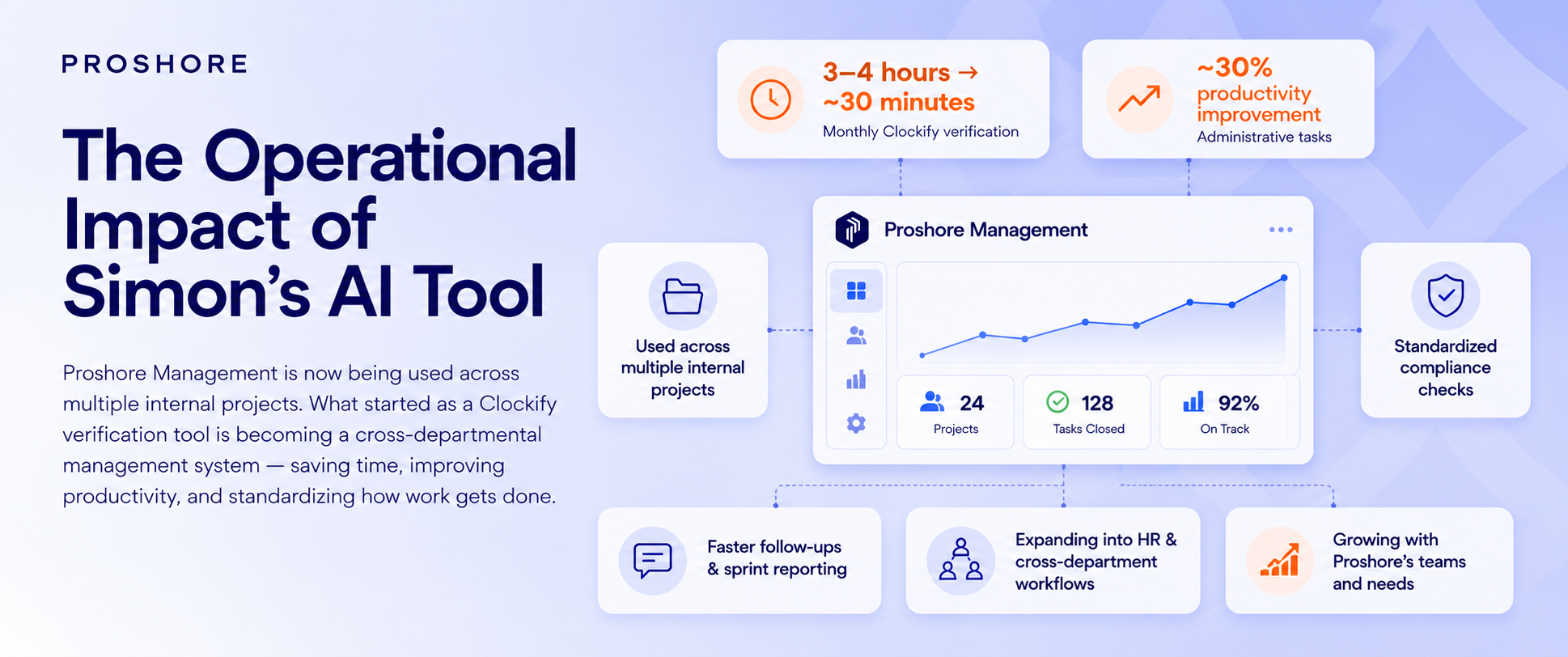
Proshore Management is now being used across multiple internal projects.
Before Simon built it, monthly Clockify verification could take around three to four hours. The process can now be completed in approximately 30 minutes.
The system has also contributed to an estimated 30 % productivity improvement across the repetitive administrative tasks it supports.
Beyond saving time, the tool standardizes compliance checks, speeds up follow-ups and automates sprint reporting. Continued feature requests from its users became the clearest proof that the MVP had succeeded.
Other teams began requesting new features. HR saw that the same platform could support its own internal processes. What started as a Clockify verification tool was becoming a cross-departmental system.
That response changed the direction of the product.
Simon chose the name Proshore Management because he did not want the system to remain limited to time tracking. He saw the potential for it to become a management platform that supports the company as its teams and operational requirements grow.
More people create more time entries, sprint records, performance reviews, leave requests, and communication requirements. Without a shared system, that work remains divided across spreadsheets, messages and separate tools.
Simon wants Proshore Management to become part of the foundation connecting those workflows.
What Simon Plans to Build Next With AI
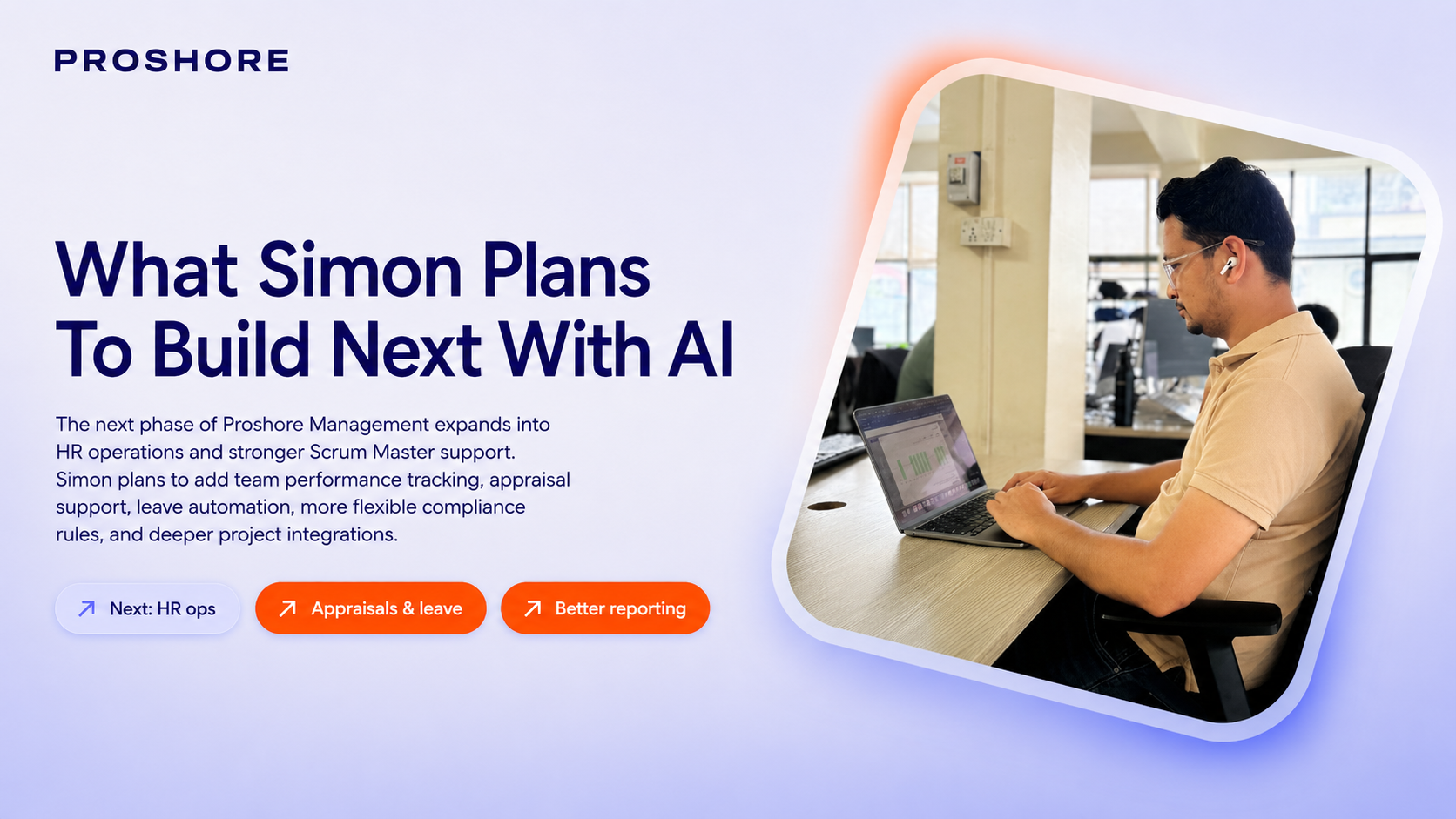
The next phase of Proshore Management will expand further into HR operations.
Requested features include team performance tracking, appraisal support, and leave automation. Simon plans to apply the same principle that shaped Clockify verification.
AI should handle repeated information collection and initial checks. The system should surface the cases that require attention. Final decisions should remain with the person responsible for the team or process.
Simon also plans to improve the existing Scrum Master features through more flexible compliance rules and deeper project integrations to strengthen reporting.
The goal is to remove the repetitive work around those decisions so Scrum Masters, HR teams and operational leaders can spend more time supporting people and improving delivery.
For Simon, the project has also been a return to his technical roots.
His Scrum Master role had taken him away from regular development, but AI gave him a way to use that background again.
He could identify an operational problem, design a product around it, and build the first version without depending on an available developer.
That independence expanded his role inside Proshore, where it became an example of how someone close to an operational problem can use AI to move beyond the limits of their formal role and create a capability that grows with the company.