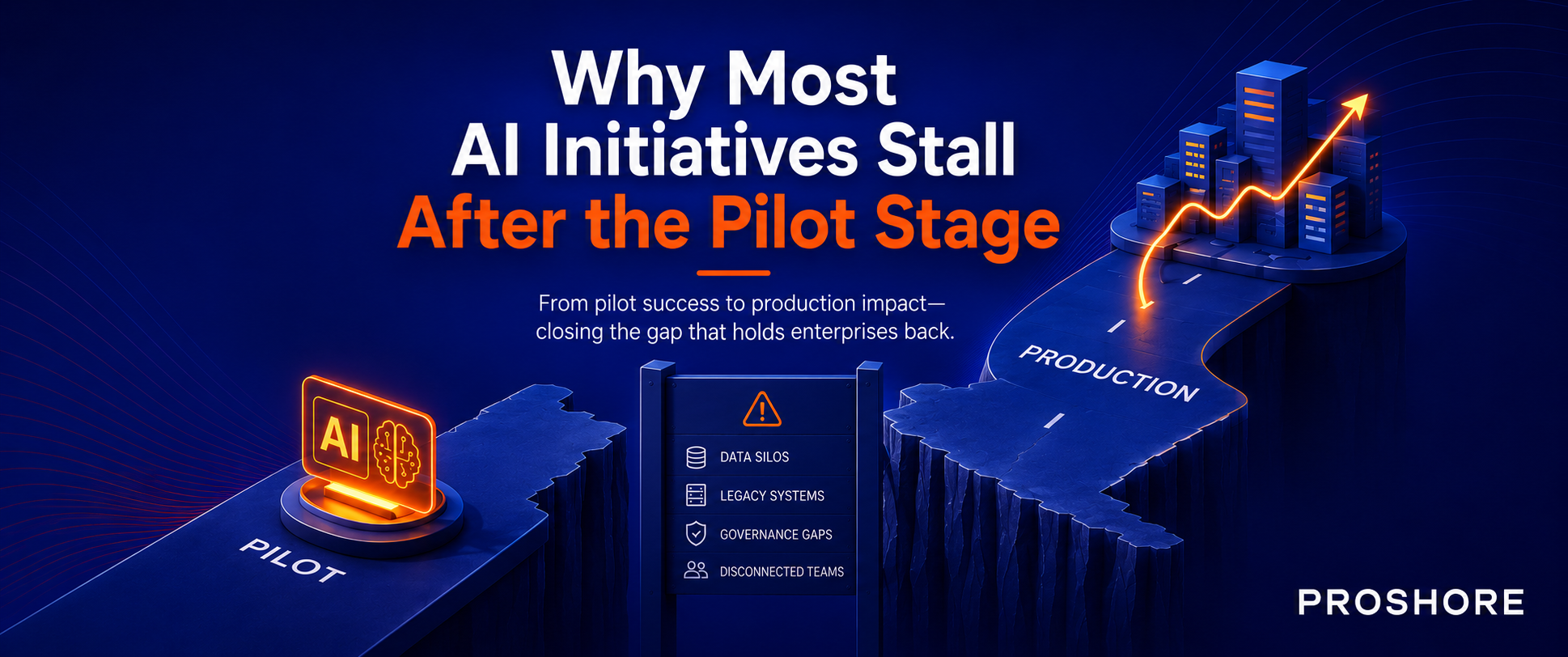
Why AI Pilots Are Easy, but Production AI Is Difficult
AI pilot success is routinely misinterpreted as enterprise readiness, with working models and proofs of concept treated as indicators of success.
In practice, experimentation outcomes do not translate into operational capability, as model accuracy does not ensure business integration, and prototypes do not function as production systems.
Most pilots produce isolated models, while enterprise value is realized only when AI is embedded into business decisions within live workflows.
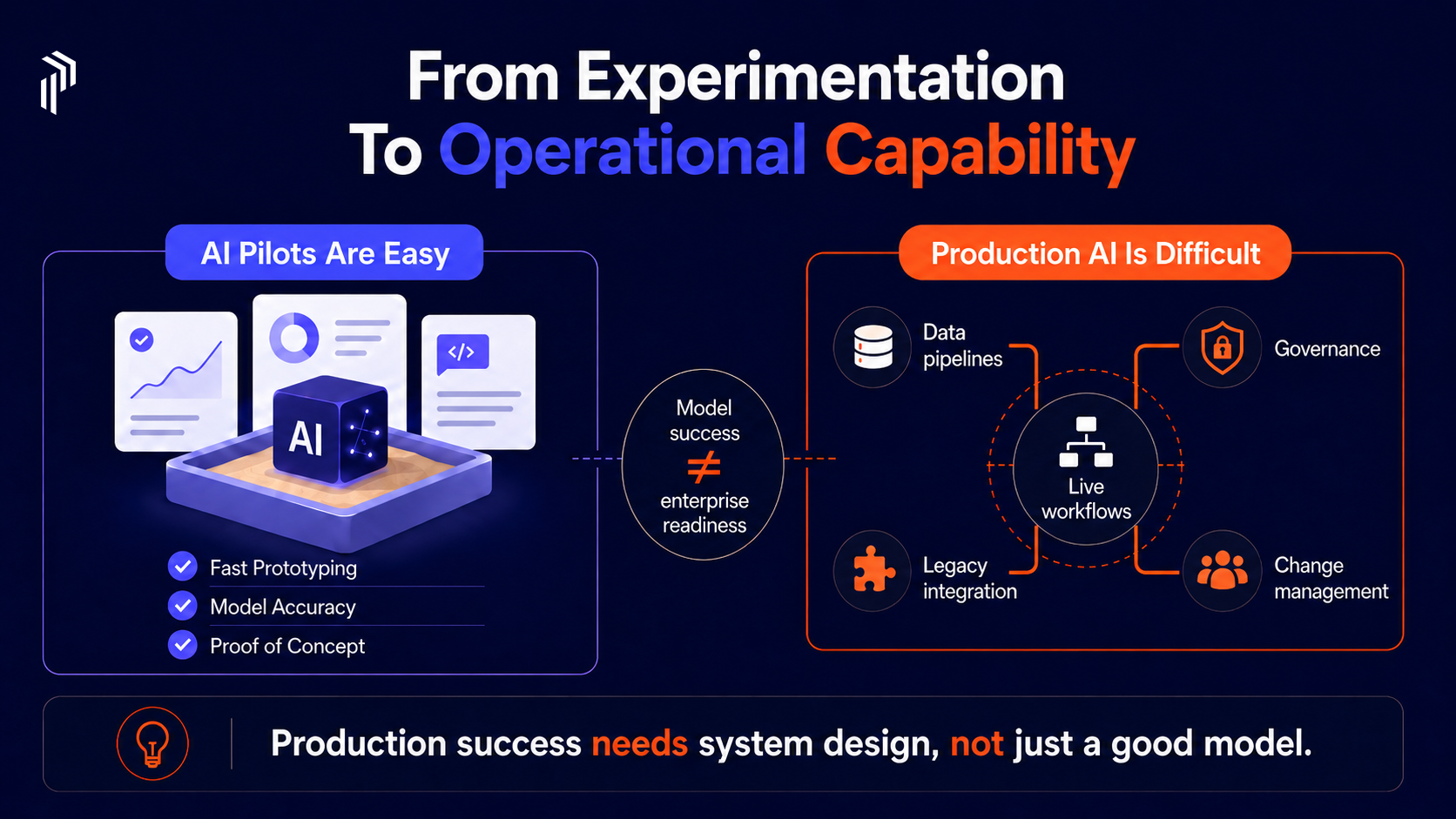
Production success depends on production-ready data pipelines, governance controls, change management processes, and repeatable execution mechanisms that extend beyond the model itself.
While rapid experimentation tools and cloud environments accelerate development, integration with legacy systems and cross-functional operations and data exposes underlying misalignment.
The limitation is rooted in a missing production system design rather than model development.
Structural Challenges Preventing AI Scaling
AI stalls reflect recurring patterns of systemic misalignment rather than technical failure.
Innovation teams operate in isolation, with ownership fragmented across data, IT, and business units.
Alignment with broader transformation programs is limited, and enterprise architecture does not support AI integration at scale.
Legacy systems impose structural constraints, and data pipelines lack production readiness.
Security and governance reviews introduce deployment bottlenecks due to late integration.
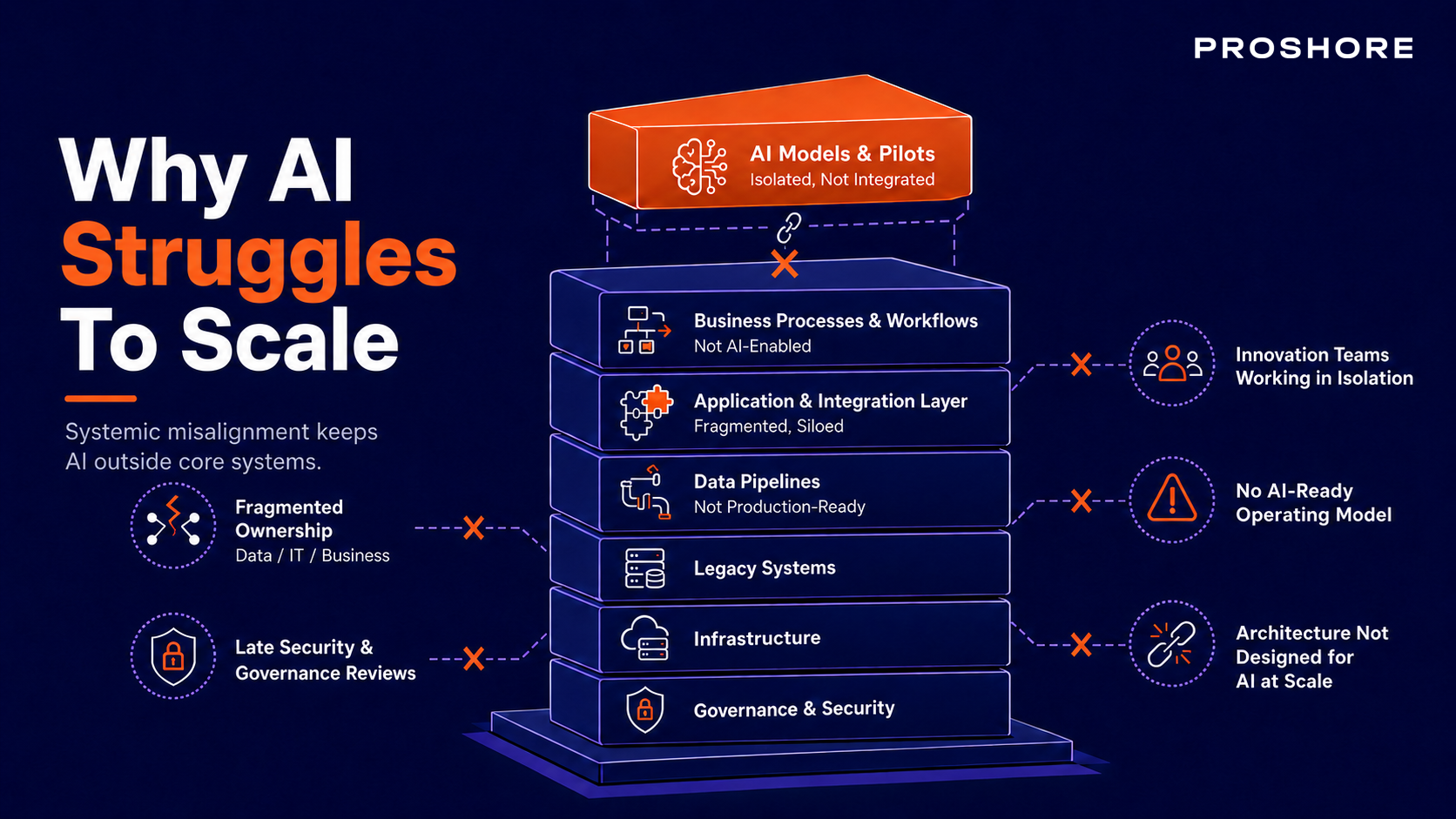
AI remains outside core systems instead of being embedded within them.
Scaling is constrained by the absence of an operating model and architecture that treats AI as a capability layer.
Organizations continue to equate capability creation in controlled environments with enterprise deployment.
These structural issues typically show up in four recurring patterns:
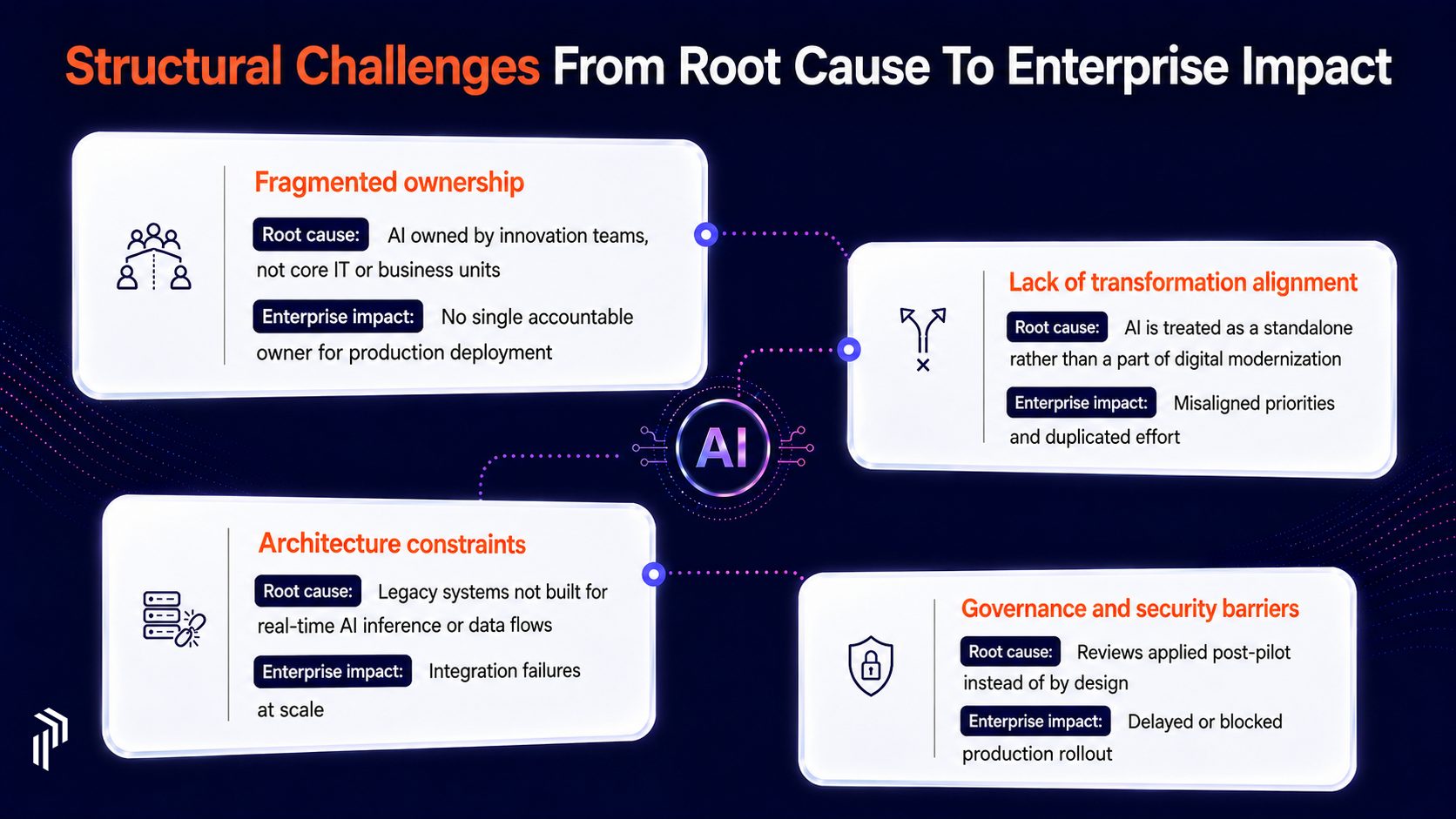
(Based on patterns in MIT’s GenAI Divide: State of AI in Business 2025 | McKinsey’s State of AI 2025, and related Gartner analysis)
The Cost of Fragmented AI Adoption
The disconnect between pilot optics and execution reality introduces compounding hidden costs.
Teams repeat similar experiments across business units without sharing learning or reusing them.
Investments are duplicated across functions.
Executive confidence declines as expected transformation value does not materialize.
This fragmentation manifests in the following hidden costs:
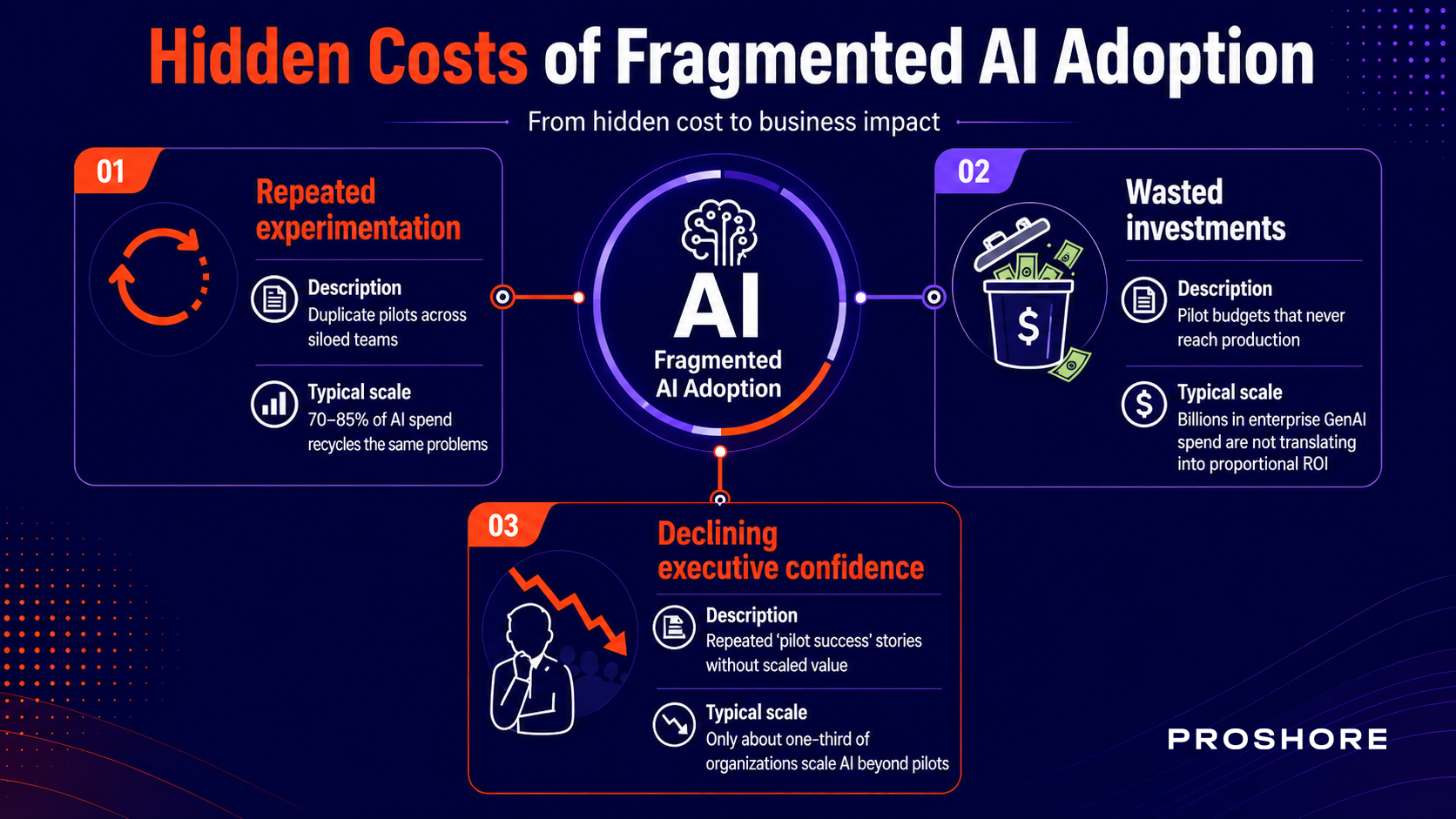
(Source: MIT’s GenAI Divide: State of AI in Business 2025 and McKinsey State of AI 2025)
A Better Approach to AI Adoption
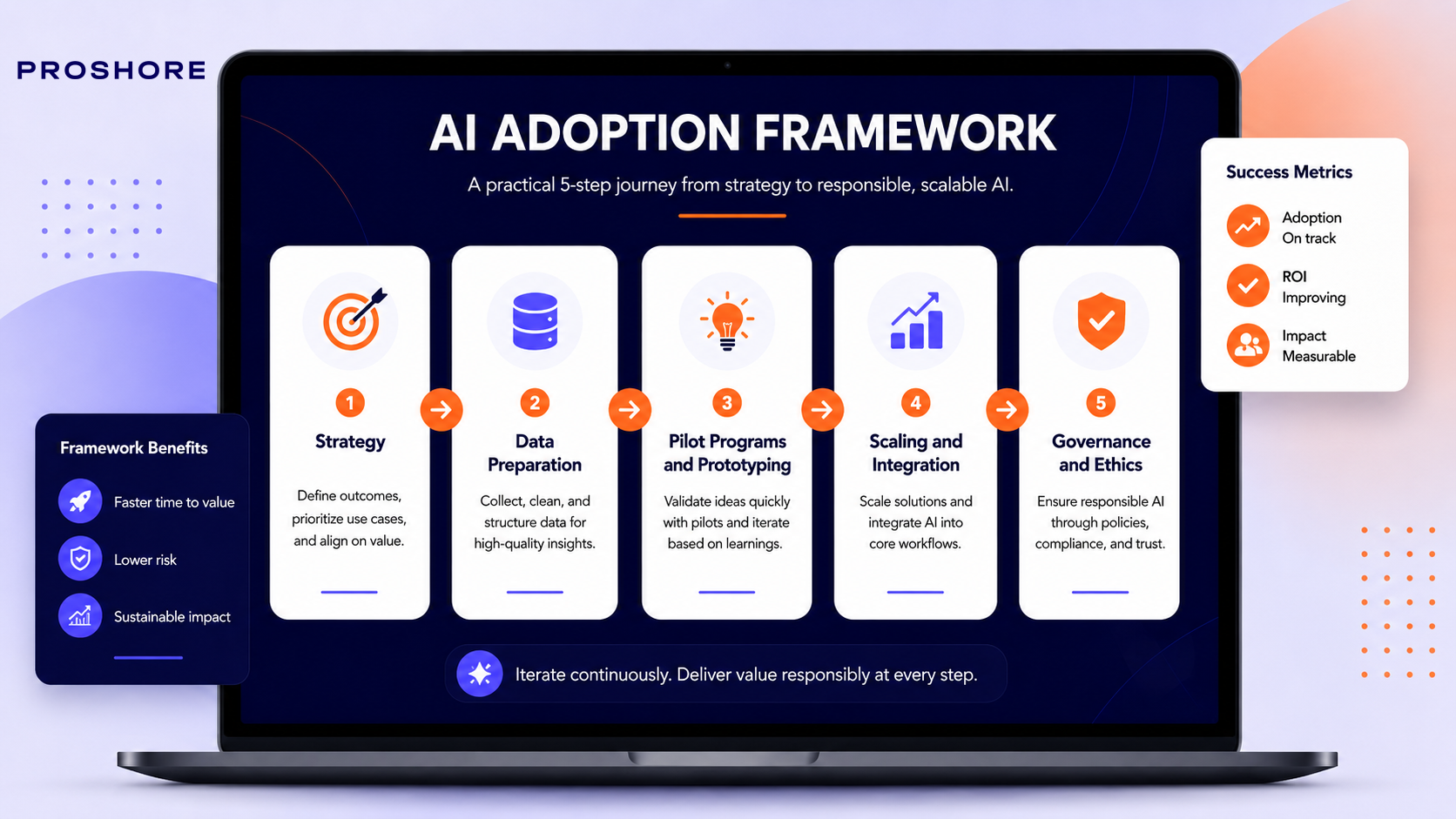
AI delivers value when positioned as a capability layer within existing transformation programs.
The operating model aligns AI with digital transformation, integrates it with cloud modernization and data architecture, and embeds it into core systems and workflows from the outset.
In this approach, architecture enables integration and scale, transformation programs drive delivery, and governance enables controlled execution.
This structure enables the transition from pilot activity to operational deployment.
What CIOs Should Look for in AI Programs
CIOs must evaluate AI programs through systems and governance alongside technology considerations.
The central question should often not be “Should we invest in AI?” but “Can our enterprise systems support AI at scale?”
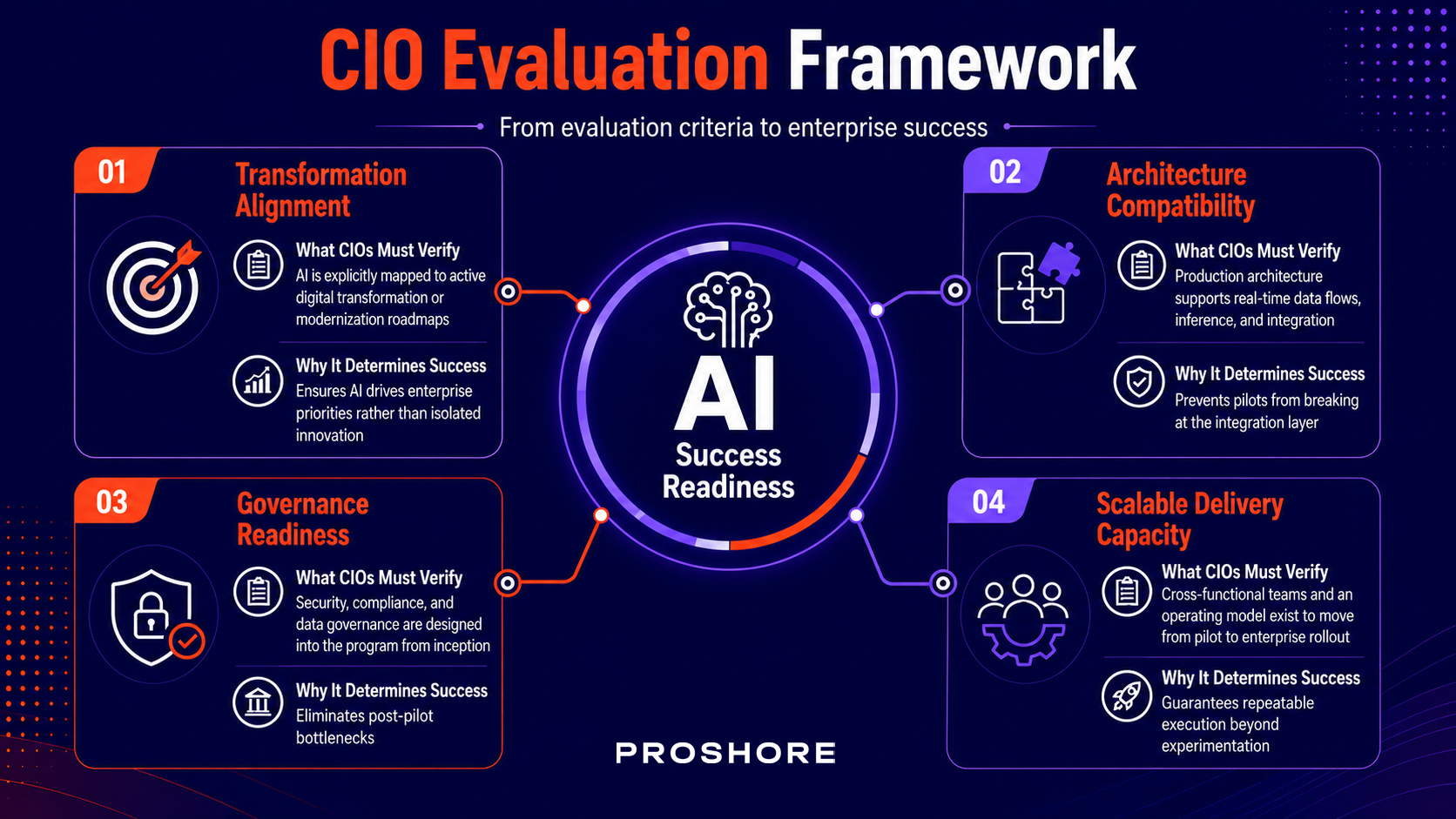
Proshore’s Role in Enterprise AI Execution
Proshore addresses the structural causes that prevent AI pilots from scaling by designing every implementation as a production system from the outset.
Instead of developing isolated models, Proshore integrates AI directly into enterprise workflows, data pipelines, and governance frameworks, ensuring alignment with transformation programs and core architecture.
At the same time, in Proshore AI is not only deployed within products but leveraged across the entire software development lifecycle.
Requirements are defined faster using AI-assisted interpretation and clear acceptance criteria. Prototyping and refinement cycles move quickly through rapid iteration and visualization, reducing back-and-forth and helping teams reach workable solutions sooner.
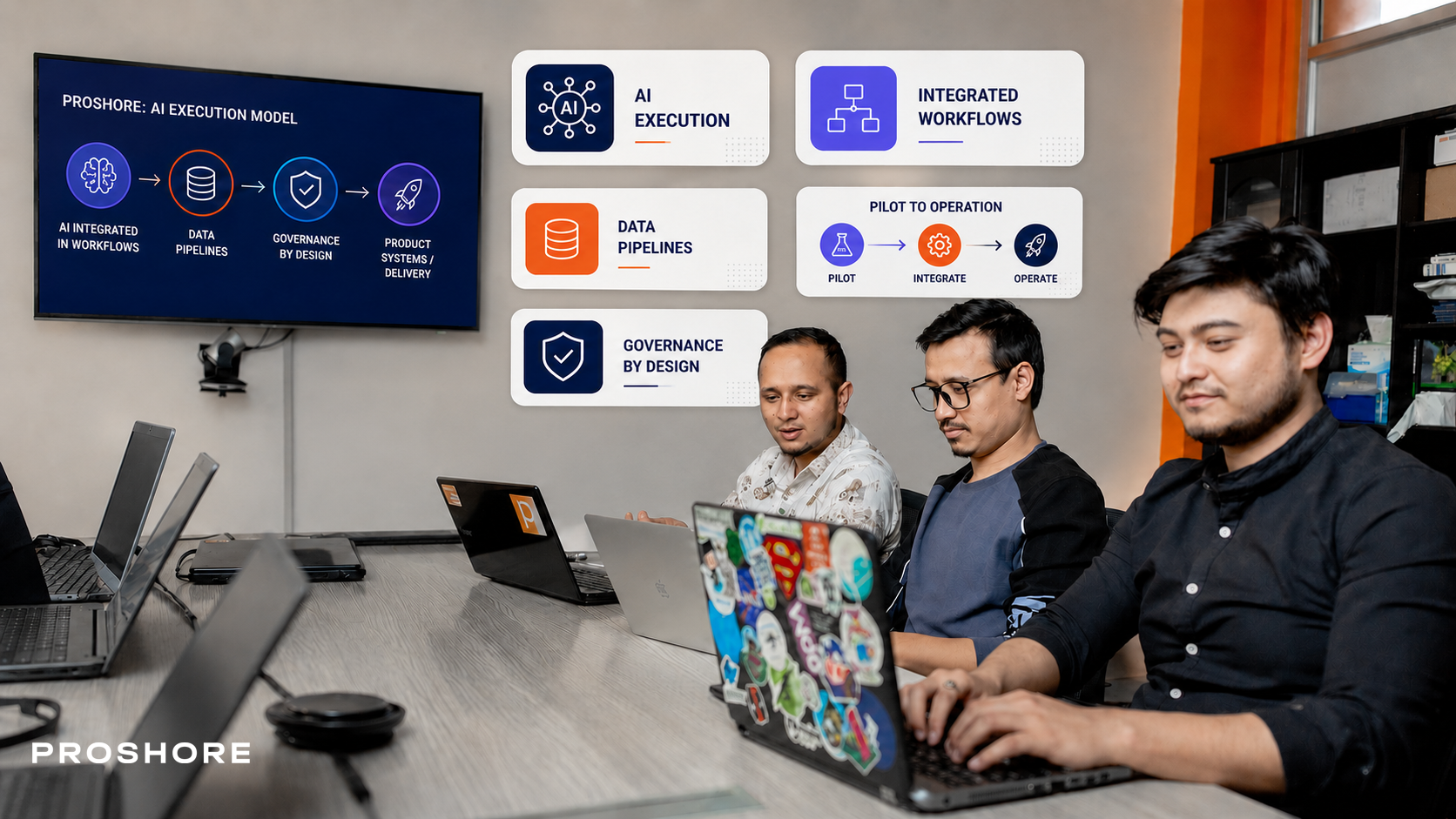
Crucially,Proshore operates within enterprise constraints. Private AI environments, DORA-aligned practices, and internal data standards are built into delivery from the start, ensuring compliance and consistency.
Prompt and context optimization keep costs predictable while maintaining performance across managed AI systems.
In practice, this approach is reflected in projects such as MerchPIM, where AI is embedded into product data workflows.
This enables enterprises to scale data quality and consistency across systems without creating parallel processes or manual dependencies.
Proshore aligns ownership, integrates with existing systems, and embeds governance in execution from the outset, preventing fragmentation and deployment bottlenecks that stall AI initiatives.
Conclusion
AI becomes valuable when it transitions from experimentation into operational capability.
The organizations that succeed are those that stop celebrating isolated pilots and start treating AI as an enterprise systems problem.
By aligning AI with transformation programs, addressing architecture and governance as first principles, and building repeatable execution models, CIOs can move beyond pilot purgatory and deliver the enterprise value their investments were always intended to create.
The technology is not the constraint. The operating model is.


Product development takeaways
How Proshore brought AI assistance into interviewstream
When interviewstream saw a chance to use AI to enhance the interview process in a positive and ethical way, they turned to our remote dev team.
Book a call
Talk to Jeroen, our Accounts director, to see if our ready-to-code dev teams are a fit for you.
Recruitment platform, interviewstream, has a strong suite of tools to simplify the hiring process and optimize the candidate experience. They also have a pre-existing partnership with Proshore.
So when interviewstream’s forward-thinking CTO, Ryan Royal, saw an opportunity to use AI to enhance the interview process in a positive and ethical way, he turned to Proshore to help ideate, iterate, and launch new functionality – in a matter of weeks. Here’s how it happened.
Proshore had a quality approach and a good philosophy about development, and about providing development services. We felt they were really trying to understand our needs, and expressed that back to us.
Faith Peterson, interviewstream
Principal Product Manager

How to introduce AI in recruitment without enforcing bias?
Right now, almost everyone in the tech world and beyond is talking about ChatGPT and the use of AI in general. There’s no question that it’s going to be a game-changer. The question is: how are companies going to use it ethically, and to their advantage?
This dilemma is especially true in the recruitment industry, where legislation introduced in the state of New York in 2023 prohibits the use of automated employment decision tools (AEDTs) unless a bias audit has been conducted. That’s to avoid unintended bias as a result of machine learning (ML).
At the same time, recruitment is first and foremost a people business. Technology needs to support and enhance human expertise, and not diminish or try to replace it. For these reasons, introducing AI into the recruitment process requires careful consideration and execution.
Ryan Royal and the team at interviewstream had been looking at the potential of AI for some time. However, due to their product’s focus on the screening and evaluation of candidates, they wanted to ensure that any new AI feature did not introduce or reinforce bias in that process.
What they needed was AI-driven functionality that could add value for recruiters but avoid some of the pitfalls associated with its use in recruitment. That’s when Ryan pitched the idea of AI-generated interview questions.
Playing around with ChatGPT, Ryan and Principal Product Manager, Faith Peterson, sketched out an idea for the new feature. All they need was a highly-skilled and experienced development team to build it.
Proshore had a quality approach and a good philosophy about development, and about providing development services. We felt they were really trying to understand our needs, and expressed that back to us.
Faith Peterson, interviewstream
Principal Product Manager
AI interview question assist feature
It was important for interviewstream that when they brought in AI functionality it had an obvious benefit to their customers, it was aligned with their company values, and also met the highest ethical standards. And this use case fitted the bill.
At the time, Proshore’s development team as a service was the only one working on enhancements to interviewstream’s core platform. It’s a role that gave them total responsibility for the new capabilities of interviewstream’s customers. That naturally grew to encompass the new AI Interview Question Assist feature.
When the partnership first began, the Proshore team was used to quickly adapting to changing priorities and business needs. And they were genuinely excited to get started on the new AI feature. Right away, they conducted an initial evaluation and started experimenting with the OpenAI API.
When Faith said interviewstream wanted to add AI functionality, the whole team were really excited. The enthusiasm level was high!
Viraj K. Shrestha, Proshore
Scrum Master

To make innovative use of AI within interviewstream the Proshore development team needed to learn new skills and knowledge – which they did. In fact, every person on the development team – Santosh, Anand, Madhusudhan and Shyam – put time into the research, going through the documentation to discover the best ways to build out the functionality. This gave everyone on the team their own perspective, so they could help each other and quickly generate solutions to any issues that arose.
During the development phase, there was a strong collaboration between interviewstream’s Product Owner and the Proshore team. Within a couple of days, Proshore had a proof of concept. From there, it was a case of working on how to best express the functionality. Working alongside interviewstream, the Proshore team iterated on the fundamental idea of giving users guidance on prompt construction for the AI in order to generate usable, targeted interview questions. The output was ten targeted questions for recruiters to add to a question bank, or include in their next interview.
Thanks to Proshore, it took just three weeks to go from ideation to production. That’s largely because the team were able to quickly adapt, quickly understand the tech, quickly implement the proof of concept, then quickly establish and iterate on user interface (UI) ideas.

How Proshore's dedicated team, with PHP experts, handled the UI improvements and UX enhancements required by interviewstream's product – a feature-rich platform operating since 2002.
Read case study
Our CEO and Sales team were thrilled. They made a big announcement and included AI Interview Question Suggest in our new feature round-up. Proshore followed up in just one more sprint to release a feature update with more cues and improved functionality around results. It was all the iteration and partnering I hope for when working in classic ‘big A’ Agile style.
Faith Peterson, interviewstream
Principal Product Manager
Continually improving the AI feature
As a result of their partnership with Proshore, interviewstream has a new AI-driven feature that’s available to customers. As interviewstream continues to iterate on the functionality, Proshore team members, including Web Developer, Santosh Pandey, bring new ideas to the table.
One of those ideas was to add ‘request history’ so that recruiters can make use of previous requests – without having to save or download AI-generated content. The team has also added download and clipboard functionality, making it easier for recruiters to incorporate the content into their interview processes.
As the partnership continues, there’s strength in collaboration. Together, interviewstream and Proshore are taking the business problem and combining ideas from the product management, and the developers to create the best possible solution.
Off the back of the success of AI Interview Question Assist, interviewstream is looking for further opportunities to ethically incorporate other AI functions into its offering, with the expertise of a Proshore development team as a service.
Something I’ve really come to value about the Proshore team is that they really bring creativity to the table.
Faith Peterson, interviewstream
Principal Product Manager
Looking for a highly skilled and cost-effective offshore software development team? Book a call.