AI has made code generation dramatically faster. Writing code still represents only part of the time required to move an engineering task into production.
Across Proshore’s engineering work, teams spend significant time understanding a change before implementation and validating it before delivery.
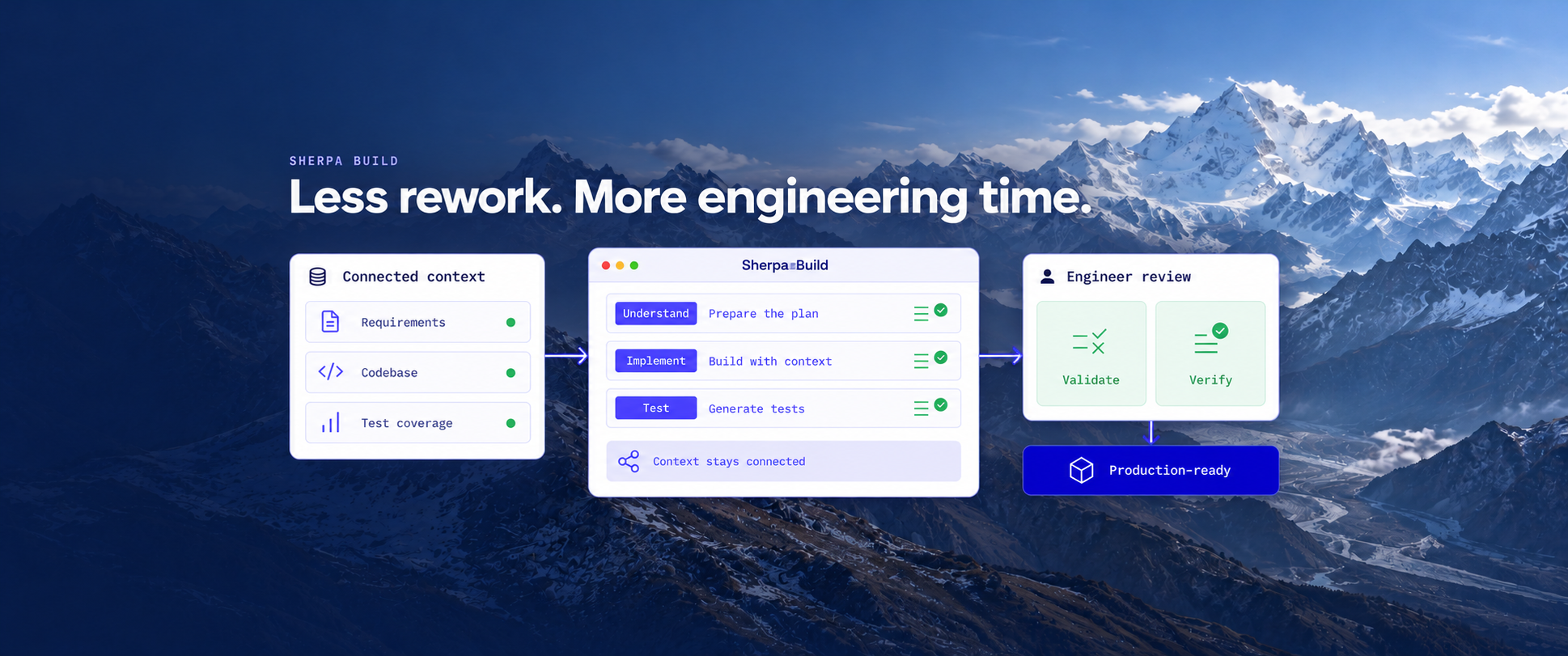
Sherpa Build applies AI across that surrounding work while keeping engineering judgment with experienced engineers.
The useful question is broader than how quickly AI can generate code:
How much engineering time can be removed from the path between a problem and a production-ready change?
Where Does AI Actually Save Engineering Time?
A development ticket can appear simple because the visible output may be a relatively small code change. The work required to reach that change can be much larger.
Before implementation begins, an engineer needs enough context to understand where the request fits within the existing system. Missing context can turn a straightforward ticket into hours of investigation.
The same issue appears later during testing and review. Each person involved needs enough understanding of the change to judge whether it works correctly within the existing product.
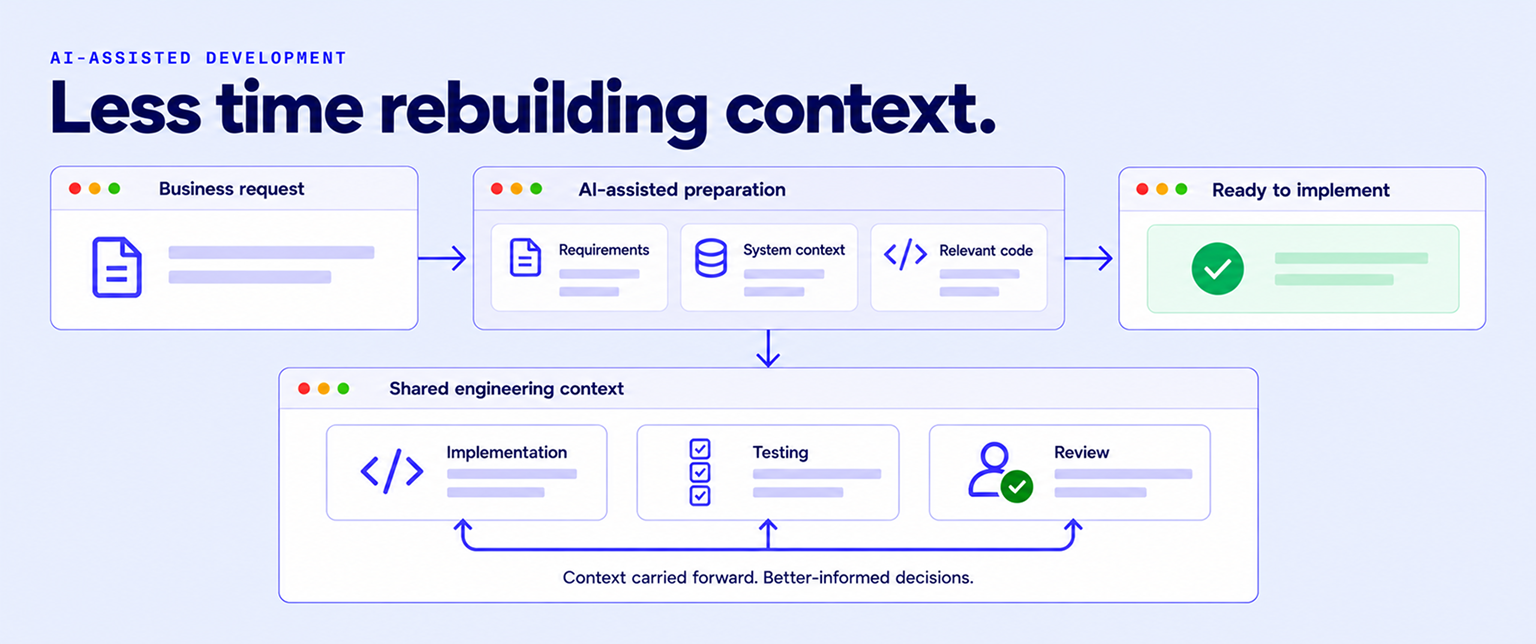
A bigger opportunity lies in reducing the context engineers repeatedly rebuild as work moves through delivery.
A meaningful amount of effort also sits between a business request and work that is ready for implementation. A requirement may describe the desired outcome while leaving the technical path unclear.
AI can reduce some of that preparation by bringing relevant engineering context closer to the task earlier in the process.
The strongest productivity gain comes from shortening the path to a good engineering decision.
What Did Proshore Learn From AI-Assisted Testing?
Proshore’s Senior .NET Developer Saiman Khatiwada began developing an AI testing agent after seeing how much effort could be spent before useful testing even started.
Requirements were sometimes fragmented across the project, which meant the developer responsible for testing first had to understand what the feature was supposed to do and how the existing code supported it.
That investigation shaped a simple principle for the experiment:
The AI needed to understand the project before it generated tests.
Without enough project knowledge, technically valid tests could still protect the wrong behavior or miss the scenarios that mattered most.
Saiman’s agent began building working memory around a defined feature so the system clearly understood the area it was supporting.
That memory connected the feature with its supporting code and existing test coverage.
With that foundation in place, the agent could prepare a test plan that reflected the feature more accurately. The developer reviewed that plan before the agent generated tests.
How Does Sherpa Build Turn AI Productivity Into Engineering Capacity?
Faster coding alone does not create more delivery capacity.
Google Cloud’s 2025 DORA research makes the same distinction. Its research on AI-assisted software development found that individual productivity gains create more value when the surrounding engineering system can turn that saved effort into greater delivery capacity.
Proshore engineers work within the client’s existing engineering environment, with Sherpa reducing the effort around work that can be accelerated reliably. The engineering time recovered can then move toward work that needs deeper technical judgment.
Sherpa Build applies that principle across delivery at a broader scale. Proshore adds experienced engineering capacity, while AI helps that capacity go further within the client’s existing roadmap.
For teams already constrained by available engineering time, the result is practical: more of the roadmap can move forward with the capacity already around the product.
What Happens When AI-Assisted Development Scales?
DPL shows what this approach looks like at scale.
Since 14 April 2026, Sherpa has taken 652 DPL tickets through to pull requests without engineers manually writing the code.
Based on the manual effort those tickets would otherwise have required, Proshore estimates that Sherpa saved approximately 2,500 engineering hours, equal to about 3.8 hours per ticket across the reported work.
Saving several hours on an individual ticket creates a small productivity improvement. Repeating that reduction across hundreds of tickets creates engineering capacity that can materially affect delivery.
As AI reduces implementation time, more engineering work can reach review within the same period. Validation therefore has to support the faster flow of changes.
Experienced engineers remain responsible for deciding whether a change is ready for production.
This makes engineering throughput a more useful measure than generated code volume.
The real question is how much validated work a team can move through delivery with the capacity available. The gain becomes meaningful when the full path to a production-ready change becomes shorter.
That is where AI-assisted development begins to affect the economics of software delivery across the team.
Where Could Sherpa Build Add Capacity?
For engineering teams, the useful question becomes:
Where is your team spending engineering hours on work that AI could help reduce?
Sherpa Build helps turn repeated engineering effort into usable delivery capacity.
Want to explore where Sherpa Build could give your engineering team more usable capacity?

For more than 15 years, Proshore has worked with enterprises whose software has evolved alongside the business.
As those systems mature, change often becomes harder, and routine work starts to take longer.
Engineers spend more time rebuilding context, releases carry more risk, and seemingly small requests can uncover far more complexity than the roadmap suggests.
That growing cost of change is one of the clearest signals that modernization deserves attention.
Modernization should start where that friction is highest, not simply where the technology is oldest.
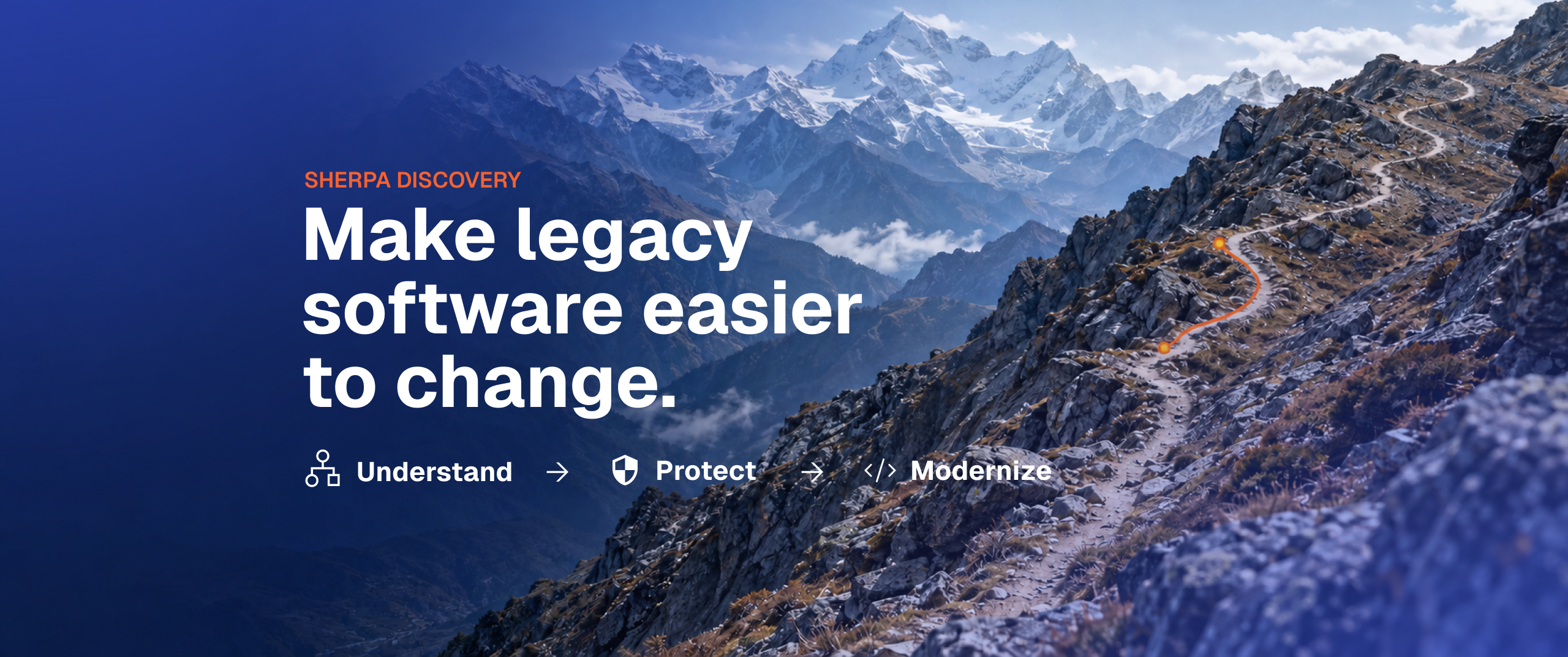
AI can lower the cost of change by reducing the effort required to understand the system before touching it.
Where Does Legacy Software Become Expensive to Change?
Modernization plans often begin with the technology that needs replacing.
The harder work often comes first. Engineers need an accurate picture of how the system actually works. Existing documentation may no longer provide that picture.
Teams also need confidence that changes won't break existing behavior. Weak tests and limited production visibility make even straightforward modernization risky.
That friction shows up in everyday engineering work. Developers spend days rebuilding context before making a change. Releases repeatedly stall around the same part of the system.
Two questions help expose where the real cost sits:
- How much effort does this part of the system consume when it changes?
- What product progress is that effort delaying?
A ten-year-old service that runs reliably and rarely changes may not be the modernization priority. A newer component that repeatedly slows delivery may carry a much higher cost of change.
Why Does Legacy Software Take So Long to Understand?
One of the most expensive parts of working with legacy software is rediscovery.
A ticket may describe the change, but engineers still have to rebuild the surrounding context before they can act safely. The real work is understanding what sits around the change and what it could affect.
Across hundreds of tickets, that investigation becomes a major engineering cost.
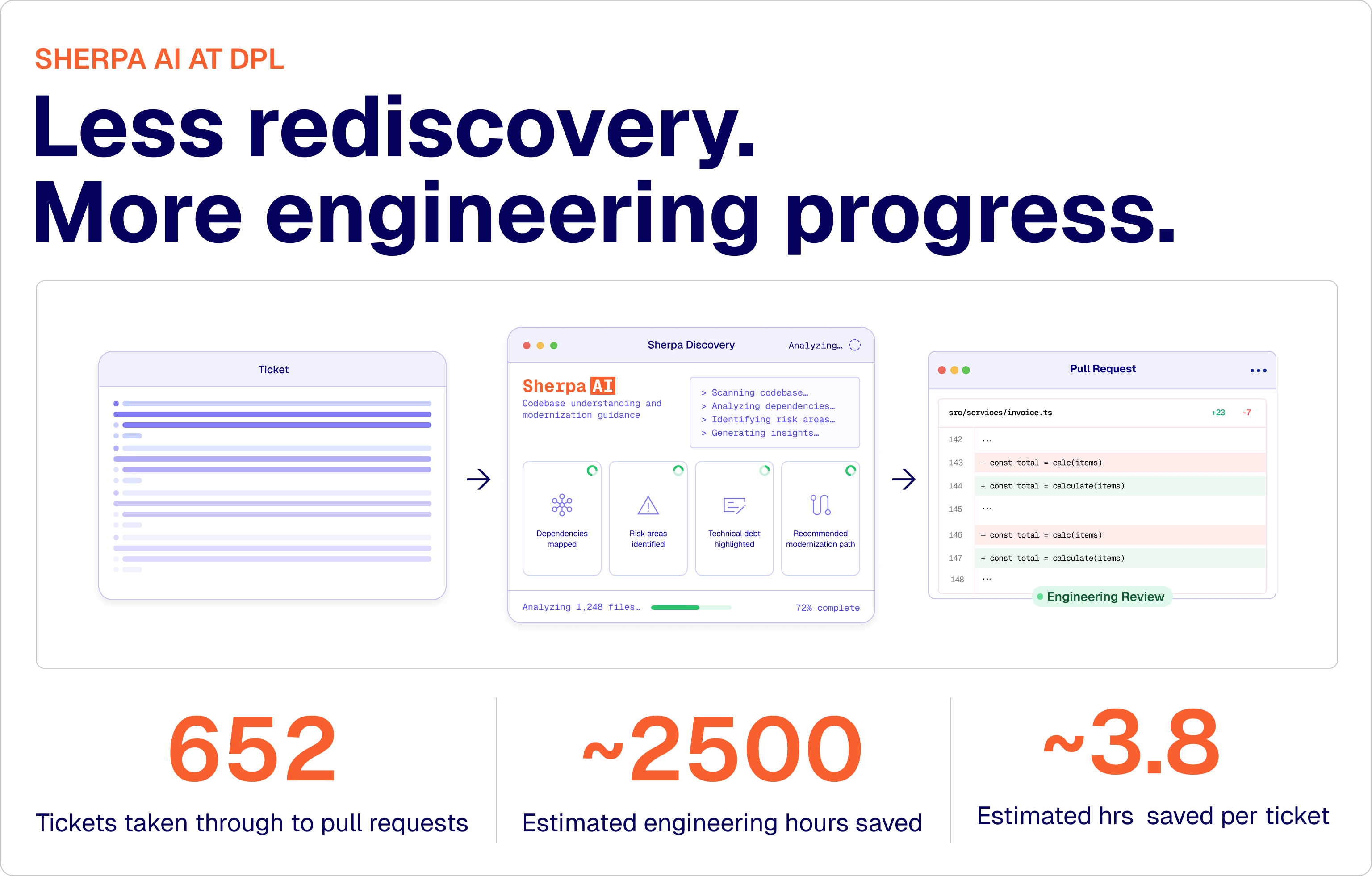
At DPL, Sherpa AI keeps the engineering context connected as a ticket moves toward a pull request.
Since 14 April 2026, Sherpa AI has taken 652 DPL tickets through to pull requests without engineers manually writing the code.
Based on the manual effort those tickets would otherwise have required, Proshore estimates that Sherpa saved approximately 2,500 engineering hours, or about 3.8 hours per ticket.
The biggest savings aren't just in writing code. It is in reducing the work needed to understand the change.
How Can AI Speed Up Legacy Modernization Without Increasing Risk?
Faster implementation matters only when teams can trust the changes they are shipping.
Google’s 2025 DORA research found widespread productivity gains from AI while warning that weak engineering practices can become more visible as AI adoption grows.
That risk is higher in mature systems, where a seemingly isolated change can affect parts of the product far beyond its original scope.
Sherpa Dsicovery treats validation as part of the modernization work, not something added at the end. Teams need enough test coverage to know when a modernization change breaks existing behavior.
At Psyflix, Proshore moved the platform from Next.js 12 to Next.js 16 in 1.5 months with two developers. The modernized application reached 71% automated test coverage.
Developer ramp-up also fell from roughly one to two months to one to two weeks.
How Much of a Legacy System Should You Modernize at Once?
Modernization is often treated as a problem that requires changing the whole system.
Proshore calls the alternative a change boundary: the smallest meaningful part of the system you can improve without destabilizing the rest of the product.
That might mean upgrading the frontend while leaving the underlying platform untouched.
Smaller boundaries matter because modernization happens while the product is still running. An effort that consumes too much engineering capacity can slow the rest of product development.
AI makes smaller modernization cycles more practical by reducing the work required before each change. Teams can modernize one boundary and use the result to decide what comes next.
The measure that matters is whether the system becomes easier to change afterward.
The next meaningful change should take less effort than the last one.
Not Sure Where to Start With Legacy Modernization?
A Sherpa Discovery Scan gives Proshore and the client team an early view of where the existing system is creating the most friction, what dependencies surround those areas, and which modernization opportunities deserve attention first.
Want to see where your legacy software is making change harder than it needs to be?

For more than 15 years, Proshore has been helping organizations develop and modernize software through long-term engineering partnerships.
Across 20+ clients and more than 200 projects, Proshore has spent years solving problems that faster coding alone cannot solve.
The harder work has been understanding complex systems, protecting what already works, and modernizing them without disrupting the business they support.
As AI began changing software development, Proshore saw an opportunity to apply it to the harder engineering problems its teams were already solving.
Proshore’s teams already understood their clients’ architecture, business context, delivery processes, and production environments.
AI could help them act on that knowledge faster, automating repetitive work, accelerating investigation, and increasing engineering capacity without removing human judgment or accountability.
That thinking became Proshore Sherpa.
AI Beyond Code Generation
Sherpa is Proshore's AI engineering capability, combining AI agents, enterprise tooling, and experienced engineers across the software delivery lifecycle.
Sherpa applies AI across four areas of software delivery: Legacy, Build, Launch, and Pulse.
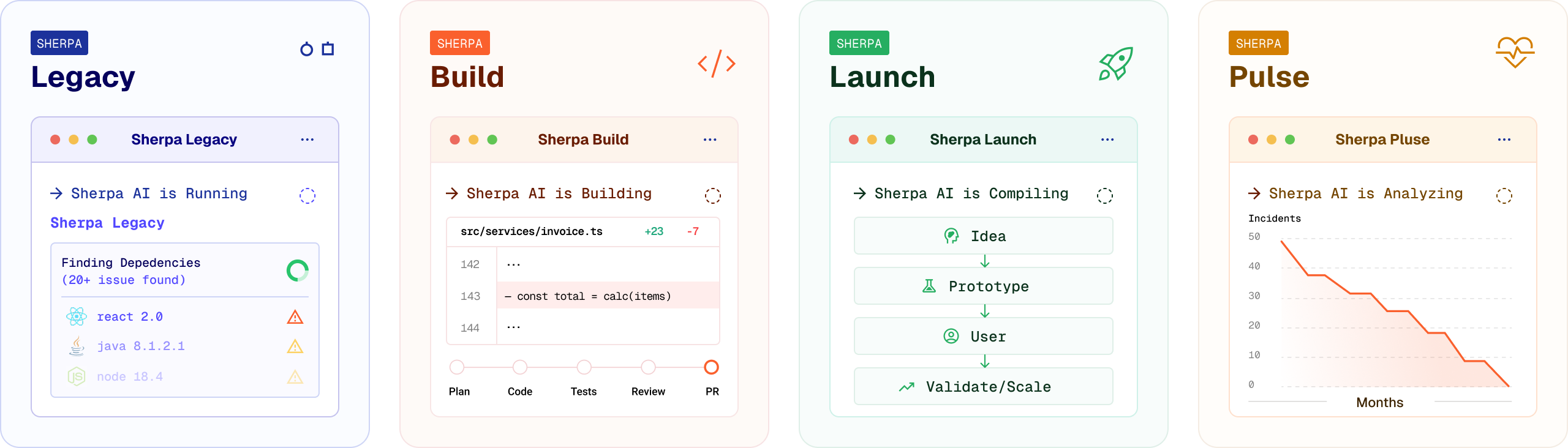
Sherpa Legacy focuses on modernizing complex existing systems. Legacy software often contains years of business logic, integrations, and dependencies, making wholesale replacement expensive and risky.
Sherpa helps teams map those dependencies, strengthen documentation and testing, determine which parts of a system can be modernized, and how to modernize them safely.
Sherpa Build brings AI into the development workflow, supporting planning, implementation, testing, and documentation. Engineers remain responsible for architectural decisions, verification, and production readiness, with the goal of moving work from planning to release more efficiently.
Sherpa Launch focuses on AI experimentation. Teams can identify a specific business problem, build a working pilot, and evaluate its technical and commercial potential before committing to a larger investment.
Sherpa Pulse extends the model into production. It connects signals from product, QA, customer support, and engineering into a continuous feedback loop, helping teams turn production issues, customer feedback, and quality findings into fixes and improvements.
Together, Legacy, Build, Launch, and Pulse extend Sherpa from existing systems and new development through experimentation and continuous product improvement.
What the Early Results Show
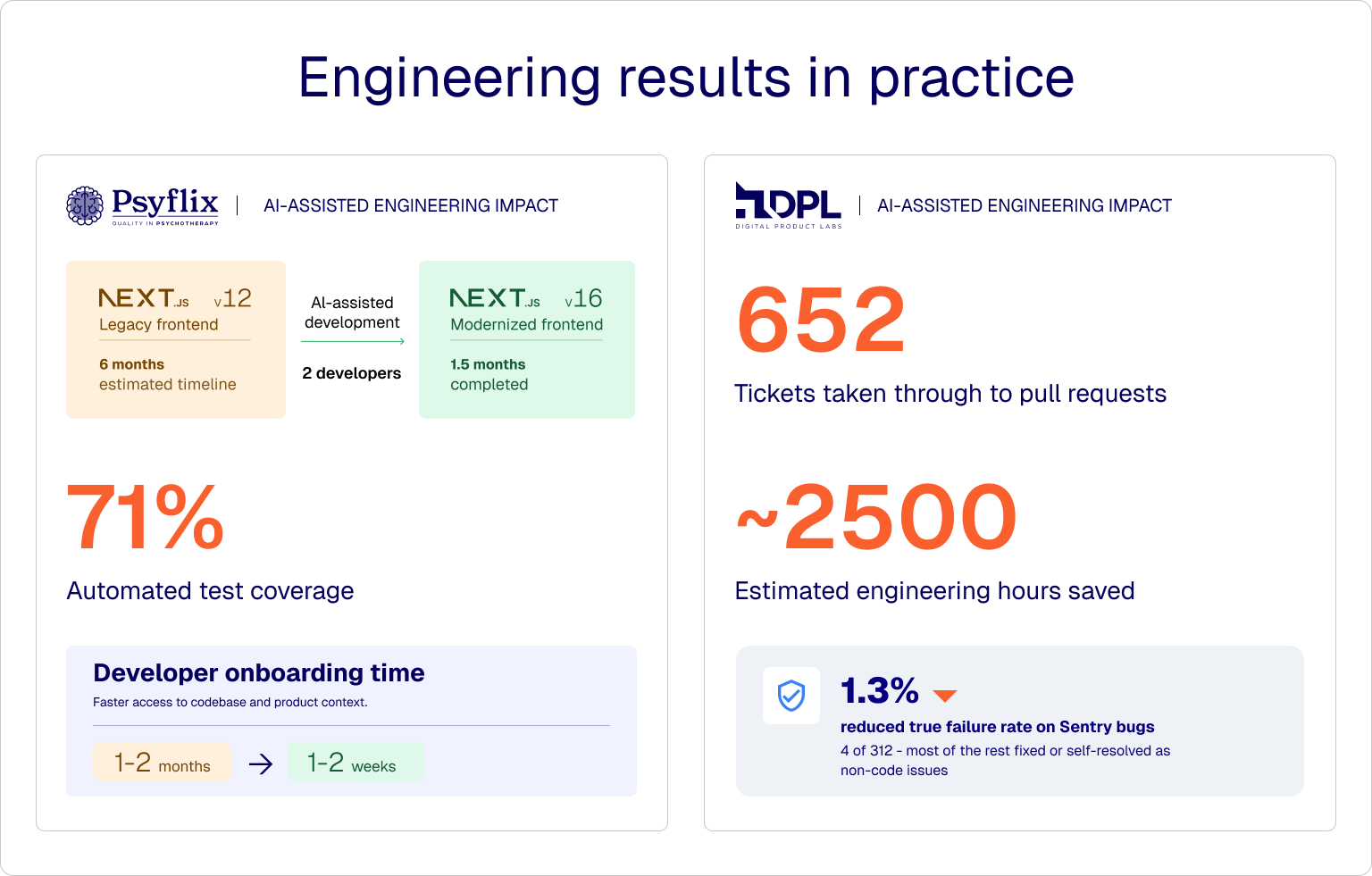
Proshore’s experience with AI-assisted engineering provides an early indication of what this model can deliver.
At DPL, an AI-assisted engineering workflow has taken 652 tickets through to pull requests without engineers writing code manually.
The workflow is estimated to have saved approximately 2,500 engineering hours. Across 312 Sentry bugs processed through the workflow, approximately 1.3% were recorded as failures.
At Psyflix, Proshore completed a major frontend modernization from Next.js 12 to Next.js 16 in 1.5 months with two developers.
The work reached 71% automated test coverage, while the time required for developers to become productive with the codebase and product context moved from one to two months to one to two weeks.
Sherpa is now being introduced into the next phase of development to support and enhance bug fixing, testing, and ongoing product work.
The business case becomes clearer when engineering time and capacity gains repeat across hundreds of tickets, production issues, and releases.
Sherpa turns those individual gains into a repeatable engineering capability across the software lifecycle.
From AI Experiments to an Engineering Capability
Sherpa represents Proshore’s move from isolated AI experiments toward a broader engineering capability that can be applied across client work.
The four Sherpa areas give organizations different ways to start depending on where the biggest challenge exists: modernizing existing systems with Legacy, improving software delivery with Build, testing new AI opportunities with Launch, or strengthening products already in production with Pulse.
Sherpa turns Proshore’s engineering experience into an AI-enabled capability that can scale across systems and client environments.


Want to explore how Proshore Sherpa fits your engineering needs?
Let’s talk about where Sherpa can support your teams, from modernizing existing systems and accelerating development to validating AI ideas and improving products in production.