









Product development takeaways
How Proshore brought AI assistance into interviewstream
When interviewstream saw a chance to use AI to enhance the interview process in a positive and ethical way, they turned to our remote dev team.
Talk to Jeroen, our Accounts director, to see if our ready-to-code dev teams are a fit for you.
Recruitment platform, interviewstream, has a strong suite of tools to simplify the hiring process and optimize the candidate experience. They also have a pre-existing partnership with Proshore.
So when interviewstream’s forward-thinking CTO, Ryan Royal, saw an opportunity to use AI to enhance the interview process in a positive and ethical way, he turned to Proshore to help ideate, iterate, and launch new functionality – in a matter of weeks. Here’s how it happened.
Proshore had a quality approach and a good philosophy about development, and about providing development services. We felt they were really trying to understand our needs, and expressed that back to us.

Faith Peterson, interviewstream Principal Product Manager

How to introduce AI in recruitment without enforcing bias?
Right now, almost everyone in the tech world and beyond is talking about ChatGPT and the use of AI in general. There’s no question that it’s going to be a game-changer. The question is: how are companies going to use it ethically, and to their advantage?
This dilemma is especially true in the recruitment industry, where legislation introduced in the state of New York in 2023 prohibits the use of automated employment decision tools (AEDTs) unless a bias audit has been conducted. That’s to avoid unintended bias as a result of machine learning (ML).
At the same time, recruitment is first and foremost a people business. Technology needs to support and enhance human expertise, and not diminish or try to replace it. For these reasons, introducing AI into the recruitment process requires careful consideration and execution.
Ryan Royal and the team at interviewstream had been looking at the potential of AI for some time. However, due to their product’s focus on the screening and evaluation of candidates, they wanted to ensure that any new AI feature did not introduce or reinforce bias in that process.
What they needed was AI-driven functionality that could add value for recruiters but avoid some of the pitfalls associated with its use in recruitment. That’s when Ryan pitched the idea of AI-generated interview questions.
Playing around with ChatGPT, Ryan and Principal Product Manager, Faith Peterson, sketched out an idea for the new feature. All they need was a highly-skilled and experienced development team to build it.
Proshore had a quality approach and a good philosophy about development, and about providing development services. We felt they were really trying to understand our needs, and expressed that back to us.
Faith Peterson, interviewstream Principal Product Manager
AI interview question assist feature
It was important for interviewstream that when they brought in AI functionality it had an obvious benefit to their customers, it was aligned with their company values, and also met the highest ethical standards. And this use case fitted the bill.
At the time, Proshore’s development team as a service was the only one working on enhancements to interviewstream’s core platform. It’s a role that gave them total responsibility for the new capabilities of interviewstream’s customers. That naturally grew to encompass the new AI Interview Question Assist feature.
When the partnership first began, the Proshore team was used to quickly adapting to changing priorities and business needs. And they were genuinely excited to get started on the new AI feature. Right away, they conducted an initial evaluation and started experimenting with the OpenAI API.
When Faith said interviewstream wanted to add AI functionality, the whole team were really excited. The enthusiasm level was high!

Viraj K. Shrestha, Proshore Scrum Master
To make innovative use of AI within interviewstream the Proshore development team needed to learn new skills and knowledge – which they did. In fact, every person on the development team – Santosh, Anand, Madhusudhan and Shyam – put time into the research, going through the documentation to discover the best ways to build out the functionality. This gave everyone on the team their own perspective, so they could help each other and quickly generate solutions to any issues that arose.
During the development phase, there was a strong collaboration between interviewstream’s Product Owner and the Proshore team. Within a couple of days, Proshore had a proof of concept. From there, it was a case of working on how to best express the functionality. Working alongside interviewstream, the Proshore team iterated on the fundamental idea of giving users guidance on prompt construction for the AI in order to generate usable, targeted interview questions. The output was ten targeted questions for recruiters to add to a question bank, or include in their next interview.
Thanks to Proshore, it took just three weeks to go from ideation to production. That’s largely because the team were able to quickly adapt, quickly understand the tech, quickly implement the proof of concept, then quickly establish and iterate on user interface (UI) ideas.

How Proshore's dedicated team, with PHP experts, handled the UI improvements and UX enhancements required by interviewstream's product – a feature-rich platform operating since 2002. Read case study Our CEO and Sales team were thrilled. They made a big announcement and included AI Interview Question Suggest in our new feature round-up. Proshore followed up in just one more sprint to release a feature update with more cues and improved functionality around results. It was all the iteration and partnering I hope for when working in classic ‘big A’ Agile style.
Faith Peterson, interviewstream Principal Product Manager
Continually improving the AI feature
As a result of their partnership with Proshore, interviewstream has a new AI-driven feature that’s available to customers. As interviewstream continues to iterate on the functionality, Proshore team members, including Web Developer, Santosh Pandey, bring new ideas to the table.
One of those ideas was to add ‘request history’ so that recruiters can make use of previous requests – without having to save or download AI-generated content. The team has also added download and clipboard functionality, making it easier for recruiters to incorporate the content into their interview processes.
As the partnership continues, there’s strength in collaboration. Together, interviewstream and Proshore are taking the business problem and combining ideas from the product management, and the developers to create the best possible solution.
Off the back of the success of AI Interview Question Assist, interviewstream is looking for further opportunities to ethically incorporate other AI functions into its offering, with the expertise of a Proshore development team as a service.
Something I’ve really come to value about the Proshore team is that they really bring creativity to the table.
Faith Peterson, interviewstream Principal Product Manager
Looking for a highly skilled and cost-effective offshore software development team? Book a call.


Right now, in software development, microservices are trending. Many of the big players in search, entertainment, and online retail have already made the shift. So what’s the appeal?
From mono to micro
Monolithic architecture is built around a single source, so that any changes require an updated version of the application from the server side. Microservices architecture works a little differently.
Rather than combining the user interface and data access code into a single program, microservices are disassembled into loosely coupled, independent services – which offers developers a number of benefits.
Let’s take a closer look at some of the lessons we’ve learned helping clients make the journey from monolith to microservices.
Why go micro?
Resilience: One of the key advantages of microservices is that if one service fails, the application continues to run. So with microservices, if one aspect of a system goes down, the impact on business is much less compared with single service architecture – where there’s always a danger of the entire system going down.
Cost Effectiveness: At the same time, the independence of microservices means they can be scaled autonomously. For example, if a website’s chat service is in high demand, the chat can be scaled independently, saving resources. Separate service scalability is also cost-effective because you’re only scaling something that’s in demand.
Should your startup choose mono or micro?
Microservices facilitate scalability in growing businesses. Doing so too soon may be overkill. They’re not always the right choice for a brand new startup, because their effectiveness only really comes into play when there are larger volumes of users, and you have clear oversight of which services you need to scale.
Also a team’s needed to manage microservices effectively – not ideal for a new startup who needs to move fast and build rather than maintain their tech stack; especially when resources and costs are already stretched.
However, for a growing application or SaaS, microservices make sense because they give you the scope to scale quickly, more frequently, and more selectively. They offer greater flexibility in terms of how you grow, and which direction you take.
Compliments from the cloud
Because microservices architecture is by its very nature granular, and broken down into components, it’s easier to maintain and improve. Having evolved alongside cloud-based solutions, microservices are highly compatible with platforms like Amazon’s AWS and Microsoft’s Azure.
In this way, microservices can be managed and monitored from anywhere, out of the box. This effectively means less time and effort spent on managing the architecture and a greater focus on application.
However, for microservices to work, they need a level of organizational readiness. And workable solutions can only happen with the understanding of everyone involved.
Using micro to go big
For smaller businesses with less than half a million customers, microservices architecture is not a prerequisite for functionality. However, for businesses that want to scale big, it’s a worthwhile investment.
One of our clients approached us because their microservice architecture was unfinished, and their lead developer was leaving. So Proshore was brought in to pick up where the lead developer had left off.
After our first meeting, we were aligned on our ways of thinking, and we met with the technical team. The organization was definitely microservice-ready, but they needed a development team to help continue the transition from monolith to micro.
And then we uncovered some key challenges.
Don’t rush production
The implementation of microservices architecture was taking longer than the client anticipated. Due to the lead developer leaving, they needed a swift handover, and had gone into production too quickly. What we found was just a codebase. It was not a suite of microservices.
As people started using this application, a lot of bugs started to emerge. So the Proshore team reached an impasse: should we focus on building features or monitoring for bugs?
We also uncovered one microservice that was stateful, not stateless. Because it was storing information and reacting differently to the same inputs, it would crash when there were lots of processes taking place at once. In turn, it would then crash the other services.
Scaling back to scale forward
Bringing Proshore on board enabled the client to scale more sustainably – by scaling back. Over the course of several months, we understood that the way we were moving wasn’t the right direction. However, further investigation showed a need to focus on fewer microservices at once, and ensure that effective monitoring was taking place.
Overall, with microservices, there are many aspects to consider depending on your business, and customer demands, from payment to email. Scaling sustainably is a long-term solution that requires robust testing and quality-assured roll-outs.
The value that Proshore offers is true consultancy and expertise. Our experience in scalable software development solutions makes us a valuable partner in your growth.
Our ‘development team as a service’ can help with strategy — as well as the technical stuff.

There’s no question that IT infrastructure is heading in one direction: towards the Cloud. For established, legacy businesses who are at the beginning of their digital transformation journey, moving to the Cloud completely might be a hard sell. After all, their current server-based systems work, so why should they change?
However, for emerging startups, even those without experience of Cloud computing, the business benefits of being a Cloud-first organisation from the get-go are obvious. Leveraging the immediate advantages of Cloud-based technology offers viability, reliability, scalability, and security. But what exactly does this mean for a scaling start-up? We drill down a bit deeper into the benefits of the Cloud for early-stage start-ups and scale-ups.
Severing The Server
With traditional servers, the process of getting your business IT infrastructure set up and secured is much more complicated than in the Cloud. Typically, you contact the service provider with your specifications, they send out servers to you, and you’re left to ensure that everything is securely set up on your premises. This can be a time-consuming process which relies on manual intervention, and effectively requires another person to be responsible for monitoring and maintaining the system.
Having someone manually managing the servers can be time-consuming and expensive, and this added layer of accountability actually distracts from the main goal of iteratively developing and improving your product, particularly in the early stages when you may have a small team, or you’re only a one or two-person business. Not only that, it requires more complex resource planning such as: what kind of servers you need, what software you require, and the right type of product licensing.
One of the reasons businesses are moving to the Cloud is that they have more power and authority to set up systems their own way in just a few clicks.

Babish Shrestha, Proshore
Director of Technology
Migrating To The Cloud
With a Cloud-based solution, everything is there for you straight out of the box. This is a tremendous advantage for an early-stage start-up, because you can use a lot of pre-built features that are already available in the Cloud. These features enable start-ups to put together their minimum viable product (MVP) and validate it much quicker. Without the complicated set-up of traditional servers, Cloud computing streamlines the whole process of setting up IT infrastructure, so that your business can focus on getting your product to market much faster.
Fast implementation is one of the ways that digital products can benefit from the Cloud. Not having the hassle of manually maintaining servers is another. And being able to focus on the product itself is a third.

Jeroen van der Horst, Proshore
Director of Accounts
Scaling Securely
Scaling is one of the most obvious factors for choosing a Cloud-based solution to business IT infrastructure because it’s much simpler to do in the Cloud compared with running your own servers.
One of our clients, Bayes, specializes in helping venture capitalists to hire specialists in different kinds of fields on short term contracts. It’s a platform that gives access to a wide network of experts. Due to the nature of their business, they hold a large volume of sensitive data, such as contact details. So it is essential for the company to have a secure and robust IT solution.
In the Cloud, we could very easily separate out their data into tiers, enabling users to access data necessary to perform day-to-day tasks, whilst keeping more sensitive data hidden and secure. Secondly, we could make the system more scalable over time, so that when the organization began to grow, and more people joined, there would be capacity available for new users to gain access to the systems.
Using traditional servers, the process of setting this up would have been very time-consuming. Security engineers and monitoring systems would have needed to be in place: a lot of additional tools and expenses to ensure everything was working properly. Whereas with the Cloud, set up was much easier and more flexible. In just a few clicks and some minor configurations, everything was ready to go. Not only that, there was peace of mind, control, and oversight in terms of security settings and features.
Scaling With SaaS
Another of our clients, Qaasaa, offers an online platform for helping real estate landlords and tenants to manage their communication. The software was originally developed as an in-house solution for the growing number of properties in their own portfolio. There was a clear need for a simple and affordable way to handle the necessary communications between landlords and tenants, such as repair requests. However, they soon realized the potential for making their software more widely available to property managers and owners around the world. So they decided to turn it into SaaS (software as a service).
In order to provide the scalability they required, a Cloud-based solution was the obvious choice. It also enabled the business to become more flexible and future-proof. This means that when larger clients are now looking to embed the platform into their own systems, it will be ready to scale at speed. At the same time, the benefit of the Cloud is that they can count on the security of the platform to handle personal details and information about payments.
Scaling Ecommerce From The Ground Up
The Cloud also provides an ideal platform for emerging ecommerce retailers who need to incorporate vast amounts of products, data, and transactions. Take Blinqed, for example, an app that connects hospitality entrepreneurs with their suppliers from the food sector, helping them to digitize and streamline both purchases and sales. When we collaborated with them, the business was looking for a way to bring their product to life and a technical team who could speed up the time to market using proven Agile ways of working.
We encouraged them to continue with a Cloud-based solution which would free them up from managing their own servers, whilst enabling them to take advantage of existing Cloud ecosystems, such as AWS Lambda. Utilizing microservices, the Cloud offered them a broad range of out-of-the-box functionality to pick and choose from (such as email and SMS) in order to meet their business needs, and without forcing them to engage with multiple third-party vendors.
Final Thoughts On Scaling In The Cloud
In line with our clients’ needs, at Proshore our expertise covers the full range of Cloud providers, including Google, Azure and AWS. Our experience also covers organizations who use their own private Cloud. Whatever the solution, the Cloud offers total flexibility to scale young businesses. There’s even the potential to create hybrid solutions which combine on-premise and Cloud-based technologies.
No matter how you’ve started out, it’s always possible to bring your business into Cloud to leverage the true potential of the available services and maximize your scalability. For start-ups, it’s a matter of choice as to how you use the Cloud. If you don’t have the capacity to manage your own servers, the Cloud is an obvious choice. The key question for start-ups is: do you want to spend your time managing servers, or do you want to focus on developing your product?
A Cloud setup might seem costly in the first place, but it’s an investment in future scalability. You only have to look at companies like Netflix who started small then scaled globally, via the Cloud (where they still are today). And although the initial outlay can be expensive, the time and resources saved by not using a managed server, alongside the Cloud’s potential for scalability and longer term savings, make it a great choice for start-ups looking to grow their business.

The great thing about microservices is that if one of your software services fails, the rest of the system stays online. For global streaming giants and hyperscalers with teams of developers handling multiple services – container orchestration makes a lot of sense.
For the rest of us, with a small team of developers working on one or two business-critical products, is it really necessary to invest in a container orchestration system such as Kubernetes, Red Hat OpenShift, Docker Swarm, or Rancher?
The short answer is no. And the good news is that it’s possible to power a scalable microservice architecture without using Kubernetes or the like. The question is how?
Let’s start by taking a closer look at microservices.
What are microservices?
In software development, microservices is an architectural style and organizational approach which breaks down applications into a loosely coupled collection of independent services that communicate via application programming interfaces (API).
The alternative is the more traditional monolithic architecture, in which all the processes run as a single service. The problem with monolithic architecture is that to scale one service, you have to scale the entire application.
Electrical circuits provide a good analogy for microservices versus monolithic architecture:
- Monolithic architecture is comparable to bulbs running on a series circuit – if one bulb blows, the entire string of bulbs goes out, and each bulb must be tested or checked to see which one has blown
- Microservices are similar to bulbs running on a parallel circuit – when one bulb blows, the others keep working, and the blown bulb is easy to identify and replace.
Right now, in software development, microservices are trending. And with good reason. The main benefit of microservices is that they are loosely coupled and deployed separately, and therefore easier to independently scale. This means maintenance and testing can take place on a particular service, without disrupting other functionality.
With microservices, which lend themselves to an Agile approach to software development, applications can be developed and scaled much faster. This type of architecture also makes it much more convenient to implement innovative and new features and expedite the time to market. You can read more about the advantages of microservices in our blog post about making the journey from monolith to microservices.
“With container orchestration systems like Kubernetes, your developers have to learn an extra technology stack – things like deployment, deployment services, and APIs. And there are time and cost implications associated with that.”
Babish ShresthaDirector of Technology, Proshore
Why use a container orchestration system?
Container orchestration systems enable you to manage and control the deployment and scaling of multiple containerized services. It’s especially useful when you have a large number of microservices because you can essentially orchestrate highly available services with limited configuration.
As we’ve already discussed, when services are loosely-coupled like this, it gives you greater flexibility to scale specific features, and more control when a particular feature needs attention, without bringing down the entire system. With the right code, using an orchestration system can also introduce a certain level of automation to your workflows.
Larger organizations could be running hundreds, or even thousands, of microservices which they manage through a container orchestration system. They’re ideal for large and complex organizations which are scaling at pace because they provide limitless scalability and can be run anywhere, whether that’s on premise, in the cloud, or in a hybrid environment. Of course, with containers, it’s also possible to pick up and deploy the same features across different environments.
But whether you’re self-hosting or opting for a managed solution, running a container orchestration system – even one that’s open source – can be expensive in terms of operational costs, training, and staffing.
“The good news is you can still build microservices using readily available cloud platforms, a serverless platform where you can replicate the same benefits of Kubernetes, without the need to learn a new programming language and how to manage it effectively.”
Babish ShresthaDirector of Technology, Proshore
The advantages of running serverless microservices
There’s no denying the business benefits of developing your software product using a microservice architecture. It provides:
- Greater flexibility to scale a particular application feature, rather than the entire app, saving time, money, and disruption to services.
- The opportunity for development teams to work autonomously on a specific microservice, thereby shortening development cycles and time to market.
- The freedom to test our new features through a process of continuous improvement, with easy roll back should you need it.
- Building blocks of code which have the potential to be reused for other features, therefore saving development time and decreasing the time to market.
But for many small and medium-sized software companies, it’s likely that the cost in time and resources in learning, setting up, deploying a container orchestration system will outweigh the business benefits – unless it fundamentally enables your business to overcome a specific challenge. But that doesn’t mean you can’t leverage the benefits of a microservice architecture. The alternative? Have you considered going serverless?
Cloud solutions like AWS, Azure, and Google Cloud provide a ready-made infrastructure which enables you to run code without managing servers. It’s cost-effective, because you only pay for what you use in terms of compute time and your containers are managed, so orchestration and security are taken out of your hands.
With a serverless solution, your containers are still portable, and it still provides the scalability you need without paying out for a container orchestration system. Another advantage of a serverless solution is that within the ecosystem, there are already existing ready-made services and software as a service (SaaS). These can save valuable development time, and speed up the development time through the use of pre-made services such as authentication and API gateways.
In a recent project, Proshore helped to deploy microservices for an e-commerce platform serving multiple buyers with thousands of products. With a container orchestration system, it would have taken around 2 months to train developers in how to manage the system before development could even begin.
To build this application in microservice architecture, a microservice backend was built in AWS Lambda using language such as NodeJS and Python. AWS Aurora was used as a main database with master slave architecture. An AWS API gateway was used to connect backend to frontend and other devices. The front end was hosted in EC2 instance. Besides this, other AWS services were used for caching, large batch jobs, and messaging.
To find out how Proshore helped the platform to seamlessly sync thousands of different product prices and data from different ERP systems, every day, read our blog post on ERP excellence.

The benefits of deploying microservices over traditional monolith architecture are well known – they’re much easier to scale, and more resilient if one service fails. This begs the question: is there still a place for monolith architecture?
The short answer is ‘yes’. As we mentioned in our previous post on migrating clients from monolith to microservices – for some companies, microservices are not always the best fit for their needs. In fact, a ready-to-code development team from Proshore recently helped a client, Psyflix, migrate a set of microservices to a single server to optimize their streaming platform.
Here are 5 reasons why companies might choose monolith architecture over microservices.
1️⃣ Keep development costs down
With microservices, you need a full-stack team to manage them effectively – something unfeasible for many startups. Without a dedicated team, microservices can easily spiral out of control, whereas monolith architecture can be easily handled by a single developer.
Building out microservices in a system like Kubernetes is expensive, and an unnecessary outlay when a product doesn’t yet have high volumes of users. With one or two thousand users, a single server is a viable option. A single codebase is also much easier to develop without the need to bring in a range of coding expertise. That makes monolith architecture ideal for early-stage startups with limited resources.
2️⃣ Faster development and testing
Running different microservices at the same time automatically makes them more complex to manage and maintain. Without proper management, having multiple teams responsible for different microservices, development and debugging can slow down.
As monolith architecture uses a single executable file, it’s much quicker to test and deploy. That makes end-to-end testing much faster, and because it’s a single codebase, development, and debugging are also much more straightforward.
3️⃣ Minimize disruption to services
With microservices, if there are issues with one part of the system, then other features can usually still run unaffected. One drawback of monolith architecture is that if something goes wrong – a single error might impact other parts of the system. However, there is a robust workaround.
Developers working in monolith architecture can overcome disruptions to a service by deploying a technique known as Server Side Generation (SSG). This hybrid approach is a combination of Server Side Rendering (SSR) and Client Side Rendering (CSR).
What it effectively does is generate static HTML pages that incorporate client-side JavaScript, so a page can be updated as and when needed. This means that, for example, if a user has begun watching a video and there’s an issue elsewhere – their viewing stream continues uninterrupted.
4️⃣ Scalability is still a possibility
Microservices are great for scaling businesses that need the ability to scale specific components up or down based on user demand. But to a certain extent, this is also possible with monolith architecture.
For example, you might initially combine 4 or 5 core microservices onto a single server in a monolith architecture. Additional microservices could be added and connected to it and scaled as needed by adding more containers.
5️⃣ Optimize resources to meet demand
What a software product offers users, the features used most frequently, and the frequency of use all impact what’s needed to ensure a smooth and seamless user experience.
If you’re dealing with a few thousand users who use a limited number of features – such as watching videos or downloading materials – for short periods of time, monolith architecture might be the best match for your needs. This will also save you unnecessary costs associated with building and maintaining multiple microservices.
Further down the line, when you’re running into millions of users around the world, splitting your product into microservices makes more sense, as famously demonstrated by the streaming giant Netflix. The beauty of monolith architecture is that both user capacity and cost are good indicators of when the time is right for microservices.
Making the case for monolith
It’s tempting for startups to jump straight into microservices without fully appreciating the potential advantages – including cost-savings – of monolith architecture. Development, deployment, and debugging can all be much more straightforward and easy to manage in monolith. On top of that, fewer APIs are needed to connect particular functionality.
For companies with a rapidly growing user base – from tens to hundreds of thousands of users in a short space of time, monolith probably isn’t the right choice. But for early-stage startups with limited resources and uncertainty about their rate of expansion, monolith gives them a solid starting point.
The good news for companies starting on the wrong path, the migration back from microservices to monolith architecture is not as painful as you might think. In our experience, there’s around a day of downtime.
With a ready-to-code development team from Proshore, you can also rest assured that when it’s the right time to make the move to microservices – we have the skills and experience to ensure a smooth transition.
In fact, we make it easy to switch back to microservices should you need to scale up in the future. For more on this, see our posts on making the move from monolith to microservices and how to scale microservices without using Kubernetes.

From monolith to microservices: What we’ve learned from helping clients make that journey

How to scale microservices without using Kubernetes
Discover how Proshore’s dedicated teams can support your migration to and from monolith and microservices – book a call.

Cloud computing – the delivery of computer services and resources over the Internet – gives companies a number of strategic advantages. But before diving in, it’s worth having a clear overview of the pitfalls and best practices, so you can get the best return on investment.
Factors to consider are your business maturity, business goals, and existing IT infrastructure. Each of these will influence whether it’s the right time to move to the cloud. Here’s our guide to the best practices for cloud computing.
Why choose cloud computing?
There are many reasons why companies move to the cloud. One reason is that they can tap into a suite of ready-made services that help speed up development time. Cloud computing platforms such as Microsoft Azure also provide reliable recovery and backup, and robust security measures, ensuring business continuity and data security.
For scaling companies, the on-demand delivery of computing resources provides a simple and accessible way to scale when they need it, without a hefty outlay of in-house IT professionals, on-premise servers, and equipment. But the cloud also comes with its own pitfalls.
Some companies decide to move to the cloud without properly considering why. To make it the right move for your business, you need to identify the benefits first. Simply making the switch won’t automatically solve all your IT challenges.
Pitfalls to avoid with cloud computing
There are three main pitfalls with cloud computing. The first is cost. Done right, cloud computing is cost-effective – you only pay for what you use. But it’s easy to overlook other costs such as deployment, operating expenses, and the cost of in-house IT professionals.
Second, whilst cloud computing offers savings against on-premise servers – and their ongoing maintenance – it also requires specific IT skills. Not every software developer is a cloud engineer. A skilled coder can be unfamiliar with cloud solutions. If cloud maintenance presents a steep learning curve to your development team, things like debugging can become a real challenge.
Third, like on-premise, cloud computing if left unmanaged can quickly become complicated and chaotic. In particular, enterprises may end up using multiple cloud providers or a combination of on-premise and cloud services. It doesn’t take long for solutions to be complex and over-engineered. This is especially true when companies choose a cloud service provider that’s misaligned with their needs and get locked into the wrong solution.
7 best practices for the cloud
Now you know some of the reasons why companies move to the cloud – and the main pitfalls to avoid – here are some best practices to follow:
1️⃣ Establish a clear cloud strategy
The best way to make cloud computing work for your business is to have a clear strategy. A lot depends on the services you need to use and your existing in-house expertise. The cloud isn’t a one-size-fits-all solution.
For instance, you might have a service that needs to be deployed – or will run more efficiently – in the cloud. Similarly, you might already have the internal resources to successfully run your IT on-premise.
Your IT strategy needs to consider the product fit, organizational fit, and how your existing resources match up with a cloud solution.
2️⃣ Choose the right cloud provider
The big techs – Microsoft, Google, and AWS – all offer cloud services. It’s the cost of those solutions and the in-house knowledge needed to manage them that varies.
The type of managed services you need also comes into play. Having a library of rebuilt components is a great time-saver, but you’ll also need a layer of customization and configuration to make out-of-the-box functionality work for you.
Making the right choice means weighing up the costs alongside your own in-house technical expertise. For example, if you have strong in-house knowledge in Google, then that will probably be the best option for you.
3️⃣ Implement advanced security
You’re going to get similar levels of security and reliability from any of the big cloud providers. Key considerations include where your data is stored – as different countries have different regulations – protecting your API, and restricting access.
Data is the new gold. Keeping your company and customer data safe is a top priority, as well as compliance with regulations such as the GDPR. If you’re handling sensitive or protected data, you need the right knowledge to implement advanced-level security measures.
4️⃣ Select a cost-effective back-up
With both on-premise and the cloud, you pay for your storage space. The key difference is the costs you incur and how you account for them. On-premise is a capital expense that also incurs operational expenses. You’re dealing with physical devices that require ongoing maintenance by technical experts.
Your cloud storage costs are relative to how much space you need, which can quickly grow if you’re holding multiple backups in the cloud. That’s why planning your backup options is important.
One of the key advantages of the cloud is that it provides high levels of availability. What that means is that your cloud services are always on. If a data center or server goes down, another server will take over – creating a seamless experience for end-users.
5️⃣ Optimize your resources and scalability
The cloud provides much more flexibility when it comes to the scalability of your resources. You can dynamically adjust the number of servers in use in response to traffic and geographic location, bringing servers offline during less busy periods and increasing capacity at peak times.
Say you have product services and payment processing, for example. You might need to scale one of these services and not the other in order to meet demand. With cloud computing, that’s really straightforward, and it can be done both manually and automatically.
6️⃣ Monitor services and performance
One of the biggest challenges of the cloud is understanding how it works. Thankfully, cloud services are much easier to monitor due to built-in analytics tools. Dashboards can be as simple or as complex as you need them to be.
By putting this kind of oversight and control in the hands of your cloud engineers, it’s much easier to optimize your services and minimize interruptions or problems affecting your service. It’s also a powerful way to visualize performance and supports conversation with nontechnical people at C-level.
7️⃣ Build in-house expertise and skills
As we’ve already mentioned, cloud engineers need an additional layer of skills and knowledge on top of what’s needed for regular software development. All developers working within the cloud need a cloud computing mindset. It’s not possible to work on a specific feature without this knowledge.
For that reason, your developers need to have a training mentality to develop the right skill set, otherwise, you can encounter problems further down the line. Alternatively, you can bring offshore development teams who already have the required knowledge.
Cloud computing engineers from Proshore
At Proshore, we understand that cloud computing isn’t right for every business. That’s why we help customers of all sizes – from startups to enterprises – add development capacity by matching the right technical expertise to their needs.
Whether you need experienced cloud computing engineers, on-premise expertise, or an entire development team as a service, we cherry-pick the right tech talent from our ever-growing talent pool in Nepal.
Need highly-skilled and ready-to-code developers for cloud computing? At Proshore, we have the expertise you need. Book a call today.

Like any construction project, coding platforms need a blueprint and a structure – an architecture – that enables projects to take shape. Microservices are a popular style of architecture for web apps. Here at Proshore our web developers are experts in using the open source, web app framework Laravel to build microservices.
Why microservices?
Before we dive into what makes Laravel and Proshore a great combination for building microservices, let’s explore why microservices might be a good fit for your software product.
In the microservices approach to software architecture, an application is built from a number of small, independent services that communicate with each other through Application Programming Interfaces (APIs). With microservices, each individual service is designed to perform a specific business function. When you think about it, the structure of microservices reflects the structure of most modern businesses.
Take online retailers as an example. They’re formed of separate services – sign-up, order processing, picking and packing, payment processing, delivery, and so on. From a business perspective, if one person tried to handle all of those things it would become slow, inefficient, and error-prone. As the numbers increase, it also becomes unscalable.
What works much better is when certain tasks are handled by Person A and others by Person B, and so on. It’s the same with microservices. Small independent tasks are handled by different services. For instance, authentication is handled by one different service, and language translations by another.
Microservices can work for web apps of all sizes. Discover how smaller dev teams can implement microservices without a container orchestration system – such as Kubernetes – in our blog on how to scale microservices.
Why not monolith?
The alternative to microservices is monolith architecture. That’s when developers build everything in a single codebase.
Think of a monolith as a single building housing everything. That works for some business models – a grocery store, for example. Different product departments can be comfortably housed under the same roof – it’s a one-stop shop.
But imagine if you tried to build a house that accommodated all of your family’s needs in one building. You’d need a living space, a workspace, a school, a hospital, a grocery store… the list goes on. It would be almost impossible. The solution? Divide the building.
When you need medical attention, you visit a doctor’s surgery or hospital rather than have those things in your own home. It’s the same for microservices. Large-scale development projects can grow too large for a single codebase. So we divide and conquer.
Discover more reasons for choosing microservices over monolith in our blog on what we’ve learned from helping clients make that journey.
Why we use Laravel PHP framework?
Laravel is a popular PHP web application framework. There are many reasons why our developers choose to work in Laravel:
How Proshore developers use Laravel
Here at Proshore, we have over 9 years of experience in working with Laravel. We’ve even established our own in-house team of Laravel experts. Here’s how we use it:
- In our case, most communication to and fro from microservices is done through API. Laravel makes it much easier and faster to build Rest API.
- On the development side, the Laravel container and dependency injection make it way easier to work with repositories. We use the repository pattern for ease of switching and better coding standards.
- With huge volumes of interrelated data, relationships start to become complicated, Laravel’s ORM makes database interaction and data manipulation much more streamlined.
- We prefer to create independent features which are easier to develop and test. Laravel by itself allows us to separate features i.e. make them independent.
- Laravel has a modular structure that is well-suited to building microservices. Using a repository pattern requires a module to be independent which is well suited as Laravel has an built-in modular structure.
- Laravel is well-documented and that enables better coding standards. Any functionality added can be documented easily based on the standards stated in the documentation that includes the tests that we write or the feature that we add.
Looking for a more specific Laravel service? Proshore can help
Tell us more about your project requirements and receive customized recommendations via email or over a 15-minute consultation call.
When to use microservices?
Microservices won’t suit every development project. A common use case is when software has a lot of separate yet related services. Imagine a scenario where you have multiple user types logging into multiple services, each with a different role and responsibilities.
Each of those services might then have language translations. Plus, each of those services might belong to a different role – some managed internally, some externally. To manage all of these things in one codebase would be quite chaotic, and disruptive to services.
Here are some other scenarios where microservices architecture might make sense:
You need scalability
Microservices enable individual services to be scaled independently, optimizing resource allocation and ensuring efficient performance based on specific service requirements.
You need agility and flexibility
Microservices architecture allows for independent development, deployment, and updates of services, providing agility and flexibility in responding to changing business needs.
You need a range of technologies
Microservices permit the use of diverse technologies for different services, allowing teams to select the most appropriate tools for each specific business function.
You need to separate out functionality
Microservices promote the segregation of functionalities, with each service focused on a specific business capability, leading to clearer architectural boundaries and easier maintenance.
You need faster testing and feedback loops
Microservices support improved testing by enabling isolated testing of individual services, facilitating quicker feedback loops, and enhancing the overall reliability of a system.
Build better microservices with Proshore
With thousands of ready-to-code developers, Proshore has the tech talent you need in multiple front-end and back-end programming languages, including Laravel.
Need an entire self-managed dedicated development team? Looking to augment your existing capabilities with highly-skilled IT professionals? Here at Proshore, we can put together the right solution for you – whether you’re working with microservices or monolith architecture.
Discover how much you could save by hiring PHP developers from Proshore without compromising on coding quality. Book a call for a free consultation with our Accounts Director and a customized proposal along with quotation.


Mobile App Development
Streamlining Flutter iOS Deployment: A Guide to CI/CD with Azure Pipelines
In today’s fast-paced mobile app landscape, delivering high-quality software quickly is non-negotiable. For Flutter developers, Continuous Integration and Continuous Deployment (CI/CD) is a game-changer that automates builds, tests, and deployments to ensure seamless releases.
Book a call Talk to our Accounts director, Jeroen, to see if our ready-to-code offshore teams are a fit for you.
At Proshore, a leading offshore software development firm in Nepal, we’ve seen firsthand how CI/CD transforms workflows—thanks to experts like Rajendra Shrestha, a senior Flutter developer on our team.
Rajendra recently shared his technical insights in a detailed article on Medium, breaking down how to deploy Flutter iOS apps to TestFlight using Azure Pipelines.
In this guide, we’ll expand on Rajendra’s expertise, blending his hands-on experience with Proshore’s proven strategies to help you master CI/CD—whether you’re a developer refining your craft or a business seeking scalable solutions.
Why CI/CD for Flutter?
Flutter’s cross-platform prowess is undeniable, but as Rajendra emphasizes, “even the most elegant codebase can falter without a reliable release process.” Here’s why CI/CD matters:
- Automation: Eliminate manual build/test/deploy tasks.
- Consistency: Reduce human error with standardized workflows.
- Speed: Release updates faster to stay ahead of competitors.
- Collaboration: Enable smoother teamwork with integrated feedback loops.
For businesses, CI/CD isn’t just a technical nicety—it’s a strategic advantage. Offshore teams like Proshore use these pipelines to deliver predictable, high-quality results across time zones. As Rajendra puts it, “Automation isn’t just about speed—it’s about trust. Clients know their releases will happen like clockwork.”
Azure Pipelines: A Perfect Match for Flutter
Microsoft’s Azure Pipelines offers a flexible, cloud-native solution for CI/CD. Rajendra, who has configured dozens of pipelines for Proshore clients, highlights the key benefits:
1
Cross-Platform Support
Build iOS, Android, and web apps from a single pipeline.
2
Scalability
Handle projects of any size with parallel jobs.
3
Integration
Works seamlessly with GitHub, Azure Repos, and other tools.
4
Cost-Effectiveness
Free tiers for small projects and pay-as-you-go pricing.
1
Cross-Platform Support
Build iOS, Android, and web apps from a single pipeline.
2
Scalability
Handle projects of any size with parallel jobs.
3
Integration
Works seamlessly with GitHub, Azure Repos, and other tools.
4
Cost-Effectiveness
Free tiers for small projects and pay-as-you-go pricing.
“Azure’s flexibility lets us tailor pipelines to each project’s unique needs,” Rajendra notes. At Proshore, we’ve leveraged Azure Pipelines to streamline deployments for startups and enterprises alike.
Step-by-Step: Deploying Flutter iOS Apps to TestFlight
Let’s break down how Azure pipelines work for Flutter iOS apps with insights from Rajendra’s playbook.
1️⃣ Prepare Your Environment
a
Apple Developer Account
Ensure you have an active account and App Store Connect access.
b
Code Signing
Generate an Apple Distribution Certificate and Provisioning Profile. Let’s break down how it works for Flutter iOS apps.
c
Repository Setup
Host your Flutter project on Azure Repos, GitHub, or Bitbucket.
2️⃣ Configure Azure Pipeline
a
Create an azure-pipelines.yml file
b
Define your pipeline stages
Here’s a simplified snippet:
trigger:<br> - main<br>variables:<br> - iosVmImage: 'macos-latest'<br> - flutterVersion: '3.24.0'<br> - archivepath: 'build/ios/archive/Runner.xcarchive'<br> - runnerAppPath: 'build/ios/archive/Runner.xcarchive/Products/Applications/Runner.app'<br> - builtAppPath: 'build/ios/ipa'<br> - exportPlistPath: 'exportOptions.plist'<br> - PROVISIONING_PROFILE_UUID: 'xxxxxxxx-xxxx-xxxx-xxxx-xxxxxxxxxxxx'<br> - SIGNING_IDENTITY: 'Apple Distribution: account_name (team_id)'<br> - appIdentifier: 'com.xxxxxx.xxxxx'<br> - teamId: 'xxxxxxxxx'<br> - artifactName: 'release_artifact_name'<br> - appStoreServiceConnectionName: 'apple_service_connection_name'<br> - appSpecificAppleId: 'xxxxxxxxxx'<br> - buildFlavor: 'Production' #Optional<br> - entryPoint: 'lib/main_prod.dart' #Optional<br>steps:<br> - task: InstallAppleCertificate@2<br> inputs:<br> certSecureFile: 'your-certificate.p12'<br> certPwd: $(certificate_password)<br> - task: InstallAppleProvisioningProfile@1<br> displayName: Install provisioning file<br> inputs:<br> provisioningProfileLocation: 'secureFiles'<br> provProfileSecureFile: 'your-provision.mobileprovision'<br> - task: FlutterInstall@0<br> inputs:<br> mode: 'auto'<br> channel: 'stable'<br> version: 'custom'<br> customVersion: $(flutterVersion)<br> - task: FlutterCommand@0<br> displayName: 'Run Flutter diagnostics'<br> inputs:<br> projectDirectory: '.'<br> arguments: 'doctor -v'<br> - task: FlutterBuild@0<br> inputs:<br> target: 'ipa'<br> buildFlavour: $(buildFlavor)<br> entryPoint: $(entryPoint)<br> extraArgs: '--no-codesign'<br> - script: |<br> security cms -D -i ~/Library/MobileDevice/Provisioning Profiles/$(PROVISIONING_PROFILE_UUID).mobileprovision > decoded.plist<br> plutil -extract Entitlements xml1 -o Runner.entitlements decoded.plist<br> chmod +x generate_export_plist.sh<br> ./generate_export_plist.sh $(PROVISIONING_PROFILE_UUID)<br> codesign --entitlements Runner.entitlements -f -s "$(SIGNING_IDENTITY)" $(runnerAppPath)<br> xcodebuild -exportArchive -archivePath $(archivepath) -exportPath $(builtAppPath) -exportOptionsPlist $(exportPlistPath)<br> displayName: "Sign ipa"<br> - task: CopyFiles@2<br> displayName: 'Copy app to staging directory'<br> inputs:<br> sourceFolder: '$(Agent.BuildDirectory)'<br> contents: '**/ipa/*.ipa'<br> targetFolder: '$(Build.StagingDirectory)'<br> flattenFolders: true<br> - task: PublishBuildArtifacts@1<br> displayName: 'Publish IPA file'<br> inputs:<br> PathtoPublish: '$(Build.ArtifactStagingDirectory)'<br> artifactName: $(artifactName)<br> publishLocation: 'Container'<br> - task: AppStoreRelease@1<br> inputs:<br> serviceEndpoint: 'Deheus App Store Connect Key'<br> releaseTrack: 'TestFlight'<br> appIdentifier: $(appIdentifier)<br> appType: 'iOS'<br> ipaPath: '$(Build.ArtifactStagingDirectory)/**/*.ipa'<br> appSpecificId: $(appSpecificAppleId)<br>
3️⃣ Handle Code Signing Securely
Azure’s secure file storage and variable groups keep sensitive data (like certificates) encrypted. Rajendra’s advice: “Automate certificate installation with the <InstallAppleCertificate> task—it’s saved us hours of debugging.”
4️⃣ Deploy to TestFlight
The AppStoreRelease task uploads the .ipa file to App Store Connect. “Monitor builds in Azure’s dashboard,” Rajendra suggests. “Clients love it when they can track progress on a dashboard without touching Xcode.”

Meet the Expert
Rajendra Shrestha, Senior Flutter Developer
With over 5 years of experience in cross-platform development, Rajendra specializes in CI/CD pipelines and DevOps automation. When he’s not streamlining deployments, he mentors junior developers and writes technical guides for the Flutter community.
Want more detailed steps on deploying iOS apps?
Common Challenges & How We Solve Them
Even with automation, pitfalls can arise. Here’s how Rajendra and his team tackle them:
- Certificate Issues: “Mismatched profiles halt pipelines,” Rajendra fix, “Implement monthly audits and use Azure’s secret rotation to avoid expiry surprises.”
- Flutter Version Conflicts: “Sync pipeline and local SDKs religiously,” he advises.
- Long Build Times: Optimize with dependency caching. Rajendra’s hack: “Cache the .pub-cache folder—it cuts a client’s build time by half.”
As an offshore partner, we help clients navigate these hurdles through offshore development teams with experts like Rajendra who know the ins and outs of mobile app development and deployment.
Why Partner with an Offshore Flutter Team in Nepal?
Choosing a Nepalese offshore team like Proshore offers unique advantages:
- Cost Efficiency: High-quality output at competitive rates.
- Skilled Talent: Nepal’s growing tech ecosystem produces top-tier Flutter developers.
- Time Zone Synergy: Overlap with European and Asian markets for real-time collaboration.
Implementing CI/CD for Flutter with Azure Pipelines isn’t just about automation—it’s about building a foundation for scalable, stress-free app development. Whether you’re a solo developer looking to optimize your workflow or a business seeking a reliable offshore partner, Proshore is here to help.
Save big on development costs with our end-to-end Flutter & CI/CD solutions. Let’s build your next app!


by Roshan Bhattarai Operations Director, Proshore

Remote development
Nepal: A serious contender in software development outsourcing
Intrigued by Nepal? This beautiful country, famed for its stunning landscapes, is also quietly emerging as a global IT hub. Let's explore how Nepal can be your ideal outsourcing partner.
Book a call Talk to our Accounts director, Jeroen, to see if our ready-to-code offshore teams are a fit for you.
Say the words ‘outsourcing destination’ to people in the software industry, and they’ll probably reply with the name of one of the major players – like Bangladesh or India.
Sure, these countries have been dominating the outsourcing market for a while now. But over the last few years, there’s been an increasingly strong contender in software development outsourcing – Nepal. And while we may be biased, Proshore has seen the talent pool grow firsthand – in Kathmandu and beyond.
Nepal: A new South-Asian IT hub
It’s true that many international companies – some big brands – have been outsourcing functionality like software development to Nepal for some time now, it’s just that as an emerging market no-one’s really talking about it in the same way as India or Bangladesh. Yet.

Roshan Bhattarai, Proshore Director of Operations
Nepal boasts of a young, tech-savvy population with a growing talent pool in IT. The government is actively promoting the sector, with initiatives like the ‘Digital Nepal Framework’ aiming to make Nepal a leading IT destination. This translates to a business environment that supports your outsourcing needs.
Similarly, the talent pool is set to only grow in numbers with the rise of remote working culture, rampant in the tech scene. While most of the youth are drawn to migrating abroad for opportunities, Nepal's flourishing IT outsourcing industry allows skilled talent to earn international rates right here at home. This social mission has been a core focus for Proshore since 2009.
Commonly outsourced IT services in Nepal
Nepalese offshore development companies and developers alike offer a variety of IT outsourcing services to cater to global tech requirements:
1
Software Development Teams
Well-rounded teams of highly-skilled developers, designers, testers, and managers adept at building cutting-edge applications using the latest technologies.
2
Custom Development
Expert developers who can aid in building custom software across industries, as a long-term team member or on a project basis.
3
Customer Support
A multilingual workforce with impeccable tech know-how ensures exceptional customer experiences.
4
Data Engineering
Experts in managing and analyzing large datasets that can help break down data and unlock valuable insights.
5
And more
Nepal hosts a range of other IT services, from web development to digital marketing.
1
Software Development Teams
Well-rounded teams of highly-skilled developers, designers, testers, and managers adept at building cutting-edge applications using the latest technologies.
2
Custom Development
Expert developers who can aid in building custom software across industries, as a long-term team member or on a project basis.
3
Customer Support
A multilingual workforce with impeccable tech know-how ensures exceptional customer experiences.
4
Data Engineering
Experts in managing and analyzing large datasets that can help break down data and unlock valuable insights.
5
And more
Nepal hosts a range of other IT services, from web development to digital marketing.
Why choose Nepal for IT Outsourcing?
Here's why Nepal stands out as an IT outsourcing hub;
1
Cost-Effectiveness
Benefit from competitive rates compared to traditional outsourcing destinations.
2
Skilled Workforce
Access a pool of English-speaking talented and qualified IT professionals.
3
Government Support
Leverage government initiatives promoting IT growth and stability.
4
Time-zone Advantage
Favorable time zone overlaps for seamless collaboration and round-the-clock development.
Finding the perfect outsourcing partner in Nepal
Now that we've established Nepal as a rising tech hub with the potential to handle your outsourcing needs, we move to selecting the right outsourcing company.
Crucial for outsourcing success, look for an outsourcing partner with:
1
Proven Track Record
Do your research – does the company have a history of delivering successful projects for clients in your industry and tech?
2
Strong Communication
Clear and transparent communication during the proposal, trial, and onboarding phases set a good precedent for the project lifecycle.
3
Agile Development
Does their working model offer the flexibility to adapt to your changing needs and embrace innovation?
4
Seamless Integration
Adding specific skillsets to your existing team through staff augmentation can be a good option for short-term projects or to fill temporary gaps.
Proshore: Your trusted partner in Nepal's IT Hub
With Proshore you can get a single developer or an entire managed team to integrate with your existing set-up and scale it up or down as required.
No matter how large or small your organization, our ready-to-code dev teams can become a part of it – the only difference is that they’re working remotely in Nepal.
If you’re a smaller enterprise, you might not have a development team of your own, and in these circumstances, Proshore becomes your team from concept to deployment.
In other situations, you may need flexibility to scale software development up or down as needed – here Proshore provides the extra capacity with skilled developers you can rely on.

Explore our services and the benefits of choosing us as your outsourcing partner
Ready to explore the potential?
Book a call with Proshore today! Let's discuss your project requirements and explore how Nepal's IT prowess can empower your business.


Remote Development
The benefits of hiring an Offshore Software Development Company
Discover how hiring an offshore software development company can reduce costs, access a global talent pool, and get to market faster. Learn the secrets to successful offshore development and how it can benefit your business.
Book a call Talk to our Accounts director, Jeroen, to see if our ready-to-code offshore teams are a fit for you.
Both software startups and scaling companies can benefit from hiring an offshore software development company. One can benefit by gaining quick traction, while the other can get expertise and extra capacity at an affordable price.
Not only that, hiring software developers will help you free up your time so that you can spend more time building the business around your product instead of building the product itself.
There’s always the option to build your own in-house team, but that will cost you a lot and might not always be feasible. Hiring and managing individual remote developers is also possible, but that can get complicated quickly.
On the other hand, with an offshore development company, you get a fully-fledged dev team that can handle everything for you.
What is Offshore Software Development?
Offshore software development is a type of outsourcing. It involves hiring developers in another part of the world to help code a software product. That could be anything from the front end of an app to the back end of a website.
Regardless of whether your offshore developers are responsible for all or part of the development process, the objective remains the same: build the best software product in the shortest possible time frame.
Under Agile principles, this objective gains an even leaner edge ensuring offshore software developers deliver on (or even before) time – enhancing the benefits of adopting offshore software development.
Benefits of Offshore Software Development
Now let’s take a closer look at the main benefits of hiring an offshore software development company, starting with the cost-benefit.
1
Cost-effectiveness
Hiring a team of software engineers – even if that team is just two people – is an expensive outlay. When you factor in local labor costs, the time and money needed to recruit, onboard and train the right employees, plus the additional ongoing costs of keeping them as company employees with sick pay, annual leave, pension contributions, and more – it soon adds up.
The benefit of hiring an offshore software development company is that you have a single cost agreed upon upfront. And when your project finishes, there’s no further cost unless you wish to retain their services.
2
Experience on-demand
You can obtain the exact skills and expertise you require using an offshore development company. In today’s world, technology is always advancing. For that reason, there is an ongoing shortage of IT specialists in certain fields, including the latest programming languages.
Hiring offshore opens up the global talent pool. When hiring in your own country becomes difficult, you can look abroad to find experienced and well-educated software engineers. Choosing the right offshore software development company means they already have the experience and understanding of your challenges.
3
Ease of recruitment
When it comes to offshore software development, you don’t have to worry about the recruitment process. Your offshore software development company handles all aspects of recruitment for you like
- selecting candidates with the right profile to suit your needs
- dealing with all the formalities
Because of this, you can completely focus on your core business and ways to grow it. Also, you don’t have to worry about maintaining an in-house team at the project’s end.
Not only this, there will be times in your business when you might have to let go of some of your employees to scale down a bit. This is definitely a challenging task and comes with additional costs.
Also, there is a chance that your team member might leave you. Again, you need to start your costly recruitment process.
4
Sustainable scaling
Like any business in software development, there are peaks and troughs.
- During peaks, you might need additional capacity to keep up with growth.
- In troughs, you might need to reduce your team to cut costs.
When you might need to add new features quickly or move towards a new vertical, you need a new team as quickly as possible.
The beauty of hiring an offshore development team through a dedicated company, as opposed to individual developers, is that they can scale with you, providing the right skills and the extra capacity you need when you need it the most.
And should the time come when you need to scale down because that piece of development is now complete, you’re not left with the difficult decision of letting employees go.
5
Faster time-to-market
Speed and accuracy are essential when you’re trying to stay ahead in a competitive market. Making the most of world time zones and the global talent pool, you could have developers working around the clock, helping you to take your product to market much sooner.
Adding capacity with a self-managed team of developers working with an Agile mindset means you don’t need to worry about day-to-day project management. Someone else handles that for you.
In addition, because developers working in Agile take an iterative approach to product development, it means you can focus on bringing core functionality to market sooner and then build it out over time.
1
Cost-effectiveness
Hiring a team of software engineers – even if that team is just two people – is an expensive outlay. When you factor in local labor costs, the time and money needed to recruit, onboard and train the right employees, plus the additional ongoing costs of keeping them as company employees with sick pay, annual leave, pension contributions, and more – it soon adds up.
The benefit of hiring an offshore software development company is that you have a single cost agreed upon upfront. And when your project finishes, there’s no further cost unless you wish to retain their services.
2
Experience on-demand
You can obtain the exact skills and expertise you require using an offshore development company. In today’s world, technology is always advancing. For that reason, there is an ongoing shortage of IT specialists in certain fields, including the latest programming languages.
Hiring offshore opens up the global talent pool. When hiring in your own country becomes difficult, you can look abroad to find experienced and well-educated software engineers. Choosing the right offshore software development company means they already have the experience and understanding of your challenges.
3
Ease of recruitment
When it comes to offshore software development, you don’t have to worry about the recruitment process. Your offshore software development company handles all aspects of recruitment for you like
- selecting candidates with the right profile to suit your needs
- dealing with all the formalities
Because of this, you can completely focus on your core business and ways to grow it. Also, you don’t have to worry about maintaining an in-house team at the project’s end.
Not only this, there will be times in your business when you might have to let go of some of your employees to scale down a bit. This is definitely a challenging task and comes with additional costs.
Also, there is a chance that your team member might leave you. Again, you need to start your costly recruitment process.
4
Sustainable scaling
Like any business in software development, there are peaks and troughs.
- During peaks, you might need additional capacity to keep up with growth.
- In troughs, you might need to reduce your team to cut costs.
When you might need to add new features quickly or move towards a new vertical, you need a new team as quickly as possible.
The beauty of hiring an offshore development team through a dedicated company, as opposed to individual developers, is that they can scale with you, providing the right skills and the extra capacity you need when you need it the most.
And should the time come when you need to scale down because that piece of development is now complete, you’re not left with the difficult decision of letting employees go.
5
Faster time-to-market
Speed and accuracy are essential when you’re trying to stay ahead in a competitive market. Making the most of world time zones and the global talent pool, you could have developers working around the clock, helping you to take your product to market much sooner.
Adding capacity with a self-managed team of developers working with an Agile mindset means you don’t need to worry about day-to-day project management. Someone else handles that for you.
In addition, because developers working in Agile take an iterative approach to product development, it means you can focus on bringing core functionality to market sooner and then build it out over time.
Offshore Software Development challenges
Whilst there are obvious benefits to offshore development, there are some common challenges associated with it:
1
Time zone differences
While your chosen offshore software development company might be self-managing and autonomous, there will still be times when you and your team will need to communicate with them.
You can always schedule daily or weekly meetings. But, there might be a problem when you need to get hold of the team in case of emergencies like your application stops working or gets hacked.
This is especially true when they’re handling one piece in a more extensive software build, and you might have different development teams working on different areas.
To overcome this challenge, always look for an offshore team who can provide continuous support per your time zone.
2
Communication barriers
In software development, English has become the language of choice. But just because people speak the same language doesn’t mean they will always fully understand each other.
In a field like software development, with its unique and complex terminology, miscommunication can occur – especially when multiple communication channels are in use simultaneously, from email to video calls.
Communication issues can cause bumps in the road that slow down development. That’s why finding an offshore development company with English-speaking developers is important.
3
Cultural differences
As with any external organization, ensuring a cultural fit with your offshore software development company is important. Different cultural values can result in different communication styles and ways of working and mismatches around expectations.
Misaligned cultural values can result in strained working relationships, which will become detrimental to both productivity and the quality of the code. You will also need to factor in things like festive holidays, which will impact development.
4
Quality control
One of the biggest fears around hiring offshore developers is poor code quality. Your code is your most valuable asset. The developers you hire could be inexperienced or recent graduates without the relevant skills or training.
Working with developers you don’t know, located in another part of the world, could result in poor code quality. This could lose you valuable time and also require a costly fix. As the offshore team handles everything, you might have no idea about how your product is built. They might be using outdated or vulnerable code. Using a reputable offshore software development company with proven examples of their work can eliminate these fears.
1
Time zone differences
While your chosen offshore software development company might be self-managing and autonomous, there will still be times when you and your team will need to communicate with them.
You can always schedule daily or weekly meetings. But, there might be a problem when you need to get hold of the team in case of emergencies like your application stops working or gets hacked.
This is especially true when they’re handling one piece in a more extensive software build, and you might have different development teams working on different areas.
To overcome this challenge, always look for an offshore team who can provide continuous support per your time zone.
2
Communication barriers
In software development, English has become the language of choice. But just because people speak the same language doesn’t mean they will always fully understand each other.
In a field like software development, with its unique and complex terminology, miscommunication can occur – especially when multiple communication channels are in use simultaneously, from email to video calls.
Communication issues can cause bumps in the road that slow down development. That’s why finding an offshore development company with English-speaking developers is important.
3
Cultural differences
As with any external organization, ensuring a cultural fit with your offshore software development company is important. Different cultural values can result in different communication styles and ways of working and mismatches around expectations.
Misaligned cultural values can result in strained working relationships, which will become detrimental to both productivity and the quality of the code. You will also need to factor in things like festive holidays, which will impact development.
4
Quality control
One of the biggest fears around hiring offshore developers is poor code quality. Your code is your most valuable asset. The developers you hire could be inexperienced or recent graduates without the relevant skills or training.
Working with developers you don’t know, located in another part of the world, could result in poor code quality. This could lose you valuable time and also require a costly fix. As the offshore team handles everything, you might have no idea about how your product is built. They might be using outdated or vulnerable code. Using a reputable offshore software development company with proven examples of their work can eliminate these fears.
Looking for something else?
Explore our resources on offshore software development

Hiring offshore developers in 2024: A complete guide
There are a number of important advantages to hiring offshore developers. In this short guide, we’ll explain how to do it, and why it’s beneficial.

Top 15 offshore software dev companies worldwide
Discover the best offshore software development companies to elevate your business. Compare top 15 providers and find your perfect match today!

A complete guide to offshore software development
Learn all about offshore software development, how it works, and its benefits and drawbacks. Also, find the best countries for offshore services and the associated costs.
Benefits of hiring Proshore’s offshore teams
Ten years ago, software companies were cautious about using offshore developers and needed convincing as to the benefits of hiring an offshore development company.
Today, it’s the industry norm. What’s changed is that forward-thinking offshore development companies have addressed the potential challenges and turned them to their advantage.
At Proshore we’ve got a proven track record of helping to build high-quality software – including apps and SaaS – by offering our experienced development teams as a service.
The advantages of hiring Proshore as your offshore software development company include:
1
Ready-to-code English-speaking remote development teams based in Nepal
Everyone on the team has a good grasp of English, so communication won’t be an issue. The only issues will be focusing on will be related to your software development needs.
2
Everything you’d expect from an in-house team (minus the office space)
Since we operate from two different locations (Nepal & the Netherlands), clients from different time zones get continuous support – meetings are conducted as per the overlap with your time zone plus software development takes place even outside your working hours.
3
Hand-picked, coached, and self-managed tech talent bespoke to your needs
All talents working as part of your extended offshore team are mutually selected along with you and can be changed or scaled up/down a need. Furthermore, they operate on new and future-proof technologies, thus ensuring high-quality results.

Hiring top tech talent is tough and expensive. That’s why more companies are choosing offshore software development companies to accelerate growth and deliver exceptional results faster and smarter.
Working with the right offshore software team can truly make a difference. You gain skilled developers, modern technology, and flexible work methods at a lower cost.
However, it’s not only about saving money. A good offshore partner becomes part of your team. They understand your vision, work in a similar way, and help you create software that pushes your business forward.
Offshore Software Development Company
Skyrocketing developer salaries and endless recruitment cycles are pushing more companies to explore offshore software development as a strategic solution.
By partnering with offshore development companies, organizations can access skilled tech talent worldwide at competitive rates.
In this article, we will dive into our carefully curated list of the top 10 offshore development companies changing how businesses build software in 2025. But first, let's understand how to choose the right offshore company that fits your needs.
New to offshore development? Check out our guides on
How to choose the right Offshore Company?
A right offshore partner will treat your dream project as their own, ensuring it reaches the market promptly and successfully. With so many offshore companies on the market, each offering similar services, it's not an easy task to choose the right one.
Here are a few things you should ask while analyzing your offshore partner:
- Past experiences of the company working on similar projects.
- Customer Ratings and Testimonials.
- Case Studies.
- Communication, Cultural, and Time Zone Compatibility
- Project Management Tools and Techniques
- Legal, Compliance, and IP Protection
- Customer Support and Maintenance
10 Best Offshore Development Companies
Below are the top 10 offshore development companies from all around the world.
1. Proshore
With a decade of experience, Proshore provides ready-to-code remote development teams based in Nepal. Our employees are trained in leading frameworks and methodologies, such as Scrum and Kanban.
- Location: Nepal & Netherlands
- Technical Expertise: Front-end, Back-end, Mobile App Development, Data Analytics, Serverless, Automated Testing, DevOps, Agile Approach
- Technologies: Laravel, Microsoft .NET, Python, PHP, C++, JavaScript, Java, Flutter, React, Cypress
- Number of Developers: 80+
Services provided by the company:
- Roadmapping - transforming business ideas into requirements
- Software Development - creating solutions that empower the business
- DevOps & Cloud - ensuring high availability in the client's infrastructures
- Software Architecture-providing future-proof solutions that are easily scalable
- Agile Transformation - allowing teams to adapt and scale quickly
Proshore operates using a 'ready-to-code dev teams' model, where they first understand the client's needs, allowing them to manage the developers, process, and output, allowing the client to focus more on business strategies.
2. N-iX
- Location: Delivery centers in Poland, Sweden, USA, Malta, Ukraine, and Bulgaria
- Pricing: TBD pending pricing call
- Technical expertise: Cloud-native Computing, Data Analytics, DevOps, Digital Platforms, IoT, Virtual Reality
- Number of developers: 2,000+
Their services include:
- Adding to an existing team
- Identifying the needs for a product
- Developing custom software
- Providing technology-related advice
N-iX specializes in creating custom software and providing consulting services. They collaborate with global organizations to provide software solutions for businesses in the finance, retail, manufacturing, and telecom sectors.
3. Eleks
- Location: USA, UK, Canada, Saudi Arabia, UAE, Japan, Estonia, Ukraine, Poland, Germany, Croatia
- Pricing: TBD pending pricing call
- Technical expertise: DevOps, IoT, Blockchain, UX consulting, VR, Market Research, Nearshore Development, Digital Enterprise
- Number of developers: 2,000+
Eleks splits its services across three categories:
- Advisory: product design, data science, cybersecurity, and technical feasibility study
- Engineering: PoC development, application development, application re-engineering, cloud migration, smart team
- Optimization: Software audit, support, quality assurance
With 18 offices worldwide, Eleks has an extensive network of developers that it uses to support companies as they grow their businesses. They are particularly focused on helping teams adopt digital transformation and unifying the digital enterprise.
4. Rikkeisoft
- Location: Vietnam, Japan, Singapore, New Zealand, Australia, Europe, USA
- Pricing: TBD pending pricing call
- Technical expertise: Business process management, web development, eCommerce site development, mobile application, UX/UI design, managed services, IoT, artificial intelligence, blockchain, cloud
- Number of developers: 1,500+
Rikkeisoft’s services include:
- Software development outsourcing
- Innovative technology builds
- Software engineers for hire
- Talent incubator
Rikkeisoft is an offshore software development company that was started in Vietnam by a group of six students. Since then, it has grown to 1,500+ employees and operates out of multiple global locations. The company primarily serves retail, finance, media, manufacturing, and automotive clients.
5. Dev.Pro
- Location: Headquartered in Las Vegas, and presence across 50 countries
- Pricing: TBD pending pricing call
- Technical expertise: Cloud Development, Blockchain, DevOps, System Integration, QA & testing, reporting, UX/UI design, IT support, AppSec
- Number of developers: 900+
Dev.Pro’s services include solutions for any part of the software development lifecycle for the following industries:
- Blockchain
- Digital commerce
- Digital transformation
- Fintech
- Technology
- Hospitality
- Healthcare
- Enterprise
Dev.Pro describes itself as a software development partner that helps companies grow faster and shorten their time to market. To this end, the company’s primary offering is custom outsourced software development, with the support of ready-made teams for each client.
6. Cegeka
- Location: Austria, Belgium, Czech Republic, Italy, Luxembourg, Moldova, Netherlands, Romania, Slovakia, Sweden
- Pricing: TBD pending pricing call
- Technical expertise: Microsoft Dynamics, 5G, Cloud, Application Management, Cybersecurity, Agile Systems
- Number of developers: 5,000+
The company delivers projects in the following areas:
- Cloud services
- Software services
- Software platforms
- Outsourcing
- Business Solutions
- Digital experiences
- Data & Automation
- 5G and mobile
- IT team extension
Cegeka is a European, family-owned company. What started as a data center has since become a company that supports other businesses with technical expertise across various industries.
7. NEORIS
- Location: USA, Argentina, Brazil, Chile, Colombia, Mexico, Peru, Spain, Czech Republic, Hungary, India
- Pricing: TBD pending pricing call
- Technical expertise: AI, Data Analytics, Cloud, Microsoft Azure, Automation
- Number of developers: 4,000+
Their services include:
- Digital strategy
- Digital architecture
- Enterprise application services
- Innovation labs
- Data & analytics
- Cloud services
- Interactive user experiences
- Smart e-commerce
NEORIS is a digital accelerator that works with companies to future-proof their products and infrastructure. The company is based largely across Latin America and Europe and serves customers in the telco, financial services, education, and agribusiness sectors, among others.
8. Knowit
- Location: Sweden, Finland, Poland, Germany, Denmark, Norway
- Pricing: TBD pending pricing call
- Technical expertise: Agile systems, Testing, Application Management, Bluetooth Application Development, Artificial Intelligence, IoT, Web Development, Cybersecurity, Data & Analytics
- Number of developers: 3,500+
Knowit classifies its services under the following categories:
- System solutions
- Experience
- Connectivity
- Management consulting
Knowit is a Nordic company based in Finland, offering digital solutions for companies that want to be better prepared for the future. They focus on creating sustainable and humane systems through innovation and digital transformation.
9. QBurst
- Location: USA, Canada, UK, UAE, India, Japan, Singapore, Australia
- Pricing: TBD pending pricing call
- Technical expertise: Cloud computing, AWS, Microsoft Azure, Data, Microservice architecture, DevOps, Cybersecurity, Blockchain, Web development, and much more
- Number of developers: 2,000+
QBurst’s services include:
- Digital transformation
- Cloud enablement
- Data & AI
- End-to-end digital services
- Digital marketing
- SaaS
QBurst is a full-service software development company that works closely with its customers to deliver software solutions. Since its founding in 2004, the company has worked on thousands of projects with brands in various sectors.
10. STXNext
- Location: Poland, The Netherlands
- Pricing: TBD pending pricing call
- Technical expertise: Python, Javascript, Node.js, Agile methodology, Product design, Web development, Mobile development, DevOps, Testing, Machine learning
- Number of developers: 450+
The company’s services include:
- Team extension
- End-to-end product development
- Consulting
STXNext is one of Europe’s largest Python software development houses, focused exclusively on delivering projects in Python. Over the last 17 years, STXNext has built deep expertise in this space, supporting customers in various industries, including retail and media.
Hire an Offshore Development Company
Located in the Netherlands and Nepal, Proshore offers highly skilled software development teams that can work as an extension of your company.
Scale at your convenience and avoid expensive hiring overheads. Get an offshore development company to look after your business needs so you can focus on building your business.
Want to explore Proshore's offerings more? Visit Build Offshore Team with Proshore.


Development services on-demand
The pros and cons of IT offshore outsourcing
Let's take a look at IT offshore outsourcing pros and cons to help you make an informed business decision about outsourcing offshore.
Talk to Jeroen, our Accounts director, to see if our outsourcing services are a fit for you.
IT offshore outsourcing is a cost-effective option for companies looking to access specialized skills and improve operational efficiency. The alternatives are to hire people in-house or outsource work to an onshore company.
Both of these can be expensive, especially for early-stage startups looking to scale. In this blog, we define offshore outsourcing and explain its pros and cons to help you make an informed business decision.
What is offshore outsourcing in IT?
IT offshore outsourcing is when a company or organization contracts out various technology functions, tasks, or services to external service providers located in different countries or regions. These service providers can be individual freelancers, specialized IT firms, or large outsourcing companies.
Offshore outsourcing has clear benefits – such as cost reduction and access to a broader talent pool – but it also comes with its own challenges – like communication barriers due to language and timezone. Here’s our list of offshore outsourcing pros and cons.
The pros of offshore outsourcing
Choosing the right partner for IT offshore outsourcing can help you minimize the risks, and maximize the benefits. Get it right, and you can enjoy the following benefits:
1
Reduced labor costs
One of the primary benefits of offshore outsourcing is the potential for significant cost savings. Labor costs are often lower in countries with lower living expenses, allowing companies to achieve similar or better results at a fraction of the cost compared to hiring locally.
2
A skilled workforce
Offshore locations often have a large pool of skilled and qualified IT professionals, including software developers, designers, and QA engineers. This provides businesses access to a diverse range of specialized talents that may not be available locally.
3
24/7 operations
Offshore outsourcing can enable round-the-clock operations. With teams working in different time zones, this can lead to faster project completion, reduced time-to-market, and enhanced customer support services.
4
Optimized resource allocation
By outsourcing non-core IT functions offshore, companies can redirect their resources, time, and attention to core business activities, strategic planning, and innovation to help gain a competitive advantage over the rest of their market.
5
Scalability and flexibility
Outsourcing IT operations offshore allows businesses to scale up or down in response to changing market conditions or project requirements without the need for extensive internal hiring or layoffs.
6
Reduced exposure to risk
By dispersing IT operations across different geographic locations, companies can mitigate talent shortages or changes in technology. Diversification helps protect businesses from localized disruptions.
7
Technological advancements
Offshore IT companies usually invest in the latest technologies and infrastructure to stay competitive. So partnering with a reputable provider gives you access to cutting-edge tools and expertise without significant upfront costs.
8
Accelerated timelines
A larger workforce working in different time zones can expedite project delivery, reduce development cycles, and bring products and services to market faster.
9
Global regulatory knowledge
Reputable providers of IT outsourcing are familiar with local and international regulations. This expertise can be invaluable in ensuring compliance with data protection laws and industry-specific regulations.
10
More room for innovation
Offloading routine tasks to offshore IT teams means employees can focus on creative and strategic tasks that drive the innovation that is crucial for long-term business growth.
11
Improved service levels
Offshore providers are motivated to maintain high service levels to secure long-term partnerships. This can lead to improved service quality and customer satisfaction.
The cons of offshore outsourcing
There are risks associated with every form of outsourcing. With IT offshore outsourcing, those risks are often very manageable compared with the benefits, as you can see from this list:
1
Differences in language and culture
One of the primary benefits of offshore outsourcing is the potential for significant cost savings. Labor costs are often lower in countries with lower living expenses, allowing companies to achieve similar or better results at a fraction of the cost compared to hiring locally.
2
Quality concerns
Maintaining consistent quality levels can be a challenge when overseeing outsourced offshore teams. Variations in standards and a lack of direct control might result in subpar deliverables.
3
Coordinating schedules
Operating in different time zones can lead to delays in response times and project management. Synchronizing work schedules and meetings might be tricky, impacting project timelines.
4
Data protection risks
Offshoring IT tasks may involve sharing sensitive data and Intellectual Property with third-party providers. It’s important to take extra precautions to safeguard proprietary information.
5
Reduced oversight
You may have limited visibility over the day-to-day activities of offshore teams. This lack of transparency can make it challenging to monitor progress and address issues promptly.
6
Unforeseen expenses
While IT offshore outsourcing can seem cost-effective, hidden expenses – such as additional project management costs, legal fees, or travel expenses for on-site visits – can arise.
7
Overdependence on one vendor
Over-reliance on an IT offshore outsourcing vendor can pose a risk if the vendor encounters financial troubles, changes business strategies, or experiences disruptions.
8
Legal and regulatory obligations
Varying legal and regulatory landscapes across countries can create complications and compliance issues, especially in industries or regions with strict regulations.
9
Reduced internal knowledge
Outsourcing core IT functions can result in a loss of in-house expertise. Over time, this may limit a company's ability to innovate and respond to changing business needs.
10
Initial transition complexity
The transition phase of outsourcing can be complex, requiring significant time and resources to establish effective working relationships and processes with offshore teams.
Reduce costs and increase tech talent
IT offshore outsourcing is the default choice for companies located in countries with a high cost of living and a lack of local tech talent. Offshoring enables these businesses to reduce their labor costs – a financial benefit that directly boosts profitability.
Offshore outsourcing also gives companies access to a global talent pool, and specialized IT expertise that may be in high demand or simply unavailable in some regions. It also mitigates localized risks and accelerates time-to-market, helping to increase competitiveness and customer satisfaction.
However, it’s important to evaluate and mitigate potential disadvantages to ensure IT offshore outsourcing adds value to your business. Developing a thorough outsourcing strategy, selecting the right offshore partners, and maintaining open communication are crucial steps to achieve successful outsourcing outcomes.
Co-located in the Netherlands and Nepal, Proshore is a trusted provider of IT offshore outsourcing solutions to companies all over the world. Consult how much you could save – compared with hiring in-house or outsourcing onshore – by getting on a call with our outsourcing expert.

With the rise of nearshore vs. offshore outsourcing, choosing the correct option for your needs can be a challenge. Making the right choice depends on a number of factors, including budget, timezone, and the technical requirements of your software build.
In this blog, we will explore the key differences between nearshore and offshore outsourcing, examining the advantages and challenges of each approach.
Nearshore Outsourcing
Nearshore outsourcing means a company contracts software development to a service provider in a neighboring or nearby country in the same time zone.
For example, if a small tech company in the United States needs help building an app, contracting a service provider from Mexico is nearshore development.
You might be wondering why companies choose nearshore development when there are other options like onshore and offshore outsourcing.
The primary reason is to leverage geographical proximity, cultural alignment, and time zone compatibility while reducing operational costs.
Let's look into these benefits of nearshore outsourcing.
Benefits of Nearshore Outsourcing
1. Time zone alignment
Most nearshore locations operate within 0-3 hour time differences. This means when a US-based project manager starts their day at 9 AM, their nearshore team in Mexico is already engaged or just beginning their workday.
This synchronization enables real-time collaboration, immediate problem-solving, and seamless communication that feels as natural as working with a team in a neighboring city rather than a different country.
2. Cultural and Geographical Proximity
Cultural proximity creates an environment where true collaboration can flourish. Teams share similar business values, communication styles, and professional expectations.
Geographical proximity offers reduced travel costs and short flight times, meaning companies can maintain closer relationships with their development teams. The face-to-face meetings become a viable regular occurrence rather than an annual event.
3. Cost-effectiveness
While nearshore outsourcing commands higher rates than their offshore counterparts, they still offer significant cost advantages compared to domestic hiring.
A senior developer in cities like Mexico or Buenos Aires typically commands a 40-60% lower salary than their US counterpart.
4. Regulatory compliance
Many nearshore countries have aligned their legal frameworks with US and European standards, offering robust intellectual property protection and data privacy regulations.
Working with nearshore partners means operating within familiar legal frameworks and a shared understanding of compliance requirements.
This regulatory alignment is valuable for highly regulated industries like healthcare, finance, and technology companies.
5. Quick travel access
The ability to reach your development team within hours rather than days transforms the nature of the nearshore partnership.
The ease of travel, simpler visa processes, and reasonable costs mean companies can maintain closer oversight of their projects without the logistical complexity associated with offshore outsourcing.
When a critical situation arises, project managers can be on-site, maintaining project momentum and addressing challenges face-to-face.
The challenges of nearshore outsourcing
While nearshore outsourcing offers various advantages, it's essential to understand its limitations and challenges.
1. Higher costs
When compared to offshore, nearshore outsourcing commands higher rates. For example, a senior developer in Mexicy or Argentina costs around $35000 - $55,000; however, their counterpart in Nepal or India costs $20,000 - $30,000.
This price difference can be crucial for large-scale projects building extensive teams.
2. Limited talent pool
Unlike massive offshore hubs like India, China, and Nepal, nearshore destinations have smaller talent pools.
This limitation becomes particularly challenging when companies need specialized skills or want to scale rapidly, often leading to increased competition for top talent.
3. Growing but immature market
The nearshore outsourcing market, especially in Latin America, is relatively young compared to traditional offshore destinations, lacking decades of experience and refined processes.
This can manifest in less standardized project management approaches and fewer established best practices.
4. Retention challenges
Proximity to the US market means nearshore developers have easier access to US job opportunities.
Companies often find themselves competing not just with local firms but with US employers offering remote positions, leading to higher turnover rates and increased salary pressures.
Offshore Software Outsourcing
Offshore outsourcing means a company hires another company or individual to do software work in a different part of the world. This is done in different ways:
- Contracting a single developer based overseas.
- Hiring an offshore software development team.
- Employing an offshore software company that provides individual developers or a team with relevant skills.
Recommended reading: Everything you need to know about offshore software development.
The benefits of offshore outsourcing
1. Cost savings
Offshore teams in regions with lower living costs can offer significantly lower labor costs.
2. Broader talent pool
Offshore outsourcing taps into the global talent market, providing companies with a much larger pool of software developers. This allows companies to find teams with specialized skills.
3. Faster development
Locating offshore teams in different time zones can enable "24-hour" work models. Get it right, and you will drastically reduce your time to market.
4. Flexibility in scaling
Offshore providers can more easily scale their teams up or down to accommodate changing project needs. This can benefit companies with seasonal spikes in development needs.
5. Mature business processes
With decades of expertise in global outsourcing, offshore destinations like India and Nepal have developed sophisticated business processes and delivery models. This translates to more predictable outcomes and fewer operational hiccups.
6. Specialzied expertise
Many offshore companies have developed strong specializations in certain technologies. For example, Proshore's offshore team specializes in Laravel development, offering companies the best in the business of Laravel developers.
Recommended reading: Hiring benefits of offshore software development company.
Challenges of Offshore Outsourcing
With all those benefits, it seems like offshore outsourcing can be a clear choice over nearshore. However, offshore outsourcing also has some challenges.
1. Time zone differences
The time zone gap is the biggest challenge in offshore outsourcing. With typical differences of 8-12 hours between the US and offshore destinations like India or Nepal, real-time collaboration becomes a challenge.
2. Cultural and communication barriers
Cultural and language differences can make communication and collaboration more challenging. Different work styles, subtle humor, and cultural references often get lost in translation, making it harder to build strong team relationships.
3. Quality control challenges
The physical distance makes it difficult to monitor development processes. Issues might not be caught until later in the development cycle, leading to costly fixes.
Also, keeping costs low can lead to juniors being assigned to tasks requiring more experience.
4. Intellectual property risks
Offshore locations may have a less robust legal system for intellectual property protection. This may invite risks like IP theft or unauthorized use.
5. Travel and face-to-face meetings
The logistics of in-person meetings become significantly more challenging with offshore teams. One visit typically requires 15-20 hours of travel time, $2000 - $3000 travel cost, extensive jet lag, and complex visa processes.
5. Regulatory compliance concerns
Ensuring compliance with local laws can be more complex when dealing with offshore teams.
Nearshore vs offshore outsourcing: Which one is for you?
Choosing between nearshore or offshore outsourcing depends on your business needs and strategic priorities.
Nearshore outsourcing is best for those who want regular visits to their team, more control over their outsourcing, and don't want to worry about regulatory compliance.
Offshore development is best for those who want specialized skills at an affordable price to bring their product to the market faster.

Proshore Bootcamp 5th edition
How a mentorship program can kickstart software development careers
Struggling to break into the exciting world of software development? You're not alone. Many aspiring developers lack the practical experience employers crave. Here's where mentorship programs like Proshore Bootcamp can bridge the gap.
about Proshore Bootcamp

A mentorship program pairs aspiring professionals with experienced individuals who act as guides and advisors. Mentors offer valuable insights, share their expertise, and provide support and encouragement throughout the learning journey.
While traditional coding bootcamps and IT training courses offer valuable foundational knowledge, they often lack the real-world experience that’s crucial for landing a job in the software development industry. Mentorship programs are essentially shortcuts as they provide guided application of theory and a cheat sheet of mistakes to avoid.
Proshore’s premier mentorship program takes it a step further.
Proshore Bootcamp: Our vision
Since our inception in 2009, Proshore’s social mission has been to create sustainable and highly skilled jobs for the talented people in Nepal within Nepal. We strongly believe that the “war on talent” – the scarcity of highly skilled developers in the West and the abundant brain drain in Nepal, can be fought sustainably.
When repurposing our social mission to the grassroots level, Proshore Bootcamp was formed. The mentorship program aims to empower future IT talents of Nepal to kickstart successful IT careers. Helping promising talents enter the booming sector creates a ripple effect that in the long term contributes to creating “sustainable and highly-skilled jobs in Nepal”.
Proshore Bootcamp was born from our developers' struggles entering the industry. They lacked guidance, clarity on career paths, and understanding of how organizations work. We created the program to ensure this generation has a smoother journey.

Krishma Shrestha, Lead Mentor Soft Skills - Proshore Bootcamp 5th edition
Why Proshore Bootcamp?
Why should starting IT professionals consider mentorship programs for their software development journey? Let's delve into the benefits of Proshore’s mentorship program and explore its impact.
Benefits of our mentorship program
Traditional learning methods often leave a gap between theory and practice. Proshore Bootcamp bridges that gap by providing a unique and intensive mentorship experience. Here's what sets us apart:
1
Real-world project focus
Gain hands-on experience by working collaboratively on a real-world software development project alongside experienced professionals.
2
Expert mentorship
Learn from industry experts who will guide you through every step of the development process, answer your questions, and provide valuable feedback.
3
Agile methodology
Immerse yourself in Agile methodologies used by top tech companies, giving you a significant advantage in the job market.
4
Multiple streams
Choose from various streams like backend development (BE), frontend development (FE), quality assurance (QA), and project management (PM) to tailor your learning to your specific interests.
5
Well-paced
Each edition of Proshore Bootcamp is designed for 60 days of hybrid working. The program is especially paced taking job and academic commitments into consideration.
6
No charge
Proshore Bootcamp is free of cost. Selected candidates are, in turn, welcome to work from Proshore’s workspace in Nepal where breakfast, lunch, and other available amenities are provided.
1
Real-world project focus
Gain hands-on experience by working collaboratively on a real-world software development project alongside experienced professionals.
2
Expert mentorship
Learn from industry experts who will guide you through every step of the development process, answer your questions, and provide valuable feedback.
3
Agile methodology
Immerse yourself in Agile methodologies used by top tech companies, giving you a significant advantage in the job market.
4
Multiple streams
Choose from various streams like backend development (BE), frontend development (FE), quality assurance (QA), and project management (PM) to tailor your learning to your specific interests.
5
Well-paced
Each edition of Proshore Bootcamp is designed for 60 days of hybrid working. The program is especially paced taking job and academic commitments into consideration.
6
No charge
Proshore Bootcamp is free of cost. Selected candidates are, in turn, welcome to work from Proshore’s workspace in Nepal where breakfast, lunch, and other available amenities are provided.
Proshore Bootcamp: The impact
Started in 2021, Proshore Bootcamp is 5 editions old. Each edition has had a different set of promising IT talent across BE, FE, PM, and QA streams working on road-mapping, time-tracking, asset management, or skill assessment tools development projects.
However, given our vision of ultimately “creating sustainable and highly-skilled jobs in Nepal”, we measure each edition's success in the careers we have helped kickstart with each edition of Proshore Bootcamp. Here’s where we stand after 5 editions,
75
bootcampers enrolled across 5 editions
1:1
average mentor per bootcamper ratio
80%
program completion or graduation rate
25%
of bootcampers received jobs when graduating
In today's AI-driven world, having a mentor who can share thoughtful insights and experiences is invaluable, particularly during their early stages of growth. This leaves a lasting impact, ultimately contributing to a stronger tech community in Nepal.
Sanket Upreti, Lead Mentor Frontend Development - Proshore Bootcamp 5th edition
Proshore Bootcamp: The 5th edition
After its fifth edition, Proshore Bootcamp continues to uphold its reputation as a premier mentorship program in Nepal. Here’s a brief recap of the mentorship program,
1
Well over 250 applications were received for the 15 seats allocated for the program. Since the 4th edition, we’ve realized that 15 seats provide the optimal output as per Proshore Bootcamp’s current capacity.
2
2 of the mentors for the program, Sahaj and Sanket, were Bootcamp alums. Sanket was even the Lead Mentor for Backend Development Stream
3
Over 30 sessions were conducted across all streams by 16 different mentors, again ensuring that an average of 1:1 ratio was maintained for mentor per bootcamper ratio.
4
Bootcampers built an MVP of a skill assessment tool, aptly named ‘Skillshore’, which they pitched to a mock audience following business pitching and go-to-market sessions.
5
13 bootcampers graduated from the 5th edition of Proshore Bootcamp. 4 bootcampers were hired by our sister company, Digital Product Labs. 1 bootcamper was hired by a leading Nepali FinTech company.
1
Well over 250 applications were received for the 15 seats allocated for the program. Since the 4th edition, we’ve realized that 15 seats provide the optimal output as per Proshore Bootcamp’s current capacity.
2
2 of the mentors for the program, Sahaj and Sanket, were Bootcamp alums. Sanket was even the Lead Mentor for Backend Development Stream
3
Over 30 sessions were conducted across all streams by 16 different mentors, again ensuring that an average of 1:1 ratio was maintained for mentor per bootcamper ratio.
4
Bootcampers built an MVP of a skill assessment tool, aptly named ‘Skillshore’, which they pitched to a mock audience following business pitching and go-to-market sessions.
5
13 bootcampers graduated from the 5th edition of Proshore Bootcamp. 4 bootcampers were hired by our sister company, Digital Product Labs. 1 bootcamper was hired by a leading Nepali FinTech company.
Preview of the skill asssessment tool developed during the program:
Updated dashboard - Skillshore
Hear from some of the Bootcampers about their experience on the 5th edition of Proshore Bootcamp:
Grateful for the invaluable mentorship program at Proshore, where mentors guided me through the intricacies of Laravel development. With their expert guidance, I mastered the art of writing clean code, explored Laravel's multifaceted features, and prioritized personal growth. As I embark on this next chapter, I carry with me the wisdom imparted by my mentors, alongside passion and determination.

Nishu Sapkota, Bootcamper Backend Stream - Proshore Bootcamp 5th edition
The Proshore Bootcamp was a rewarding journey. Under a mentor's guidance, I explored new testing tools and honed my skills, becoming a proficient tester with improved soft skills. The comprehensive program covered both manual and automation testing. I'm grateful for this opportunity and to Proshore Nepal for granting me a job in QA, allowing me to gain real-world experience.

Prashant Maharjan, Bootcamper QA Stream - Proshore Bootcamp 5th edition
Proshore Bootcamp connected me with incredible mentors who generously shared their knowledge and guided us through any obstacles we faced. It wasn't just a first step; Proshore propelled me into the world of frontend development. I must say, within the span of three months, it feels like we underwent an UPDATE ourselves.

Shaun Pant, Bootcamper Frontend Stream - Proshore Bootcamp 5th edition
A remarkable experience! Working alongside my team and mentors, I discovered the power of collaboration and problem-solving. Learning Agile project management methods equipped me with valuable skills, and the connections I made have opened doors for opportunities. Proshore Bootcamp wasn't just about knowledge; it was a transformative journey.

Dristi Shrestha, Bootcamper PM Stream - Proshore Bootcamp 5th edition
Grateful for the invaluable mentorship program at Proshore, where mentors guided me through the intricacies of Laravel development. With their expert guidance, I mastered the art of writing clean code, explored Laravel's multifaceted features, and prioritized personal growth. As I embark on this next chapter, I carry with me the wisdom imparted by my mentors, alongside passion and determination.
Nishu Sapkota, Bootcamper Backend Stream - Proshore Bootcamp 5th edition
The Proshore Bootcamp was a rewarding journey. Under a mentor's guidance, I explored new testing tools and honed my skills, becoming a proficient tester with improved soft skills. The comprehensive program covered both manual and automation testing. I'm grateful for this opportunity and to Proshore Nepal for granting me a job in QA, allowing me to gain real-world experience.
Prashant Maharjan, Bootcamper QA Stream - Proshore Bootcamp 5th edition
Proshore Bootcamp connected me with incredible mentors who generously shared their knowledge and guided us through any obstacles we faced. It wasn't just a first step; Proshore propelled me into the world of frontend development. I must say, within the span of three months, it feels like we underwent an UPDATE ourselves.
Shaun Pant, Bootcamper Frontend Stream - Proshore Bootcamp 5th edition
A remarkable experience! Working alongside my team and mentors, I discovered the power of collaboration and problem-solving. Learning Agile project management methods equipped me with valuable skills, and the connections I made have opened doors for opportunities. Proshore Bootcamp wasn't just about knowledge; it was a transformative journey.
Dristi Shrestha, Bootcamper PM Stream - Proshore Bootcamp 5th edition
Curious to learn more about Proshore Bootcamp?
Dive into our past Bootcamp recaps for insights into our previous editions and our impact on Nepal's software development landscape.
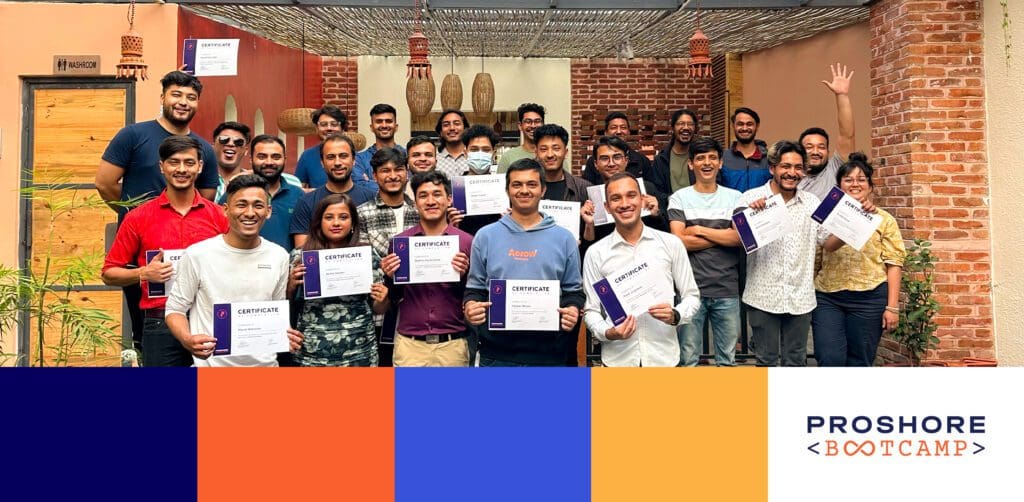
Proshore Bootcamp #4: Kickstarting careers In software development
Proshore Bootcamp once again gives aspiring IT professionals in Nepal the chance to gain valuable experience of working in software development.

Proshore Bootcamp #3: More than a mentorship program
Read our 3rd editon's recap to learn why Proshore Bootcamp improves on regular coding bootcamps, IT training, and programming courses.

Proshore Bootcamp #2: A premier IT mentorship program in Nepal
The 2nd edition of Proshore Bootcamp continued our mission to create better job opportunities for IT professionals in Nepal. Read about how it went.


by Krishma Shrestha HR Manager, Proshore

Proshore Bootcamp 6th Edition
A transformative journey into Real-World Software Development
For aspiring software developers in Nepal, gaining hands-on experience in real-world projects is often a challenge. Proshore Bootcamp, a mentorship-driven coding program, has been bridging this gap by offering immersive learning opportunities to talented individuals twice a year.
Learn more Explore our mentroship program, find out if its for you, and put your hat in the basket.
The recently concluded 6th edition of the Proshore Bootcamp proved to be yet another impactful experience, equipping participants with essential technical and soft skills while fostering a strong sense of collaboration and problem-solving.
A Bootcamp Built on Experience and Mentorship
The heart of Proshore Bootcamp lies in its mentors—seasoned professionals who dedicate their time to nurturing the next generation of developers. For the 6th edition, mentors like Sanket, Kundan, and Binaya, among others, brought years of experience, empathy, and leadership to the table.
Sanket Upreti, the Frontend Stream Mentor Lead and former bootcamper, emphasized the cyclical nature of growth: “Once being a bootcamper myself, that is enough motivation to help others grow.” His approach focused on breaking down complex tasks into manageable steps, guiding participants to “solve smaller components first before tackling the bigger picture.”
Kundan Karna, the Backend Stream Mentor Lead, highlighted the importance of foundational skills. Many bootcampers initially struggled with programming basics, so he conducted targeted sessions on research techniques and documentation. His proudest moment? Seeing three past bootcampers evolve into full-time Proshore developers—proof of the program’s career-launching impact.
Meanwhile, Binaya Dhungana, a six-time mentor and QA Stream Mentor Lead, tackled challenges like impostor syndrome and communication gaps. He shared, “Many felt overwhelmed, doubting their abilities. We emphasized progress over perfection and celebrated small wins.” His team-building exercises and focus on “clear, concise communication” helped bootcampers thrive in collaborative settings.
Overcoming Challenges, One Step at a Time
Like any rigorous program, Bootcamp #6 came with its share of challenges. Participants faced:
👩💻 Technical Complexity
Newcomers often froze when starting features. Mentors like Sanket encouraged iterative problem-solving.
🎭 Imposter Syndrome
Binaya’s candid sharing of his own learning curves normalized struggles, fostering resilience.
⏳ Time Management
With tight deadlines, bootcampers learned to prioritize tasks using tools like time-blocking.
🗓️ Communication Gaps
Remote collaboration demanded clarity. Regular stand-ups and feedback sessions turned hesitant speakers into proactive team players.
A standout example was Usan Sakhakarmi, who transformed from a nervous presenter to a confident problem-solver. His team’s late-night brainstorming sessions to resolve a critical project blocker showcased the program’s emphasis on ownership and collaboration.
Transformations That Speak Volumes
The impact of the bootcamp was evident in the transformations observed among the bootcampers. Sanket recalled how a group of bootcampers resolved a major project blocker by collaborating in online meetings, researching, and brainstorming solutions.
Their ability to take responsibility and work as a team showcased their growth in both technical skills and career prospects.
<> Skill Development
Bootcampers mastered Laravel, API optimization, and agile workflows.
🚀 Career Launchpads
Multiple participants, including Binayak and Usan, transitioned to full-time roles.
📢 Confidence Boosts
Graduation day—where teams presented projects to a live audience—was a pinnacle moment. As Sanket recalled, “Seeing them receive applause for months of hard work was unforgettable.”
For Kundan, one of the most rewarding experiences was seeing past bootcampers transition into full-time roles at Proshore. Three backend developers who started as bootcamp participants are now part of the company—a testament to the program’s effectiveness in nurturing talent.
A Bootcamper’s Journey: From Classroom to Career
For the bootcampers, this was more than just a training program—it was an exciting journey that pushed them beyond their comfort zones. The amalgamation of which could lead to a career kickstart!
Binayak, a bootcamper who discovered the bootcamp through a YouTube video, was able to secure a trainee position at Proshore’s sister company, Digital Product Labs (DPL).
✈️ Key Takeaways from Binayak’s Experience
⚖️ Balancing Act
Juggling college exams and bootcamp tasks required discipline. A hybrid schedule—technical work by day, studies by night—kept him on track.
🗣️ Beyond Code
Non-technical sessions on presentation skills (led by me, Krishma Shrestha) and soft skills boosted his confidence, essential for the modern developer.
<> Technical Wins
Kundan’s lessons on optimizing Laravel APIs left a lasting impact, equipping him with industry-relevant expertise.
Looking Ahead: Refining the Bootcamp Experience
While Bootcamp #6 was a success, with the development of ‘Vision Board’, mentors also identified areas for improvement:
1
Binaya noted that some QA candidates had fewer tasks, highlighting the need for better project planning in future editions. For example, integration of QA testing modules ensures even more holistic preparation.
2
Ensuring that all participants have ample learning opportunities should and will remain a priority for the program.
As the Proshore Bootcamp continues to evolve, its mission remains the same: to provide aspiring developers with the skills, experience, and mentorship needed to thrive in the industry. With every edition, it reinforces the belief that learning by doing, coupled with the right guidance, can unlock immense potential in Nepal’s tech talent.
The bootcamp was an incredible learning experience. It felt more like an exciting journey rather than just office work. I particularly enjoyed the non-technical sessions, as they helped me build confidence and improve my communication skills

Binayak Kunwor Backend Trainee & Bootcamp #6 Graduate
Are You Ready to Join the Next Edition?
For those looking to kickstart their careers in software development, the Proshore Bootcamp is more than just a learning experience—it’s a launchpad for success.
If you’re eager to gain real-world project experience, collaborate with experienced mentors, and develop skills that set you apart, the next edition awaits you. Stay tuned and take the leap toward your future in tech!

How a mentorship program can kickstart software development careers
Many aspiring developers lack the practical experience employers crave. Here's where mentorship programs like Proshore Bootcamp can bridge the gap.
Proshore Bootcamp #4: Kickstarting careers In software development
Proshore Bootcamp once again gives aspiring IT professionals in Nepal the chance to gain valuable experience of working in software development.
Proshore Bootcamp #3: More than a mentorship program
Read our 3rd editon's recap to learn why Proshore Bootcamp improves on regular coding bootcamps, IT training, and programming courses.

It was a normal day in the office: busy and fun. People were busy on their own project. In the meantime, a notification pops up in the slack channel “Proshore’s 10th anniversary”. It was not surprising though. The amazing thing was how time flew. It was just a few months ago when we celebrated the 9th Anniversary.
“I was sure there is going to be fun. I have recently been a member of Proshore and it will be the right time for me to know each other and build a strong bond with them”, says Atul who has joined us a week before. On the other hand, Sakar was not happy, as he was going to miss this celebration due to his exams. We missed you there.
Prakash dai was busy responding to the forms about the anniversary. The forms included the preferences of the people. “It’s the only time when all the members of Proshore family are together and not divided by some projects. So, we want everyone to participate so that they can relax and have a nice gateway from their day to day work”, says Prakash when asked about the importance of participation. Everyone was planning their outing in a different way.
https://www.youtube.com/watch?v=67qVWOvTqdUWe moved towards outing venue after having lunch in our office. It was 15:00 on the clock when we reached there. When we reached the venue, we had cold juice offered by the resort. It was a sunny day and cold juice turned out to be a good addition to this summer.

Previous Next We went to our respective room to get fresh. We went to the garden restaurant for snacks. “When I first saw snacks, I was not sure how good it was. There was a sandwich and I am not a fan of bread. Although, I took one as I was feeling hungry. It was amazing. The taste of cheese made it tastier than I expected”, said Babish when asked about the snacks.

Previous Next
Before the game, the first thing to do was to celebrate Proshore’s 10 years of success. Thanks to Ashish dai, who brought delicious muffins from mollie.

After this, we were expecting a great time ahead and we had it. It was time for team building game named “Scavenger Hunt”. There were four members for conducting this game: Prakash, Manoj, Shikha, and Babish. We were divided into 5 teams: Team1, Team2, Team3, Team4, Team 5.
Everyone thought the game would be easy, but it was not. Let me explain the game.
There were 5 tasks in this game and the one who has more correct answers would win the game. The questions were not easy to find as we thought initially. The questions were hidden in a QR code, which was stuck in different parts of the resort. There were a total of 13 QR codes pasted. Each group had 2 QR codes assigned to them. The difficult task was to find the correct QR code for the respective team. And when you find them, the questions were tricky.
I remember the first question: “What is long and hard and has cum in it?” It was difficult to think positive for every one of us. Don’t wonder, the correct answer is “Cucumber”. I am quite sure that the question was designed by Manoj. God bless him!

So, it wasn’t easy to find those questions for the teams. The surface was never flat, that’s why we had to climb stairs many times. It was challenging. The main theme of this game was team building. It taught us how a team should work together to achieve a goal. It helped to know each team member.
Later, we all headed towards the swimming pool.
“Run …splash!”. This is the story of every swimming pool.
The interesting thing here is, who didn’t know to swim were more excited. They were excited to click the photos rather than swimming 😂. Bikram was eager to click photos with his new Samsung GALAXY S10. The level of drama was increasing as they were posing underwater 😂. I was holding “go pro” because I don’t know to swim. That’s why I was in poolside clicking the photos. Rajan, Karan, Guru, and Bidur were swimming well. It was 6 in the evening and it was snack time.

Previous Next
Everyone was tired after swimming. In the meantime, snacks would really refresh everyone’s mood. People were sitting with own “gang” in different tables 😄. Talks with your friends with a chilled beer in hand is always an amazing feeling. Addition to that, BBQ is always good with beer. After having enough beer, some people were having a healthy discussion with each other whereas another group was dancing.

Previous Next
After hours of dancing and discussion, it was time for dinner.
After dinner, most of the people went to their respective room. Some people were even discussing with some “tequilas”(called whiskey). The topic of discussion this time was again football. Babish, a Chelsea fan was alone discussing with the other two Liverpool fans(Sameer and Arpan). Other two interesting guys: Rudra and Tek were having another discussion, guess the topic? It was “Messi vs Ronaldo”. Let me tell you, Rudra is a fan of Ronaldo whereas Tek is of Messi’s. As usual, the discussion ended with no conclusion 😂. Babish was playing guitar whereas others were singing along with him. It was already midnight, and we headed towards our own rooms.

Next day was a hangover for most of the guys. Some of the guys (who didn’t drink well last night 😛)visited “Santaneshwor Mahadev” temple which was twenty minutes walk far from the resort. We had a heavy breakfast before swimming. Finally, we packed off and checked out at 12:00 noon.
It was an amazing experience. In my opinion, such an outing helps us know each other very well. People can’t be frank to other people in the workplace due to the role assigned to them. That’s why outing is important to know each other as they are franker here than in the workplace. This is how you build your team strong.
At last, thanks to our organizing members for making this anniversary activities successful.
You can watch the video of our Anniversary on our YouTube channel.

Why is Proshore based in Nepal? Why do our developers stay there, instead of us bringing Nepalese talent back to the Netherlands? After all, there are plenty of jobs for the taking in our country. These are both sensible questions that I am happy to answer in this article.
How did Proshore end up in Nepal?
Let's start at the beginning. In 2008, my business partner Haico happened to find himself in Nepal. Inspired by his interest in international entrepreneurship, he wanted to outsource some of the software development activities to a foreign country. Haico and his Nepalese contact Roshan therefore formed a cooperative alliance with a local partner. Unfortunately, that partnership didn't last very long. Nevertheless, Haico and Roshan kept in touch afterwards and in 2009, the two decided to set up an international business together; one with offices in the Netherlands and in Nepal. You guessed it: Proshore was born. We started out fairly small with just five FTEs. Today, our team is made up of more than sixty people - and counting, since we continue to grow rapidly!
Why are we not bringing Nepalese talent back to the Netherlands?
The question remains why we choose to stay in Nepal. As you undoubtedly now, a full-on war on talent is raging in the Western world. Technical talent in particular is incredibly scarce and therefore precious. At the moment, that is not the case in Nepal and other Asian countries. Contrary to many other recruitment parties, we nevertheless made a conscious decision not to bring Nepalese developers to the Netherlands permanently. I want to take a moment to explain why that is.
Nepal is dependent and susceptible to outside influence
The country's infrastructure leaves a lot to be desired. The political situation has been unstable for years. Although investments are being made in the country's economy, hardly any of that money comes from the national government. Instead, most of the money comes from the two rapidly growing economies that Nepal is caught between: India and China (since the earthquake in 2015). As a result, the country is extremely dependent in an economic sense. Since the country cannot properly support itself, it is highly susceptible to outside influence. At the moment, Nepal's import outweighs its export by a factor of thirteen. Although the country certainly has the potential to create its own industry, not enough is currently being done to facilitate that. Here’s an example: Nepal has the tallest mountains in the world and the most water. In theory, those natural resources could help the country become the largest international provider of green energy. At the moment, however, Nepal regularly imports more than fifty percent of the power it needs from India.
Talented youths seek their fortunes elsewhere
Another major problem that Nepal faces is unemployment, which sits at about forty percent. That should come as no great surprise. The country does not have a strong economy of its own and jobs are therefore hard to come by. That is especially true for highly educated people. As a result, around 1,600 people leave Nepal every day in search of a job elsewhere. Countries such as Australia, Japan and the United States are popular destinations for Nepalese professionals. The working population in these countries is ageing and they face a shortage of new employees. In addition to recruiting employees in Nepal, they also actively offer student visas to talented students. With job guarantees and other lofty promises, they hope to entice the Nepalese youths to stick around once they have finished their studies. In other words: the talented youths whose job it should be to build up Nepal are all leaving the country. If we were to go over there to recruit talented professionals and bring them back to the Netherlands, the situation would only exacerbate.
Creating an export product and top talent
That is not what we want. On the contrary; we would much rather invest in the country itself. First of all, we do so by creating an export product: Nepalese software that is being sold in the Netherlands. Secondly, we help to create top talent. When we form development teams for our clients, we always make sure to include a couple of training positions. As part of every team, we train several new people to become software developers. Many of them are fresh out of university. If not for the job we offer them, they would not have had many career opportunities in their own country and might therefore have sought their fortunes elsewhere. In other words, we do not search for the one percent of top talent for our clients. We would much rather create these talents ourselves. If you ask me, that is a far more sustainable approach and one that will surely help the country in the long run. We are truly grateful to Nepal Although we ended up there by happenstance, Nepal has won our hearts these past few years. We are truly grateful to her. I hope - as do my colleagues in the Netherlands and Nepal - that many other companies will follow our example.

Co-located in the Netherlands and Nepal, Proshore was founded in 2009. Its mission is to create sustainable and highly skilled jobs for people in Nepal by offering managed development teams as a service to Software as a Service (SaaS) companies.
But how did it grow from a two-person start-up to an international team with over 70 employees?
This is the story of Proshore.
Selling Wine Online
Co-founder Haico’s first online business grew out of a student project in the form of a shop selling wine and gift boxes. With the rest of his team dismissive of the idea of selling online, Haico ran with the project himself, leveraging the potential of online paid advertising at a time when it was still a relatively new concept.
Business boomed. With many companies traditionally sending wine gifts at the end of the year, by 2006 Haico was working exceptionally long hours, and ready for his next challenge – a Customer Relationship Management platform. So he sold his wine business and went looking for an international development team to help build his software.
International Entrepreneurs
Haico’s search led him to Nepal, where he had made contact with a company that seemed like they might be able to help. Unfortunately, it was clear from early on that they lacked the process and quality needed to bring the project up to standard. However, Haico was impressed by one of their technical project managers called Roshan.
The owner was also just about to relocate to India, but undeterred, Haico pitched a joint venture, with the requirement that someone like Roshan was in place. For the business owner, it was a non-starter. But Roshan and Haico stayed in touch. They soon agreed that they wanted to entrepreneur the idea together.
With a bit of capital to invest from the sale of his wine business and Roshan onboard, Haico decided to set up an office in Nepal, finding office space and listing vacancies for a new venture. After working for two years as a business advisor at a larger company in the Netherlands, Haico had the simple objective of becoming an international entrepreneur.
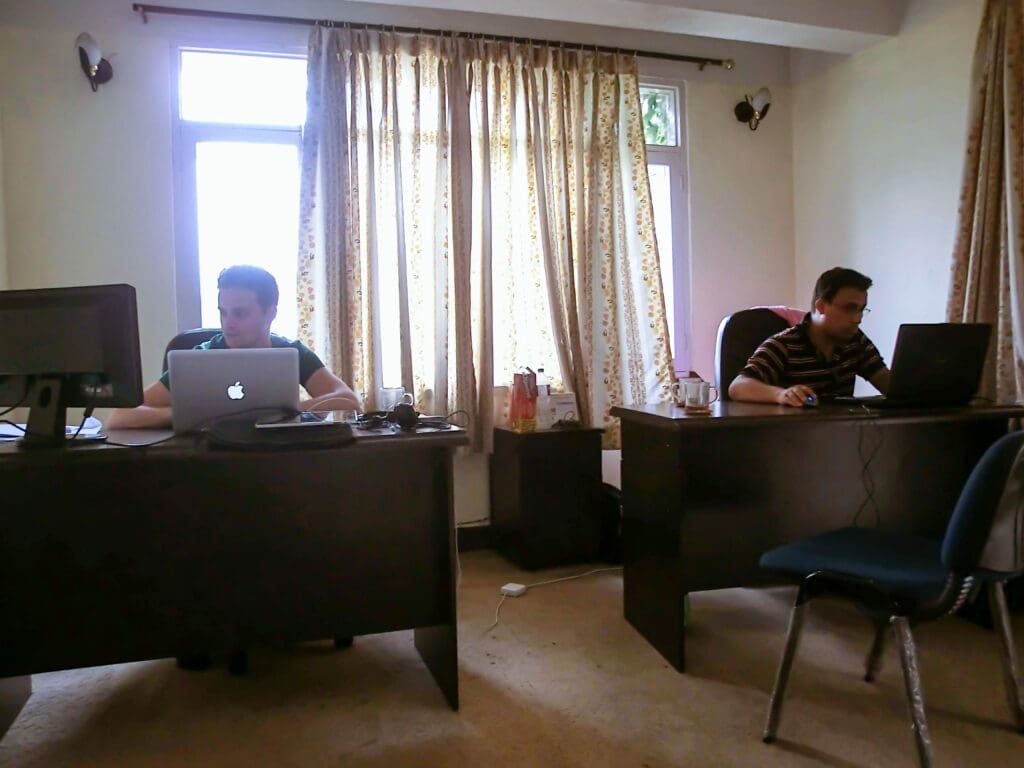

Selling Designs To Life
Back in 2009, there were a lot of graphic designers and marketers looking to create websites, but without the technical knowledge to do so. So, Haico and Roshan realized there was an opportunity to serve as a technical partner by offering their programming capabilities.
However, after working on a number of projects, the pair soon realized that as a technical partner, they were not able to influence the design or offer advice, even when they saw huge potential for improvement. So they started to develop web applications alongside consulting, where they offered some design, development, and support. This second business model yielded more growth for their company, so they started to optimize their processes in Nepal. They were then able to attract bigger clients, such as the grocery chain Ekoplaza.
The Start Of Teams As A Service
With the consulting side of the business really starting to expand, Haico looked to find hire project managers in the Netherlands. They even set up an office on a technology campus. However, it became increasingly difficult to scale their model there, compared with Nepal.
They also started to feel that their efforts in the Netherlands were distracting them from the potential scalability of the Nepal operation. So Proshore decided to pivot to a new model, offering software development teams as a service.
“So now, we're delivering a team, and this team is being integrated directly with the customer’s team. This is a much more scalable model, and it's also a durable model because we try to partner with companies who are growing, and have clear ambitions.”
Haico Duisters, Proshore, Co-Founder
With a renewed focus on supporting startups, scale-ups, and companies looking to grow their software, Proshore began to capitalize on a gap in the market for technical teams who could work alongside in-house teams for a given purpose. Their services also grew to include other technical roles, such as quality analysts, and scrum masters.
Bridging Eindhoven And Kathmandu
Looking ahead, Proshore has ambitions to scale its Nepalese organization. That’s where they want to build and develop. It’s where they have their HR. Meanwhile, back in the Netherlands, their sales and consulting team works to secure clients and manage the integrations.
Discover how integration with Proshore can help your SaaS scale sustainably by booking a call with us today.

by Krishma Shrestha HR Manager, Proshore
Careers
15 years in UX: Ashish’s Journey from Nepal to Global Design Excellence
How does a graphic designer from Nepal become a global UI/UX expert? For Ashish Tamrakar, the answer lies in 15 years of relentless adaptation, curiosity, and a partnership with Proshore—a company he helped shape from its infancy.
Career at Proshore Discover our current openings and resources on starting a career in offshore software development.
From wrestling with Internet Explorer 6 in 2008 to designing AI-powered interfaces today, Ashish’s journey is a masterclass in turning limitations into opportunities. For aspiring Nepali designers eyeing international careers, his story proves that talent, not geography, defines success.
From Pixels to Problems: The Evolution of a Designer
When Ashish joined Proshore as a graphic designer in 2008, “UI/UX” wasn’t even a buzzword in Nepal. His toolkit? CorelDraw and a creative eye. However the web design world was shifting, and clients demanded more than static visuals. “I had zero coding experience,” Ashish recalls. “Suddenly, I was debugging layouts in IE6 (Internet Explorer 6) and pleading with browsers to render CSS consistently.”
Enter Roshan, Proshore’s co-founder and one of Ashish’s first mentors. “Roshan sir handed me WordPress tutorials and said, ‘Learn to think like a developer.’ That changed everything.” Ashish began designing with functionality in mind, not just aesthetics. He mastered HTML, embraced frameworks like Tailwind CSS, and rode the tsunami of design trends—from skeuomorphism’s 3D buttons to flat design’s minimalist revolt.
But survival in tech requires foresight. “Every two years, the rules change,” Ashish warns. “If you stop learning, you become obsolete.” Today, he’s tackling AI tools like Figma’s AI-powered prototypes, proving that adaptability isn’t optional—it’s existential.
🥡 Takeaway
Trends fade, but problem-solving is timeless. Design for usability first, then beauty.
Building a Career Without Borders: Remote Work & Global Mindsets
Early Proshore was a startup in every sense: open desks, Saturday hikes, and a flat hierarchy that blurred lines between interns and founders. This culture of collaboration fueled creativity. “We weren’t just coworkers—we were pioneers,” Ashish reflects.
Then came the pandemic. Remote work erased commutes but also casual coffee breaks. For Ashish, a new father, flexibility was a double-edged sword. “I saved hours by working from home, but missed the spontaneous brainstorming that sparks innovation.”
Yet, remote work unlocked global opportunities. Ashish’s designs now serve clients from Amsterdam to Sydney. One standout project? A “Choose Your Shoes” configurator built with Tailwind. “International clients demand precision. Their feedback pushed me to think beyond Nepal’s design norms,” he says. Another example, a Dutch AgriTech client, De Heus, taught him the power of brand consistency. “Their strict guidelines forced me to innovate within constraints.”
Proshore’s “no monotonous work” ethos kept him hooked. “Every project felt like a puzzle. I’d switch from e-commerce layouts to AI dashboards, always learning.”
✈️ Takeaway
Remote work isn’t just about convenience—it’s a gateway to global standards. Treat every client as a teacher.
Ashish’s Blueprint: Advice for Aspiring Nepali Designers
Proudest Milestones
While Ashish has been part of nearly all client projects since he's been with us, here are some professional milestones that stand out to him.
1
Designing the “Honey” logo for a client during my first years – and getting it approved.
2
Leading Proshore’s WordPress migration, slashing load times by 40%.
3
Cracking Tailwind CSS to build responsive interfaces in record time.
Common Pitfalls to Avoid
🗣️ Ignoring Client Communication
“A beautiful design is useless if it doesn’t solve the client’s problem. Ask why before how.”
🤖 Fearing AI
“AI won’t replace designers—it’ll replace those who ignore it. Use tools like i for wireframe ideas, not final drafts.”
😵💫 Tutorial Overload
“Don’t just copy code. Break it, tweak it, make it yours.”
Actionable Tips
🖼️ Design Portfolios That Tell Stories
“Showcase projects where your design moved metrics. Did your i boost conversions? Simplify navigation? That’s what clients care about.”
🫂 Embrace Cultural Fluency
“Study color psychology. Red means passion in the West but luck in Nepal. Design for your audience, not your portfolio.”
🧐 Stay Curious, Not Complacent
“Follow designers like Chris Coyier (thanks to Roshan’s mentorship!) or Aarron Walter. Reverse-engineer their work.”
https://www.youtube.com/watch?v=HZhAFHmdX1k
The Future is Fearless
Ashish’s journey—from Kathmandu to global projects—debunks the myth that Nepal’s tech scene is “too small” to compete. “Our humility and hunger are advantages,” he insists. “Nepali designers understand diverse user needs because we’ve navigated resource constraints ourselves.”
As AI reshapes design, Ashish’s advice is simple: Adapt or pivot. “Learn AI tools, but protect your creative voice. Let machines handle grids; humans handle empathy.”
Design has no borders. All you need is curiosity and a browser.

Ashish Tamrakar Senior UIUX Designer, Proshore
The next 15 years of tech won’t be ruled by Silicon Valley alone. They’ll belong to designers who merge cultural insight with technical grit. For Nepali talent, the world isn’t just a market—it’s your canvas.


November 10–13 Lisbon, Portugal
Tech Conference
Proshore Joins Global Innovators at Web Summit Lisbon 2025
From November 10 to 13, Proshore will take part in Web Summit Lisbon 2025, one of the world’s most influential technology conferences.
Book a call Talk to our Accounts director, Jeroen, to see if our ready-to-code offshore teams are a fit for you.
The event brings together entrepreneurs, leaders, and technologists from across the globe to explore emerging technologies, the impact of AI, and the future of the digital economy.
Representing Proshore are Roshan Bhattarai (Operational Director), Jeroen van der Horst (Account Director), Babish Shrestha (Technology Director), and Haico Duisters (Managing Director).
They will join thousands of industry experts to discuss how organizations build and scale technology teams, implement new digital strategies, and strengthen global IT capabilities.
What We’re Excited About
This year’s Web Summit focuses on how digital transformation, AI, and cloud innovation are reshaping the way IT departments and global teams collaborate.
Proshore’s team looks forward to connecting with innovators, learning from new perspectives, and sharing experiences from working with distributed tech teams that drive scalability and long-term growth.
From cloud-native development to data-driven digital transformation, Proshore remains committed to helping organizations succeed at the intersection of people, process, and technology.
Web Summit Lisbon provides the perfect setting to continue that mission and engage with the ideas shaping tomorrow’s digital landscape.
Meet us at Web Summit 2025—let’s talk tech and innovation!

Security budgets continue to expand rapidly in 2026, with global spending now approaching $240 billion, yet many enterprises still experience frequent incidents and only marginal improvements in their overall risk posture.
IBM’s Cost of a Data Breach Report 2025 shows the global average breach cost has eased slightly to $4.44 million, the first decline in five years, thanks in part to faster AI-assisted detection in some organizations.
However, the U.S. figure hit a record $10.22 million, and shadow AI incidents added an average of $670,000 when they occurred.
Meanwhile, third-party and supply-chain attacks now account for nearly 30 % of breaches, AI-enhanced threats are shortening detection windows, and human factors still drive roughly two-thirds of incidents.
Gartner notes that through 2028, more than half of enterprises will encounter at least one significant security shortfall linked to poor integration and operating-model gaps rather than a shortage of tools.
The disconnect becomes clear after controls go live. Dashboards fill with alerts, compliance reports look solid, and tool deployments finish on time, yet core business processes, decision rights, and risk accountability often stay trapped in outdated, siloed structures.
Security Maturity Does Not Translate to Real-World Protection

Security initiatives regularly achieve strong maturity ratings and complete major rollouts within planned timelines, but the expected drops in incident rates, faster response times, and lower financial exposure seldom appear across the enterprise.
In practice, layering on new tools creates coverage without the fundamental redesign required to weave security into daily operations.
Controls activate in the environment, but they inherit the same fragmentation, overwhelming alerts, and manual handoffs that predated the latest investment cycle.
Lasting resilience appears only when security capabilities support redesigned workflows, continuous threat intelligence, automated remediation, and tight coordination between teams.
This demands mature risk ownership, shifts in organizational behavior, and an architecture that treats security as a business enabler instead of a standalone compliance checkbox.
Advanced security platforms and automation accelerate initial setup, yet they cannot fix tool proliferation, missing cross-system linkages, or the absence of ongoing risk-tuning processes.
The real barrier lies not in the availability of technology but in the lack of a bridge between control deployment and measurable reductions in enterprise risk.
Structural Issues Behind Enterprise Security Failures
Shortfalls like these arise from recurring organizational patterns rather than isolated technological shortcomings.
Security efforts often advance independently of business strategy groups, while architecture, operations, and compliance teams step in only after key choices are finalized.
Outdated assumptions linger, and complex multi-vendor or hybrid setups quickly generate concealed complexity.
Rising geopolitical demands and data-sovereignty rules now trigger expensive last-minute adjustments that should have guided early design decisions.
Effective protection at scale remains out of reach when security is treated as a specialized compliance task rather than a foundational element of enterprise performance.
In 2026, as AI agents expand their attack surfaces and third-party risks double, enterprises that rely on checklist-driven programs rather than integrated risk strategies keep falling short.
Four patterns surface consistently:
(Based on patterns in IBM Cost of a Data Breach Report 2025 and Gartner cybersecurity trends for 2026)
Security Spend Without Risk Reduction and Its Impact
When programs wrap up without a built-in risk framework, inefficiencies spread throughout the organization. Tool selection and integration work get repeated across departments.
Live environments accumulate alert fatigue, and expanding AI threats magnify noise and overlook signals.
Executive belief weakens as expected gains in resilience, regulatory standing, and cost protection deliver only partial results.
These pressures appear in several consistent ways:
(Source: IBM Cost of a Data Breach Report 2025)
A More Effective Path to Security-Driven Resilience
Security creates lasting enterprise strength when it operates as a core layer woven into wider digital and operational change programs.
The operating model ties security work directly to business goals, updates controls alongside infrastructure and application changes, and builds risk oversight, automation, and refinement into the foundation instead of adding them later.
Design choices, delivery flows, and performance habits support each other from the start.
This approach shifts security from a periodic compliance exercise into a continuous source of trust and operational stability.
Key Elements That Shape Security Success
Enterprise security efforts are judged by strategic fit, implementation strength, and ongoing results, not simply by tool rollout progress.
The pivotal question shifts from whether protections are in place to whether the organization has the frameworks needed to sustain meaningful risk reduction at scale.
Proshore Enterprise Security Approach and Outcomes

Proshore addresses the structural issues that prevent security investments from delivering sustained risk reduction.
Security is embedded into business processes and system design rather than added after deployment.
At Altec, Proshore implemented a multi-layered cloud security architecture across network, application, and subnet levels. Secure access was enforced through VPN authentication and IP whitelisting. Test and production environments were clearly separated.
This reduced risk and improved reliability, and created a secure foundation for scaling operations.
With Health Catalyst (Upfront Healthcare), Proshore delivered security-focused platform enhancements aligned with enterprise standards. Automated testing and DevOps practices strengthened platform stability and improved reliability. The platform performs consistently in a secure environment.
Across these engagements, security is built into system design and delivery rather than added after deployment. The result is stronger protection and controlled access. Platforms scale without introducing additional risk.
Improving Enterprise Security Outcomes and Risk Reduction

Security capabilities deliver genuine enterprise protection only when spending leads to full operating-model transformation.
Enterprises that look past deployment numbers and treat security as a strategic business discipline, focusing on architecture integration, shared risk ownership, and continuous refinement, achieve noticeably better protection.
By folding security thinking into broader modernization programs, creating habits of ongoing improvement, and building resilience by design, organizations can escape the cycle of heavy outlays paired with stubborn exposure.
The tools are available. What matters is how they become part of the way the business actually runs.

In today’s digital-first world, software isn’t just supporting the business—it is the business. From internal tools to customer-facing platforms, companies are under constant pressure to ship faster, scale reliably, and still maintain quality. So how do modern software teams pull it off?
Let’s break it down.

1. Clear Problems Before Clever Solutions
High-performing software teams don’t start with technology—they start with problems.
Instead of asking “Which framework should we use?”, they ask:
- What pain point are we solving?
- Who is affected by it?
- How will we measure success?
This problem-first mindset prevents overengineering and ensures the final product actually delivers value.
2. Modular, Scalable Architecture
Modern applications are built to evolve. That’s why many teams rely on:
- Modular codebases
- API-driven architectures
- Cloud-native infrastructure
This approach allows teams to scale specific features independently, reduce risk during updates, and adapt quickly as requirements change.
3. Automation Everywhere
Speed without automation doesn’t scale.
Successful teams automate:
- Testing (unit, integration, end-to-end)
- Deployments (CI/CD pipelines)
- Monitoring and alerts
Automation reduces human error, shortens release cycles, and frees developers to focus on solving real problems—not repetitive tasks.
4. Collaboration Beats Silos
Modern software development is a team sport.
Designers, developers, QA engineers, and product managers work closely together—often in short feedback loops. Tools like shared design systems, issue trackers, and real-time communication platforms help keep everyone aligned.
The result? Fewer surprises and better products.
5. Continuous Improvement
Great software is never truly “done.”
High-performing teams regularly:
- Review what worked (and what didn’t)
- Gather user feedback
- Refactor and optimize
This culture of continuous improvement ensures the software stays relevant, performant, and easy to maintain.
Final Thoughts
Building software faster doesn’t mean cutting corners. It means making smarter decisions—about architecture, processes, and collaboration.
At its core, modern software development is about clarity, consistency, and care. When teams get those right, speed naturally follows.
Want to learn how your software team can improve delivery without sacrificing quality? Get in touch with us or explore more insights on our blog.
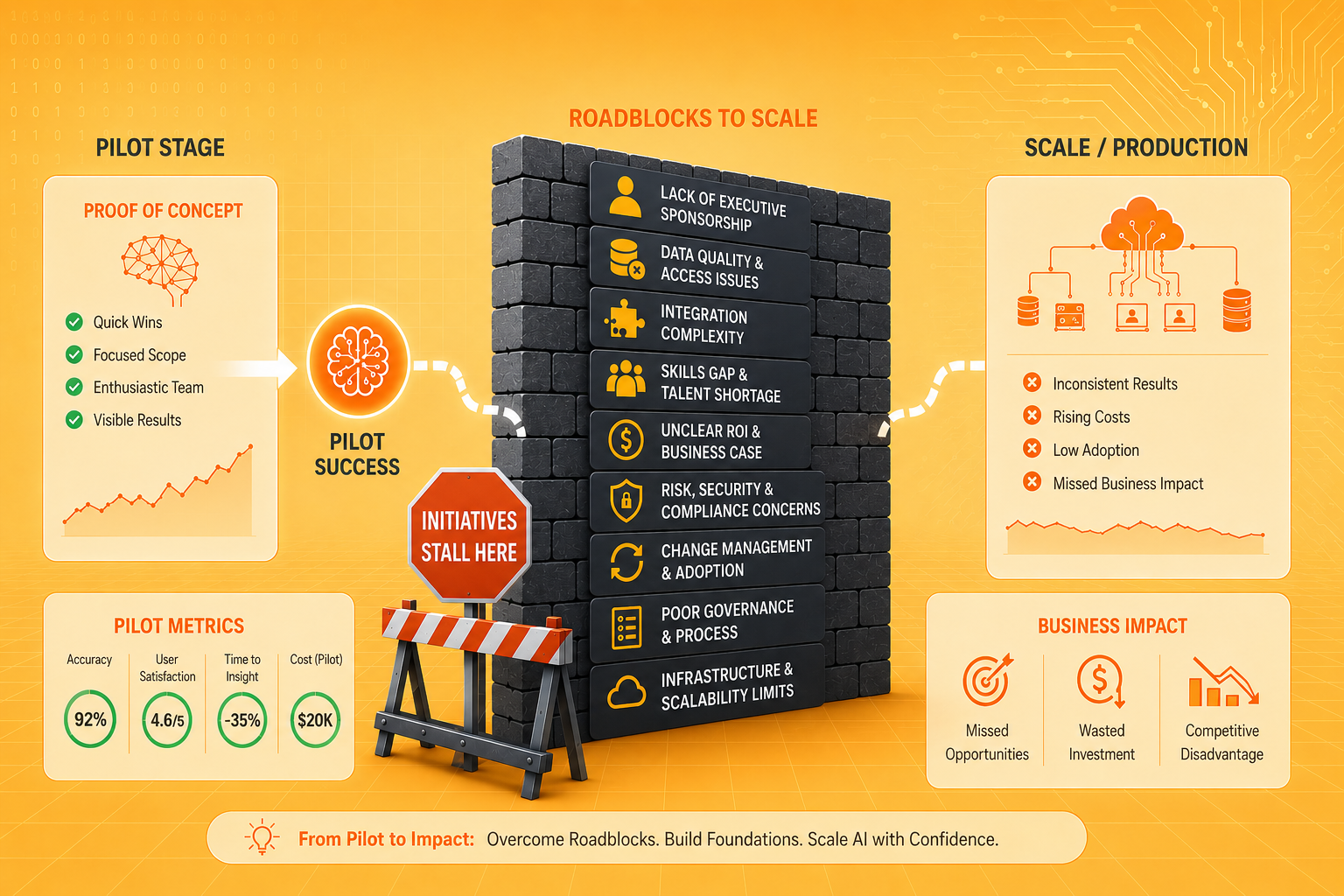
As a TypeScript developer, I’ve witnessed firsthand the power and potential this language brings to the table. Don’t get me wrong, JavaScript has been the web’s backbone for years.
JavaScript has been the cornerstone of web development for decades. Its dynamic nature, ease of learning, and vast ecosystem have made it a go-to choice for countless developers worldwide. However, as projects grow in complexity and the demands of modern web applications increase, JavaScript’s limitations can become apparent.
Enter TypeScript, a superset of JavaScript that adds optional static typing to the language. By allowing developers to define types for variables, functions, and objects, TypeScript offers a more robust, scalable, and maintainable development experience.
JavaScript's Strengths, Our Shared History
Let’s acknowledge JavaScript’s strengths:
Dynamic Typing
Quick coding without upfront variable type definitions.
No Build Step
Pure JavaScript runs directly in browsers or Node.js, eliminating compilation hassle.
Mature Ecosystem
Thousands of libraries and frameworks make JavaScript incredibly versatile.
Prototyping Powerhouse
Its flexibility makes it ideal for quick prototypes and smaller projects.
These valuable aspects have made JavaScript the dominant force in web development. However, with great power comes great responsibility… or rather, a higher chance of bugs.
JavaScript's Achilles Heel: Runtime Errors and Maintenance Challenges
Runtime Errors
Dynamic typing means errors like passing the wrong data type or accessing non-existent properties only show up at runtime. This creates a debugging nightmare.
Scalability Issues
As projects grow, managing untyped code becomes a challenge. Debugging becomes more difficult, and refactoring code can be risky.
Limited Auto- completion & Tooling
Without static types, IDEs struggle to provide robust features like intelligent auto-completion and code analysis, slowing developers down.
These valuable aspects have made JavaScript the dominant force in web development. However, with great power comes great responsibility… or rather, a higher chance of bugs.
My colleagues faced a similar set of challenges when working on a Zendesk app – learn how they used TypeScript to transform a chaotic JavaScript code into a maintainable and efficient fortress.
TypeScript: The Supercharged Successor
Enter TypeScript, a superset of JavaScript that addresses these limitations. Here’s why I, as a TypeScript developer, am a huge advocate:
Explore more detailed benefits of TypeScript Development, shared by my colleague and fellow JavaScript Developer, Atul Shrestha.
Native Framework Support: Building with Confidence
Many popular frameworks now embrace TypeScript natively:
React
First-class support for typed components and hooks leads to better prop validation, reduced runtime errors, and an overall smoother developer experience.
Angular
Built with TypeScript from the ground up, Angular’s official documentation and tutorials use TypeScript as the default.
Vue
Vue 3 offers full TypeScript support, with improved tooling for creating typed components, enhancing type safety and maintainability.
Node.js
With tools like ts-node and Deno (a Node.js alternative), TypeScript runs natively in server-side environments, enabling fully typed backend applications.
The Future is Typed: Why TypeScript Wins
TypeScript’s advantages make it the clear winner for most modern development projects:
The bottom line, today, there’s little reason to avoid TypeScript. Its native support in major frameworks, tooling improvements, and static typing advantages make it the clear choice for most modern projects. Whether you’re working on a small personal project or building a complex enterprise-level application, TypeScript gives you the best of both worlds: the flexibility of JavaScript with the safety and reliability of a statically typed language.
So, while JavaScript remains a powerful and essential tool for many developers, TypeScript is the future. If you haven’t made the switch, there’s no better time than now!
Let’s build the future of web development together, one typed line at a time – hire a dedicated TypeScript development team from Proshore today.

“ Proshore provide an open culture and flexible working environment, where the team doesn’t have to worry about ‘nine to five’. They believe if you love your work then you don’t have to work a single day”
In this interview, Prakash Bhusal (Operations Manager) and Babish Shrestha (Head of Engineering) scoop us more about IT company Proshore and its culture. It is possible to work from home now and then, but Prakash and Babish want to make the office attractive to work:
“Proshore is a fun working environment, we know that if a company is not flexible and puts too much pressure on team members, it is not productive. So we make it fun and work flexible, so people don’t hate Mondays. We want them to prefer collaborating at the office as it builds more cohesiveness between the team”
What do you look for when you hire an IT employee?
We encourage people to challenge themselves, make them competitive. There should always be a match between a company and individuals vision. We work with Agile philosophy so we look that in an individual as well. We are not focused only on output but look at individuals way of identifying the problems and decision making for the solutions. The solution does not always have to be done in a complex way.
To make our team members love their work, we try to help them work smart and not too many hours. At the end of the day, it’s about the value that we are trying to provide to our team members and customers.

When we hire, we especially look at their skill set: what can they offer that our customers need. This does not have to be only technical skill set. Communication skill is equally important
-Prakash Bhusal, Operations Manager at Proshore
How is Proshore different from other IT companies in Nepal?
Compared to other IT companies in Nepal, I think we are moving more into the direction of attractiveness, that people want to work with us. We try to learn from team members, within the borders of our own strategy. This is also important for our customers, the price is less important than quality for them. This helps people grow, other IT companies have flexible working hours, but with restrictions that we don’t have. We don’t believe in overtime and most of the time try to avoid it. We don’t ask people why they are late, as long as they work their project hours.
We have an open office culture, there are no departments and not many closed rooms. We are very focused to create a learning environment for the people. For that, we encourage every member to learn from other people who are working on a different project. In this way, everyone can communicate and collaborate and can discuss with each other.
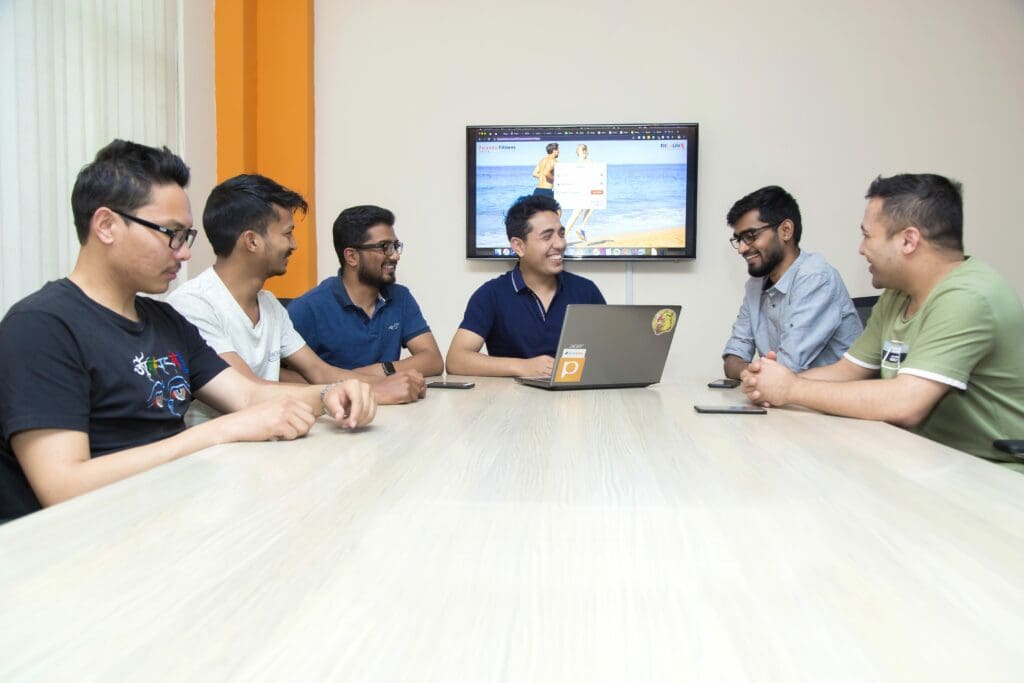
People who work together on a project, sit with each other. Each individual is their own boss. They are giving a clear set of goals and strive for that.
We know salaries are important so we pay on time 🙂. We have our reviews on time. We don’t provide project bonuses but more of an organization bonuses since we believe its collaborative effort of every team member. We even have marital leave, maternity leave, paternity leave and more and in addition, there is also leave encashment. Intangible benefits are usually no problem, for instance, we don’t expect our team members to work on weekends. Breakfast and lunch are provided so they don’t have to work empty stomach 😊. We are also very flexible in providing casual leave. At the end of the day it is important that our team members are happy. Especially if you notice that a certain day off is important for this person.

“We want people to learn and be challenged, we help them with their career and offer them the latest technology. We don’t force people to use any specific language set but give them room for suggestions before making a decision through collaboration”
- Babish Shrestha, Head of Engineering at Proshore
Do you have extra activities for team-members?
We also organize events for our team, like picnics and annual night stay on our anniversary. A break is very important to be productive in the afternoon. So, during our lunch breaks, we do other stuff together, like watching an episode of Game of Thrones or tea gossip. We all play futsal every Wednesday. But you can also play FIFA or Counter-strike. It all makes a lot of sounds 😅, but only during lunchtime. I even wanted to bring a Snooker table.

We also go rafting together, or hiking or cricket or other indoor games. We never force team members to do work the whole day. Especially at the end of the day, people like to do an office game like table tennis.
Why should IT employees work at Proshore?
When I talk to the IT people about Proshore, I mention that they work with very technical projects for very interesting customers. The cost pressure is much lower, we don’t bid to IT projects as many companies do. The customers of Proshore are the end customers with whom we work ourselves, they tell us about the company problems that we have to solve. So we can really advise them about the best platform. Most IT companies in Nepal fail because they are started by people that go for a low price and low cost.

All of our customers are from the Netherlands, which makes making IT choices easier. The way the Dutch market works can be very different than other cultures. The IT market is however large enough in the Netherlands, so there is enough work for us. We still need new people!
With the modern world, the working culture is gradually changing in all work-space. The companies are slowly rising over restrictions for their smooth flow. People are no longer bound to their work-space. Applying pressure on work is not fruitful for this generation. Inspiration and motivation yield a positive output. With the age of learning and sharing, it’s essential for any work-space to have a learning and collaborative environment.
At last, we think we are still learning. Workplace culture is very important and our every action are focused towards making it better. We know sometimes it works and sometimes does not but you learn and make changes accordingly.

“I enjoy working at Proshore, a company with a good environment. It feels like home, we work as a family and the colleagues are friendly. I have been working here for 6.5 years and saw the company grow”Sakar Khatiwada is Web developer at Proshore, we interviewed him together with Software Developer, Sushant Shah. Sakar has been much longer with the company, whereas Sushant has been with us for 6 months.

What is your most important customer?
Sakar:” I have worked for our customer Meubeltaxi for 3 years, now I only work for them for a week in the month. For Meubeltaxi, I developed the whole IT-system: from requirements to analysis, front-end, and back-end. And all processes: from order to invoicing.”“It was a fun project. I needed some help, but I did most of it alone. The client was also very cooperative; We moved our communication from Skype to Trello; It gave less confusion, and the process was better. In Trello, they could track everything that we were doing.”I also built applications for Pluscloud, which delivers tools and services for customer contact. I had to make small applications, an extra plugin that will add features in the Zendesk dashboard. I also worked for Heineken. I made small applications for their export division.”
How long have you worked at Proshore?
Sakar: “I have been working at Proshore since I got my bachelor’s degree in Information Management. I have also done postgraduates in psychology and am now doing my master’s in business studies. I like to improve myself, but I also like to keep myself busy. I need a healthy stress level 😃”
My workday usually starts with going through the requirements, which is 2–3 days of work from the beginning. I look at what I should deliver that day and start with the work. My specialty is PHP and JavaScript. Sometimes I write in Trello or ask the customer on Skype when collaboration is needed. That is how my day goes. I enjoy it.”Sushant Shah has been working at Proshore since February, he also has specific projects to work on: “I am working on Personal Fitness Nederland(A SaaS for Fitness Schools) and this month I will start a new project. After the design is ready, I can start developing.”

What study did you do before working at Proshore?
Sushant: “I completed my degree in computer science, and after that, I started working for a company as a developer. My specialties are PHP, Javascript, and Python. I studied in India on an international institute, a top university there.”“My working day starts when I come in at 11.00. I have been assigned to Personal Fitness Nederland(PFN), so I start with what the client has sent me. I look at the requirements and make a plan. I then start my work. I try to work efficiently and communicate with my contact person in Personal Fitness Nederland(PFN) and my Dutch colleague Haico regularly. According to what he tells me, I make priorities and technical requirements.”
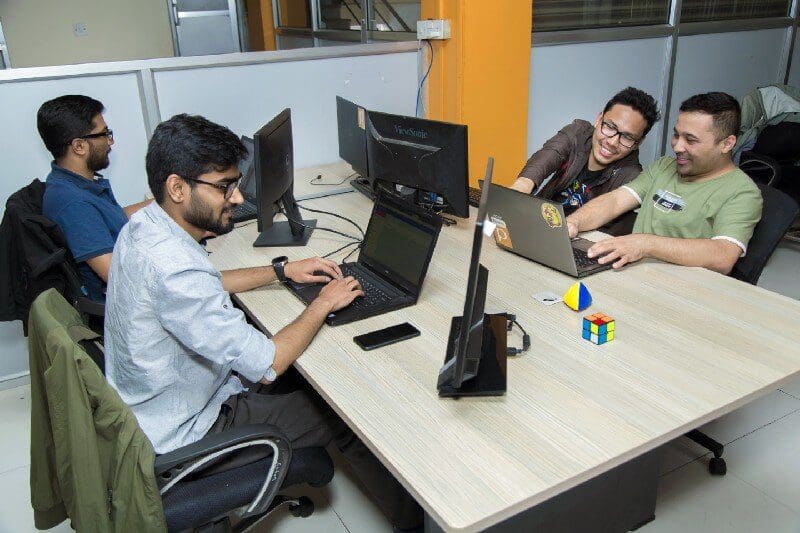
“Proshore is a good company, it has a very good environment. I have seen a lot of IT companies, but this one is very well managed. Colleagues are great; we meet whenever we are free. In the 3–4 months, I have learned a lot. It was new for me to work for a dutch company and I had to learn how to communicate with a dutch client. But I enjoy working like this now”

Sheetal is the project lead of different Projects like Blinqed, who has multiple roles for managing projects to doing the Quality Analysis of projects based on the requirements given by the client. Not only Blinqed, but he also leads different Projects like Ekoplaza, Datafanatics and more. We will try to know more about Sheetal and how his journey began from Intern Quality Analyst here in Proshore.
When asked him “Why did you become a Quality Analyst?” he jokingly said, “I am too lazy to code and I like finding the problems in others code”. He is the person who tries to match the solution that is provided by the developer to the client’s requirements. Testing system from a different perspective is a part of his job. The proactive nature is what makes him suitable for the job. His analytical skills to see the problem that might occur and the system that may be impacted by a change has always ensured the right system to be delivered to a client without hampering the existing system.

He makes a summary of the meetings and the requirements that are scattered. He makes sure that the expectations of a client are understood and implemented by the developers. He says that being proactive and focusing more on research is required to do the job right.
Besides work, he likes cooking and experimenting with dishes. He used to play guitar but his interests are slowly shifting towards violin. He watches football and is a fan of Arsenal F.C. in the English Premier League and Germany in the FIFA world cup.

Sometimes, you only need a single developer to help create your online product or platform. However, since they must possess very specific knowledge and experience, they can be quite hard to come by. Bastiaan Koetsveld, owner of VoorkomLeegstand, faced just such a challenge.
Vacant property management
“Real estate owners use our services to avoid the risks of (temporary) vacancy,” Bastiaan explains about his company VoorkomLeegstand. “Think of e.g. squatting, vandalism, unnoticed leaks and all the damage they can cause. We help to maintain the liveability of the area. Via our platform, we offer (temporarily) vacant properties as residential or office space or as studios for artists and other creative individuals.”
The heart of the business operations
Circa five years ago, Bastiaan worked together with in-house developers to create a back- end management system. It was designed to bring supply and demand together and support the company's own processes. This platform is now used to support (almost) all of the company's operational processes. “The system forms the heart of our business operations,” Bastiaan explains. “It was in need of an update, however. I wanted to rewrite the system in a new PHP framework: Laravel. That should help to make our platform more robust, flexible and scalable. We want a system that supports both our own and our clients’ operational processes more effectively and to which we can more easily add new features in the future.”
Flexibility and cost considerations
Bastiaan needed a developer who understood what had to be done. “We needed someone who would think along with us and provide input. Someone who could come up with ideas of their own after we painted the big picture,” Bastiaan explains. “We made a deliberate choice not to recruit anyone ourselves. We manage vacant properties; we are not a technical firm, nor do we want to become one. By outsourcing the further development of our platform, we can focus on what we do best.” Bastiaan was also eager to avoid the many obligations and high costs involved in hiring Dutch developers. “I chose to work together with Proshore because it allows me to remain highly flexible,” he explains. “I only have one Nepalese developer working for me at the moment. However, if I want to expedite the process, I know we can easily scale up the operation.”
The costs of the whole ordeal were also an important factor. “I wanted to go live with the first version within six months,” Bastiaan adds. “It looks like we will make that deadline. I am certain we would not have been able to achieve the same results with the same budget if we had used Dutch developers.”
“Only three out of forty developers passed the test” Bastiaan knows from experience how hard it can be to find good Laravel developers - in the Netherlands and abroad. “That kind of specialist knowledge is truly scarce,” he says. “For Blendr - one of the other projects I am involved in - we once recruited international freelancers via Upwork. The developers who offer their services on that platform all promise to possess the skills you need. Unfortunately, that is not always true. More than once, we were left disappointed with the results.”
Bastiaan's business partner therefore decided to create a test, specifically for the Laravel framework. “Before developers get to work for us, we have them take the test first,” he explains. “To date, more than forty developers have taken the test and only three candidates have passed it. One of them was the programmer from Proshore who now works for us! He was not the fastest of the bunch, but he did complete the assignments the best.”
The benefits of an entire team
The collaboration with this specialist is going well. “It is nice and clear,” Bastiaan says. “Every week, we work on a sprint. At the start of the week, we discuss what the developer will be working on. At the end of the week, he gives me a demo and I offer him feedback on the newly added functionalities. That works great for me, because it keeps me closely involved in the process.”
Even though Bastiaan is only working with one developer, he still enjoys the support of an entire team. “For example, I can exchange thoughts with other experts at Proshore about strategic choices, if I feel a need to,” he explains. “Furthermore, everything my developer builds for me is first tested internally by Proshore's permanent test team, even before I ever see it. By that time, most of the bugs have been eliminated, which really saves me a tonne of time.”
Working together remotely
Are there any challenges to working together from such a great distance? “Not really,” Bastiaan says. “That was never really an issue for me to begin with. The Nepalese developers possess the knowledge they need and their English is generally excellent. Working together remotely may take some getting used to, especially if you are not familiar with such tools as Slack and Trello. You'll get the hang of it soon enough, though. Once you have sorted out your communication and the quality of the work is in order, it is certainly worth the time you invested.”
Would you like to know what our development teams in Nepal can do for your organization? Schedule an introductory meeting without any further obligation.
Why is Proshore in Nepal? We are asked that question a lot. In this article, we want to tell you more about it. One important reason for our presence in Nepal is because we can have a real impact there!
One of the issues that the country faces is that it imports thirteen times more than it exports. That means enormous sums of money and a wealth of knowledge, experience and industriousness are lost to other countries. Many Nepalese people seek their fortunes abroad. This braindrain is a national problem for Nepal.
“I have seen a lot of IT companies, but Proshore is very well managed. Colleagues are great; we meet whenever we are free. In the three to four months, I have learned a lot. I enjoy working like this.” Sushant Shah, software developer Proshore
By hiring people on permanent contracts in Kathmandu
and offering them a great place to work, we help build the future of Nepal. This has resulted in highly satisfied employees
and a high retention rate. We also play sports together a lot (such as our weekly futsal matches), celebrate important moments together, eat lunch and breakfast together and
our employees regularly organise outings themselves.
Would you like to know more about our company and our employees? Take a look at our blog or the Career page on Proshore's website.

With offices in both Eindhoven and Kathmandu, Proshore is a company born out of international entrepreneurship. And while we’re helping software companies to sustainably scale using our unique ‘development teams as a service’ model, with over 70 employees and counting, we’re also growing ourselves.
One thing we often get asked is how we manage to bridge the gap between the Netherlands and Nepal. New customers are also curious to know how our ‘teams as a service’ works in practice. So let’s take a closer look at how we operate and the processes we use to help our customers sustainably grow their software solutions.
Communication And Culture
There are two important elements to the continued success of Proshore as a company: communication and culture. These two things may be intangible and difficult to measure, but they’re also an important part of our sustainable growth and long-term development as an organization.
“From the start, it’s been important for us to meet regularly to align our goals and ambitions. I think that’s the key thing” - Haico Duisters, Proshore, Co-Founder
More Than Just A Resource
But what sets Proshore apart from other software development companies is that we’re not just delivering a resource. A resource can be found anywhere and everywhere. When companies choose to partner with us, they’re not just getting an add-on to their existing teams.
Instead, we go above and beyond by providing carefully-managed, integrated teams as a service. The beauty of this system is that it can be scaled to fit our customer’s needs. So a partnership might begin with two developers, but it has the potential to grow to include other roles, such as quality analysts.
Before we begin working with a new customer, we assess their needs through a technical assessment from our CTO. We also evaluate what they’ll need to achieve their goals, so we can provide a team to deliver what’s actually required.
Once this has been agreed, we deploy a scrum master to set up the process and steer meetings with the product owner on the customer’s side. This helps to ensure our expectations are aligned with a common understanding of how the two teams can integrate by effectively merging into one.
We’ve found that regular and effective communication between the scrum master and the customer can help to address and alleviate potential areas of conflict. The scrum master also ensures that we maintain an iterative approach to development.
“You want to have an integrated approach to resolving the customer challenges around the software development.” - Haico Duisters, Proshore, Co-Founder
Connected And Onboarded
With partnerships predominantly located in Europe, Haico and Jeroen are able to maintain an effective relationship at customer-level, ensuring a smooth integration that’s aligned with both our customer’s expectations and our own quality standards.
The customer-facing team in Eindhoven and the operations team in Kathmandu are connected by the scrum master based in Nepal. Onboarding also has a significant part to play in keeping up an effective communication between the teams. And for co-founder Roshan, it all comes down to the process:
“I think it's all about the scrum because in the scrum, you clearly set the expectations and the goal of the sprint. Then you communicate that to the client, so there’s no surprise. It’s expectation mapping. And I think that's what’s working.”
- Roshan, Proshore, Co-founder
Staying connected is an important part of the Proshore mindset. Unlike traditional models of outsourcing, where a few developers are distributed to meet customer needs, Proshore offers a team solution and a team experience. We feel it’s important to really understand customer needs, their motivations, and their capabilities. And then we try to elevate those things in line with their ambitions.
Teamwork enables us to be more effective than say a single developer brought in to add a capacity. It also provides our customers with complete transparency. Our Agile approach enables us to develop software iteratively – fast feedback, fast failings, and a constant feedback loop.
Everyone in the team has access to what’s working and what isn’t working, what the expectations are, and what needs to be done. This level of transparency facilitates constant communication.
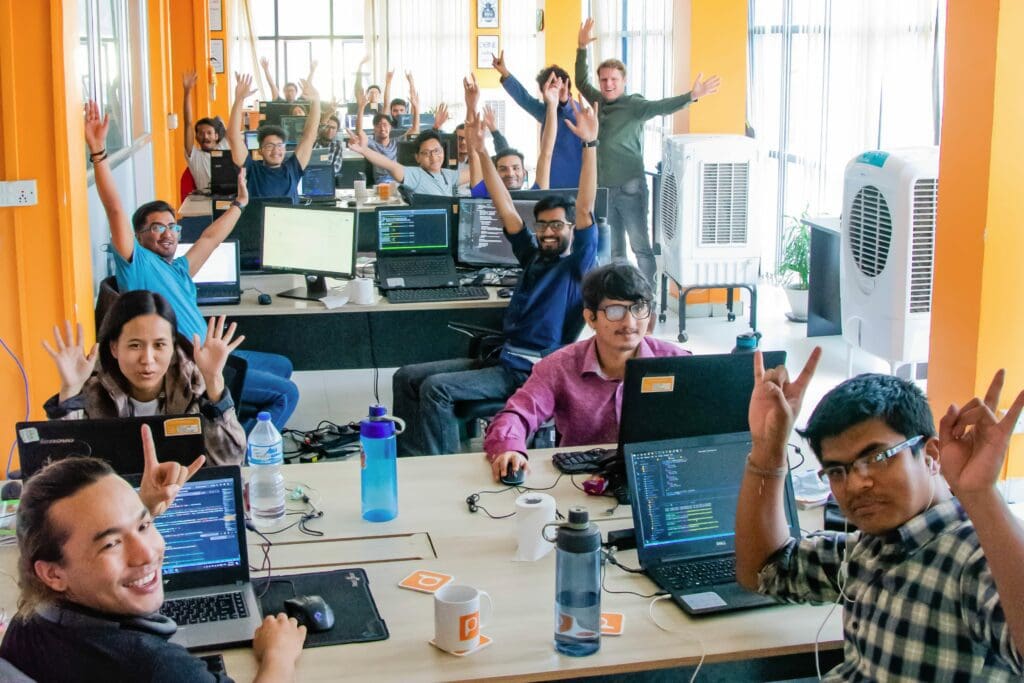
Being Part Of The Conversation
Everyone on our development team is encouraged to have a voice, and take a lead in our refinement sessions. We really like everyone on the team to have the chance to speak up and be part of the conversation about the work that we’re doing. And the same goes for our customers. We like to foster a communicative culture where there’s an open and positive dialogue that helps to drive our development forward.
And the great thing about Proshore is that those conversations happen across continents, between Europe and Asia. It’s really important to us that we create high-tech, high-paying jobs in Nepal, so that we can give back to the country and encourage highly-skilled individuals, to stay in the country rather than move abroad.
Many global software companies are now coming around to the idea that working across continents can work, with the right people in place. Interested in scaling your software development with the help of Proshore? Book a call with us to find out more.


Harnessing the power of ‘Big Data’, alongside smart investment in digital technologies has created end-to-end transparency – and the automation of core processes for leading supply chain organizations, who have traditionally relied on manual processes.
So if some of the world’s largest manufacturers and shipping companies are successfully implementing and realizing the return on investment of digital transformation and automation, then surely your business could too? We explore what it takes to get automation right.
Solving Complex Problems With Simple Automated Solutions
If you’ve read the case study about our collaboration with Kite Pharma, you’ll not only be aware of how Proshore’s ‘Team as a Service’ can provide fast and responsive agile solutions to software development but also how automation can unlock and add value to supply chain logistics.
Kite Pharma, who provide cutting-edge cancer treatment through cell therapy, rely on a complex global supply chain to ensure the timely treatment of critically-ill patients. Due to the medical and global complexities of their services, the company needed a single system that would essentially automate the processing of large volumes of important tracking data.
With vital tracking information being communicated via emails, the organization required a system that would scan emails for relevant data and use the database as a dashboard. With high volumes of emails, and a variety of spreadsheets in place, the solution required a single piece of software that could accurately scan and extract data at scale.
In this particular case, the automated solution to the problem was fairly simple, but the impact of its successful implementation was huge, and potentially life-changing for patients.
Sometimes the best solution to a complex problem is a simple one.
Proshore helped to develop a piece of software that automated the collection of important tracking data, mitigating human input errors, and providing a dashboard with clear oversight of the entire supply chain. With an automated system in place, the client was able to drive long-term efficiencies in time and cost to help achieve improved patient outcomes.
Taking an agile and collaborative approach to automation
The key to our success with Kite Pharma was our collaborative and iterative approach toward software development that would ultimately lead to effective automation. Their stakeholders and decision-makers led the project with a clear vision of the outcome: robust and reliable real-time updates on the progress of highly important medical cargo.
From a development perspective, there were lots of complex business rules that the application needed to navigate. This required extensive discovery, navigating their systems to understand how they worked. And once they were understood, the right approach became clear.
Because we built the software step by step, iterating and testing incrementally, in collaboration with the client, we were able to ensure its robustness and fitness for purpose.
A huge amount of trust was placed in Proshore to build the system, and we were given the freedom to select the technology that would work best, in order to meet the desired outcome.
Overall, the collaboration proved that tech doesn't need to be complex to have a huge impact. What mattered most in creating this software automation was clarity, simplicity, functionality, and ease of integration.
The Benefits Of Automation
So what are the benefits of automation, and how can we apply lessons learned to other industries? Automation is the key to making gains in key areas of your business. Wherever there’s a manual process involving data, there’s the scope to replace it using an application programming interface (API) to connect different software.
Often scaling businesses are operating ineffectively using multiple spreadsheets which can lead to duplicate files, increased potential for human error, and time-consuming extraction of data. Whilst automation can lead to resistance from within an organization, by identifying how it can resolve pain points and involving employees in its inception, it has the potential to save time and cost and enable you to maintain and utilize accurate and reliable data at scale.
Interested in automation? Find out what a collaboration with Proshore could do for your software development.


Remote development challenges
Overcome project ownership challenges with managed teams
Bringing in ‘dedicated teams’ can create new project ownership challenges for product owners – Proshore's self-managed teams can be the solution.
Talk to Jeroen, our Accounts director, to see if our ready-to-code dev teams are a fit for you.
Whatever sort of software you’re developing, when you look to a solution like an 'offshore development team' to scale and expedite your coding, you might be forgiven for asking: who’s in charge here?
After all, although they might be seamlessly integrated into your existing set-up, you’ve hired a ‘managed team’. But what does that mean exactly, and how does it impact project ownership?
What is a ‘managed team'?
A managed team is a group of external software developers, and other related roles, who are brought alongside to add expertise and scalability in the completion of a project, or a particular part of a project. The tech company leverages the skill sets and resources of the ‘remote development team’ to fulfill their goals.
These collaborations usually take one of three forms. Either, the managed team is the main developer and the client is a Product Owner, or they are brought in to enhance any existing in-house development capabilities.
In the second scenario, this could also involve working with other teams brought in by a client to achieve a particular goal. Both teams work independently on different areas of the same project using their own separate processes.
Thirdly, the teams might integrate, typically with an even number of developers from both sides completing the same backlog of work to be done.
How do the three main types of partnership work?
Sole development partner
In the first type of partnership, the managed is the sole developer and has exclusive responsibility for building the software application. This means a lot of decision-making and technical discussions are made by the managed team itself.
The client will have the brief and the managed team follows the roadmap they’re given using their own iterative process. In this scenario, the client’s Chief Technology Officer (CTO) will often assume the role of Product Owner (PO).
Team augmentation
In the second type of partnership, there is already a development team in place, and the managed team collaborates with them, drilling down and identifying chunks of work to be done.
In terms of ownership, this way of working can be more tricky because there is already an established development team when the managed team comes in at a later stage to add capacity.
Typically, the new team will work separately on different aspects of the project using potentially different approaches to development.
Integrated capacity
The third type of partnership is more integrated, with both sets of developers fully alongside each other as a merged team.
In this scenario, it’s important to establish who’s managing the project from the get-go.
No matter what the setup, it’s always a good idea to focus on the best way to move forward with clients using an Agile approach, working in short sprints of work to be done. In this way, onboarding is quicker, and it’s easier to integrate more effectively to deliver incremental blocks of completed work.
Best way to structure development teams
At Proshore, with larger products, we’re usually able to agree on a particular area to work on, for example when there’s a separate back end and front end. This creates clear and discrete workflows for each team. It also ensures there’s no overlap on the work to be done. Typically, in this scenario, we would have separate sprint goals and work more or less independently of each other.
Alternatively, we can work as a single team with both sets of developers addressing the same backlog of work to be done. We collaborate and do the refinement together, so from an outside perspective, we’re essentially one and the same team. Whoever we work with and whichever way we set up, above all else, the Agile way of working enables us to add value where it’s most needed.
We try to provide managed teams wherever possible because we have a scrum master, and sometimes we may even take the lead and manage the client’s teams as well.
From our side, it's always that Agile way of working that helps us to collaborate together, and that’s where we feel that we can create value for Product Owners.
Babish Shrestha, Proshore
Director of Technology
Ultimately, when we’re collaborating, the best setup is the one that is right for the client’s business and their needs. From experience, the most successful results usually come from collaborations where the teams are evenly matched in terms of skills and ways of working because they can integrate more seamlessly. More often than not, the right way of working comes down to a combination of the Product Owner’s preferences, the team setup, the maturity of the team, and each team’s roadmap. Managing two teams can be difficult, especially for those with less experience. Not only that, simply having more people to manage can be a challenge in itself.
Sometimes we find that the Product Owner is not experienced in Agile, so our focus is on communication and reporting, through collaborative refinement, review, and retrospective, which helps to define the team structure.
Final thoughts on project ownership
Wherever possible, we try to work collaboratively with a client, ideally, with an even number of developers from our team and theirs, all focussed on the same sprint goals. This takes careful management, so developers on both sides are fully aligned in terms of working practices and experience. Setting up as separate teams is easier in the beginning, but it can be trickier for the client to tie everything together further down the line.
There is no magic formula for getting project ownership right. The right approach to project ownership varies from client to client, project to project. No matter what the configuration, with our managed teams, we always try to take a consistent approach by using Agile methodology and by matching our experience and expertise to the customer’s needs.
When a partner uses an Agile approach, it’s much easier for us to onboard and integrate our teams. But if a Product Owner is not experienced in this way of working, we still try to embed Agile practices like regular communication. As an offshore development company, we need to be adaptable to suit the client’s approach to project ownership.
Here are 11 tips for managing remote teams if you choose to do it yourself. With Proshore, we take care of that for you.
Next read

Extra Capacity: 6 Ways To Work Well With Remote Teams
Looking to bring in offshore devs? Get our expert outlook on how to work well with your remote team – and how to get the best out of them.

Haico Duisters Managing Director

Overcome project ownership challenges with managed teams
Bringing in ‘dedicated teams’ can create new project ownership challenges for product owners – Proshore's self-managed teams can be the solution.

Babish Shrestha Director of Technology

From micro to self-managed Remote Software Developers
Learn how one of our clients, CMNTY, was able to scale without intensive micromanaging through our self-managed remote software development model.

Jeroen van der Horst Account director Interested in all our stories?
Read everything about it. Blog overview

When you’re scaling a software company, it can be a challenge to meet growing customer expectations and deliver shippable code. One moment you’re starting out as an entrepreneur with a small team, and the next moment you’re faced with the need to recruit. And fast.
The truth is, when you’re in a fast-paced competitive market such as developing software as a service (SaaS), investing time and money in making, training, and retaining additional hires – the right hires at that – can be a drain on finance and resources. Ultimately, it impacts the time to market of your next iteration or new product.
Teams as a service offer you everything you’re looking for in an in-house development team, without taking up desk space, weighing down your costs, or draining your time.
Recruitment Challenges For SaaS
As the market for SaaS continues to grow, so do the barriers for outcompeting rivals. Recruitment can be a major hurdle for a number of reasons.
Firstly, there’s the war on talent, so getting the right candidates through the door can be a real challenge. You need to find people with the right skills and experience, and even then you still need to provide training to ensure the quality of their output.
Then there’s retention and career development to consider. It can get complicated very quickly – providing the right opportunities to encourage employees to stay and grow in your organization. At the same time, you have to ensure they’re able to work collaboratively – they might need coaching in soft skills alongside hard skills. That takes time.
Thirdly, when you take on employees, you need to ensure that the opportunities are there for them long term. Sometimes there’s a need to scale down as well as up. Being an employer reduces your flexibility and could end up being costly if you need to downsize your operation.
It goes without saying that there’s a lot to consider.
Enter Teams As A Service
That’s when a software development team as a service comes in. Rather than making additional costly hires, or looking to an agency to deliver ‘software developers’, choosing a software team as a service gives you access to a much broader talent pool.
This means the search can be narrowed down more precisely to individuals with skills and expertise matched to your specific needs. In essence, you’re contracting out your HR functionality to a specialist in software development recruitment, one which can draw from their talent pool, boot camps, and headhunting to ensure recruits are ready-trained and ready to code!
With freelancers, you get individuals who have the requisite job titles, but who are not necessarily a good fit for your organization. You’re also bringing in individuals as opposed to a team. Of course, that team may only consist of one developer to begin with, but further down the line you may need to scale.
With a team as a service, you get more than just an extra person with the right job title. The groundwork is done for you, so that you get the right people – not just a resource. Deployed by experts in integration, you can trust that the development team will have an Agile mindset, using proven methodologies that will enable seamless integration with your organization, whether they’re your primary technical team or working alongside your in-house developers.
An effective software development team as a service should plug in to your company and cut recruitment and training costs. And with a solution from Proshore, you’re buying in proven expertise for putting together teams as a service, teams that will understand your challenges and help you overcome them.
Understanding Your Challenges
We want to connect to your challenges – we don’t just want to solve them – not only providing a resource but supporting your business in multiple areas. Our teams as a service offer a good fit for your organization, integration with your in-house team, and full alignment with your product owner.
Babish Shrestha, ProshoreDirector of Technology
Remote teams are trending, creating a growing global market for talent. If you’re bringing outside teams into your organization, getting it right relies on bringing on board tried and tested developers who are not just doing a job, but invested in your success.
The biggest value a team as a service can provide is a strategic understanding of your goals in relation to the work to be done. That’s not an automatic given when you take on a staffing agency to add capacity. With Proshore, we understand our developers and their needs in order to provide exceptional productivity and quality without being micromanaged.
Scaling Up And Down
Being an employer gives you less scope to scale as every new hire requires a recruitment process, followed by training, and onboarding. Should you need to scale down, it becomes more complicated to reduce employee numbers.
And if you find the right candidate, and they later leave, you then have to run the entire process again. This can be particularly problematic in software development, where losing capacity impacts how much work can be done within a sprint cycle.
Bringing in consultants can be expensive and whilst it might provide obvious short term benefits, it may not add the value you’re looking for in the long term. On the other hand, teams as a service gives you the flexibility to scale up and down as needed, so your capacity is more closely aligned with your development needs. As you only pay for what you require, it can help reduce your development costs. For example, you might begin with one developer and then require the services of a small managed team. Further down the line, if you need to scale back, it can be done without complicated and time-consuming HR work. Proshore works with you, taking a consultative approach as part of the right personnel provision for your development needs.
What Success Looks Like
We can answer the challenges of recruitment and delivery in software development because we understand the obstacles associated with integrating a team in order to add capacity. We bring the best by providing a mature delivery process and collaboration.
Babish Shrestha, ProshoreDirector of Technology
Success is different for every customer. In essence, most enterprises know they need to add capacity, but they might not necessarily be clear on where and why it is most needed. Proshore can help your organization drill down to what really matters and identify the important work to be done. Teams as a service helps your enterprise overcome the scarcity of talent, help you reduce your time to market by providing a self-managed team that’s practised in Agile ways of working, and most importantly ready-to-go from the get go.
All of these advantages help you cut costs. After all, there’s no need to spend time and money on recruitment, and no need to manage operations when you hire a self-managed team. You also gain a competitive advantage because our teams are experienced and talented and matched to specific needs. Not only that, we know what good integration looks like because it’s what our business is built on.
Interested to learn how teams as a service from Proshore could work for you? Find out how we helped to add developer capacity for customer services solution provider Pluscloud.

As a PHP developer, 'Blackfire' might be a name you have come across before or maybe not even heard of. For our resident PHP expert, Angel Maharjan, it was a similar case until a few months back. Even though he had 9 years of experience in PHP, Angel found Blackfire to be a revelation in his workflow.
Being such an exciting topic, it was only natural that Blackfire was scheduled into our ‘Knowledge Sharing Session’ (KSS) open to both Proshorians and IT enthusiasts outside Proshore. Read on for a grasp of what Angel shared during his one-hour workshop.
Code using too many resources?


PHP developers, regardless of their experience, must have come across situations like the ones presented above. The dreaded ‘error’ in terms of your application’s execution time and memory. This generally means that you,
- go back to your code,
- hunt down the parts utilizing the most resources, in terms of execution time and memory, and
- rectify the code to correct the error, which could take multiple tries.
All PHP developers will all agree that It is a tedious task to manually track which part of your code is using resources through, let's say, microtime() or memory_get_usage() kit. The process takes up a lot of time and effort on the developer’s part lengthening the project or task delivery.
This is where Blackfire comes in. It provides a solution wherein PHP developers do not have to manually track execution time or memory usage errors in their code.
Blackfire to the rescue
Blackfire.io describes itself as a ‘Code performance observability solution’ offering the following features for your code performance,
- Monitoring management automation
- Profiling
- Testing
While Blackfire offers both paid and free features, a lot of functions are already included in the free version. Angel focused more on Blackfire’s free features in his session. He specifically talked about the profiling features of Blackfire, which provides detailed assessments of the function requests that slow down a developer’s code.
Using Blackfire’s profiler, through the browser extension or terminal, you can profile specific function requests of your app. Once Blackfire starts profiling the specific app functions, it sends multiple requests to create a bigger sample, hence, providing a more accurate analysis.
Once profiling is done, you can check the specific profiling test on your Blackfire account, analyzed in different views according to execution time and memory usage. The paid version of Blackfire includes views such as input/output time, CPU time, and more.
Profiling the problematic areas in your code
The execution time view profiles all the function calls and their execution time in inclusive and exclusive time, whereas, the memory usage view profiles all the function calls and their memory usage in both inclusive and exclusive memory.
By creating blocks of your function calls and differentiating them through nodes, colors, and borders, Blackfire profiles each function of the request and helps identify which functions are using the most resources.
Darker the color of the block, thicker the border, or thicker the arrow helps the developer pinpoint which parts of your code are using the most reserves according to execution time or memory usage. This visual chart automatically helps developers understand which part of their code needs to be changed to optimize their application performance.

Once you make the necessary changes to your code, after identifying them from Blackfire's profiler or terminal, you can again profile the request to check if the functions have been optimized. You can check between current and previous profiling tests on your Blackfire account. Since each profiling test is uploaded to the Blackfire server, it is easy for developers to browse and share results even when you don’t have access to your code.
Installing Blackfire is as easy as using the platform
After making a free account with Blackfire, you generally have to download three things,
- A language extension.
- ‘Blackfire agent’ that needs to be installed on the operating system.
- ‘Profiling client’ that can be installed from the browser extension or terminal.
With these in place, you can start monitoring your PHP application’s performance right away!
We hope that the KSS summary above gives you an idea of what Blackfire is and how you, as a PHP developer or even Python or GO Developer, can use the free features to monitor your application’s performance.
During his one-hour workshop, Angel used an open-source project from GitHub to demonstrate Blackfire’s profiling features and installation in action. You too can get access to the workshop recording and see Blackfire in action.

When it comes to getting projects done on time, being able to manage client expectations as well as developer needs are critical parts of successful delivery. Deadlines don’t have to be a burden when you look at them the right way.
Whenever clients come to us with a new project they’re always conscious of a few factors. Usually, at the top of the list, are budget and time. This is a reasonable pair of priorities and we’re a team who is experienced in delivering on the requirements of our customers. Our delivery success is built on a few core concepts that help to align our customers and our developers so that everything we work on builds what the customer needs.
Delays are possible in any project but the amount of time we dedicate to planning has a direct impact on how well we cope with delays and get projects back on track so that the end result is still achieved at the right time and at the right price.
The Pressures of Development
As with any business, the pressure to deliver comes straight from the client, and managing that pressure is a big part of being a Scrum Master. If a client believes that a project will be released in 5 sprints from our initial plans but actually with a variety of rich features on top of the basic platform it’ll be more like 10 sprints then we need to analyze the next step.
Reasonably so, the word ‘delay’ is like a red rag to a bull for customers. They always expect a project completed on time and if we aren’t able to do that then they will lose confidence in us. Because of this, we will never just tell a client no.
Let’s take that quick example of a 5 sprint project again. The customer wants features that will make the project 10 sprints but they still want it in 5. We must be agile in our thinking and understand what we can accomplish in those 5 sprints that most closely aligns with the customer's vision.
Perhaps we provide a product that can immediately go to market and then advise that the rich features can be added during updates. It’s like manufacturing a functional car rather than a luxury one. This means the customer can immediately get value from the release but also have a scope for development in the future.
Mindset Is Everything
“The first thing to make sure of is that the team is aware of what agile actually means and how to have an agile mindset within the team and the project. Developers will have their own experiences with different methodologies and if they all work to their own experiences and not a single, joined-up system, then it will create havoc during development.”

Samir Maharjan Scrum Master, Proshore
Dealing with pressure in a team starts with changing the mindset of the people in it. The best way to think of deadlines is from a proactive perspective. Rather than laying the pressure on a team with a critical deadline, we think in an agile way. We think about things like “how can we achieve that?” and “could this work?”. Rather than having to face off with a deadline, we shift the focus to the action we can take to achieve it.
That’s also helped by having a well-drawn-up plan showing which developers are going to tackle which tasks and what the time frames are for those activities. The plan gives the team clarity over what they’re doing and they’re never spending time finding out what to do next.
It’s about evolving a mindset around what needs to be completed. We don’t apply pressure by talking about deadlines, we simply see the opportunity to do it right, efficiently, and all while keeping the customer happy.
Goals
A big part of keeping a team on top of a project and its deadlines is goal setting. As part of scrum, we have a standup meeting each day, where we talk about personal goals and sprint goals. These goals keep everyone aligned and keyed in on what the rest of the team is doing. As they see progress on each part of development they understand what their part is and that together we will complete the sprint in time.
We discuss these goals and how we are going to achieve them, again it’s all about the mindset and just focusing on what is achievable and how we can do it. If there are roadblocks or delays we simply ask “how can we get past them?”
Time Allowances
“When looking at a sprint we have to understand our people’s capacity. Sure I could block out 8 hours every day but being realistic, people cannot just work flat out for 8 hours, day in and day out. I take that into account when I put together the sprints and build in buffer time to let our developers test, take breaks, and discuss things with the rest of the team.”
Samir Maharjan Scrum Master, Proshore
A huge part that unfortunately some team leaders miss is the welfare of the developers doing the work. If people are overworked and tired they’re going to produce bad products at a slower rate. Because of that, a big focus for always delivering on a customer’s needs is ensuring the people tasked with that delivery have enough time allocated to everything they do.
When we plan sprints we always take into account that an 8-hour day isn’t really an 8-hour day. We plan in space to have team meetings, tests, take breaks, and process customer feedback and all that keep the developers fresh. The rest they get doesn't always even have to be a complete stop, it just needs to be a break from what they are focused on. The time away from that task – even if it’s just a half-hour – can give them time to process what they’ve been doing and return to it with more energy.
Client Comms
“Making client communication as immediate as possible is a huge part of dealing with roadblocks. A week's delay in communicating a problem can completely undermine the customer's confidence in you.
Samir Maharjan Scrum Master, Proshore
The moment a roadblock appears that cannot be overcome, we contact the client. That approach, that transparency, goes a long way in developing trust between the client and ourselves as well as making the development process more streamlined.
One of our clients is a large data analysis company and they have a number of separate teams so communication can be a challenge. Based on their timeline and budget there was a gap between what they wanted and what could be achieved, so we have to create common ground. Based on their budget we planned for 2 full-time developers and then looked at what those developers could achieve and got that as close to their requirements as possible. Our planning makes our style of honest communication possible.
Making client communication as immediate as possible is a huge thing that some developers don’t do. Customers need to know that we take their issues seriously and that our process and tools can get the project back on track but only with input from them.
With the right mindset and goals in a team, combined with a great plan and transparent communication which focuses on building long-term relationships with customers, Proshore can handle any deadline.
Want to find out how Proshore could be your best developer? Talk to us today.

When you’re delivering software development at scale and at pace, unforeseen changes to the product or personnel can have a real impact on product delivery. Like it or not, change is an integral part of software development. The real trick to success is how you handle it.
Proshore Scrum Master, Milan Khanal, has worked in software development for over 7 years, both as an engineer and a manager. Taking projects through from ideation to the production phase means Milan has a position of oversight and influence over the end product. He’s also highly experienced in using Agile processes to help stakeholders stay aligned with their goals, and enjoy great value and product success.
Why change happens in software development
The first thing I like to validate with the client is: do the changes that you’re going to make add value to the product we are going to make?

Milan Khanal
Scrum Master, Proshore
Change is a fundamental aspect of software development: markets change and competitors release new features. Every software company has different expectations for their product, its timeline, and how the roadmap should run.
Typically, there’s strategic placement of particular developments within certain calendar months. But it's common that as development gets underway, new features and new content become a priority in response to the market or competition.
With technology rapidly evolving and through ongoing conversations with key stakeholders, new priorities for the product can emerge. With iterative development, clients can get a minimal viable product (MVP) much faster, and this often prompts the realization that other features and content can be added.
In software development, change is expected. But before implementation, it needs to be validated. For example, does the value of the change offset the impact on existing development work? Is it worth pushing back the change to allow for the completion of current priorities in the roadmap?
Successful change management needs negotiation around decision-making and what’s most important at that time for the product’s development. Any change that can be validated creates a win-win situation for the product owner and the development team.
Ways to handle change when developing software
Getting change management right is a delicate balancing act. When a change request is received, the first step of the process is to validate the changes with the deployment team. This is in case what the client is requesting is either too time-consuming for the timeline, beyond the reasonable scope of the current sprint, or likely to lead to significant technological issues.
In acknowledging a change request, it’s important to know where it came from and why it’s important to the business aims. Seeing the vision and the business case for making a change, as well as its goal and the reason for making it, are crucial. It helps to alleviate pressure on the development team when they can see how a change fits into the overall work to be done.
With a clear change management process in place, there’s also the opportunity to consider pushing changes back until other priorities are completed. Fortunately, taking an Agile approach means development teams can be more responsive and incorporate changes within the next sprint cycle. This also requires clear communication between the client and the team in order to maintain the correct priorities.
How to approach big changes to software products
When a change makes sense, it gives you value, and there’s not too much distraction from the roadmap, we accommodate it – because we understand the competitive environment.
Milan Khanal Scrum Master, Proshore
Major changes should not and cannot be rushed. This is because if a team is halfway through a sprint, adding additional work will mean that nothing will actually get completed. It makes much more sense to put it into the next sprint plan once the current sprint goals have been met.
This helps to alleviate pressure on the team and enable them to finish one set of goals before starting on the next. Bigger changes also need to be broken down into smaller chunks so that work can be completed iteratively, which means faster delivery of key functionality for the client.
Accommodating changes in staffing
Changes to staffing also impact the development of a software product. For that reason, it’s important to conduct thorough off-boarding as well as onboarding when developers leave and new ones join.
Following a professional process, it’s important to manage knowledge transfer so that no important information is not lost. New developers need onboarding on technical stacks, which might mean giving sessions one to one, building-up team connections, providing access and reviewing experience in regular meetings.
In terms of onboarding, no matter how experienced they are, a new developer needs to get used to the system, other team members, the product, and the client. For that reason, it’s expected that a new developer on a product won’t initially provide the same value as the existing team. They need time to embed. However, an effective strategy to get them involved and adding value from the get-go is to get them to go over quality assurance because a new perspective can shed new light – such as missed bugs.
With a new client or change in client personnel, it’s advisable to spend the first week investing in the internal development team and getting them onboard with the client’s expectations. A kick-off meeting helps you to gain perspective from the client’s side and their perception of the product and its competitors.
By maintaining open communication channels, developers can talk directly with the client and each other in order to get the best guidance. At Proshore, we encourage this connectivity and flexibility, so we become colleagues rather than a separate outside team. After all, the success of a software product is also our success as developers.
Agile development — built for change
Change is welcome, but there has to be negotiation on deadlines because a change request and the pre-agreed work to be done for a sprint, cannot be completed simultaneously.
Milan Khanal Scrum Master, Proshore
Taking an Agile approach gives development teams the mindset they need to iterate at pace, in a culture of quick wins and failing fast. Often, the barriers to dealing with change effectively are less about delays and deadlines and more about onboarding clients with Agile ways of working.
Sometimes there is a market need to make changes to a product, and veer off slightly from the roadmap journey. And sometimes there is a need based on funding. Either way, change often comes from competitors or developments in the market, so we expect it to happen. Thankfully, Agile software development teams are set up to handle it. Whatever the reason, change needs to have a measurable and realistic impact.
During a sprint, it’s essential to minimise change. The project design phase should give enough monthly direction to create focus and improve team output. Too many changes requests further down the line creates lag.
It’s also important that software companies determine specific goals for what they want each month. If there are too many stakeholder ideas, filter them down and focus on the ones that give the most business value and create an MVP which can be marketed, and then iteratively developed further.
There are also a few other ways to negotiate change requests. Firstly, they can be prioritised according to their business value and technical difficulty – using methods like MoSCoW analysis.
Another approach is to allow all changes as long as they don’t violate the sprint goal. It’s also good practice to check whether the proposed changes impact the project scope, budget, schedule, quality, or risks – and whether they should be implemented ASAP or added to a product backlog.
The bottom line for software development teams is to be adaptable to change requests, with minimal impact on development team members.

Product development takeaways
Driving Ecommerce excellence through software development
Learn how we helped a scaling eCommerce platform sync thousands of different products and prices from hundreds of catering suppliers with thousands of restaurant owners.
Talk to Jeroen, our Accounts director, to see if our ready-to-code dev teams are a fit for you.
When it comes to software development, sometimes a challenge can’t be solved by an out-of-the-box solution. Instead, it requires thinking outside the box.
That’s exactly what was required when Proshore helped a scaling eCommerce platform sync thousands of different products and prices from hundreds of catering suppliers with thousands of restaurant owners.
Handling large volumes of product data
Orderxl, formerly Blinqed, is a B2B eCommerce application that connects catering suppliers with restaurant owners and streamlines the ordering process. It gives buyers the best possible prices, and sellers the flexibility to make their pricing more dynamic.
Proshore initially came on board to provide Orderxl with the technical expertise they needed to make their application a reality. One of the initial challenges was to import huge volumes of historical product data and pricing from a legacy system into the new software. As their business rapidly scaled, our attention shifted to how to handle increasing volumes of incoming data and accelerate pricing updates for users on the front end.
Multiple buyers are connected to multiple sellers. The challenge with this application was that for each of the thousands of products, there can be a discount or a price change. Every day, each price change has to be reflected on the front end of the website.
Bipin Manandhar
Team Lead, Proshore
Buyers want the best possible deal on their catering supplies, so the application provides dynamic pricing, which is controlled by the wholesaler. However, due to the sheer quantity of data, the time taken to parse this information was creating a bottleneck between the sellers’ enterprise resource planning (ERP) systems, and the price changes being reflected on the front end of the website.
That’s when Proshore’s development team as a service stepped up to provide an innovative way of speeding up pricing changes on the front end.

How Proshore took full ownership of developing OrderXL, formerly Blinqed's, business concept from paper to an app, allowing the co-founders to focus on business development and partnerships. Read case study
Capacity to handle over 750,000 pricing changes per day
Every hour of every day, product information, including pricing, has to be pulled from multiple ERP systems. This is then reflected on the front end of the website. Data is dynamic and is completely based on buyer and seller activity.
However, when a wholesaler has over twenty customers and each one of those has a bespoke catalog of thousands of products, the amount of data flowing into the system soon stacks up. In terms of pricing change records, the system can handle over 750,000 record updates per day. And it was the parsing of all that product data for each customer that was slowing down the system.
Importing and reading huge volumes of data meant that customers didn’t always see the most recent prices in real-time, there would be a delay in loading times – sometimes nearly 30 seconds per order page and occasionally crashing when buyers searched the product listing.
To tackle the problem:
- We requested that wholesalers only provide the updated product data, rather than submitting the entire product catalog.
- With the help of a developer based in the Netherlands, we were able to filter the data so that all the relevant changes from an ERP system could be sent in a single file.
- We upgraded the AWS relational database based on need. Performance was monitored and queries were optimized to provide better scalability.
- We also split the database into Reader and Writer instances, making it quicker to read data needed for the front end.
These improvements reduced the amount of data flowing into the system which needed to be parsed. In turn, this increased the speed at which price changes appeared on the front end.
In fact, over time, Proshore’s development team reduced the time taken to parse one dataset from 4 to 5 hours down to under 10 minutes!

When you’re running a successful software development startup, the time will come when you need to scale your team. You might have started as a one or two-person outfit, but now you need to build up your business.
As your startup gains traction – new features, bug fixes, product updates, and funding deadlines demand a growing development force. But how do you scale effectively? Read on to explore different scaling options and address potential challenges to guide you through this crucial step of maintaining momentum and achieving targets.
Options for scaling up your development team
There are several ways to approach scaling your software development team. The best choice depends on your specific needs, budget, and growth goals. Here are some popular options:
1. Internal Hiring
Building your dev team in-house allows for tight control over culture and processes. However, this approach can be time-consuming, competitive, and costly, especially when recruiting top talent.
2. Offshore Outsourcing
Leveraging offshore dev teams offer access to a wider talent pool and potentially lower costs. However, communication challenges, time zone differences, and cultural nuances can arise.
3.Dedicated Dev Teams
This option provides access to pre-vetted, experienced developers who can integrate seamlessly with your existing team. It offers a faster and more cost-effective solution than traditional in-house hiring.
4.Staff Augmentation
Adding specific skillsets to your existing team through staff augmentation can be a good option for short-term projects or to fill temporary gaps.
Challenges and Solutions: Scaling smoothly
We often work with startups who have a validated idea or a minimum viable product (MVP) that they’ve put together with minimal resources. Their resources were enough to establish the product – but now it’s time to build an entire organization – not an easy job.
Jeroen van der Horst
Accounts Director, Proshore
Scaling your development team will introduce new challenges. Here are some common hurdles and solutions to navigate them effectively:
FAQs
Why scale up a development team?
There are several reasons why scaling your development team might be necessary:
- Increased Product Demand: As your user base grows, the need for maintaining and improving your software product increases. A larger development team can handle this workload more efficiently.
- New Feature Development: Introducing new features requires additional development resources. Scaling your team allows for simultaneous work on existing tasks and future-oriented projects.
- Improved Development Speed: A larger team can potentially reduce development time and accelerate product iterations.
When should you scale your development team?
There’s no one-size-fits-all answer, but some indicators suggest it’s time to scale:
- Your development backlog is growing: This signifies an inability to keep up with product demands with your current team size.
- Time-to-market is too slow: Scaling can help you deliver new features and updates quicker.
- Employee morale is declining: If your team is overworked and stressed, it’s a sign you need additional resources.
Finding a reliable partner for scaling software
Instead of building software from the ground up, you can utilize ready-to-code dev teams to reliably accelerate development and meet your development deadlines.
Jeroen van der Horst
Accounts Director, Proshore
For technically-minded business owners involved in product development from the outset, delegating control can be uncomfortable. You have a clear vision for the product’s evolution, high standards, and ambitious goals – but the last thing you want to do is end up micromanaging a development team.
On the other hand, less technical founders might struggle to trust others to deliver high-quality code on time, especially with looming deadlines, customer expectations, and a growing backlog. Freelancers might be a temporary solution, but will they commit long-term?
This is where ready-to-code dev teams come in. We eliminate these worries.
1. Reduced Recruitment Hassle
Our existing pool of over 4500+ pre-vetted developers saves you time and money on recruitment.
2. Confidence in your code
With a team tailored to your needs, you gain access to expert help, accelerating development and tackling your backlog efficiently. These remote, full-stack, English-speaking teams are self-managed, freeing you to focus on your core business.
3. Seamless Integration
Because developers are selected based on specific skills and cultural fit, onboarding is swift. Agile methodology ensures constant communication, keeping everyone aligned.
At Proshore, we don’t just offer offshore software development, we’re a reliable partner who can provide you with an extended team fully invested in your business success. Book a call and let us help you find a development team that understands your challenges.

In agile software development, the customer is at the front and centre of everything you do. Iterations of your product only add value to your business if there’s a clear benefit for your customers. Collaboration between development teams and the customer are essential to prioritize the work to be done in order to continuously improve your product. This essential colloboration is empowered by Customer Support.
Proshore’s sister company, Digital Product Labs, provides an integration which enables merchants to sync product data between Shopify and Etsy. When it comes to updating and uploading product information and real-time pricing, Etsy Integration & Sync is a niche Micro-SaaS which saves merchants time and effort. They only have to update information once, and it syncs across both eCommerce platforms.
The success and evolution of this Micro-SaaS is partly due to the ongoing dialogue between Digital Product Labs and its customers. Right at the centre of that conversation is customer support. In this blog post, HR Manager, Krishma Shrestha, explains the business benefits of customer support, and why it makes a great first step on the career ladder for future developers.
What is customer support?
Customer support is a team of people who provide support and guidance when a customer experiences problems with a product or service. Their role is to help customers find solutions as quickly and as efficiently as possible. In software development, customer support, sometimes referred to as technical support, covers a range of services from onboarding and training to troubleshooting and maintenance.
As with any eCommerce tool, merchants rely on Etsy Integration & Sync to give customers the best prices at the right time. Any disruption to that service can have a direct impact on their bottom line. So for Digital Product Labs, it’s essential to resolve issues as quickly as possible.
How customer support works at Digital Product Labs
Customer satisfaction is really important for the development of the product. When customers feedback, we do our best to develop that feature. Customer support is a key piece in the communication between customers and developers. Jillian Xilas Customer Support, Digital Product Labs
By employing customer support staff in different time zones, Digital Product Labs is able to offer around-the-clock support no matter where their customers are based. They also take a tiered approach to customer support, so that simpler technical problems can be handled at the first point of contact. This could be via live chat or a support ticket.
If the problem cannot be solved at the first level, and a slightly more technical response is required, the case is pushed to a more technical team member with deeper product knowledge. Should deeper technical knowledge be required to resolve the issues, the ticket is sent to the development team for a more thorough deep dive.
This process ensures that simpler technical queries are handled within 24 hours, whereas high-level technical solutions are typically investigated, within a few days. Throughout this process, customers are informed by email, chat or video calls, so they stay regularly updated.
Customer support at Digital Product Labs includes the following features to ensure customer satisfaction:
- 24/7 customer support
- Support tickets and live chat
- Prioritization based on urgency
- Ongoing training and onboarding
The business value of customer support for customers
Being in customer support helps developers see what the customer wants, not what we want. This helps us improve as a team, and improve the product as well. Kabin GurungCustomer Support, Digital Product Labs
When you produce a software integration for an eCommerce platform like Shopify or Etsy, there’s a knock-on effect for the merchants’ business if something is not working properly or malfunctioning.
In the case of Etsy Integration & Sync, any interruption to the service can impact real-time data regarding stock levels and product availability. This could lead to issues with supply and demand, causing customers to cancel orders due to delays in availability, or backlogs of items which are appearing as out of stock on the front end.
If real-time price fluctuations are affected, then merchants and their customers are not always getting the best prices and the best time. That’s why customer support is so important. Customer support is the bridge between customers and the development team. It helps to keep both parties in the loop at all times, helping to resolve problems quickly and smoothly
Why customer support is important for product development
Fixing customer issues in real-time helps developers see the value of what they’re doing. They feel a sense of responsibility, and helping someone else makes them feel good. Kabin GurungCustomer Support, Digital Product Labs
Agile software development uses a customer-focused approach so that it’s customer needs that really drive development forward. Without that connection, product development would come to a standstill. So customer support is really important for five key reasons:
- By building an ongoing and collaborative relationship with customers through customer support, new features can be added as a result of their feedback.
- Onboarding sessions can help users to understand how any new enhancements can make their life easier.
- When a new customer joins, customer support takes a very active role in onboarding and provides demos to help them get started.
- Constant feedback from customers provides a roadmap for new features and a process of continuous improvement, which can benefit, and help to grow, the customer base.
- It’s not possible for developers to be on the frontline with customers. Customer support is that important bridge between the two.
From customer support to software development
Customer support is a very good career stepping stone if you want to become a software developer because you learn important soft skills. These things help you make a product more user-friendly and more focussed on the customer needs. Jillian Xilas Customer Support, Digital Product Labs
Customer support is the backbone of product development. Without it, new features could be added, but they might not necessarily fit with the customer's needs, and they may not add any real value to the product. That’s one reason why anyone interested in a career in software development would benefit from experience in customer support.
By taking a role in customer support, future developers gain a first-hand insight into how customer interaction informs product development. It helps them understand the context in which developers work, and the value that the right enhancements can bring to both the customer and the business.
Customer support is a great role for future developers who need to gain experience of the industry, build up experience of the industry, and also see how customer feedback feeds into an agile product development schedule.
Thinking about a career in software development or customer support? Proshore builds, trains and coaches agile development teams in Nepal. View our career opportunities.

Sometimes when a problem is so small, it can seem like no-one else shares it. When that problem relates to software as a service (SaaS), which already addresses particular pain points, it might make you wonder if an even more specific solution would be worth developing.
With businesses and consumers trying to maintain control over an ever-growing tech stack, there’s an increasing need and market for SaaS solutions which cater to very specific niches – such as merchants looking to sync and update product data in Shopify and Etsy (without uploading the data twice).
You only have to browse the extensions, add-ons, and accessories available in your favourite software marketplaces to realise that a gap in the market is a gap in the market, no matter how small.
That’s where Micro-SaaS comes in.
What is Micro-SaaS?
Micro-SaaS is a scaled-down SaaS which targets a niche market. From a business perspective, it uses the SaaS model, but typically runs with a smaller team, lower overheads, and serves a narrower user-base. As a point product, Micro-SaaS is intensely focused on doing one thing better.
Whether it’s run by a solopreneur or a small group of individuals, because Micro-SaaS targets a niche audience, it generally solves a problem using minimal resources. For that reason, a typical Micro-SaaS will be bootstrapped and not dependent on external funding.
The term was first coined by Tyler Tringas to describe his StoreMapper app:
https://youtu.be/i3d1asTrWUQ
In a world, where many businesses are benefiting from niching down their products and services, there are increasingly micro-sized problems which require micro-sized solutions. This means Micro-SaaS is usually focused on sustainability and profits over scalability and long-term growth.
“If your company creates a SaaS for an existing platform, such as Shopify, ZenDesk, or JIRA, which solves a very specific problem – that’s a form of Micro-SaaS.”
Roshan BhattaraiDirector of Operations, Proshore
How is Micro-SaaS different to SaaS?
Whereas SaaS offers a very broad and scalable solution to meet a range of customer needs, Micro-SaaS is designed to solve a single pain point, or a smaller set of problems. If SaaS is the whole jigsaw, Micro-SaaS is a missing piece – that gets found.
A Micro-Saas, such as a Shopify or Zendesk app, is developed within a larger, more firmly established SaaS platform and can therefore leverage its user base. However, providing a micro solution doesn’t necessarily mean that a Micro-SaaS is a small business. In fact, some Micro-SaaS app, like Klavio, are worth millions of dollars.
Like all niche products and services, Micro-SaaS appeals to a much smaller group of people or companies with whom it resonates more strongly. For this reason, it is more likely to understand and respond to their pain points more effectively, and attract a more dedicated following.
Why is Micro-SaaS trending?
With Micro-SaaS, you get the same recurring revenue (typically monthly) as SaaS, but you’re delivering it to a group using the same, larger SaaS ecosystem. When you think about it, this means you can focus your solution on a pre-existing market, saving you time and money on your initial marketing efforts.
Sure, you might have a smaller audience, but that enables you to build a stronger connection and deeper customer loyalty. Through being dedicated to being the best at solving a smaller number of problems, you become a trusted partner as opposed to a software vendor.
Running a Micro-SaaS also gives you total flexibility over where you operate your business. Essentially, as long as you have a computer and an Internet connection, you have the freedom to work from anywhere. Your business is essentially location neutral.
The other great thing about Micro-SaaS is that because you start small, it often comes out of a labour of love, a side-project outside a day job which you can develop and nurture until the time is right to launch. This is a low-risk way to test your software before fully committing to entrepreneurship, and your latest business venture.
Focussing on a single, or smaller number of problems, also enables you to be more creative with the solutions, even if you don’t necessarily have a background or expertise in software development.
What are the different types of Micro-Saas?
When it comes to Micro-SaaS, there are three main types: platform, independent, platform dependent, and platform-agnostic.
- Platform independent Micro-SaaS has a lot in common with its SaaS counterpart, and takes the form of an app, whether that’s for desktop, mobile or web – or all three. It will look and feel like a SaaS solution, but it’s essentially a point product which resolves one (or perhaps a few) problems.
- Platform dependent Micro-SaaS s developed for existing platforms and usually appears as an add-on, extension, or accessory which complements or fills a particular gap in the main SaaS product. It will be specifically tailored to, and dependent on, existing solutions like Teams or Shopify, such as Shopify PIM apps that keep product data consistent.
- Platform-agnostic Micro-SaaS is designed to integrate (via APIs) with a variety of existing SaaS within a particular market. For example, marketing automation platforms, or financial software. This approach means the product is not solely dependent on one SaaS. It might also take the form of a white label product, which can be rebranded by other companies to market as their own.
Why use Teams as a Service to build Micro-SaaS?
The great thing about Micro-SaaS is that in contrast to SaaS, which requires much more intensive heavy lifting, anyone with an entrepreneurial eye able to spot a gap in the software market, can potentially build a low-cost, ready-to-market solution within a much shorter time frame.
Proshore’s ready-to-code development teams provide a straightforward, fast, and effective way to develop your Micro-SaaS at pace. You don’t need to hire, train or manage developers – all that is handled for you. All you need is a gap in the market, and an entrepreneurial idea to take forward. It’s that simple.
When our sister company, Digital Product Labs, came to us, they’d seen a gap in the market for automation software that could update product data across different e-commerce sites. They’d noticed that merchants were spending too much time separately updating their product feeds on different sites. After narrowing down their Micro-SaaS solution to a niche group of merchants on both Shopify and Etsy, we helped them to create an API that could sync key information between the two platforms, so merchants only had to enter updates once.
Traditionally focussed on consultancy, award-winning Zendesk Premier Solution Provider, Pluscloud, decided to transition into software around 2018. Their mission was to launch their own suite of SaaS products built on the Zendesk platform. With Proshore onboard, they scaled their in-house capacity with one of our self-managing development teams, increasing and decreasing numbers in line with their needs. So far, Proshore has helped them develop over 10 Pluscloud Micro-Services which provide previously unavailable functionality to the Zendesk ecosystem.
If you’re feeling inspired and wondering how Proshore could help bring your Micro-SaaS to market, book a chat with us today.

Software testing is a method that checks whether the actual software products match expected requirements, are defect-free, and can be released in the market. For a long time, these testing methods were manual in nature, but today, most repetitive manual processes can be automated.
In this article, we summarize some of the takeaways from our Software Developer and QA enthusiast, Ashish Shakya’s knowledge-sharing session on automating quality assurance.
Why automate QA testing?

The team saves time. As you can see in the chart above, automated testing takes very less time in comparison to manual testing when it comes to execution time. Once automated testing is set up, almost all manual testing actions can be done with a click of a button.
Higher test coverage. Automated testing increases the test coverage of your product. This enables you to test more features properly and even scenarios that were not possible via manual testing, maximizing the quality of the outcome.
Better insights. Automated testing not only gives insights into the software but also allows easy access to memory leaks, data tables, file contents, and other internal program states.
Facilitate reusable test scripts. Automated testing allows the test specs once written to be reused for similar kinds of test criteria in the future. QA automation does take time to set up leading to increased turnaround time initially. However, in the long run, it increasingly saves even more time, effort, and money.
Validate complex scenarios effectively. With the use of programming concepts like loop and other helper functions, complex scenarios can be easily validated using automated QA testing.
So with the benefits of QA automation clearly laid out, you may be wondering, “That’s all good but how can I start automating?”. We wondered the same thing when we started and then we stumbled upon Cypress.
What is Cypress?
Cypress is a complete end-to-end automated testing experience providing a robust framework for web test automation. It’s built on top of Mocha, a rich JavaScript test framework, making testing simple and convenient. Basically, this enables Cypress to test anything that runs in a browser.
Highlighting features of Cypress
Having been using Cypress for some time now, Ashish lists down the features he loves most about Cypress.
Time Travel. Cypress takes snapshots as your tests run. This allows you to review what happened in each step by simply hovering over any commands in the command log.
Debuggability. In case of failure, you can review screenshots and videos, taken automatically by Cypress, to pinpoint why your tests are failing. With the option to debug directly from familiar tools like Chrome DevTools, Cypress’s comprehensive errors and stacks traces provide quick solutions.
Tons of plugins support. An active open-source community along with extensive plugin support make the Cypress ecosystem a team favorite for testing among Proshorians.
Relevant hooks. Relevant to most frameworks, especially modern ones like React.JS or Vue.JS, “hooks” are a set of actions that you want to perform before or after a test is executed. Cypress has an impressive collection of valid ‘pre’ and ‘post’ conditions or “hooks” for a test case or test suite.
Dashboard . Cypress’s dashboard is very brief which allows quick insights into the results and progress of tests that were executed.
Cross-browser testing. Through parameters, Cypress can conveniently run tests within Firefox and Chrome-family browsers (including Edge and Electron) locally and optimally in a Continuous Integration pipeline.
Viewport sizing. By simply defining the viewport, Cypress also allows users to test responsive layouts by changing the viewport within the app itself.
Start automated testing
Cypress allows not just QA but Developers an intuitive and easy foray into the world of automated testing. And as we have established earlier, automation makes the software development cycle much shorter and easier for all parties involved.
Were you losing clients because of tight time-to-market expectations? Do your deployment and release processes planned taking manual testing into account? Invest in automation today, to gain a competitive advantage in the market today.
Do not have the expertise to do so? Why not explore Proshore’s 'remote development teams' solution for your software development needs? Our teams of self-managed experts are well-versed in automated testing and can build software your customers will love – in half the time.
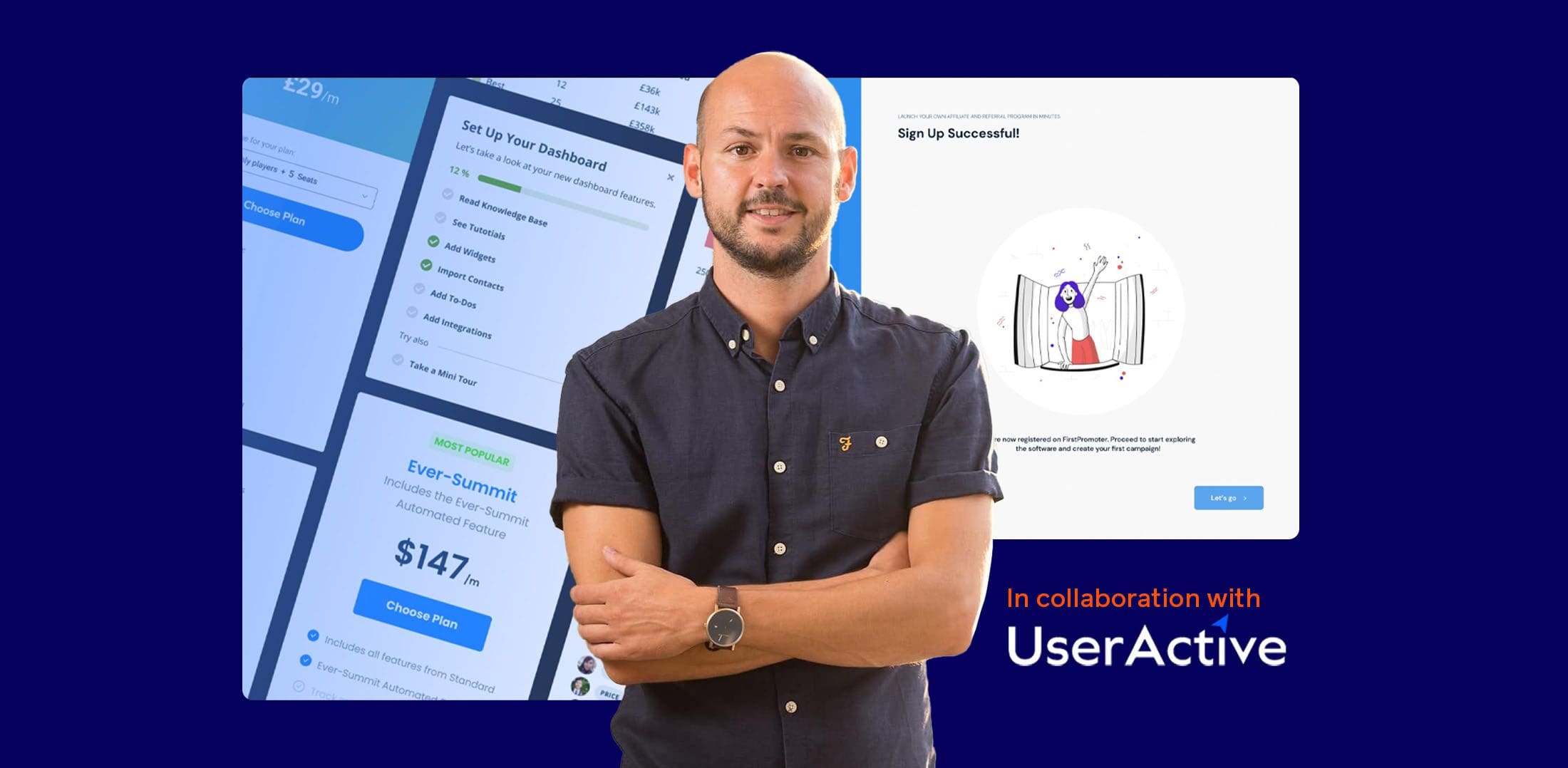
When it comes to user experience and software, first impressions matter. From a business perspective, those first impressions not only last, they have the potential to improve user retention and increase a customer’s lifetime value. That’s why providing an optimized user onboarding experience is so important to get right, the first time.
Peter Lovingis a UX/UI designer and founder of UserActive who helps software as a service (SaaS) companies to create meaningful products users love. In a recent Knowledge Sharing Session (KSS) held by Proshore, Peter explained his approach to user onboarding and how to design an exceptional experience.> Watch the KSS recording on demand
Common challenges for user onboarding
The barrier to entry to SaaS is lower, but the requirement for a better user experience is higher. The requirement to demonstrate value quickly and an intuitive product is also critical.

Peter LovingSenior Product Designer, UserActive
From a tricky integration to people signing up, but not actually using the product, user onboarding brings its own unique set of challenges for software companies. Whether it’s how to get users to be more active with the features of your product, or reduce churn, it can be difficult to know the best way to onboard customers. Here are three common challenges:
- Firstly, research shows that for SaaS products, around 30% of users log in once – and never come back. That’s almost a third of all new users. When you then consider that there’s another segment of users who log in several times, and don’t return, it becomes clear that churn is a fundamental issue for SaaS providers.
- Secondly, after wrong product fit and lack of engagement, poor onboarding causes churn. By building loyalty and impressing your users from the get-go, you can create the opportunity to demonstrate that you can solve their problems and provide value. Without this, there'll be little to no commitment from the user to move forward with your product.
- Thirdly, no matter what your sector or niche, SaaS is an increasingly crowded and competitive market where effective onboarding is becoming a key differentiator. Approaches such as product-led growth mean that products are becoming more self-service orientated. Users are getting accustomed to being able to do more themselves without requesting help.
The business and customer value of onboarding means that software companies are investing heavily in their onboarding flow. Getting it right, making it intuitive, and creating value quickly are essential for making your product stand out from the pack, and differentiate your offering from competitors.So what can you do to make a really strong first impression, and create a powerful impact to help retain a greater percentage of these early-exit customers? How can you prevent users from leaving and encourage them to make repeat visits?
How to approach user onboarding?
82% of enterprise organizations rate their onboarding approach as a key driver of value.
Peter LovingSenior Product Designer, UserActive
By making the right impression, you increase the chances of getting new users to come back again, and again. To do this successfully, you need to provide an optimum onboarding experience for your SaaS users. This means treating them like a guest at a luxury hotel, and here’s why.When you arrive as a guest at a five-star hotel, you’re warmly welcomed so that you feel valued, and you’re suitably impressed by the reception. The hotel thanks you for booking and says they hope you enjoy your stay. Next, the hotel delivers your bags to your room and shows you all the available facilities, such as the restaurant, a spa, a swimming pool, events, and so on. This might include a short guided tour as well as demonstrating the features of your room, how you can get help, and who’s available to support you during your stay.With a SaaS, your user arrives with a problem that needs to be solved. Immediately, you want them to feel that your product will solve their problems and provide a sense of relief. To help the user get started, it’s advisable to:
- Demonstrate the features of your product
- Show how they can get help and who’s there to support them
- Direct them to relevant content to help educate them on using your product.
If you view your product as a five-star hotel, you’ll give users a great experience and impress them by demonstrating its value. Identifying where users are dropping off can help you identify content gaps, such as a user guide for getting specific functionality set up.
What an optimum onboarding flow looks like?
Optimal onboarding has five key stages. Let’s take a closer look at how each one works.
1. Welcome your new user
By showing appreciation for a new user signing up, they’ll feel valued. By carefully framing your offering, you can also provide reassurance by confirming that your product is the right choice for their needs.This is also an opportunity to educate the user on how the product will solve their issues, and build their expectations in anticipation of using the product. This stage of the process requires careful consideration of how you want the user to feel, such as relief that they’ve found a solution, empowered to solve their problem, or eager to get started.You can achieve a warmer welcome by including a 60-second welcome video to let users see the value of your product before you make any mention of pricing. Focus your users’ attention, one step at a time, and follow a process.
2. Help them visualize success
Think of a journey. Your user is travelling from A to B. There’s a problem they need to solve. In simple terms, your product is the vehicle that’s going to take users from being sad about an issue to feeling happy that it’s resolved.For this reason, it’s important to fully understand your customer’s needs and how your product can help. Perhaps it opens up a new sales channel or saves time. The next step is to show users how your product takes care of their problems – and paint a picture of their future success.
3. Showcase your product’s value
With the end result fixed in your users’ minds, it’s important to demonstrate how your product can solve their pain points. With clarity over the pain points, it’s important to match pain points with the features (and therefore the solutions) your product brings.This validates that your product meets their needs and gives you the chance to demonstrate the benefit of each feature. For example, your SaaS might enable users to sync information, and automate product updates quickly and efficiently between different e-commerce platforms.
4. Promote user habits
By this stage, your users can visualize future success. They know how your product solves their pain points, and they can see the benefits that different features bring. Now they’re ready to start using your product, it’s time to promote user journeys and help them start ‘doing work’.In order to promote good user habits, you need to incentivize them to get value from your product. Your planning should start with a list of work that needs to be done to achieve the end result. Understanding the steps they need to take can help you determine the navigational flows required. The key question here is: what can your product do to remove as much work as possible from your users?Showing users how you can facilitate their journey is a great way to get them onboarded and up and running in no time at all. This will also help to build loyalty and commitment within your product.
5. Reduce onboarding friction
In order to reduce onboarding friction, it’s important to map out the steps required at every stage of the process. That might include things like account set up and sign-in, integrations with other apps or services, configuration management, and setting up a dashboard.With the process mapped out, you’re then able to identify the points of friction and design an onboarding flow that does as much of the work as possible, minimizing the amount of work required from the user. This might include things like the option to skip certain non-essential set-up features, such as personalization, or helpful guidance such as step-by-step instructions for connecting integrations.Essentially, you need to remove as much friction as possible by taking control of the heavy lifting and reducing the user’s workload.
Creating capacity for exceptional onboarding
Without question, getting onboarding right can help to reduce churn rates, keep customers engaged and committed, and ultimately differentiate your SaaS product in a competitive market. Following these five steps, from welcoming new users to identifying opportunities to reduce friction, can help create an exceptional SaaS onboarding experience.Need additional capacity to develop your SaaS onboarding process without hiring expensive, in-house developers? Whether you need to increase developer capacity in the short term or bring in a managed team to handle your entire product going forward – Proshore’s development teams are ready-to-code an exceptional SaaS user experience.Book a call with Peter and Proshore’s Account Director, Jeroen van der Horst, today. You can also watch the insightful KSS in full, below. Workshop recording Peter's knowledge-sharing session was an interactive one. With Q&As and examples, get even more insights into the steps mentioned above.Watch now

Product development takeaways
Building a customizable dashboard for a market-research SaaS
Learn how we helped CYS Group build a powerful dashboard with customizable widgets and the takeways from the feature development.
Talk to Jeroen, our Accounts director, to see if our ready-to-code dev teams are a fit for you.
Let’s say you’re looking for a front-end team who can handle a complex and customizable customer-facing dashboard in Angular. Finding the right tech talent locally might be a challenge. But if you tap into the global IT talent pool, and you’ll almost certainly find the expertise you’re looking for, at a cost-effective price.
For many software companies, hiring offshore developers has a lot of advantages – particularly if your needs are niche, and you want to cut your time-to-market.
As an example, here’s the story of how one of our remote dev teams built a powerful dashboard for a market research SaaS platform, what was needed, how we approached it, and what we learned.
Why dashboards are important
With so much valuable data flying around, especially in a field like market research, it’s important to have centralized and clear oversight in order to do more with your data. Dashboards have become the go-to solution for visualizing data in order to make it meaningful, derive actionable insights, and ultimately inform decision-making.
When data is essential for the continuous improvement of your business, you need to be able to view it and articulate it in the most useful ways possible. This can be particularly challenging when you need to gather and synthesize data from multiple sources. Connected to a variety of data sets, a dashboard is a customizable window into all that data you’re collecting.
What was needed
Building a dashboard is one thing, typically they’re fairly static with standardized visualizations for things like sales and revenue. But creating a powerful dashboard for a market research SaaS platform – that’s a next-level task.
Market research is all about data. A lot of data. That means your customers need multiple ways to visualize it – over and above your average dashboard. So when we collaborated with CYS Group on their market research SaaS product, it was one of the most advanced builds we’d ever done.
Users of this dashboard needed a whole host of customizable widgets to eliminate the need to export data to a spreadsheet and manually create graphs and infographics. This tool needed to do it all.
How it was built
Having previously worked on other market research tools, the Proshore team had knowledge around the industry, but we also added value through Agile ways of working. This enabled us to seamlessly integrate with an existing development team in India and align our sprint cycles.
Whilst an in-house team worked on the backend, we developed the front end. Compared with similar web application frameworks, Angular is more structured. It requires more technical expertise and has a steep learning curve. The trouble is, it’s hard to find developers with the right skills for working with Angular.
The pay-off for SaaS companies using Angular is robust and reliable code. It also has a strong boilerplate and a range of tools which, with the right know-how, make developing the front end of an application much easier. That means not everything has to be built from scratch. There are ready-made components which help make it highly scalable and secure.
In terms of coding in Angular, if any gets broken during the development phase, it gets automatically flagged before going into production, which helps quality assurance.

Read our guide on hiring offshore Angular Developers Learn more
How we collaborated
With an experienced team of Angular developers, Proshore was the ideal offshore software development partner for building a powerful, customizable dashboard. We were also experienced in Agile ways of working.
Running on separate sprint cycles meant we could align with the in-house team. Before work on the front end could begin, the backend and connecting APIs needed to be ready. Once the data points and everything else was in place, then we could begin our work.
Using Scrum, we were able to work collaboratively whilst creating different features. It helped us see the big picture whilst focusing on the work to be done. In other words, two teams were working separately yet collaboratively to create a single product.
Challenges we faced
This was no ordinary dashboard. It contained numerous widgets, and each widget contained its own data, with different states to manage. This data was generated through multiple calculation methods and special formulas. To build it, we also had to understand over 50 infographics.
Every calculation needed to be checked and verified with the APIs before ensuring that the data was being handled in the right way. With market research data, there are various scales, so we had to ensure the scales were correctly processed. Backwards compatibility was also a key consideration. New functionality needed to work not only with the latest dashboard but with older versions as well. This involved extensive testing.

One of the most sophisticated features of the dashboard is the ability for users to render their own image SVG (scalable vector graphic) charts. This enables them to create infographics. To facilitate this, we needed to create a UI to enable them to drag and drop within the image itself. This also had to be able to update dynamically as per the API.
For many standard dashboard builds, there are libraries of ready-made third-party tools. However, due to the specialist requirement of this market research SaaS platform, there simply weren’t any third-party offerings. As a result, we built our own custom libraries from scratch.
So in order to achieve the end-goal of a highly customizable market research dashboard, we not only had to connect the correct data through APIs, we had to build additional libraries to handle the required level of dynamic customization needed.

How CYS utilized Proshore's dedicated team to remodel and increase their development capacity – accelerating their roadmap and taking their market research platform from MVP to maturity. Read case study
What we learned
This was a landmark build for Proshore. After successfully completing the dashboard, and seeing it go live, our team feels like they can build anything.
We now have a much deeper understanding of highly-complex dashboards, the level of customization needed, and how much dynamic information is required. Ultimately, we learned how much potential there is for visualizing data for users, and how important it is to get calculations 100% accurate – because this data is driving decision-making at a high level.
Key learnings that we’ve taken forward from this collaboration are:
- Terminology: Software development is highly technical. Ensure collaborating teams communicate clearly by agreeing and using the same terminology.
- Business Logic: Make sure that all team members understand the business logic of the build. It’s easy enough to follow instructions, but you need to understand the user.
- Open-mindedness: Take experience and knowledge forward into your next development, but don’t make any assumptions. No two dashboards are the same!
Sometimes in software development, there’s a business need to augment an existing in-house or offshore team, increasing capacity to speed up development. Other times, there’s a need to add value by bringing in specialist, outside knowledge. And often you need both – extra capacity and expertise. That’s where Proshore comes in.
Need to build a complex and customizable dashboard for your software product? Book a call to discover out how we can help.


Remote Development
Hire Offshore Developers in 2025 - Proshore
Accelerate your product launch by hiring Proshore's offshore developers. Simplify the process of finding, choosing, and building a top-tier team tailored to your business needs.
Book a call Talk to our Accounts director, Jeroen, to see if our ready-to-code offshore teams are a fit for you.
Offshore Software Developers
Hiring offshore developers has become a common practice in the software development industry. This trend is driven by the global shortage of skilled IT talent and the cost-effectiveness of lower overhead expenses.
According to one survey from Manpower, more than 76% of employers lack the right talent in IT and technology. This has increased the demand for IT professionals worldwide.
To put it in perspective, US labor statistics show a shortage of 40 million skilled IT workers worldwide and forecast a rise to 80 million by 2030.
This leaves software development companies with two options:
- Compete for local talent within your own country at a significant cost.
- Outsource software development or hire offshore developers to augment your existing team.
Steps to hire offshore developers

Define your business needs
Be clear about the skills you need and how they align with your goals to ensure you get the best fit for your business.

Get references and recommendations
Doing your homework will help mitigate the risk of making the wrong hire. Analyze developer's experience via testimonials, reviews, and case studies.
Ensure that you are getting the right expertise as per your project requirements.

Create a clear job description
Provide a crystal clear description of what's required. From the beginning, set expectations for your remote developers—what they should know and what they will work on.
Spend time with the developers, share your goals, and ask for plans on how they can help you with your business.

Establish effective communications
Remember, it's your product—don't just leave everything to the developers. Get involved in important decisions and set up a proper communication channel and medium.
If things are not working out, don't hesitate to cancel the contract.

Looking for self managed offshore developer?
Hire ready-to-code developers from Proshore. Test the team’s output during a 60-day trial period. Not happy with someone? We will replace them at no extra cost.
Offshore Developers Vs. In-house Hiring
Weighing up on whether to hire developers offshore or in-house can be challenging because of different factors.
Here are some pros and cons of each:
In-house Hiring
Choosing to hire developers in-house means you're investing in a long-term team that works closely within your company. This model offers greater control over day-to-day operations, collaboration, and alignment with your company culture. But is it the right choice for your growth goals?
Here’s a quick look at the pros and cons:
Pros
- Employees are part of your company from the get-go.
- You can ensure that they are a good fit through an extensive hiring process.
- They will show up and put in a performance for your business every day.
Cons
- Hiring in-house takes time.
- It's also expensive. There's the cost of onboarding and training. You also have to factor in the additional costs of providing pensions, sick pay, insurance, office supplies, and so on.
Hiring Offshore Developers
Working with offshore developers can be a smart choice for businesses that want to grow quickly without spending too much. You gain access to talented people from around the world and can speed up progress. However, it's important to think about the coordination challenges that can arise with remote teams in different countries.
Here’s a breakdown of the pros and cons:
Pros
- Helps you reach out to a global market of tech talent
- You get instant access to the expertise you need.
- It can be more cost-effective.
- You can scale up or down quickly without worrying about hiring overheads.
Cons
- With so many options available, narrowing down your search for the right talent can be a challenge.
- Language barriers, working across time zones, and cultural differences might cause problems.
Challenge of Hiring Offshore Developers
Handing over your product to a team of developers based somewhere else in the world can feel like you're giving up control. That's why choosing the right offshore partner is so important to the success of your collaboration.
Despite the obvious benefits of hiring offshore developers, some business leaders still have reservations about it.
Three major concerns are communication, time zones, and technology.
1
Communication
English has become the industry standard for communication in software development. However, some offshore developers might struggle with proper communication because they are not native speakers. Mainly due to different accents.
2
Collaboration
Because developers work from different regions in different time zones, collaborations and meeting setups might be challenging.
Many modern collaboration tools and remote technologies have been used to fix this issue. However, this poses a major threat to effective collaboration.
3
Skills and Technologies
Part of your decision-making around choosing offshore developers will involve aligning their skills and expertise with your chosen software stack.
That’s why you should ensure there is no gap in technological know-how between your developers.
1
Communication
English has become the industry standard for communication in software development. However, some offshore developers might struggle with proper communication because they are not native speakers. Mainly due to different accents.
2
Collaboration
Because developers work from different regions in different time zones, collaborations and meeting setups might be challenging.
Many modern collaboration tools and remote technologies have been used to fix this issue. However, this poses a major threat to effective collaboration.
3
Skills and Technologies
Part of your decision-making around choosing offshore developers will involve aligning their skills and expertise with your chosen software stack.
That's why you should ensure there is no gap in technological know-how between your developers.
Hire Offshore Developers from Proshore
Hire ready-to-code offshore developers from Proshore and streamline the process of sourcing, selecting, and assembling the best tech talent for your business.
- Leveraging our broad and deep talent pool, we hand-pick the right people for your needs, saving you valuable time and money on hiring.
- You can cut out training costs because our developers are matched to your tech stack and ready to code from day 1.
- Whichever direction you're scaling in, we scale with you. By talking to us about your specific needs, we can tailor a team package to suit you, from a single developer to a complete self-managed team, including QAs, designers, DevOps, and Scrum masters.
We carefully match our developers to your requirements, and if a mismatch occurs, we seamlessly integrate another team member without wasting a single day.

Remote development challenges
Onboard or Outsource? Recruit and retain the best tech talent
Should you recruit offshore software developers in-house, or outsource them through an offshore development company? Gain an HR perspective.
Talk to Jeroen, our Accounts director, to see if our ready-to-code dev teams are a fit for you.
With a global shortage of top tech talent, like in Western Europe and the US, finding skilled developers on home soil can be almost impossible. Additionally, for startups and small software companies, luring passive candidates away from lucrative positions in big companies is simply not an option.
So in countries with a higher cost of living, the expense and scarcity of tech talent means companies have to look elsewhere for the expertise they need.
The natural choice is to bring in remote offshore software developers. But should you recruit them in-house (onboard), or outsource development to an offshore company?
In this blog post, we’ll help you decide through the lens of the HR department.
1️⃣ A remote-first industry
Software development is a sector where the trend for remote working has proven popular with workers and profitable with businesses – since 2020. Whilst in other sectors, business leaders have been seen busy devising strategies to encourage the workforce back to the office, software development remains a viable remote-first industry.
There is a two-sided advantage to tapping into this remote workforce. Companies in countries with a higher cost of living can access a global market to find the right talent at a fraction of the cost. Simultaneously, developers in countries with a lower cost of living, like Nepal, gain access to better pay rates by working remotely for a company in another country.
The challenge faced by software companies outsourcing offshore development is ensuring they get the right talent at the best price.
Proshore Nepal had also gone fully remote during the pandemic and adopted a flexible hybrid 'work from home' policy after the lockdowns. Given our agile way of working, the hybrid policy was easily implemented without any dropoff in productivity. Additionally, it has helped our devs achieve a better work-life balance, keeping them energized for every sprint!
2️⃣ Onboard in-house or outsource offshore?
Any hiring decision should be made based on your company’s unique needs. Sourcing, recruiting, onboarding, and training any new employee takes time and money. Whilst opening your doors to a global market broadens and deepens the available talent pool, it can also be a financial and administrative burden.
If you hire remote developers in-house, you incur the same long-term costs as any other employee. This is further complicated by how to correctly onboard them to your company, and account for their pay and deductions in a way that’s compliant with employment regulations, and tax laws. If they’re based abroad, this can be time-consuming and challenging. Getting it wrong also carries financial and reputational risks.
By outsourcing to an offshore software development company, like Proshore, you pay a fixed fee and everything related to recruitment, onboarding, and training is handled for you.
With Proshore, all the HR processes from recruiting, hiring, onboarding, training, retaining, and replacing are taken care of so that business/product owners can focus on company growth.
3️⃣ Onboard in-house or outsource offshore?
Another viable option is to hire a freelance developer located in another part of the world. But the chances are you need a team. If not immediately, at some point in the future your operations will expand and your development needs will increase. With a solo freelancer, where do you go next? Hire more freelancers? Putting together a remote team made up of individual freelancers gets complicated quickly.
Whether you’re hiring in-house or contracting development out to remote developers, there are risks attached to both. Freelancers can be fickle. What if a better offer comes along? They might leave, and you’re left to pick up the pieces. Hiring in-house is also risky. What if it turns out you made the wrong hire? You might be stuck with an expensive mistake and a less-than-ideal development team.
Bringing in a skilled and experienced development team from a reputable offshore software development company can mitigate these risks and more.
At Proshore, our ready-to-code dev teams can be scaled up and down, and have high retention – essentially bringing a piece of mind often not associated with outsourcing offshore. We monitor and plan ahead of time so that even if we do face changes they are managed efficiently.
A hub of tech talent in Nepal🇳🇵
Based in the Netherlands and Nepal, Proshore is perfectly positioned to connect software companies in the West with top tech talent in Nepal. We’re proud to be part of a promising IT outsourcing hub, fuelled by a steady stream of well-educated IT professionals. Because we offer highly-skilled jobs with competitive rates of pay, working with Proshore is an attractive proposition for the best and brightest tech talent in Nepal.
With Proshore, not only do software companies get the expertise they need when developers join our team they also enjoy training opportunities and upskilling to put them on the path to becoming full-stack developers. But we don’t just employ new developers for their technical expertise alone.
At Proshore, we pride ourselves on having a positive, inclusive, and collaborative culture. Our developers need to be team players who have a positive mindset, and an ability to see the big picture.
We value willingness to learn and develop just as important as having the prerequisite technical skills. So when recruiting, we provide feedback to every candidate after the first stage. So if they’re not successful the first time around, they have points for development to work on for the next time.

It’s no secret that using offshore devs and remote teams is a cost-effective way for software companies to add extra capacity and accelerate production. Not only does it help reduce overheads, it also opens up a global IT talent pool.
The beauty of adding capacity with a remote team is that you have none of the costs associated with attracting, recruiting, and retaining in-house talent. At the same time, you get ready-to-code developers with exactly the right skills and expertise needed to make your software a success.
But, you probably already knew that. Bringing in offshore developers is a given. What you really need to know is how to work well with your remote team – and how to get the best out of them.
With 15 years of experience, our Managing Director, Haico Duisters, opens up about 6 ways to get the best out of remote development teams;
Asynchronous Development
An Agile Delivery Model
Managed Remote Teams
Skills aligned with challenges
Robust recruitment methods
An agreed upfront fee
1️⃣ Asynchronous Development
Remote teams existed pre-pandemic, but the situation undoubtedly helped to accelerate the adoption of sustainable, long-term remote working.
Across multiple industries, hybrid working is now common, with employees splitting their time between home and the office. Proven remote working practices have shown that effective communication and productivity are no longer the concerns they once were.
Agile software development is a great fit for remote working access time zones. That’s because by carefully aligning sprint cycles, development can take place 24/7 – something to think about if you’re looking to reduce the time to market.
2️⃣ An Agile Delivery Model
When you bring in a remote development team, you’re not just getting a resource – they come with prior experience and a tried and tested working process. Agile delivery models give you exactly that – more flexible and adaptive development opportunities.
Different teams take care of different parts of the SaaS or software product. For example, some companies already have their own developers in place. When an offshore development team is brought in, it can then handle a specific area of development. This means integration and alignment is much easier to achieve – as long as your business goals are clearly shared and understood.
For other businesses – typically start-up SaaS – remote developers can also create capacity by joining existing teams. Using a buddy system is a great way to get remote workers up to speed on company culture, relevant business information, and make them feel part of a current engineering team.
3️⃣ Managed Remote Teams
Every company has different needs, but there’s much to be said for bringing in a hand-picked remote team, over multiple, individual outsourced developers.
For starters, it can help make working well with your remote developers much more straightforward. With individuals, you have to take control of each individual’s performance – as you would with employees. Managed teams manage themselves, under your direction.
With Proshore, our remote teams come with a dedicated Scrum Master who takes the responsibility for alignment with your Product Owner, and helps to optimize the team’s performance.
Put simply, an agile delivery model includes planning, refinement, and delivery, and eliminates micromanagement. There’s also no need for the HR functionality typically needed to onboard your own employees.
The other advantage of our ready-to-code development teams is that they can scale with your needs. This model allows you to add extra capacity without you having to source, recruit, and onboard additional talent. It’s taken care of on your behalf, at a significant saving in both time and cost.
4️⃣ Skills aligned with challenges
It goes without saying that when you bring in a team of offshore developers, they need to have the right skills for your development needs. Hiring a team puts the responsibility on your chosen offshore development company to select the most suitably qualified team members.
Matching the right skills is one thing. It’s also important that they understand what the real challenges are behind your need to add extra capacity. This can also provide vital clues as to the right solution for your challenges. The best solution is not just about having the correct coding skills and experience, it’s also about understanding the business case. If the remote team understands the business case, it gives their work meaning, and enables them to see how it fits into the bigger picture – and you’ll get a better product.
Of course, it is possible to build software without the right expertise. Companies sometimes look to low-code solutions for faster iteration. For generic applications, like a company Intranet, that’s a viable route. But for successful software and SaaS, it’s not always a viable option to pick and choose from ready-made components to create something new. When you need something unique and bespoke, that’s when remote development teams can help.
5️⃣ Robust recruitment methods
Hiring a team of remote developers means you can step aside from hiring duties, but that doesn’t mean compromising on quality or settling for second best. One thing you should check is the hiring statistics of your offshore software development company. How quickly can they source and onboard new teams? How broad and deep is their talent pool?
At Proshore we can connect your business with thousands of highly-skilled IT professionals living in Nepal. In 2023, we doubled the number of applicants to open positions, and we’ve also reduced our average time to hire from over 90 days to less than 20 days. That’s because we have a wealth of available talent on our database, above 4000, and a steady talent pipeline of new recruits from our mentorship program.
6️⃣ An agreed upfront fee
Let’s face it, when you’re hiring in-house, sourcing, recruiting, and retaining the best tech talent is expensive and time-consuming. With remote development teams, this cost can be dramatically reduced, whilst at the same time giving you extra capacity and improving your output.
Before you sign an agreement, make sure the costs are clear. This gives you peace of mind and cost certainty going forward. Find out how much you could save by using our handy cost calculator.
Final thoughts on adding extra capacity
Modern software companies are free from the limitations of working out of a single location. They can pick and choose from the best IT talent spread all over the world. But being spread out doesn’t mean being spread thin. Rather than viewing time zones as a limitation, working with a remote global workforce facilitates 24/7 operations, and accelerates development time.
With a managed team of remote developers from Proshore – whether you need one person or an entire Agile team – you can add extra capacity at speed. There’s no need to incur the costs of hiring in-house, and no need for the complexities of traditional HR functionality – everything you need is available for a pre-agreed and cost-effective fee.
A growing talent pool of over 4,000 developers – screened, assessed, and ready to code.
Commitment to the delivery of your product and the delivery process.
Experienced Agile teams who work closely with your Product Owner.
Add extra capacity and speed up the time to market your software product with ready-to-code devs. Book a call with Proshore to get started.

Rajendra Shrestha is a recent graduate of Nepal College of Information Technology (NCIT), with a Bachelor of Engineering in Software Engineering. He’s also approaching his first full year as a mobile app developer at Proshore.
For Rajendra – who’s also currently completing a master’s degree in computer engineering – part of Proshore’s appeal is the flexible working arrangements. This means he can study and work in software development at the same time.
Continuing our ‘employee stories’ series, we spoke to Rajendra about his experience of working for Proshore, what he’s enjoyed most, and where he would like to take his career next.
What did you do before Proshore?
Since I was young, I’ve had a passion for mobile development. I built apps and tried coding many things for my phone.
In mobile app development, technology moves quickly! When I first started training, the main programming language was Java. Today, I mainly work in Flutter – the open-source UI kit created by Google for cross-platform applications.
The mobile app development sector has always fascinated me. Before joining Proshore, I worked for a fintech company for almost three years. They provided banking solutions through mobile apps, with a product aimed at banking corporations within Nepal.
What led you to Proshore?
I’d actually been following Proshore for a long time. A friend from college, who worked for the company, recommended it to me. They enjoyed working as part of the team. Now approaching my first year with the company, so do I!
What really appealed to me about joining Proshore was working on international projects, and learning how to handle them. I was also keen to learn how to develop software iteratively to keep improving products.
Where will your skills and experience take you next?
Right now, I’m focussed on two things: finishing my master’s degree and honing my skills as a mobile app developer.
However, in the future, I would like to move sideways and learn other aspects of software development. That’s because as developers, we cannot be complete with only one skill set. We need backend and frontend knowledge, especially if further down the line we want to become full-stack developers.
In terms of my next steps, eCommerce is everywhere right now. So what I’d most like to do is something new. I’m really interested in the possibilities of artificial intelligence (AI) and machine learning (ML). At college, I did a project which involved ML, where I had to train the modules and integrate them into an app. This really sparked my interest.
As a developer, I’d like to become more independent and self-reliant, which will come as my knowledge and experience grow. I’d also like to develop my knowledge of other programming languages, and with this knowledge, heighten my project management skills. Because Proshore works on so many different types of projects, opportunities are certain to come up. In the future, I’d also like to mentor junior developers.
What do you enjoy most about Proshore?
There are so many answers to this question! The flexible working arrangements mean I can study and work at the same time. The learning environment here is also very positive; my teammates are very helpful. I guess you could say that it’s been a very fruitful environment to both learn and work!
There are opportunities to learn many things around software development. That’s because Proshore has many different projects, in a range of programming languages, with many international partners. As a team, we also have the opportunity to take part in social activities, such as football.
Right now, most of Nepal’s economy is agricultural. So I’ve really enjoyed working on a poultry app. Basically, it enables farmers to optimize food production by surveying their flock and recording the features of individual hens. The data collected is used to help improve their farming techniques. I like the way it combines a traditional occupation with cutting-edge tech.
So far, what’s been most challenging about your role?
We have such a helpful team that so far anything I’ve found challenging has been easily overcome. I also think anything can be solved – or I can Google it! One area that I have found tricky is localization. That’s when an app needs to integrate multiple languages.
Traditionally, we put different languages side by side within the frontend of an app. To overcome this, I’ve engineered a piece of code that enables different languages to be handled in the backend of the app and shown in the frontend. Now, we don’t need to manually enter different languages. This was a huge challenge for me, but highly rewarding.
If you could code any piece of software, what would it be and why?
I’ve dreamed of designing an app that helps farmers to grow plants. It would give instructions on planting and caring for different kinds of plants to optimize their growth and yield.

At Proshore, people are important. In fact, when we’re hiring, we value personal skills as much as technical skills. So we wanted to bring back the idea of highlighting Proshorian stories by making a series of posts about them.
Kicking the series off with Rajendra, we next spoke to Nikesh Maharjan, Team Leader for dating products. Nikesh has been with the company for over 5 years. We asked him about his journey to Proshore, his career so far, and his plans for the future.
What did you do before joining Proshore?
I’m from Godawari, Nepal – a place of natural beauty near Kathmandu. In 2016, I completed a BSc in Computer Science and Information technology at the Himalaya College Of Engineering.
After graduating, I first started as a PHP web developer, training at one of the top institutes in the city – Broadway Infosys. I’d been working for another IT company for about 5 months when I had the chance to join Proshore.
How did you get started at Proshore?
Proshore was actually recommended to me by my college Head of Department. So I applied for an open role and got an interview.
There were two parts to the interview. The first was an introduction and logical test. The second part was a task-based test to create a homepage for a website. I passed both tests and started working for Proshore in December 2016 as technical support.
After 6 months, I took the opportunity to work two shifts to learn new skills. In the daytime, I worked as a developer and technical support, and in the evenings I worked for the sales team.
Tell us about your current role
I’ve now been at Proshore for over 6 years! In that time, I’ve had the opportunity to learn many new skills across different areas, including software development, project management, and sales. I want to learn everything!
Currently, I’m the Team Leader for 3 dating products. Not only that, I’m also a Sales Manager. I deal directly with clients selling our product, bringing custom projects, and planning development projects with the team. That means I’m involved from end to end. After I verify the development, it’s delivered, and we hand it over to the client.
What do you enjoy most about working for Proshore?
I love working here. It’s a friendly environment, we have opportunities to learn new things, and we’re offered flexible working patterns. My role is client-facing, so it’s very people-focused.
I really enjoy talking to new people, exploring new ideas, and learning how to handle different characters. I get to meet people from many different countries because our clients are based all over the world, including Europe and the US. Everyone is different! Client handling is something I’ve improved over the years, with guidance from my managers in both the Netherlands and Nepal.
One of the projects I’m most pleased with was a website for a Korean client. We got around the language barrier, and they were very happy with the quality and delivery of the site. Afterward, they wanted to send us some Korean gifts, but there was a problem, so instead, they sent us tips to hold a party and celebrate!
What’s most challenging about your role?
In such a varied role, time management is often a challenge.
Handling multiple customers each day means I need to stay up to date with different projects at the same time. That’s why it’s so important to keep a record of conversations and ensure nothing is missed!
So I’d say the biggest challenges are effective time management, utilization of the team members, and ensuring we have good project delivery.
Where will your skills and experience take you next?
In the next 5 to 10 years, I want to explore selling other types of digital products, especially in the eCommerce sector. I also want to explore the process of project management within big projects more deeply.
If you could code any piece of software, what would it be and why?
If I could code any piece of software, I’d want to make a system that uses Artificial Intelligence (AI) to help users try on clothes before ordering them. I don’t know if it exists yet for clothes, but I’ve seen a similar solution for glasses on Lenskart.

What is Offshore Software Development?
Offshore software development is a business process where a company outsources some or all of its software development to partner companies located in another country.
As a business owner, you can hire an individual developer or an entire offshore development team to serve as an extension of your business. Offshore outsourcing is valuable for companies looking to expand their technical team without worrying about hiring overheads.
You can easily scale up or down as needed.
Offshore vs Onshore Software Development
Onshore software development is the practice of hiring contractors who are based in the same country.
Less cost-effective as you have to pay them the same rate as your in-house developers.
Offshore software development refers to hiring contractors from different countries.
More cost-effective as you can hire developers from south-Asian countries like Nepal and the Philippines.
For more detailed differences, visit our blog post on onshore versus offshore development.
Benefits of Offshore Software Development
Here are some of the benefits of hiring an offshore team for your development needs:
Learn more about the benefits of hiring an offshore development company.
Challenges of Offshore Software Development
Offshore development is a common practice nowadays, but it comes with certain challenges:
Time zone differences
While working with teams located in different time zones, you may need to rely on asynchronous communication, which can take some time.
Cultural influences
Some countries may have different working and communication styles, which might create problems with knowledge and requirement transfer.
Less control over hiring
Some offshore providers may try to increase profit margins by hiring lower-priced engineers, which can negatively impact the quality of their work.
Because of these challenges, choosing a good offshore partner is crucial. To avoid these challenges, make sure to vet your partner properly and look at their past experiences.

14+ years in offshore development.
Try our ready-to-code offshore teams.
Different steps involved in Offshore Software Development
Here are the basic steps to follow when starting with offshore hiring:
Best countries for Offshore Development
Nepal 🇳🇵
Nepal has a comparatively low cost of labor, making outsourced software development relatively inexpensive at an average rate of $25 to $40 per hour.
The country also recently revitalized its education systems to prioritize digital skill sets. More than 5,000 university graduates go into the tech and business process outsourcing sectors every year.
For a more detailed overview, visit our blog on top countries for offshore software development.
Cost of Offshore Software Development
Offshore development costs can range from $25 to $200 per hour per developer, based on different factors such as:
- location of the offshore company
- project requirements
- experience of the technical team
Check out our guide on offshore development rates by country and technology for a proper price comparison.
Tips for hiring Offshore Software Developers
Make sure to read our comprehensive guide before hiring offshore developers in 2024.
When is the best time to opt for Offshore Software Development?
The best time to hire an offshore development team depends on your business needs and requirements. However, it may be beneficial to consider hiring an outside team if:
- Your projects need specific expertise that you don’t have in-house, consider hiring offshore talents.
- Your startup needs to quickly scale its technical capabilities.
- You want to add new features to your software without disrupting the current tasks of your in-house developers.
- You have a limited budget but still want to compete in the market, by hiring teams from countries like Nepal and India, where you can access top-notch resources at a low cost.
PROSHORE - your Offshore Software Development Company
With over a decade of experience, Proshore is a leading offshore software development service provider from Nepal.
We offer a unique ready-to-code dev teams mode that starts with understanding your needs, taking ownership of the project, and managing developers, processes, and outputs such as milestones and deliverables.
We ensure a smooth development process so that you can focus on your business strategies – let’s discuss your requirements over a 15-minute call.
If you’re looking for specialized offshore development services, you can also choose from our vast tech expertise:
- Offshore Laravel Development
- Offshore PHP Development
- Offshore Java Development
- Offshore .NET Development
- Offshore React Development
- Offshore NodeJS Development
- Offshore Vue JS Development
- Offshore Python Development
- Offshore Frontend Development
- Offshore QA Team
- Offshore Mobile App Development


Remote Development
Everything you need to know about Offshore Mobile App Development
As a company that has successfully delivered over 100+ applications worldwide, we've seen the evolution of offshore mobile development. Initially, it started as a simple cost-saving strategy but has become a strategic business advantage.
Book a call Talk to our Accounts director, Jeroen, to see if our ready-to-code offshore teams are a fit for you.
Whether you're a startup founder looking to build your first MVP or an enterprise seeking to accelerate your digital transformation, understanding the nuances of offshore mobile app development is crucial in today's competitive market.
In this blog, you'll get our tested insights on navigating offshore development and maximizing your investment in mobile development. This guide is not based on theoretical knowledge but on real experiences, challenges we've overcome, and success stories we've helped create.
So let's get started.
What is offshore mobile app development?
Offshore mobile app development is the practice of building mobile applications by partnering with development teams in a different country. It combines technical expertise with cost-effectiveness, allowing businesses to leverage global talent while maintaining project control from their local office.
Cost analysis of offshore mobile development
Mobile development costs vary based on different factors, and understanding these is crucial for effective budgeting and decision-making. From our experience working with diverse clients, here are major cost factors:
1. Development rates by region:
Factors like local economic conditions, market maturity, and available talent pool influence the rate across regions. Here are typical hourly rates:
Southeast Asia
Nepal: $20 - $40
India: $25 - $50
Philippines: $25 - $50
Vietnam: $20 - $40
Eastern Europe
Poland: $35 - $55
Ukraine: $30 - $55
Romania: $25 - $45
Hungary: $40 - $50
Belarus: $35 - $50
Latin America
Brazil: $30 - $55
Argentina: $30 - $55
Peru: $30 - $50
Colombia: $30 - $50

To learn more, visit our article on offshore development rates by country.
2. Project components that impact cost
Mobile app projects consist of multiple components that contribute to the overall development cost. The key elements are:
Design and UX Development
The more complex the design, the higher the cost. It includes,
- UI/UX design and prototyping
- User flow mapping
- Interactive mockups
- Design system creation
Frontend and backend development
Contributing the majority of the app development cost, it includes,
- Native/cross-platform app development
- API development
- Performance logic
Third-party integration
Similarly, depending on the need, you can opt for integrations like payment gateways, social media, and analytics tools that directly influence the cost.
Apart from those mentioned above, other cost-inducing components include,
- Testing and QA
- Project management
- Maintenance and support
3. Additional overhead
It's important to consider operational costs beyond the core development. While often overlooked, these costs can significantly impact your budget.
Communication overhead
You'll need video conferencing tools and real-time collaboration platforms.
Knowledge transfer
This includes initial training sessions, creating detailed documentation, and proper handovers.
These additional overhead costs typically take up 10-15% of your total project budget, but investing them properly often leads to smoother project execution and better results.
How to start with offshore mobile app development
You need careful planning and the right approach before starting an offshore project – select the model that best suits your business. At Proshore, we offer three proven models:
1
Dedicated team model
Best for long-term projects with evolving requirements.
A dedicated team works exclusively on your project. You get better control and flexibility while maintaining consistent team knowledge about your project.
> Related article: What is a dedicated software development team and where to hire one?
2
Project-based development
Best for projects with clear requirements and fixed scope.
Your offshore partner manages everything from development to delivery within agreed timelines and budgets. You can completely focus on your business goal.
3
Staff augmentation
Best when you need to quickly scale your existing team.
You can hire specific expertise while maintaining direct control over the development process.
> Related article: A complete guide to IT team augmentation
Development Process
Once you finalize your choice of development model, you can move ahead with the development process. Here's our tested process.
1. Requirement gathering
Document everything about your app - from features and technical requirements to business goals and target audience. This clarity helps avoid costly changes later.
Tip: Start and grow with an MVP. Don’t waste time building unnecessary functionality. Decide what’s most important and start with that.
2. Choose the right tech stack
Based on your requirements, you can choose different technologies. For example,
- For native development, you can either use Swift or Objective-C with UIKit for iOS apps and Kotlin with the Android SDK for Android apps.
- For cross-platform development, you can go for React Native or Flutter.
Tip: If you want high-performing apps with platform-specific features, go with native development.
3. Choose your development partner
While choosing a partner, look beyond the cost. Evaluate their portfolio, technical expertise, and, most importantly, how well they communicate.
We'll dive deeper into this topic later on in the blog: How to choose the right development company.
4. Understand the development timeline
Typically, a timeline can vary from 3 to 6 months, depending on the complexity of your requirements. Here's a breakdown of the timeline.
Phase 1: Planning and design
2-4 weeks
- Define project scope
- Gather requirements
- Document user stories
- Visualize design wireframes and prototypes
- Select tech stack and architecture
Phase 2: Development
5-10 weeks
- Setup development environment
- Build core features
- Integrate API
- Setup database
- Implement UI/UX simultaneously
- Conduct code reviews
Phase 3: Testing
4-8 weeks
- Conduct and execute fixes from
- Functional testing
- Performance testing
- Security testing
- Ensure compatibility with iOS and Android
- Gather user feedback and make improvements
Phase 4: App Store Submission
1-2 weeks
- Meet iOS requirements
- Set up App Store Connect
- Create a privacy policy
- Finalize app details and assets.
- Fulfill Android requirements
- Set up Google Play Console
- Obtain content rating,
- Pepare store listing.
- Submit app for review
- Address app store feedback
Phase 1: Planning and design
2-4 weeks
- Define project scope
- Gather requirements
- Document user stories
- Visualize design wireframes and prototypes
- Select tech stack and architecture
Phase 2: Development
5-10 weeks
- Setup development environment
- Build core features
- Integrate API
- Setup database
- Implement UI/UX simultaneously
- Conduct code reviews
Phase 3: Testing
4-8 weeks
- Conduct and execute fixes from
- Functional testing
- Performance testing
- Security testing
- Ensure compatibility with iOS and Android
- Gather user feedback and make improvements
Phase 4: App Store Submission
1-2 weeks
- Meet iOS requirements
- Set up App Store Connect
- Create a privacy policy
- Finalize app details and assets.
- Fulfill Android requirements
- Set up Google Play Console
- Obtain content rating,
- Pepare store listing.
- Submit app for review
- Address app store feedback
5. Build your team structure
This includes developers, designers, QA engineers, and project managers. We recommend interviewing key team members to ensure they fit your project needs.
6. Setup your project infrastructure.
This includes communication tools, development environment, and reporting structure.

Ready to start mobile app development?
Let's discuss your project requirements.
Benefits and challenges of offshore app development
The potential cost savings are the marquee benefit of outsourcing mobile app development, but that's not all. Here are some of the major benefits why you should choose offshore mobile development:
1
Cost optimization
We have seen companies save 40-60% on development costs compared to hiring local teams. This isn’t just lower hourly rates – you also save on infrastructure, requirements, and employee benefits.
2
Global talent access
You can find the exact expertise your project needs. Need a React native expert? Or perhaps a flutter specialist? The global talent pool has you covered.
3
Round-the-clock development
With teams working across different time zones, development progresses round-the-clock.
Our clients usually see their projects completed 30-40% faster than traditional approaches.
4
Scale as you grow
The offshore team offers flexibility. You can expand your team for major feature push and scale down after the launch without any HR complexities.
5
Focus on growing your business
The most strategic benefit is that you can concentrate on business strategy, marketing, and building customer relationships. Your offshore team handles technical development.
1
Cost optimization
We have seen companies save 40-60% on development costs compared to hiring local teams. This isn't just lower hourly rates - you also save on infrastructure, requirements, and employee benefits.
2
Global talent access
You can find the exact expertise your project needs. Need a React native expert? Or perhaps a flutter specialist? The global talent pool has you covered.
3
Round-the-clock development
With teams working across different time zones, development progresses round-the-clock.
Our clients usually see their projects completed 30-40% faster than traditional approaches.
4
Scale as you grow
The offshore team offers flexibility. You can expand your team for major feature push and scale down after the launch without any HR complexities.
5
Focus on growing your business
The most strategic benefit is that you can concentrate on business strategy, marketing, and building customer relationships. Your offshore team handles technical development.
Challenges of offshore mobile app develpoment
Offshore development often comes with some challenges, however their impact varies based on your offshore partner.
1
Communication
Can be tricky across time zones and cultures. We’ve found that setting clear communication protocols, using the right collaboration tools, and maintaining regular video meetings helps bridge this gap.
2
Time zone differences
Can delay critical decisions. Setting clear overlap hours and having emergency communication channels helps maintain smooth operations.
3
Cultural differences
Can impact project execution. The key is to foster cultural awareness and establish clear work expectations from the start.
4
Quality concerns
Often comes up when discussing offshore development. You can avoid this by implementing robust quality assurance processes and choosing partners with proven track records.
At Proshore, we maintain strict coding standards and regular code reviews to ensure consistent quality.
5
App store compliance
Can be challenging with offshore teams. Different regions may have varying familiarity with platform guidelines.
We ensure compliance through:
- Pre-submission checklist
- Regular policy updates
- Dedicated compliance review
6
Device fragmentation
Especially in Android development, which requires extensive testing.
We manage this through:
- Priority device selection
- Responsive design implementation
- Performance optimization for various specs
1
Communication
Can be tricky across time zones and cultures. We've found that setting clear communication protocols, using the right collaboration tools, and maintaining regular video meetings helps bridge this gap.
2
Time zone differences
Can delay critical decisions. Setting clear overlap hours and having emergency communication channels helps maintain smooth operations.
3
Cultural differences
Can impact project execution. The key is to foster cultural awareness and establish clear work expectations from the start.
4
Quality concerns
Often comes up when discussing offshore development. You can avoid this by implementing robust quality assurance processes and choosing partners with proven track records.
At Proshore, we maintain strict coding standards and regular code reviews to ensure consistent quality.
5
App store compliance
Can be challenging with offshore teams. Different regions may have varying familiarity with platform guidelines.
We ensure compliance through:
- Pre-submission checklist
- Regular policy updates
- Dedicated compliance review
6
Device fragmentation
Especially in Android development, which requires extensive testing.
We manage this through:
- Priority device selection
- Responsive design implementation
- Performance optimization for various specs
Offshore development often comes with some challenges, and their impact can be severe, depending on your offshore partner.
Top destinations for mobile app development
It's important to consider factors beyond costs while selecting a destination for your development. Each region offers unique advantages and challenges.
To help you narrow down your search, we have compiled a list of top countries:
India 🇮🇳
Known for its massive tech talent pool and mature IT industry.
Advantages
- A large number of experienced developers
- English proficiency
- Well-established tech infrastructure
- Competitive rates: $25 - $50/hour
Challenges
- Time zone differences with US/Europe
- Quality inconsistency across vendors
- High developer turnover
Nepal🇳🇵
Emerging as a reliable development hub with strong technical talent.
Advantages
- Competitive rates: $20 - $40/hour
- Growing tech ecosystem
- Strong work ethic
- Lower turnover rates
- Cultural compatibility
Challenges
- Smaller talent pool compared to India
- Relatively new tech infrastructure
- Time zone differences with US/Europe
Eastern Europe
Preferred for complex technical projects and European collaboration
Advantages
- High technical expertise
- Cultural alignment with Western clients
- Convenient time zone for European clients
- Strong problem-solving skills
Challenges
- Higher rates: $34 - $55/hour
- Political instability in some regions
- Language barriers in some countries
Latin America
Ideal for US-based companies seeking nearshore options
Advantages
- Similar time zones with the US
- Cultural proximity
- Growing tech scene
- Good English proficiency
Challenges
- Rising rates: $30 - $55/hour
- Varying technical expertise
- Scarce talent pool for specialized skills
Want to learn more about choosing the right destination? Check out our detailed guide on the best offshore development countries.
How to choose the right offshore partner for mobile app development
You now have all the information you need about offshore mobile development. The next clear step is to choose the right development partner, as they can make or break your project.
During the selection process, you need to focus on these key areas:
1
Track record and portfolio
Review their past work, particularly projects similar to yours. At Proshore, we encourage clients to examine our case studies and speak with previous clients.
You can look for:
- Completed projects
- Experience in your industry
- Technical expertise in your required technologies
2
Communication standards
As we already discussed, effective communication is important for offshore success. You need to evaluate
- Response time to queries
- English proficiency level
- Communication tools and processes
- Reporting structure
3
Technical expertise
You need to verify the team’s technical capabilities. Ask for
- Team qualifications and certifications
- Code quality standards
- Development methodologies
- Security practices
4
Contract and pricing structure
Make sure your contract includes
- Clear payment terms, including any hidden costs
- Intellectual property rights
- Confidentiality agreements
- Project milestone definitions and deliverables
- Maintenance and support terms
1
Track record and portfolio
Review their past work, particularly projects similar to yours. At Proshore, we encourage clients to examine our case studies and speak with previous clients.
You can look for:
- Completed projects
- Experience in your industry
- Technical expertise in your required technologies
2
Communication standards
As we already discussed, effective communication is important for offshore success. You need to evaluate
- Response time to queries
- English proficiency level
- Communication tools and processes
- Reporting structure
3
Technical expertise
You need to verify the team's technical capabilities. Ask for
- Team qualifications and certifications
- Code quality standards
- Development methodologies
- Security practices
4
Contract and pricing structure
Make sure your contract includes
- Clear payment terms, including any hidden costs
- Intellectual property rights
- Confidentiality agreements
- Project milestone definitions and deliverables
- Maintenance and support terms
Red flags to watch out for
At Proshore, we have onboarded clients who have tried different offshore partners before coming to us. According to them, here are a few red flags you should avoid:
- Unusually low rates as their USP
- Reluctance to provide references
- Lack of clear communication processes
- Undefined project methodologies
- No information about the team assigned to you
Hire Proshore as your offshore mobile app development partner
With 15 years of experience, multiple clients, and app and feature releases we combine technical excellence with reliable delivery. Our dual presence in the Netherlands and Nepal offers you:
- Global-standard project management with competitive development rates
- Ready-to-code development teams
- Established agile process
- Transparent communication
- Quality-focused delivery
See how we have helped clients similar to you.

FinTech Built with Node.js
“A lot of software products can take more time than expected. In order to minimize this risk, we decided to take the offer from Proshore because they could provide the hours we needed, at the right price.”

Taco van Wachem, Surebird
— Founder
Surebird: An InsurTech solution that compares policies daily for customers and facilitates switching to better alternatives.
How Proshore helped Surebird take its algorithm-dependant concept to launch – slashing the MVP's time to market down to 3 months!

HR Tech Built with Laravel
“We needed a really reliable development partner. I feel that with Proshore we’ve found it. And if we need to scale up the team, that’s also possible.”

Hardy de Heer, Psyflix
— European Operations Manager
Building a educational video platform for Psyflix, a leader in mental healthcare
How Proshore's dedicated team for Psyflix continuously yet comprehensively develops and implements the product roadmap to grow the eLearning platform globally.

Ecommerce Built with Laravel
“Right now, our app is being used by more than 7000 merchants… Our growth is led by our tech team and our top-notch support team.”

Roshan Bhattarai, DPL
— Co-Founder
Digital Product Labs: API that integrates and syncs products between Etsy and Shopify
Find out how Proshore and Digital Product Labs partnered to connect the popularity of Etsy with the power of Shopify through a new API.
FinTech Built with Node.js
“A lot of software products can take more time than expected. In order to minimize this risk, we decided to take the offer from Proshore because they could provide the hours we needed, at the right price.”
Taco van Wachem, Surebird
— Founder
Surebird: An InsurTech solution that compares policies daily for customers and facilitates switching to better alternatives.
How Proshore helped Surebird take its algorithm-dependant concept to launch – slashing the MVP's time to market down to 3 months!
Read case study
HR Tech Built with Laravel
“We needed a really reliable development partner. I feel that with Proshore we’ve found it. And if we need to scale up the team, that’s also possible.”
Hardy de Heer, Psyflix
— European Operations Manager
Building a educational video platform for Psyflix, a leader in mental healthcare
How Proshore's dedicated team for Psyflix continuously yet comprehensively develops and implements the product roadmap to grow the eLearning platform globally.
Read case study
Ecommerce Built with Laravel
“Right now, our app is being used by more than 7000 merchants… Our growth is led by our tech team and our top-notch support team.”
Roshan Bhattarai, DPL
— Co-Founder
Digital Product Labs: API that integrates and syncs products between Etsy and Shopify
Find out how Proshore and Digital Product Labs partnered to connect the popularity of Etsy with the power of Shopify through a new API.
Read case study


Remote Development
The best countries for Offshore Software Development
The best offshore software development countries are India, Nepal, China, the Philippines, Brazil, and Ukraine. Find out what these countries offer.
Book a call Talk to our Accounts director, Jeroen, to see if our ready-to-code offshore teams are a fit for you.
Uncertainty in the global economy is one of the main reasons why many tech companies are outsourcing their software development to countries all around the world. In fact, in the next four years, the global IT outsourcing market is set to reach $682.3 billion.
That’s why every country is trying to provide the best software outsourcing services and make a name for themselves.
In this article, we will look into the 10 best countries for outsourcing software development. We will cover the pros and cons, average outsourcing rates, and time zones of these countries. Read on for details.
10 best offshore software development countries
To make it more relevant, we have categorized the country according to regions and sorted them accordingly.
Asia Region
Asia is well known for its offshore offerings, ranging from call centers to manufacturing services — and the software development space is no exception. The region is particularly appealing for its wealth of available professionals at a relatively low cost.
In no particular order, here’s a list of popular IT hubs in the Asia region.
1. Nepal 🇳🇵
Nepal has recently revitalized its education systems to focus on digital skills, making it a growing tech hub for outsourcing IT services.
Each year, over 5000 college graduates enter the technology and business process outsourcing industries.
Timezone: UTC +5:45
Hourly rates: $25 – $40
Pros
- Low labor cost – making outsourced software development relatively inexpensive.
- Experienced in IT outsourcing with 100+ IT outsourcing companies providing the services.
- Thousands of IT graduates (5000+) join the industry every year.
Cons
- The country has a fairly basic data protection law, meaning customers have to identify outsourcing companies that abide by additional standards.

Cut costs and time-to-market significantly!
Hire pre-vetted offshore developers from Nepal
2. India 🇮🇳
India has one of the world’s largest populations and is a major provider of IT outsourcing services, which makes it possible to obtain high-quality services at a cost-effective rate.
Timezone: UTC +5:30
Hourly rates: $25 – $50
Pros
- India has a large population and a vast pool of talent.
- There is a highly skilled tech workforce with 2.6 million STEM graduates produced annually.
- A wide variety of services are available in software engineering, web, and app development.
Cons
- Data security can be an issue, it is recommended to find a provider with relevant ISO certification.
- Fluctuating exchange rates may affect hiring costs.
3. China 🇨🇳
China is considered a good option for outsourcing IT services for several reasons:
Timezone: UTC +8
Hourly rates: $50 – $80
Pros
- China has a large, highly educated, and skilled workforce, making it an ideal destination for outsourcing IT services.
- A vibrant tech industry and home to some of the world’s fastest-growing IT companies.
- China is a big market for software and technology products which gives companies an opportunity to tap into the local market and also test their products before exporting them
- The country has a rapidly growing talent pool with over 4.7 million tech graduates every year.
Cons
- Communication barriers may arise as only a small percentage (10 million) of China’s population speak English.
- The time difference with most major markets can also be a challenge.
4. The Philippines 🇵🇭
Timezone: UTC +8
Hourly rates: $25 – $50
Pros
- Communication is not a problem as a large population speaks English.
- A renewed education system has resulted in many high-quality graduates in the last few years.
- Low costs due to the low global value of the Filipino peso.
Cons
- The time difference with major markets can be an issue.
- The Phillipnes’ IT market is less mature compared to other countries, such as China.
5. Vietnam 🇻🇳
Timezone: UTC +7
Hourly rates: $20 – $40
Pros
- Vietnam has a strong outsourcing market, which is a major contributor to its economy.
- The economy of Vietnam is stable and has seen a growth of 2.9% during the COVID-19 pandemic, which helps to maintain steady hiring costs.
- The country offers skilled tech talent at low costs.
Cons
- Vietnam currently lacks a unified data protection law, which could put a company’s intellectual property at risk.
- There is little to no time zone overlap with most major markets.
The benefits of outsourcing from Vietnam and Nepal are alike but there are a few key areas that make Nepal the perfect for your offshore development needs – book a 15-min call to learn more.
South America
South America is an attractive destination for North American companies seeking outsourced talent due to the lower cost of staff, a high proportion of English-speaking professionals, and similar time zones.
However, Latin American outsourced software development companies tend to be more expensive than those in Asia and Eastern Europe.
6. Brazil 🇧🇷
Timezone: UTC -2, -3, -4, -5
Hourly rates: $30 – $55
Pros
- A young workforce, with around 38.2% of the country’s population under 25.
- The country is known for providing good junior developers, who can be brought in to fill a company’s team.
- The country is making efforts to improve its STEM education.
Cons
- A shifting political environment makes it difficult for foreign investment.
7. Argentina 🇦🇷
Timezone: UTC -3
Hourly rates: $30 – $55
Pros
- Argentina is one of the most educated countries in Latin America, with a growing software engineering sector.
- The country has a strong focus on innovation and has established tech parks to encourage tech development.
- The time difference with much of Easter and the Central United States is minimal.
- Offshore software development companies in Argentina boast high retention.
Cons
- High inflation rates may lead to increasing costs.
- Limited availability of developers specialized in niche technologies.
Eastern Europe
Eastern European countries have gained a reputation for having top-notch resources and strong educational programs. Additionally, they tend to have competitive prices and a high proficiency in spoken English.
This makes them an attractive option for Western European countries in similar time zones.
8. Romania 🇷🇴
Timezone: UTC +2
Hourly rates: $25 – $45
Pros
- Romania has a growing IT industry, producing thousands of new software developer graduates annually.
- The country has a successful high-tech unicorn, UiPath, which indicates a growing interest and demand for developers in the tech space.
- It’s located in Central Europe allowing for significant time zone overlap with Western Europe and North America.
Cons
- Many Romanians migrate to other countries for work, which can result in lower availability of talent.
- The costs for outsourcing IT services may be higher when compared to countries in Asia.
Outsourcing your development needs to a country based in a similar timezone may pose fewer perceived risks but may also decrease the benefits of a wider talent pool, decreased costs, and round-the-clock remote development – book a 15-min call to learn more.
9. Poland 🇵🇱
Timezone: UTC +1
Hourly rates: $35 – $55
Pros
- Poland has a robust software development landscape, with over 100 companies dedicated to software development, compared to other countries in the region.
- The country is a member of multiple organizations (including NATO, WTO, and EU), which ensure secure data sharing and storage.
- 30% of the Polish population speaks English, reducing the language barrier.
Cons
- The cost of outsourcing IT services tends to be higher than in other countries in the region.
- High competition in the space can lead to a high rate of talent turnover.
10. Ukraine 🇺🇦
Timezone: UTC +2, +3
Hourly rates: $30 – $55
Pros
- Ukraine has a large and growing pool of professionals, with an increase of 30,000 specialists per year in the past decade.
- The country has a solid history of outsourcing software development.
Cons
- The ongoing conflict with Russia poses safety concerns for individuals working within its borders.
Summary: Best countries for Offshore Software Development
- Nepal: <$25-40/hr, UTC +5:45
- India: <$25-50/hr, UTC +5:30
- China: $50-80/hr, UTC +8
- The Philippines: <$25-50/ hr. UTC +8
- Vietnam: <$20-40/hr, UTC +7
- Brazil: $30-55/hr, UTC -2,-3,-4,-5
- Argentina: $25-100/hr, UTC -3
- Romania: $25-45/hr, UTC +2
- Poland: $35-55/hr, UTC +1
- Ukraine: $30-55/hr, UTC +2,+3
What makes a country best for offshore software development?
When considering outsourcing software development, each country has its own advantages and disadvantages. The best country for your business will depend on your specific needs.
However, there are certain factors that make a country a good choice for offshore software development:
1
Lower cost of living which allows access to expertise at a more affordable rate.
2
Quality education that deepens the pool of talented developers.
3
High business standards that establishes trust in receiving what was agreed upon.
4
International standards laws for data and IP protection.
1
Lower cost of living which allows access to expertise at a more affordable rate.
2
Quality education that deepens the pool of talented developers.
3
High business standards that establishes trust in receiving what was agreed upon.
4
International standards laws for data and IP protection.
Tips to choose the right country for outsourcing software development
By now, you should have a good understanding of what to consider when selecting a country for outsourcing your software development.
Here are some tips to keep in mind when making your choice:
1
Look for a country with specialized developers in the specific type of work you need.
2
Evaluate the country’s business environment to ensure it aligns with your company’s work style.
3
Ensure that the country has a high proportion of English-speaking professionals to facilitate communication.
4
Take into account the time zone. Will you have any overlap with the team so that you can have meetings and review their work in real-time?
5
Compare the average rates. Are they lower than what you would pay for in-house development?
1
Look for a country with specialized developers in the specific type of work you need.
2
Evaluate the country’s business environment to ensure it aligns with your company’s work style.
3
Ensure that the country has a high proportion of English-speaking professionals to facilitate communication.
4
Take into account the time zone. Will you have any overlap with the team so that you can have meetings and review their work in real-time?
5
Compare the average rates. Are they lower than what you would pay for in-house development?
The above points will help you weed out the countries that don’t make sense for your business and allow you to choose a region that best fits your outsourcing needs.

Cost saving is one of the main reasons why businesses prefer outsourcing their tech project. Offshore software development rates for companies residing in Asia, Europe, or Latin America will be much lower than the costs associated with building an in-house team.
Hiring an offshore team means you don't have to worry about health benefits, professional growth opportunities, and office gear for the employees. You will just pay for the work done. This directly saves you lots of money. Additionally, offshore teams allow you to scale up and down quickly without having to pay for expensive recruiting processes and severance packages for termination.
With cost being such a big incentive for choosing offshore talent, it’s no surprise that companies want to know how rates vary by region and project type.
In this guide, we will examine offshore software development rates in different countries in Asia, Africa, Latin America, and Eastern and Western Europe. We will also compare rates for various technological skills like PHP, Java, front-end, and back-end development and look into the factors that affect pricing.
Read further for more information.
Offshore software development rates by country
In 2021, the global IT outsourcing industry was worth $526.6 billion, with hundreds of cities worldwide acting as outsourcing hubs for companies requiring extra support for their tech projects.
Each of these cities differs in terms of their rates, depth of expertise, educational programs, ways of doing business, and more. And when it comes to rates, there are two primary groups to consider.
Group 1:
Teams based in countries and regions with high standards of life (and cost of living), with stable economies. These include the US, Canada, Australia, Western Europe, and Israel.
Group 2:
Countries with less developed local markets with professionals looking to support companies in other countries. These include countries from Asia, Latin America, Africa, and Eastern Europe.
As the cost of living is typically lower in the second group of countries, they are able to offer reduced rates without compromising on the quality of work. In recent times, these countries have become real players in the outsourcing economy.
Software development rates in Western Europe
Within Western Europe, outsourcing tends to be more expensive and focused towards offering experts and fractional advisors to share their expertise.
CountriesRatePopular tech expertisePopular IT hubsGermany$50-$150 / hourJavaScript, Python, JavaBerlin, Munich, Frankfurt, CologneUnited Kingdom$50-$150 / hourJavaScript, Python, JavaLondon, Leeds, LeicesterSwitzerland$100-$200 / hourJavaScript, Python, .NETZurich, Geneva
Offshore software development rates in Eastern Europe
Countries in Eastern Europe that have developed a reputation for outsourcing software development include Ukraine, Belarus, Poland, and Romania.
CountriesRatePopular tech expertisePopular IT hubsUkraine$30-$55 / hourPython, Java, RubyKyiv, Kharkiv, Dnipo, LvivPoland$35-$55 / hourJava, SQL, Python, C++Warsaw, Wroclaw, KrakowRomania$25-$45 / hourPHP, Java, JavascriptBucharest, Cluj, TimisBelarus$35-$50 / hourJavaScript, Java, NETMinsk, Gomel, Vitebsk, MogilevCzech Republic$35-$55 / hourJavaScript, Python, JavaPrague, BrnoHungary$40-$50 / hourJavaScript, Python, JavaBudapest, Debrecen, Miskolc
Offshore software development rates in Latin America
Latin America isn’t always considered an outsourcing destination, but it has emerged as a place with competitive talent, reasonable rates, and convenient operating hours for North American and European time zones.
The talent pool is also substantial because many professionals are keen to seek employment outside their borders due to political and economic instability.
CountriesRatePopular tech expertisePopular IT hubsArgentina$30-$55Java, Python, SQLBuenos AiresPeru$30-$50Node.jsLimaBrazil$30-$55Java, Python, SQLRio de Janeiro, Porto Alegre, Curitiba, Blumenau, and LondrinaColombia$30-$50JavaScript, HTML, PythonMedellin, Bogota
Outsourcing your development needs to a country based in a similar timezone may pose fewer perceived risks but may also decrease the benefits of a wider talent pool, better cost-benefit ratio, and round-the-clock remote development – schedule a consultation to learn more.
Offshore software development rates in Africa
Africa is another continent that is often overlooked when it comes to outsourcing tech talent, but recent tech investment has spurred growth in the sector. Additionally, the region has time zones that align with much of Europe and the Middle East.
RegionRatePopular tech expertisePopular IT hubsSouth Africa$20-$50Java, PythonWestern Cape, Durban, GautengEast Africa$20-$50Python, JavaScript, PHPMombasa, Kisumu, EldoretNorth Africa$20-$50PHP, PythonRabat, CairoWest Africa$20-$50SQL, Java, PythonLagos
Offshore software development rates in Asia
Countries like India, China, the Philippines, and Nepal have established Asia as one of the popular destinations for outsourcing software development projects. The main reason behind this sudden growth is the affordable rate (due to the low cost of living and strong currency conversion) compared to other regions.
Additionally, a larger population means the availability of broader tech talent, which makes the pricing competitive.
CountriesRatePopular tech expertisePopular IT hubsIndia$25-$50Java, C++, PythonBangalore, Chennai, Mumbai, KolkataChina$50-$80Python, Algorithm, Functional DevelopmentBeijing, Shanghai, ShenzhenThe Philippines$25-$50PHP, ASP.NET, Ruby on RailsManilaVietnam$20-$40Java, PHP, .NETHanoi, Ho Chi Minh CityNepal$20-$40Microsoft.net, Python, PHP, C++, JavaScriptKathmandu
The benefits of outsourcing hubs across Asia may seem alike but there are a few key areas that make Nepal the perfect for your offshore development needs – schedule a consultation to learn more.
Comparison of offshore software development rates by country
Country / RegionHourly RatesSwitzerland $100-$150Germany$50-$150United Kingdom$50-$150China$50-$80Hungary$40-$50Poland$35-$55Czech Republic$35-$55Belarus$35-$50Argentina$30-$55Brazil$30-$55Ukraine$30-$55Peru$30-$50Colombia$30-$50India$25-$50The Philippines$25-$50Romania$25-$45South Africa$20-$50East Africa$20-$50North Africa$20-$50West Africa$20-$50Vietnam$20-$40Nepal$20-$40
Offshore software development rates by technology
As mentioned earlier, the rate of offshore software development also varies based on your technological requirements.
Here's a list of popular technologies and their possible outsourcing rates;
FAQs
What factors determine offshore software development rates?
As we’ve determined, where an offshore software development company is based has a significant impact on the rates they might charge. Each country has its own income levels, costs, living standards, and exchange rates.
Plus, the depth and breadth of technology education and expertise vary from place to place. This is all going to influence how much a company is willing to charge for its work.
Other factors that will determine a company’s rates include
- The size and level of experience of the development team.
- The tech stack or programming language required for the project.
- The company’s reputation and global presence.
Why does outsourcing software development to Asia cost less?
The reason it costs less to outsource software development to Asia is that the cost of living is often lower in Asian countries than in the Western hemisphere. This means that what seems like a low hourly rate for North America or Europe could actually go further in Asian economies.
The benefit here is that since many Asian countries are investing more in building robust technology expertise in their education systems and beyond, you don’t actually have to compromise on the quality of the work.
How much do Proshore’s offshore development teams cost?
Proshore's development team is largely based in Nepal, which results in low costs for offshore software development compared to other regions. The best part is you don't have to worry about the quality of work.
Our team is well-trained with the latest technologies. You can look into our past work to get a better idea about the quality of work we do.

The great thing about training and working in IT – and more specifically Agile software development – is that there are many different career paths to take. From quality analytics and testing to mentoring junior developers, there are a wealth of opportunities to learn new skills and carve out a career.
As with any profession, some people know exactly what they want to do right from the start, whilst other people discover what they enjoy doing by trying out new things. Both Biraj Singh Karki and Viraj Kumar Shrestha are Scrum Masters at Proshore. However, they each took a different journey to arrive at the same destination. So in this edition of our employee stories, we found out more about their individual experiences.
What did you do before Proshore?
Biraj: I currently live in Kathmandu. I completed my BSc in IT at Islington College, which is affiliated with London Metropolitan University. Before joining Proshore, I did two internships: firstly as a web designer at Archiesoft Technology, and secondly, at ZenLabs in Laravel development. I joined Proshore in 2021 as a Quality Analyst.
Viraj: I’ve lived in Kathmandu my whole life, and I completed my Bachelor of Information Management at Prime College. I'm not the kind of person who plans everything out. I have more of a ‘whatever happens, happens’ mindset. At university, I was involved in many clubs, and that’s what made me interested in management.
How did you find out about Proshore?
Biraj: I wrote a post on a Facebook group about internships for a Quality Analyst (QA). In response, one of the team members from Proshore actually connected with me. He sent over my resume to HR, and everything went from there.
Viraj: My career started with an internship at Studio Matrix – a web design company. I stayed there for 4 years. By the end, I thought I was out of love with programming, but one of my seniors from Prime College was working at Proshore and encouraged me to apply. In my interview, they liked what I said about management, and I got the job.
How did you progress to Scrum Master?
Biraj: I initially started as a QA, testing the codes and features that the developers had written. Then in April 2022, I got an opportunity to lead a team for the product Faire Integration & Sync. That’s when the transition process began. The move was gradual, and now I've completely transitioned from a QA to being Scrum Master for around 5 products.
It was a planned move. In my third year of university, I started researching the pathways to being a Scrum Master or a Project Manager. I found out QA was a good route to becoming a Scrum Master.
Viraj: Within a week or so of joining Proshore, one of our Scrum Masters, Simon Shrestha, asked me what I wanted to do in life. I’d never been asked that before! What I knew from my college days was that I loved interacting with people, getting to know them, and solving their problems.
I enjoy motivating people. At the same time, I'm not someone who goes into technical jargon, I talk in simple terms, so anyone can understand me. So it’s my characteristics that make me a good fit for the role of Scrum Master.
What’s it like to be a Scrum Master at Proshore?
Biraj: One of the major parts of the job is removing impediments for teammates. Whenever there’s a new project, or we acquire a product, we assign team members and facilitate Scrum events, like daily Scrum and planning meetings for what we are going to be doing for the next sprint.
Viraj: For me, it's kind of like being in the background – leading the team, but letting them take all the credit! Before I transitioned from a developer to Scrum Master, the team that I worked in used to be very dependent on me. Now, it’s more about empowering them – giving the power to the team itself, and encouraging them to come up with their own solutions.
What’s the best thing about being a Scrum Master?
Biraj: Before this role, I'd never been much of a people person. So for me to transition and take this role – I had to become a people person. I had to change my mindset. Now I get to lead all kinds of interesting projects.
Viraj: For me, it's about seeing people grow. That’s the best part of being a Scrum Master.
When I was a developer, junior developers would run most decisions through me. Now in my current role, I have to facilitate the values of Scrum – openness and respect for each other; the courage to provide constructive feedback to one another. That’s what I really like about the role of Scrum master.
Do you have any tips for aspiring Scrum Masters?
Biraj: I think it’s important to know what you want to do in life. That way, you can pave your path for whatever you want to do later. So if you want to become a Scrum Master, you have to have certain qualities that you need to develop as a developer or in any other role you’re doing in the industry.
Viraj: I think the best tip that I can give is to have patience because it might take some time for you to become a Scrum Master. For me, it has been a year in the making. Also, it’s good to have team support – that’s going to make your transition much easier.
If you could code any piece of software, what would it be and why?
Biraj: There are a few transport apps that people currently use in Nepal. I’d be interested in creating a car rental application – like Lyft – where people rent their vehicles. People can pick up a vehicle from any spot they like and then leave it somewhere else.
Viraj: I think a piece of software that answers trivial questions you have. Suppose you’re planning an outing, or you need random answers – I think that would make people's life a lot easier, right?

For any online business, it's important to get your frontend (UI and UX) right. Otherwise, there will be lots of frustrating users leading to a large number of drop-offs and switching to your competitors.
This is why many companies are hiring offshore frontend developers to provide the best experience for their customers. Additionally, the huge competition in the current job market makes it so difficult to hire the right in-house candidate with the right budget.
In this article, you will learn everything that you need to know before hiring offshore frontend developers. Let's get started.
What is an offshore frontend developer?
As you’re probably aware, frontend developers build the user-facing aspects of a website or web application. They require coding skills in HTML, CSS, and JavaScript.
Frontend developers create different components of web interfaces through which people interact. Hence, everyone who wants to create a website or web application will need frontend developers.
But, there's an increasing shortage of available frontend developers in regions such as Western Europe and US. The scarcity of talent has led to increasing costs in employing frontend developers. That's why companies have started to look offshore.
Offshore frontend developers are located offshore – in another country or on another continent – and fill open roles in frontend development.
The benefits of hiring frontend offshore developers
To win the war for talent, software companies are expanding their available talent pool by hiring offshore developers. Here are the main benefits of hiring frontend developers from outside.
1. More talent: With offshore hiring, companies open doors to a broader and deeper talent pool of frontend developers. They can now hire individuals from all around the world.
2. Cost-cutting: Offshore hiring also removes the overheads associated with accommodating office space. And, pay will be lower for frontend developers compared to many western countries.
3. Convenience: The presence of offshore software development companies, or rather partners like Proshore, makes recruitment easy. Sourcing, hiring, onboarding, and training are taken care of for you.
4. Increased productivity: Hiring people from different time zones can give you a competitive advantage. They can provide customers with 24/7 support and enable around-the-clock frontend development for quicker completion of tasks and faster time-to-market.
5. Expertise: With a wider pool of talent, you can get frontend developers with specific/niche skills or expertise that may not be readily available in a single location.
6. Flexibility: Markets change. Customers change. And your business needs change as well. Using offshore frontend developers gives you the ability to pivot and scale fast.
A checklist for hiring offshore frontend developers
Hiring an offshore frontend developer would be first based upon your requirements.
However, if you’re hiring offshore frontend developers for the first time, or want to ensure you’re getting the right people, here’s a handy checklist of essential skills and experience to get you started:
- Proficiency in HTML, CSS, and JavaScript.
- Knowledge of frontend development frameworks.
- Familiarity with key UI/UX principles and practices.
- Understanding of SEO best practices.
- Previous experience in creating frontend applications.
- The ability to build responsive web pages.
- Experience in graphic design applications.
- Good communication and interpersonal skills.
- A growth mindset, taking on feedback from teammates and clients.
The cost of hiring frontend developers
Due to the talent shortage in the West, top tech talent is in high demand and can be expensive to hire and retain, particularly for startups. For example, in the United States, the annual cost for a full-time in-house frontend developer was $70,000 in 2022.
However, the cost of hiring frontend developers in other regions like Asia, Africa, and Latin America will be much lower. And it will be cost-effective to look for talent in countries in these regions.
The following table compares the typical hourly rates for outsourced frontend developers in different regions:
RegionsHourly RatesNorth America$140Australia$105Western Europe$68South America$63Eastern Europe$55Asia$45
It's worth noting that the cost of hiring a frontend developer also depends on their levels of experience and skills. On average, Junior Frontend Developers cost around a third less than Full Stack Developers.
Recommended Reading: Offshore Software Development Rates
The challenges of hiring offshore frontend developers
If you’re unprepared, hiring offshore frontend developers can be a challenge, which carries its own risks. However, choosing a reputable offshore development company can alleviate concerns and help you avoid common pitfalls.
Many entrepreneurs and software company founders feel reluctant to hand over responsibility for frontend development to developers located in another part of the world. Trust is an important factor in their decision-making.
Business leaders can also have concerns about employee reliability and retention, which directly impact production speed and timelines. Ensuring a cultural fit in terms of company values, expectations, and code quality are other perceived challenges.
Proshore is an offshore software development company with highly skilled employees located in both Nepal and Netherlands and Nepal. We hand-pick the right talent for your needs – whether that’s frontend developers or any other role. How?
Our talent pool extends to over 1500 trained professionals. Plus, we handle everything to do with hiring, including onboarding and training. The bottom line is that we build offshore development teams that you can trust for the long term.
Frontend developers: Offshore vs. Onshore
With fierce competition for the best frontend developers from both small and large companies, acquiring the best talent in your home city or country can be difficult.
Many of the best developers are ‘passive candidates’ – already happily employed and not actively seeking a new role. Even if you can attract these talents, retaining them long-term can become a further challenge.
Ultimately, you are left with two options when hiring frontend developers: hiring offshore or onshore developers. Both options have their pros and cons, and it's important to compare them before making a decision;
Onshore hiring
Pros:
- Onshore hiring is the traditional recruitment method, which can be done through an in-house recruitment team or an external agency.
- For non-remote roles, onshore hiring means frontend developers will be in the same location. Hence, they are likely to speak the same language leading to better communication and collaboration.
- Additionally, onshore hiring also ensures a similar cultural background and time zone.
Cons:
- Remote working is now the industry norm for the software development industry. Hence, convincing top talent in an office-based role in a specific location will be difficult.
- The high demand for frontend developers means the supply of top talent is limited.
- If you are looking for candidates locally, the talent pool will be significantly smaller.
- Additionally, the high demand means higher office overheads and salaries, making it more expensive to hire onshore developers.
Offshore hiring
Pros:
- Moving the software development side of your business to another location is a cost-effective way to scale up your operations, augmenting your existing developer capacity with highly skilled tech talent from around the world.
- As we’ve already mentioned, you get access to a larger talent pool and gain the flexibility and expertise you need on demand.
- You can also play the timezone difference to your advantage.
Cons:
- As we’ve already covered, trust, communication, and cultural fit are all potential barriers unless you use a reliable offshore development company like Proshore.
Still not sure what’s right for you? We can help you make an informed decision regarding offshore versus onshore software development.
Tools used by frontend developers
As web technology evolves, so do the tools used by frontend developers Here’s a summary of the basic tools used by frontend developers:
- Code editors are where frontend developers write and edit code.
- Web development tools enable developers to test and debug their code.
- JavaScript libraries provide pre-written code snippets to speed up development.
- Version control systems help developers track and manage frontend code.
- Social development environments enable developers to showcase snippets of code.
- Web development frameworks are sets of resources and tools developers use.
- A CSS preprocessor enables developers to generate CSS from its own syntax.
Watch this video to learn about 7 commonly used tools frontend developers use:
https://www.youtube.com/embed/I527_XR76PE
FAQs
What are the technical skills needed for offshore front-end developers?
- HTML
- CSS
- MySQL
- JavaScript
- JSON
- AJAX
- Node.js
- React
- Java
- DOM Manipulation
Which countries have the best offshore front-end developers?
Countries all over the world offer offshore front-end developers. Eastern Europe, South America, and Asia are popular offshore destinations. To learn more, read our article on which countries offer the best offshore developers.
When should a company hire offshore front-end developers?
Making the decision to hire offshore developers depends on a number of factors. Each business is different, with varying needs. Need help to decide? Read our handy guide on why companies should hire offshore developers.
Offshore development teams from Proshore
If you’re searching for frontend developers, Proshore provides cost-effective, ready-to-code development teams as a service. Why consider hiring offshore frontend developers from Proshore? Here are three reasons:
- Hand-pick the frontend talent you can use as your in-house team.
- Our team focuses more on cultural fit and communication.
- We handle everything when hiring developers as per need.
Looking for frontend developers? Find them offshore with Proshore.

Due to its popularity, getting hold of the best Node.js developers can be a challenge, which is why most companies expand their search offshore. If you’re planning to hire offshore Node.js developers but aren't sure where to start, you've come to the right place.
Why choose Node.js?
Node.js offers several advantages over competing runtime environments.
- It is built on Google's V8 JavaScript engine and is known for its ability to handle large volumes of data and requests quickly and efficiently.
- Unlike traditional web applications, Node.js doesn't create a new thread for each request, instead runs on event-driven architecture that handles multiple requests concurrently. Thus, it can be highly scalable.
- Thanks to a large and active developer community, Node.js also has several pre-existing libraries and modules that make it easier to build complex applications quickly and efficiently.
- Because it’s based on JavaScript – a widely used and familiar programming language – it’s much easier for developers to learn and start using.
- Another key feature of Node.js is its cross-platform compatibility, including Windows, Linux, and macOS. This makes it much easier to develop and deploy applications across multiple platforms
What is an offshore Node.js developer?
From the name itself, you can derive that offshore Node.js developers – from different countries – specialize in using Node.js technology to build applications. They are often hired by companies looking to leverage the expertise and cost-effectiveness of remote talent, rather than hiring expensive and hard-to-find developers locally.
You can find Node.js developers in countries like Nepal, India, and the Philippines, where the cost of living is lower than in the United States or Europe.
Hiring offshore can provide cost savings and flexibility, as companies can access a larger pool of talent and scale their development teams quickly.
What skills do Node.js developers require?
Node.js developers are responsible for building and maintaining server-side applications. Here are some of the skills that a Node.js developer possesses.
Technical Skills
- Proficiency in JavaScript: Node.js is built on top of JavaScript, so developers must have a strong understanding of JavaScript.
- Knowledge of frameworks and related technologies: Developers should be proficient in the Node.js framework, as well as related technologies including Express.js, MongoDB, React, and AngularJS.
- Experience in building server-side applications: As Node.js is primarily used for building server-side applications, developers should have experience working with servers, APIs, and databases.
- Understanding of asynchronous programming: Developers need a solid understanding of asynchronous programming techniques because it’s designed to handle asynchronous I/O operations,
- Familiarity with RESTful API design: Design and implementation of RESTful API is a common use case for Node.js.
- Knowledge of software development best practices: All software developers should be familiar with best practices for their chosen programming language, including version control, testing, debugging, and code optimization.
Soft Skills
As Offshore Node.js developers usually work as part of a wider team, collaborating and communicating with other developers, project managers, and stakeholders, their soft skills are also important. These include:
- Effective communication, collaboration, and time management skills: These are crucial for offshore Node.js developers to succeed — especially in a remote working environment.
- Strong problem-solving skills: Node.js developers need to be able to analyze complex problems and develop creative solutions to address them.
- Flexibility and adaptability: Developers should be able to work in a fast-paced, dynamic environment and adapt to new technologies and requirements as needed.
Where to find offshore Node.js developers
You can find Node.js developers in different countries all around the world. However, while choosing any developers, you should consider factors like,
- language proficiency
- time zone compatibility
- technical skills
- past experience
- cultural fit.
Here are some of the popular countries where you can find Node.js developers:
- India has a large pool of skilled developers with experience in Node.js and related technologies. The cost of living and wages in India are lower than in the US or Europe, making it a popular destination for offshore development.
- The Philippines is becoming an increasingly popular destination for offshore development, thanks to its large pool of talented and English-speaking developers. The cost of living and wages in the Philippines are also relatively low.
- Eastern Europe has a growing community of Node.js developers, with countries like Poland, Romania, and Bulgaria becoming popular destinations for offshore development.
- Latin America has a growing tech industry, with countries like Mexico, Brazil, and Argentina developing a reputation for skilled Node.js developers.
- Nepal has a vibrant tech hub in Kathmandu and a strong education system for qualifications in IT, making it an ideal place to find Node.js developers.
6 simple steps for hiring offshore Node.js developers
Hiring offshore Node.js developers can be a challenging process, but following these steps will help you find the right talent for your project.
In this step-by-step guide, we’ll take you through the complete process of hiring, from defining your project requirements to finding the right talent and managing the development process.
Step 1 – Define your project
Before you begin searching for developers, it’s a good idea to clearly define your project requirements. That includes the tech stack, scope, timeline, and budget. This will help you evaluate developers more effectively and ensure their skills and experience match your needs.
Step 2 – Choose an outsourcing partner
Choose a reliable outsourcing partner. There are many outsourcing companies claiming expertise in Node.js development. Choose a partner that has a good track record of delivering quality work and can provide you with access to a pool of skilled and experienced developers. Look for social proof from satisfied clients.
Step 3 – Evaluate candidates
When evaluating developers, look for those who have experience working with Node.js, as well as related technologies and frameworks such as Express.js, MongoDB, and React. Review their portfolios, references, and online profiles to assess their skills and experience.
Step 4 – Shortlist candidates
Once you have a shortlist of candidates, conduct technical interviews to assess their technical knowledge, problem-solving skills, and ability to work in a remote team. You may also want to consider giving them a coding test.
Step 5 – Test soft skills
Effective communication and collaboration are critical for remote work. During the interview process, evaluate the candidate's communication and collaboration skills, as well as their ability to work in a team, regardless of whether that’s remote or in-person.
Step 6 – Provide guidance and feedback
It's important to manage the overall development process effectively. Use project management tools to track progress, communicate regularly with the team, and provide clear guidance and feedback.
Common issues with hiring offshore Node.js developers
Hiring offshore Node.js developers can be a great way to access skilled talent at a lower cost, but it's not without its challenges. Here are some general issues that companies may encounter when hiring offshore developers:
1. Communication barriers:
Communication can be a challenge when working with remote teams, especially when it comes to differences in language and culture. That’s why it's important to establish clear communication channels and protocols from the start. This helps to make everyone comfortable communicating in a common language.
2. Time zone differences:
When working with offshore teams, time zone differences can make it difficult to schedule meetings and collaborate in real-time. It's important to establish a schedule that works for everyone on the team and to use tools like Slack or Zoom to facilitate communication.
3. Quality control:
It can be challenging to maintain quality control when working with remote teams, especially if you don't have a physical presence in the same location. That's why you should establish quality control standards for reviewing and testing code to ensure code is of high quality.
4. Intellectual property (IP) security:
When working with offshore teams, there may be concerns about IP and data security. For that reason, it’s vital to establish clear agreements and contracts with the team to ensure that your intellectual property is protected.
5. Cultural differences:
It's important to be aware of cultural differences and to establish clear guidelines and protocols to ensure that everyone on the team is comfortable working together.
How much does it cost to hire an offshore Node.js developer?
The cost of hiring offshore developers is affected by different factors, including their location, experience, the complexity of the project, and the length of engagement.
Nevertheless, the typical cost of hiring offshore Node.js developers ranges from $10 to $70 per hour.
Here are some approximate costings:
LocationTypical cost per hourIndia$10 – $35Eastern Europe$30 – $70The Philippines$10 – $25Latin America$20 – $50Nepal$18 - $35
Offshore Node.js Developers from Proshore
For most companies, the choice is between hiring individual freelance Node.js developers or a bringing in a team of developers from an offshore software development company. Here are five reasons why hiring a Node.js development team from an offshore company like Proshore is a good option:
1. A larger talent pool
Offshore companies open up a larger pool of tech talent located in different regions, making it possible to have around-the-clock development. Proshore has teams in both Nepal and the Netherlands who work in two different time zones.
2. The right skills and expertise
By gaining access to a larger talent pool, offshore companies offer a wide range of skills and expertise, including Node.js. Proshore clients gain access to a range of skills, such as UX/UI design, database architecture, and project management – all from one company.
3. Previous experience
Previous experience is important for ensuring the best quality results from offshore development companies. Every day, Proshore teams work on complex projects using agile principles, an iterative approach and tried and tested frameworks. They also provide ongoing support and guidance to ensure a project is completed on time and within budget.
4. Flexibility to scale
Companies of all sizes need the flexibility to scale. Drawing on a large pool of tech talent, Proshore is able to scale development in line with a business’s needs. This makes it easy to adjust the number of people working on a project when capacity needs to change.
5. Quality assurance and code quality
Code quality is essential to any Node.js project. Proshore has established quality assurance processes to ensure the code meets the highest quality standards. For that reason, clients can be confident that their project is in safe hands and that the final product will meet their expectations.

Offshore PHP Development Services
A typical PHP development project includes building a wide range of web applications, from simple websites to complex enterprise applications.
Based on your company size and project requirements, the service can vary. Here are some of the popular PHP development services:
1. MVP Development
Services include discovery and planning, design and prototyping, development and testing, deployment and maintenance.
2. E-Commerce Development
Services include online store design and development, payment processing integration, shipping and fulfillment integration.
Proshore also specializes in developing custom eCommerce solutions for businesses of all sizes.
3. Custom Web App Development
Services include scalable and reliable architecture design, secure development practices, compliances, ongoing maintenance, and support.
PHP Developers and the skills they need
Most offshore development companies already vet their developers during hiring so that clients do not have to worry about their skill set.
Nevertheless, you also have to do some vetting because, in the end, it’s your business. You should be able to differentiate whether you are getting the right talent.
PHP development usually involves both the front-end and back-end of web development. Based on this, here are some technical skills PHP developers should possess:
Apart from these technical skills, you should also look for soft skills like:
If this seems like too much work, you can always hire industry-expert offshore development companies. You only need to do a proper background check of assigned developers – look for technical skills and their past projects.
Proshore has an experience of 15+ years with 4500+ pre-vetted developers and offers a 60-day trial period.
Identify whether we fit your business requirements over a free consultation call
Cost of Offshore PHP Development
The cost of PHP development largely depends on two factors:
Your Project Requirements
It involves the experience of developers you need and the complexity of your project.
Based on developers’ experience, the cost can vary from $20 to $200 per hour.
Junior Developers
$20 – $40
Mid-level Developers
$40 – $100
Senior Developers
$100 – $200 or more
Similarly, the complexity of your project determines its duration, which directly influences your cost.
The country you are getting service from
The living costs and exchange rates directly influence offshore development costs. Countries like Nepal, India, and the Philippines, with lower living costs and higher exchange rates, generally provide offshore services at affordable costs.
On the other hand, countries like the US, the UK, and Australia tend to charge higher due to the reasons mentioned above.
Explore offshore development costs by country and technology.
Top countries to hire offshore PHP developers
When hiring a PHP team, it is essential to consider factors such as language proficiency, cultural compatibility, and time zone differences to ensure effective collaboration.
Below are the countries known for providing quality offshore development services:
Nepal 🇳🇵
A growing tech hub in Kathmandu, combined with high-quality IT education providers across the country, makes Nepal an ideal location for finding affordable PHP developers.
India 🇮🇳
One of the top outsourcing destinations for IT services, including PHP development. India has an ever-growing talent pool and experienced PHP developers who offer cost-effective services.
Philippines 🇵🇭
A popular destination for outsourcing PHP development services due to its skilled workforce, English language proficiency, and low labor costs.
Poland 🇵🇱
Known for its highly skilled software developers, including PHP developers, Poland offers cost-effective and high-quality services.
Romania 🇷🇴
Another European country with a large pool of talented PHP developers who offer competitive rates.
Learn more about the best offshore software development countries.
Proshore - Offshore PHP Development Company
Since operations began in 2009, Proshore’s offshore software development services have included PHP development. In fact, it’s one of our major stacks – we specialize in the Laravel framework.
Our portfolio includes various case studies that showcase how we have successfully partnered with companies to deliver high-quality PHP development solutions.
Operating from Nepal has helped us become a cost-effective option for companies based in Europe and the US.
To give you an idea of the potential cost-savings, here’s a comparison between PHP team costs across countries compared with our team in Nepal:

With the field of software development now a global market, many companies seek out Angular developers offshore. Not only is this approach cost-effective, but it also opens the door for more specialized talent based on a project's specific needs. In fact, offshore development has become the default option for businesses looking to hire high-quality offshore Angular developers at affordable rates.
Whether you're a small business owner or a large enterprise, this guide will give you the knowledge needed to successfully hire and manage offshore Angular developers and ensure the success of your project. In this guide, we'll explore the benefits of hiring Angular developers offshore and some of the common challenges.
What is an offshore Angular developer?
Angular is a popular open-source web application framework maintained by Google. It enables developers to build dynamic, robust, and scalable web applications. With its powerful features and flexibility, Angular is now the go-to choice for businesses looking to build complex and sophisticated web applications.
When it comes to Angular developers, they can work on various aspects of the development process – coding, testing, debugging, and deploying web applications. However, they specialize in front-end web development.
Due to its popularity, finding and hiring experienced Angular developers can be challenging. That’s why companies with limited budgets or in regions where there is a shortage of tech talent are hiring Angular developers offshore. With the world moving to offshore hiring, you can also hire offshore Angular developers who will be working from different offshore locations.
Offshore Angular developers usually work from countries where labor costs are lower than in the company's home country. They can either work independently or as part of a larger offshore development team, collaborating with a company's internal team members, ensuring the successful completion of a project.
The benefits of hiring Angular developers offshore
There’s no question that hiring Angular developers offshore gives companies a number of key advantages. Here’s a summary of some of the main benefits:
- Cost savings: Offshore development centers are often located in countries with lower costs of living. This can result in significant cost savings for businesses that hire Angular developers offshore. For example, in the US Angular developers can cost between $50 and $200 per hour, whereas in Nepal hourly rates are closer to $20 to $40.
- Reduced risk: Reliable offshore Angular development companies will have well-established processes and procedures in place. This will make project management easier. It also means deadlines and milestones are more likely to be met on time and on budget.
- Access to a wider talent pool: By hiring Angular developers offshore, businesses gain access to a wider talent pool. This is particularly beneficial for businesses that are struggling to find the right talent locally to work on the frontend and other Angular-specific technology.
- Faster time to market: Due to differences in timezone, offshore Angular developers can provide around-the-clock development coverage, which can help businesses to accelerate the time to market for new products and services.
- Flexibility and scalability: By using an offshore Angular development company, capacity can be scaled according to the needs of the business, whether that’s due to a spike in demand or the need to ramp up development for a new project.
- Focus on core business activities: By outsourcing Angular development, companies can free up internal resources for other core business activities, such as marketing, sales, and customer service.
Offshore vs Onshore Angular development
In contrast to offshore Angular development – where development is outsourced to a different country – onshore software development takes place within the same country as the client or employer.
But which is right for your business?
Here are some of the main differences to help you make the decision:
CriteriaOnshore AngularOffshore AngularCostOffshore project management might take more time and effort due to distance and communication challenges.Regional differences in the cost of living can make offshore hiring more cost-effective.Time zone Being in a similar time zone can make collaboration easier.Time zone differences mean meeting times and working hours need careful co-ordinating. CommunicationCommunication is often easier due to language and cultural similarities.Overcoming language barriers and cultural differences may require extra effort to ensure clear communication.Talent poolThe local talent pool can be limited and may not have the required skills or experience.A global talent pool of skilled Angular developers will have expertise that may not be available locally.Project managementOnshore can be easier to manage due to physical proximity and the ability to meet regularly in person.Offshore project management might take more time and effort due to distance and communication challenges.Regulatory complianceFamiliarity with local labor laws and regulations can make it easier for onshore developers to comply.With offshore developers, it may be more difficult to ensure compliance with local laws and regulations.
Overcoming challenges in offshore Angular development
Hiring offshore Angular developers is not without its challenges. Here are some of the common challenges and how to overcome them:
- Communication: One of the main challenges of offshore Angular development is communication. The difference in time zones, language barriers, and cultural differences can lead to misunderstandings and delays in project delivery. To overcome this challenge, it's essential to establish clear communication channels and set expectations upfront. Regular meetings, video conferencing, and messaging tools can help keep everyone on the same page.
- Quality control: Ensuring consistent quality across a distributed Angular development team can be a challenge. For that reason, it's crucial to establish clear quality standards and processes, conduct regular code reviews, and provide detailed feedback to offshore developers. Using a project management tool – like Trello or Jira – can help track progress and ensure that deadlines are met.
- Talent management: Working in different time zones can make it challenging to manage and supervise offshore Angular developers. That’s why it's important to create a sense of teamwork and strong team culture. This can motivate and engage offshore developers. At the same time, it’s important to establish clear roles and responsibilities, set deadlines, and provide regular feedback.
- Security and data protection: Offshore developers may have access to sensitive data, which can pose a security risk. To overcome this challenge, it's essential to establish clear security protocols and ensure that offshore developers comply with them. This includes using secure communication channels, complying with data protection regulations, and following best practices for cybersecurity.
- Regulatory compliance: Offshore Angular development is likely to require compliance with different legal frameworks and regulations. To overcome this challenge, it's essential to seek legal advice and ensure that offshore developers comply with all relevant laws and regulations. This includes employment laws, data protection laws, and tax regulations.
Skills to look for in offshore Angular developers
As with any good developer, offshore Angular developers need both technical skills and soft skills. This mix means they’ll be able to contribute to a project’s success and deliver high-quality applications. Here are some of the key skills needed:
Technical Skills
- Angular framework expertise: Extensive knowledge of the Angular framework – including its core concepts, components, modules, directives, and services – is essential. Understanding ‘lazy loading’ for Single Page Applications is important as well as router guards and interceptors.
- Up-to-date knowledge: Familiarity with the latest developments in Angular – such as ‘Signals’ – is really useful, especially because it’s new to more experienced developers.
- Knowledge of SOLID principles: By design, Angular requires good architecture and a good developer needs to know different ‘design patterns’. This alleviates mess and complications further down the line.
- HTML, CSS, TypeScript, and JavaScript proficiency: HTML, CSS, TypeScript, and JavaScript are the building blocks of Angular applications. Proficiency in these technologies is a must.
- Front-end development skills: Angular developers need to focus on business logic more than design logic. Awareness of front-end design logic, including experience in user interface design, responsive design, and cross-browser compatibility is helpful.
- Experience with RESTful API and web services: Angular applications often interact with backend services. For that reason, Offshore Angular developers should have experience with building and consuming RESTful APIs and web services.
- Familiarity with web development tools: Developers should also be familiar with web development tools such as Yarn, Git, npm, Webpack, and Gulp. Knowledge of Webpack or Gulp is also an advantage.
- Testing and debugging skills: Look for offshore Angular developers who know how to test and debug Angular applications. Ideally, they should have experience in unit testing, end-to-end testing, and debugging tools like Karma and Jasmine.
Soft Skills
- Communication and collaboration: All developers need excellent communication and collaboration skills to work effectively in a distributed team environment.
- Problem-solving skills: Solving complex problems and troubleshooting any issues that arise are an integral part of any development process.
Steps for hiring Angular developers offshore
No matter where your candidates are located, the hiring process is never straightforward. To help make it easier, here’s a step-by-step guide for hiring offshore Angular developers:
Step 1 – Project requirements
Before hiring offshore Angular developers, you’ll need to define your project requirements. Be sure to include the scope of the project, the timeline, and the budget. You’ll also need to identify the required skill sets and experience levels.
Step 2 – Begin the search
With your project requirements in place, you can now search for individual Angular developers or offshore Angular development companies. Look for companies with experience in Angular development and a good track record of delivering quality projects. You’ll find these companies through online directories, referrals, and search engines. For individual candidates, you can look into freelancing platforms like Upwork.
Step 3 – Shortlist candidates and conduct interviews
Shortlist potential candidates based on their experience, skill set, and availability. Request details for each shortlisted candidate and evaluate them. Conduct interviews of shortlisted candidates. Ask them to talk about their previous work on Angular projects, and evaluate their communication and collaboration skills. The interview should ideally include a technical assessment as well.
Step 5 – Ensure cultural fit
Getting offshore developers who have the right cultural fit is important for effective development. Factors such as work style, time zone, language proficiency, and understanding of cultural differences can have an impact.
Step 6 – Finalize an agreement
After you’ve evaluated the candidates, and made an offer, you’ll need to finalize the contract which will cover project requirements, payment terms, deadlines, quality standards, and communication protocols.
Step 7 – Begin onboarding
With the contract finalized, begin the onboarding. It’s important to set up communication channels, provide access to project management tools, and share necessary resources and training.
Step 8 – Monitor progress
Monitor progress and provide ongoing feedback during the development process. Conduct code reviews, evaluate the quality of work, and address any issues or concerns as they arise. This includes the technology used in the project. As technology is constantly changing, make sure you use the latest one, which is stable and has proven to be secure.
FAQs
Should you hire onshore or offshore Angular developers?
Deciding whether to hire onshore or offshore Angular developers depends on various factors, including the scope of the project, budget, timeline, and the availability of talent. To help you decide, we’ve put together a more detailed comparison. See the section on Offshore vs Onshore Angular development.
What is the cost of hiring Angular developers offshore?
The cost of hiring Angular developers offshore varies by country and is affected by various factors such as experience level, expertise, and location. That being said, the actual cost can range from $20 to $100 per hour.
Here’s a comparison table of the cost per hour in US dollars for Angular development services in Nepal, India, and Poland:
Country Typical cost per hourNepal$20-$40India$20-$50Poland$40-$70
It is important to note that these rates are indicative. Costs can vary, and offshore Angular development companies can charge different rates for different services.
Offshore Angular development from Proshore
If you’re looking to hire offshore Angular developers, look no further than Proshore. Based in the Netherlands and Nepal, you get top Angular tech talent at a competitive price.

Developed by Microsoft, .NET is a cross-platform framework that allows developers to build robust and scalable applications for web, desktop, mobile, gaming, and IoT platforms. You can also use pre-built .NET components to accelerate development whilst maintaining high performance and security.
Offshore .NET development is popular for a number of reasons.
- Companies can reduce costs by outsourcing development to countries with a lower cost of living.
- Offshore development also allows companies to tap into a wider pool of skilled developers with expertise in various aspects of .NET.
- This enables companies to develop software without incurring expensive recruitment and training costs.
.NET is also popular because it supports various programming languages such as C#, F#, and Visual Basic. This makes it easier for developers to work with their preferred languages, optimizing development efficiency.
What skills do .NET developers need?
.NET developers build and maintain applications using the .NET framework. A successful developer needs a combination of technical and soft skills.
Technical skills
Soft Skills
7 tips for hiring offshore .NET developers
When it comes to offshore .NET development, finding the right people is important for the success of your partnership and product. Here are 7 tips for what to look for when hiring offshore .NET developers:
Note: When hiring offshore .NET developers, it’s crucial to evaluate their skills, experience, and portfolio to ensure that they can deliver quality work.
It’s also important to communicate the project requirements and clearly establish expectations and timelines to avoid any misunderstandings.
Where to find .NET developers
There are various places where you can source offshore .NET developers. Here are some commons ways to find offshore .NET developers:
Freelancing platforms
Platforms such as Upwork, Freelancer, and Fiverr provide access to a pool of freelance .NET developers. These platforms usually charge a commission on the payments made to the developers.
Offshore development companies
Many offshore development companies specialize in .NET development. Typically, they manage the entire development process, covering all roles within a development team.
Referrals and recommendations
Referrals from friends, colleagues, or industry contacts can be an excellent way to find reliable offshore .NET developers. Recommendations can be sought on social media or professional networking platforms such as LinkedIn.
Online communities
Joining an online community for .NET developers is another way to find offshore talent. Some examples include GitHub, Reddit, and Stack Overflow.
The cost of hiring offshore .NET developers
The cost of hiring .NET developers depends on a variety of factors such as,
- Countries from where you are hiring developers,
- Past experience of developers, and
- Complexity of your project requirements.
Nevertheless, the cost of hiring offshore .net developers ranges from $15 to $100 per hour.
Developers from countries with a lower cost of living, such as India, Nepal, the Philippines, and Serbia, tend to have lower hourly rates. However, it’s important to note that lower rates do not necessarily mean lower quality work.
Get a customized outsourcing quote
Tell us more about your project. Get a custom development plan with quotation.
Name
First
Message
How to hire offshore .NET developers
Now that you have a basic understanding of how offshore .net development works. Let’s see how you can hire offshore developers for your dot net development. Here are the steps,
1️⃣ Define your project requirements
Start by defining your project requirements, including
- the scope of work
- timeline
- budget,
- and any other relevant details.
This will help you identify the skills and expertise you need from your offshore .NET developers.
2️⃣ Search for offshore .NET developers
Use the tips previously outlined to find the best developers as per your need. Research each potential candidate thoroughly, checking their portfolio and reviews to ensure that they have the right skills and experience.
3️⃣ Conduct interviews
Once you’ve identified potential candidates, schedule interviews to assess their skills and experience. More than that, try to analyze whether they will be culturally fit.
Always conduct video interviews if possible and ask questions about their past experience in the related project.
4️⃣ Test their skills
Consider setting up a skills test or a small project to test their skills and demonstrate the quality of their work. This will also help to evaluate their processes, communication skills, and attention to detail.
5️⃣ Check references
Before making a final decision, ask for references and check them thoroughly. This will provide insights into the developer’s work ethic, reliability, and coding quality.
6️⃣ Set clear expectations and communication channels
Once offshore .NET developers are hired, establish clear expectations and communication channels. Set up regular check-ins and ensure that they understand the project requirements and deadlines.
7️⃣ Set clear expectations and communication channels
Before starting the project, sign a contract that outlines the project details, payment terms, and confidentiality agreements. This is a must.
Why hire offshore .NET developers from Proshore?
When it comes to hiring offshore .NET developers, you have two options: hire freelance .NET developers or hire a team of developers from an offshore software development company.
Here are five reasons why hiring a .NET development team from companies like Proshore may be the best option:

React is one of the most popular libraries for web development. Due to its popularity, companies are always on the lookout for good React developers. This can make finding the right talent within your region challenging.
That's why companies are hiring React developers from offshore countries like Nepal, India, and Vietnam. Hiring developers offshore can be a highly effective approach to development – when you know what you’re doing. To help you get it right, here’s our guide to hiring offshore React developers.
An introduction to React development
React is a popular JavaScript UI development library used for building user interfaces. It was developed by Facebook and has become popular due to its flexibility, scalability, and ease of use.
React developers build components for applications that enable faster and more efficient development. React also uses a virtual DOM (Document Object Model) that helps improve the performance of the user interface (UI).
Offshore React development is when a company hires React developers located in a different country or region to develop their application. Here’s how it usually works:
- A proper development plan needs to be put in place, including the choice of libraries and frameworks. React has evolved a lot since its introduction, so it’s important to decide if developers are working in React or constituent frameworks like Next.
- Before jumping into reusable components, there has to be a standard in place for development. That’s because, with offshore hiring, different people have different development preferences, which can vary from region to region.
- Choice of libraries should be a team decision. There’s no right answer! As a project grows, there also needs to be space for future decision-making. Key questions to consider include: how do you want to manage ‘state’? Do you need Redux? Do you use React Query, RTK Query, or another package?
- Before development begins, it’s vital to set up clear communication channels to address language barriers and any scheduling discrepancies. When these things are set, scrum events can help the team stay in sync.
- Development typically begins with static designs, imitating mock-ups, and wireframes. Functionality is then developed alongside the backend, closely followed by robust test patterns.
Where to hire React developers
Based on your requirements, you can either hire individual React developers or an entire React development team. As mentioned before, for both cases, you will have options to hire onshore and offshore. Here’s where to hire, with pros and cons:
Freelance platforms
Platforms like Upwork, Freelancer, and Fiverr allow you to browse a pool of freelance React developers and select the best fit for your needs.
Pros:
- Flexibility to hire React developers for short-term projects.
- A large pool of developers to choose from.
- Lower costs compared with hiring a full-time employee.
Cons:
- Coding quality can be inconsistent.
- Limited oversight and control over React developers’ work.
- Communication and time zone differences can be challenging.
In-house hiring
Hiring React developers as full-time employees gives you tighter control over the candidate selection process and your team, especially when you have ongoing development needs.
Pros:
- Greater control and oversight over your development team.
- Easier communication and collaboration with developers.
- Ability to build a React development team for the long term.
Cons
- Higher costs compared with hiring freelance, React developers.
- A smaller talent pool of React developers.
- Hiring and onboarding can impact development time.
Offshore software development companies
Offshore software development companies supply React developers with the relevant skills and experience for your project. They often work remotely.
Pros:
- Lower costs compared with hiring in-house developers.
- Access to a larger pool of skilled developers.
- Established development processes and project management.
Cons:
- Communication and time zone differences can be challenging.
- Direct control over the development team is limited.
- Coding quality can be inconsistent in some instances.
Onshore development companies
Onshore development companies are located in the same country or region as their client and provide React development services.
Pros:
- Easier communication and collaboration with the development team.
- No timezone differences to work around.
- Ability to build long-term relationships within your development team.
Cons:
- Much higher costs compared with offshore development companies.
- Access to a limited pool of React developers.
- Hiring and onboarding can be time-consuming and expensive.
7 tips for hiring offshore React developers
Decided to hire React developers offshore? Time to start the hiring process! To get the best results, take a strategic approach. Here are 7 tips for getting it right:
1️⃣ Define your project requirements first
Clearly define your project requirements, including the scope, timeline, and budget. Do you need one developer or an entire team? This will help you communicate your needs.
2️⃣ Choose a reputable React development company
Carefully research development companies. Choose one with a good reputation and a track record of success. Identify companies with relevant React experience and ask to see samples from past projects. Look into the similar projects that the companies have done earlier, if possible talk to previous clients as well.
3️⃣ Evaluate the skills of potential React developers
Look for React developers with relevant skills and experience. Ask to see examples of their previous work and get them to complete a coding test.
4️⃣ Communicate clearly
Ensure you set up clear communication channels, expectations, and provide regular feedback. Use video conferencing and instant messaging tools to stay in touch.
5️⃣ Establish a project management process
Establish a project management process that includes regular check-ins and progress updates. Project management tools will help to keep the React project on track.
6️⃣ Consider cultural differences
Take time to understand your offshore React developers’ culture and communication style. Be flexible and patient, and be aware that cultural differences can have an impact.
7️⃣ Protect your intellectual property
Whoever you’re working with, make sure you have a contract in place that includes provisions for intellectual property (IP) protection. Consider using tools like Git or Bitbucket to control access to your code.
Skills required for offshore React developers
Offshore React developers need a range of technical and non-technical skills. Here’s a list:
Technical skills
- Proficiency in React: Offshore React developers must have a strong understanding of React, including its core concepts, component lifecycle, and state management. They should also be able to work with React libraries and frameworks like Redux, React Router, and Next.js.
- Proficiency in JavaScript: A strong understanding of JavaScript is essential for offshore React developers, as React is built on top of it. Familiarity with modern JavaScript features – including ES6+ syntax and asynchronous programming – as well as functional programming concepts are also needed.
- Familiarity with CSS and HTML: Offshore React developers must work with CSS and HTML and its related technologies, including preprocessors like Sass and LESS, and libraries like Bootstrap and Material UI. A good understanding of responsive design principles is also important.
- Experience with Git: Git is a tool for version control. Offshore React developers need experience of Git to collaborate on projects with distributed teams. They need to understand Git workflows – like branching and merging – and have a good understanding of Git commands.
- Familiarity with RESTful APIs: Offshore React developers work with RESTful APIs to build client-side applications that interact with server-side APIs. For that reason, they need to be able to make API calls using tools like Axios and Fetch, and have an understanding of HTTP methods.
- Debugging skills: Debugging skills are essential for offshore React developers, as they will need to identify and fix bugs. They need to understand debugging tools like Chrome Developer Tools, and be able to use console logs effectively.
Non-technical skills
- Strong problem-solving skills: Offshore React developers should have strong problem-solving skills because they will need to identify and solve complex coding problems.
- Communication skills: Offshore React developers work collaboratively with other developers, project managers, and stakeholders. For that reason, they should be able to communicate clearly and show competency with video conferencing and messaging tools.
The cost of offshore React developers
Factors such as location, skills, experience, and the complexity of a project all impact the cost of hiring offshore developers. The cost of hiring offshore React developers ranges from $10 - $60 per hour. Here’s a comparison of the average hourly rates for different regions (for guidance purposes only):
RegionAverage hourly rate (USD)Eastern Europe$25-$50Asia$15-$30Latin America$30-$60Africa$10-$25
Potential risks when hiring React developers offshore
While hiring React developers offshore is a cost-effective way to build high-quality applications, it comes with potential risks. To make the process work for you, it’s important to carefully evaluate these risks and take steps to address them. Like any other offshore hiring, here are some of the common risks involved in hiring offshore React developers:
- Communication barriers: Language barriers and time zone differences can make communication difficult between you and your offshore developers. This can lead to misunderstandings and delays in the development process.
- Cultural differences: Cultural differences between you and your offshore team may cause misunderstandings and miscommunication. Differences in work style, business practices, and attitudes toward deadlines need to be considered.
- Quality control: Quality assurance can be challenging when working with an offshore React team, especially if you have limited experience of managing remote developers. Establish clear standards and processes for quality control and regularly review the work.
- Intellectual property concerns: Other countries might not have the same level of intellectual property (IP) protection as yours. That’s why it’s important to establish ownership and confidentiality agreements up front.
- Security concerns: If your React team is located in a country with less stringent data privacy laws, there may be security risks associated with sharing sensitive information. Set up clear security protocols and communication channels from the start.
- Lack of accountability: Holding an offshore React development team accountable for their work can be a challenge. Ensure you establish clear expectations and have a contract in place, so both parties have accountability.
Hire offshore developers from Proshore
At Proshore we train, hire, and assemble your React development team so that you don’t have to. We invest in bootcamp and mentorship programs to train and educate developers about React. In fact, our ready-to-code ‘development team as a service’ is the ideal way to get the React developer capacity you need on a budget that suits your business.
Based in the Netherlands and Nepal, we hand-pick the right expertise for your needs from our deep talent pool, saving you valuable time and money in the hiring process. You also cut down training costs because our developers are matched to your stack and ready-to-code in any language, including React. Our use of Scrum practices means our developers follow can easily integrate with your existing development team.
By talking to us about your specific needs, we can tailor a team package to suit you, from a single developer to a complete self-managed team including testers, designers, DevOps, and Scrum masters.
Interested in hiring offshore React developers through Proshore? Book a call
FAQs
Why are React developers in high demand?
React is widely used by businesses of all sizes to build web applications. React developers are in demand in the job market due to the popularity of React and the growing market for web applications. React development also requires a high level of expertise and experience. As a result, React developers are highly valued for their skills.
Which country is best to hire React developers?
The quality and expertise of React developers vary widely due to individual skills and experience. High-quality React developers can be found in many parts of the world, including:
- United States: The US has a large pool of experienced React developers and a strong startup culture that supports development.
- Eastern Europe: Countries such as Ukraine and Poland have a growing reputation for high-quality React developers at reasonable rates.
- India: With a large population of skilled developers and a lower cost of living, India has become a popular destination for offshore React development.
- Latin America: This region has a growing talent pool of React developers, and many companies have experience working with US clients.
- Nepal: With a growing tech hub in Kathmandu, Nepal has a fast-growing technology sector with well-trained and experienced tech talent, including React developers.

Remote Development
Offshore Python Development - A Complete Guide
Tap into a global talent pool with offshore Python development and get the right fit for your project requirements.
By partnering with a reliable offshore development service provider, you can streamline your development process, reduce costs, and focus on scaling your business operations.
Ready to discuss your project requirements?
Talk to our Accounts director, Jeroen, to see if our ready-to-code offshore teams are a fit for you.
Offshore Python Development Services
A typical Python development service includes robust and scalable web development, automation, migration, and upgrade of legacy applications.
Here are some of the popular Python development services:
1
Web Development
Services include full-stack development, server-side scripting, and browser compatibility testing.
We help you develop robust web applications using Python frameworks like Django and Flask.
2
Data Science and Visualization
Services include data collection, analysis, and the creation of interactive dashboards.
We help you extract actionable insights from complex data using libraries such as Pandas, NumPy, and Matplotlib.
3
API Development and Integration
Services include RESTful API design, development, and integration with existing business systems.
We offer secure, scalable, and maintainable API solutions.
4
MVP Development
Services include planning, prototype designing, and developing MVP.
We work with startups and entrepreneurs to create functional and user-friendly MVPs.
5
Automation
Services include scripting and process automation to streamline workflows, reduce errors, and enhance productivity.
6
Migration
We modernize legacy systems with Python and handle smooth, low-risk migrations for enterprise teams.
1
Web Development
Services include full-stack development, server-side scripting, and browser compatibility testing.
We help you develop robust web applications using Python frameworks like Django and Flask.
2
Data Science and Visualization
Services include data collection, analysis, and the creation of interactive dashboards.
We help you extract actionable insights from complex data using libraries such as Pandas, NumPy, and Matplotlib.
3
API Development and Integration
Services include RESTful API design, development, and integration with existing business systems.
We offer secure, scalable, and maintainable API solutions.
4
MVP Development
Services include planning, prototype designing, and developing MVP.
We work with startups and entrepreneurs to create functional and user-friendly MVPs.
5
Automation
Services include scripting and process automation to streamline workflows, reduce errors, and enhance productivity.
6
Migration
We modernize legacy systems with Python and handle smooth, low-risk migrations for enterprise teams.
Offshore Python Developers and Their Skills
Most offshore development companies already vet their developers through extensive hiring and training processes so that clients do not have to worry about the developer's skill set.
Nevertheless, you also have to do some vetting because, in the end, it's your business. You should be able to differentiate whether you are getting the expertise as per the cost.
The skills of Python developers differ based on the development service you choose. However, Python development usually involves back-end development and data analysis.
Based on this, here are some technical skills offshore Python developers should possess:
- A deep understanding of Python syntaxes and best practices.
- Experience with popular Python libraries such as Django, Flask, and Pyramid.
- Ability to work with databases like PostgreSQL, MySQL, or MongoDB.
- Experience in developing and integrating APIs using REST or GraphQL.
- Proficiency in a version control system like Git.
- Skills in writing tests and debugging.
- Based on project requirements, experience with different libraries such as Pandas, NumPy, TensorFlow, Matplotlib, and Scikit-learn.
- Experience with web servers such as Apache, Nginx, or IIS.
Apart from these technical skills, you should also look for soft skills like:
- Communication Skills - Most of your developers will be offshore, so a strong command of English is required for effective communication.
- Project Management - Working in different time zones can be a challenge if not managed properly, so you need someone who is self-managed and has experience in one of the project management frameworks (preferably Agile).
- Problem-solving Skills - Not exactly soft skills, but the ability to write optimized code and diagnose and fix errors is important.
If this seems like too much work, you can always hire industry-expert offshore development companies like Proshore. We have 4000+ pre-vetted developers and offer a 60-day trial period.
Why Offshore Python Development with Proshore?
Book a free demo call and identify whether we fit your business requirements.
No matter which company you choose, don't forget to do a proper background check of assigned developers - look for technical skills and their past projects.
Cost of Offshore Python Development
The cost of Python development largely depends on two factors:
- Your project requirements.
- The offshore country you are getting service from.
1
Your project requirements
It involves the experience of Python developers you need and the complexity of your project.
Based on experience, the cost of Python developers can vary from $20 to $100 per hour.
Similarly, the complexity of your project determines its duration, which directly influences your cost.
2
The country you are getting service from
The living costs and exchange rates directly influence offshore Python development costs. Countries like Nepal, India, and the Philippines, with lower living costs and higher exchange rates, generally provide offshore services at affordable costs.
On the other hand, countries like the US, the UK, and Australia tend to charge higher due to the reasons mentioned above.
Here's a table for more localized costs:
Location Typical cost per hour Nepal $20 – $40 India $10 – $40 Poland $30 – $60 China $25 – $50 Argentina $20 – $50 Vietnam $10 – $30
Learn more about the offshore development costs.
Countries to Hire Offshore Python Development Team
When hiring an offshore Python team, it is essential to consider factors such as language proficiency, cultural compatibility, and time zone differences to ensure effective collaboration.
Below are the countries known for providing quality offshore development services:
NepalA growing tech hub in Kathmandu, combined with high-quality IT education providers across the country, makes Nepal an ideal location for finding affordable Python developers.IndiaOne of the top outsourcing destinations for IT services, including Python development. India has an ever-growing talent pool and experienced developers who offer cost-effective services.PolandKnown for its highly skilled software developers, including Python developers, Poland offers cost-effective and high-quality services.PhilippinesA popular destination for outsourcing development services due to its skilled workforce, English language proficiency, and low labor costs.VietnamAs an emerging player in offshore development, Vietnam offers a young workforce with strong software development skills.
When hiring an offshore Python team, it is essential to consider factors such as language proficiency, cultural compatibility, and time zone differences to ensure effective collaboration.
Below are the countries known for providing quality offshore development services:
Learn more about the best offshore software development countries.
Proshore - Offshore Python Development Company
Since operations began in 2009, Proshore’s offshore software development services have included Python development.
Our portfolio includes various case studies that showcase how we have successfully partnered with companies to deliver high-quality Python development solutions.
Operating from Nepal has helped us become a cost-effective option for companies based in Europe and the US.

Cypress is a powerful testing tool for Quality Assurance (QA) engineers and developers using modern JavaScript frameworks including React, Angular, and Vue. It’s commonly used for both end-to-end and component testing.
One of its defining features is the ability to visualize data for both technical team members, such as developers – and non-technical users – like Product Owners (POs). Here’s how and why we use it at Proshore.
What is Cypress?
Cypress is a JavaScript-based testing framework for web applications. It’s a powerful QA tool that enables automated testing that can help improve the speed, quality, and reliability of testing. Cypress is a tool that makes it easy and efficient for QA engineers to write and run automated test scripts.
Cypress provides fast and reliable testing results. It’s used to help teams identify and address bugs and other issues – as part of the continuous development and improvement cycle. Features include automatic waiting, time travel debugging, and real-time reloads.
Why is Cypress used?
Once a developer starts implementing or establishing a folder structure in JavaScript, this will be automatically shared with Cypress. So it’s simple to implement Cypress as part of continuous improvement and continuous delivery (CI/CD).
The great thing about Cypress is that it automatically generates videos and screenshots of errors for non-technical team members, like the Product Owner (PO). This helps them to understand what's going on in the system, what’s been tested, and what hasn’t been tested yet.
Cypress provides a two-way view of errors, recording video, and taking screenshots of the user's actions at the frontend, alongside the code. It puts both technical and non-technical viewpoints side by side to make error detection and resolution easier.
How Cypress supports QA testing
Cypress supports QA testing as part of the software development process. Here’s how:
- A simple setup process allows QA engineers to quickly get started. The syntax makes it easy to write and understand test scripts.
- Fast test execution takes place at the same level as the application being tested. This gives QA teams fast feedback on an application’s behavior.
- Automatic waiting means it waits for elements to become interactive, eliminating the need for explicit waits and sleeps in test scripts.
- Intelligent retries are carried out on failed commands until they pass, enhancing test stability and reliability.
- Real-time reloading and instant feedback in response to actions taken during test execution. Testers can make adjustments in real-time, reducing debugging time.
- Comprehensive debugging and error handling allows testers to inspect the application’s state at any point in time, taking screenshots and videos of test failures.
- Robust built-in assertions and utilities make it easy to write meaningful and expressive tests. Document Object Model (DOM) manipulation and APIs, simplify the interaction with elements during test execution.
- Seamless integration with CI/CD pipelines makes it simple to incorporate Cypress into the CI/CD pipeline to enable automated testing and deployment workflows.
- An active and supportive community ensures continuous improvement, frequent updates, and resources, including plugins, extensions, and example projects.

Webinar Recording
Discover the benefits of QA automation and using Cypress to start automating software testing 🔥
7 business benefits to using Cypress
By definition, anything that improves the speed and efficiency of QA testing adds value to the entire software development process. Here are 7 business benefits:
- Faster testing: Cypress offers fast test execution times and a straightforward setup process, allowing QA teams to run tests quickly and efficiently. This leads to faster feedback, and therefore faster bug detection and resolution.
- Cost savings: QA engineers can create and execute tests more efficiently, reducing the time and effort required for manual testing. This, in turn, can lower overall testing costs and increase productivity.
- Increased test coverage: QA teams can easily create and execute a wide range of tests, including end-to-end, integration, and UI. Comprehensive test coverage helps testers to identify and address issues across different layers, leading to improved quality and reliability.
- Enhanced product quality: By automating the testing process, Cypress helps testers to detect issues earlier in the development cycle. Problems are identified and resolved much faster to ensure product quality.
- Accelerated time-to-market: Faster feedback and prompt action to address errors reduce the time needed for bug fixes and overall development iterations. This helps companies deliver products to market faster.
- Reliable regression testing: Cypress’s framework for regression testing ensures that existing functionalities continue to work as expected after each software update or code change. This helps prevent regression issues and ensures the stability of the application over time.
- Improved collaboration and communication: Cypress has a user-friendly interface and intuitive syntax, making it easier for developers and QA engineers to collaborate. Clear and descriptive test scripts can be shared among team members, promoting better communication and alignment between development and testing teams.
Quality coding from Proshore
Co-located in the Netherlands and Nepal, we provide ‘ready-to-code development teams’ to companies looking for a cost-effective way to increase their software development capacity.
Our solutions cover everything from a single developer to entire teams, including highly-skilled developers, Scrum Masters, and QA engineers.
Our model of CI/CD incorporates robust QA practices – and Cypress – to ensure our clients get high-quality web applications.


Remote Development
11 proven tips to manage your offshore team – challenges, tools, and expert advice
Learn effective strategies for managing offshore teams, from communication to quality control. Plus, get our recommended tools and solutions to common challenges in offshore development.
Book a call Talk to our Accounts director, Jeroen, to see if our ready-to-code offshore teams are a fit for you.
Earlier this year, we onboarded a client for offshore software development. They shared how management challenges with previous outsourcing partners had delayed their launch by 6 months.
This experience, which is recurring in many of our offshore-familiar clients, shows how effective management of offshore teams can be the difference between project success and failure.
If you're new to outsourcing or looking to optimize your offshore team, here are our 11 proven management tips.
What is offshore software development?
Offshore software development is a business process where a company outsources some or all of its software development to partner companies located in another country.
Reduced cost, access to a global talent pool, easy scaling, and faster time-to-market are some of the major benefits of hiring an offshore team. To learn more about benefits, visit our guide on the benefits of hiring an offshore team.
11 Tips to Manage Your Offshore Teams
Let's first understand why these management tips matter.
Our experience shows that most offshore partnerships fail not due to technical skills but because of ineffective management practices. The wrong approach can lead to missed deadlines, quality issues, and frustrated teams on both sides.
Having helped numerous clients overcome their offshore challenges, we've compiled a list of proven management tips for key areas that directly impact project success.
Communication and Cultural Integration
Culture eats strategy for breakfast – no matter how well thought your strategy is, you will never get outsourcing right without a collaborative culture.
1
Establish clear time overlap windows
Offshore development projects succeed when teams maintain at least 3-4 hours of overlap daily. To make the best of the overlapping hours,
- Schedule key meetings during these hours.
- Use tools like Slack or Microsoft Teams for asynchronous updates.
- Create a shared calendar marking each team member's working hours and availability.
2
Build a culture of open communication
Language barriers often create misunderstandings. Set up daily check-ins and encourage team members to ask questions, no matter how small.
Document all discussions in simple, clear language: We've found that teams using templates for updates and maintaining meeting minutes have fewer misunderstandings.
3
Integrate teams culturally
You need to include your offshore members in company events, even if it's virtual. Creating a separate channel for casual conversation and celebrating team achievements will make the team feel connected.
You can also plan regular visits to your offshore location when possible. This helps build trust, which you can't achieve through virtual meetings alone.
Project Management and Visibility
Establish a system and mechanisms where everyone involved can overview or know the project's progress at any given time. With the right offshore development partner, like Proshore, you can also leverage their existing system.
4
Maintain project visibility
Use project management tools like Jira to track progress in real time. You can ask teams for daily updates with specific metrics - tasks completed, roadblocks faced, and upcoming deliverables.
Also, ensure that dashboards are shared with stakeholders for transparency. This helps identify potential delays before they impact deadlines.
5
Performance tracking
You need clear metrics to evaluate your offshore team's work quality and progress. Track things like sprint velocity, code quality scores, and meeting deadlines.
This helps you make data-driven decisions to improve team performance.
6
Integrate teams culturally
You need to identify potential risks early when working with offshore teams. Things like communication gaps, resource constraints, and technical issues can impact your project.
Always have a backup plan ready - like having extra resources on standby or alternative communication channels.
This ensures your project stays on track even when challenges arise.
Technical Quality Management
Setting a structure and pre-defined standards will go a long way, especially when managing an offshore team that scales alongside your product.
7
Developer onboarding
You must create a structured onboarding process for new offshore team members. Have a clear checklist covering technical setup, project context, and coding practices.
This helps new developers become productive faster and maintains consistent development standards across the team.
8
Prioritize knowledge documentation
You must create a centralized knowledge base covering technical decisions, architecture diagrams, and coding guidelines. This will reduce knowledge gaps and ensure consistent understanding across the team.
And, if there are any important meetings regarding project direction, you can record them and make them accessible to all team members.
9
Set clear quality standards
You must define and document your coding standards from the start. For consistent coding practices, you can try regular peer review sessions to discuss code improvements.
And, for quality QA, you can implement
- Rigorous QA processes
- Regular code reviews
- Automated testing
Legal and Compliance
Safeguard your product and party – prevention is better than cure.
10
Legal requirements
You need clear contracts that outline project scope, timelines, and quality standards.
Get legal experts to help with compliance, especially for data protection and IP rights.
11
Data security
You will definitely need a clear data security protocol when working with your offshore team. For secure project management,
- Set up secure access controls and VPN for remote connections
- Implement encryption standards for all communications
- Create clear guidelines for handling sensitive information.
Need a ready-to-code dev team for your project?
Hire offshore devs from Proshore. Let's discuss your requirements
Tool for effective management of offshore teams
When managing offshore teams, you need the right tools to keep everything running smoothly. Here's our recommended toolkit based on different management needs:
1
Daily Communication
- Slack helps with real-time messaging and organizing team conversations into channels.
- Microsoft Teams combines chat, video calls, and document sharing in one place.
- Zoom works great for clear video meetings, especially with larger teams.
2
Project Management
- Jira lets you manage Agile projects and track tasks easily.
- Trello offers a simple way to visualize project workflows.
- Basecamp combines project management with team communication.
- Monday.com helps streamline workflows and team collaboration.
3
Development and DevOps
- GitHub makes code collaboration and version control simple.
- GitLab provides a complete DevOps platform with CI/CD capabilities.
- Jenkins helps automate your building and deployment process.
4
Quality Control
- Code Climate for monitoring code quality automatically.
- Selenium when you need reliable automated testing.
- Cypress for testing your web applications thoroughly.
5
Knowledge Sharing
- Confluence works well for creating detailed project documentation.
- Notion helps organize and share information flexibly.
6
Time Management
- World Time Buddy helps you plan meetings across different time zones.
- Doodle makes scheduling team meetings easier.
7
Security
- LastPass or 1Password for secure password sharing.
- Enterprise security features in Slack and Microsoft Teams.
- VPN tools for secure connections.
8
Screen Sharing
1
Daily Communication
- Slack helps with real-time messaging and organizing team conversations into channels.
- Microsoft Teams combines chat, video calls, and document sharing in one place.
- Zoom works great for clear video meetings, especially with larger teams.
2
Project Management
- Jira lets you manage Agile projects and track tasks easily.
- Trello offers a simple way to visualize project workflows.
- Basecamp combines project management with team communication.
- Monday.com helps streamline workflows and team collaboration.
3
Development and DevOps
- GitHub makes code collaboration and version control simple.
- GitLab provides a complete DevOps platform with CI/CD capabilities.
- Jenkins helps automate your building and deployment process.
4
Quality Control
- Code Climate for monitoring code quality automatically.
- Selenium when you need reliable automated testing.
- Cypress for testing your web applications thoroughly.
5
Knowledge Sharing
- Confluence works well for creating detailed project documentation.
- Notion helps organize and share information flexibly.
6
Time Management
- World Time Buddy helps you plan meetings across different time zones.
- Doodle makes scheduling team meetings easier.
7
Security
- LastPass or 1Password for secure password sharing.
- Enterprise security features in Slack and Microsoft Teams.
- VPN tools for secure connections.
8
Screen Sharing
Common challenges with managing offshore teams
Even with proper management practices in place, you might face certain challenges with your offshore team. Here are common issues we've seen clients encounter:
1
Communication barriers
Despite having overlapping hours and communication tools, language differences can still lead to misunderstandings. Cultural nuances and time zone gaps might affect how messages are interpreted and acted upon.
2
Team integration issues
Building trust without face-to-face interaction can be challenging. When teams work from different locations, discussing complex ideas and resolving conflicts takes extra effort. You might also notice different working styles and priorities across locations.
3
Quality control concerns
Maintaining consistent code quality becomes trickier with remote teams. Different development practices and coding standards between your local and offshore teams can impact project quality.
4
Resource management
Managing tasks across time zones requires careful planning. You might face:
- Unexpected delays in deliverables
- Higher turnover rates due to a competitive market
- Disrupted project continuity with team changes
- Challenges in resource allocation
5
Security and compliance
Working with teams in different countries brings additional security considerations:
- Ensuring compliance with different data privacy laws
- Protecting intellectual property rights
- Maintaining secure data access protocols
- Managing legal and contractual requirements
1
Communication barriers
Despite having overlapping hours and communication tools, language differences can still lead to misunderstandings. Cultural nuances and time zone gaps might affect how messages are interpreted and acted upon.
2
Team integration issues
Building trust without face-to-face interaction can be challenging. When teams work from different locations, discussing complex ideas and resolving conflicts takes extra effort. You might also notice different working styles and priorities across locations.
3
Quality control concerns
Maintaining consistent code quality becomes trickier with remote teams. Different development practices and coding standards between your local and offshore teams can impact project quality.
4
Resource management
Managing tasks across time zones requires careful planning. You might face:
- Unexpected delays in deliverables
- Higher turnover rates due to a competitive market
- Disrupted project continuity with team changes
- Challenges in resource allocation
5
Security and compliance
Working with teams in different countries brings additional security considerations:
- Ensuring compliance with different data privacy laws
- Protecting intellectual property rights
- Maintaining secure data access protocols
- Managing legal and contractual requirements
How Proshore helps to manage your offshore teams
Best practices and using the right tools are one way of managing offshore teams. However, to succeed, you need experience, proven systems, and a partner who understands your challenges firsthand.
At Proshore, we provide a complete ready-to-code development framework that takes all your pain of managing offshore development and ensures the project's success.
Our approach comes from years of helping clients overcome common offshore development hurdles while delivering successful projects.
Here's how we put our experience to work for you:
We eliminate time zone and language barriers through
- A dedicated scrum master who takes ownership of agile development and communication.
- Clear communication channels for different needs.
- Detailed documentation of every decision made.
- Structured daily updates to keep you informed.
We offer quality ready-to-code devs from day 1
- Build and scale your team from a pool of 5,000+ vetted developers.
- Automated testing from the start.
- 60-day trial period for you to build your trust while we build your product.
Flexible outsourcing model to match your product stage
- Project-based development for projects with clear requirements and scope.
- Dedicated team model for long-term projects with evolving requirements.
- Staff augmentation when you need to quickly scale your existing team.

More than 90% of internet users access the internet via smartphones, which makes a huge market for both developers and companies. Mobile app development is the process of creating software applications that run on mobile devices. The enduring popularity of smartphones and tablets means there are apps for almost everything, including entertainment, communication, and productivity.
Mobile app developers use various programming languages, frameworks, and tools to create apps for Android and iOS. The overall development process involves various stages, including ideation, design, development, testing, and deployment. For companies developing an app, it can be tough to find the right tech talent at the right price. That’s why companies are going offshore to find mobile app developers.
Introduction to mobile app development
Mobile app developers are software developers who specialize in creating applications for mobile devices such as smartphones and tablets. They work on leading mobile platforms – iOS and Android – using programming languages such as Flutter, Dart, Java, Kotlin, Swift, and Objective-C to create apps.
App developers use a range of related technologies such as APIs, cloud services, and databases to develop mobile applications that meet the needs of their clients. They can either operate independently or as part of a development team, often specializing in a specific area such as user interface design, backend development, or quality assurance.
There are two main options for hiring mobile app developers:
Onshore mobile app development
Onshore mobile app development takes place within the same country as your company. This option enables direct communication and collaboration between you and your development team. It can be beneficial when you prefer face-to-face meetings and close communication with your development team.
Offshore mobile app development
Offshore mobile app development involves developing applications outside your home country, typically in countries with lower labor costs. This option can be more cost-effective and gives you access to a larger talent pool. Due to distance and time zone differences, successful communication, and collaboration need careful planning.
> Read our complete guide on offshore mobile app development
How to hire offshore app developers
Hiring offshore app developers can be a cost-effective way to develop mobile applications. However, it’s important to carefully approach the hiring process to ensure that you find a reliable and skilled development team. Here are the main steps involved in hiring app developers:
Step 1 – Define your project requirements
Before you begin your search, define your project requirements in detail, including the features you want, the mobile platforms you want to target (Flutter, java, etc), and the budget you have available.
Step 2 – Research offshore app developers
Identify offshore app developers with a good reputation and positive reviews. You can find freelancers and companies through online marketplaces, referrals, or industry events.
Step 3 – Evaluate each app developer’s expertise
Evaluate each developer’s expertise by reviewing their portfolio, case studies, and client references. This will give you an idea of their experience with similar projects and their overall skill level.
When evaluating an app developer, ask yourself questions like,
- “Do they match my app’s nature?” Your company could be working in eCommerce, Healthtech, FinTech, On-demand services, EdTech, or Games – if they have experience in a similar field there are high chances that your new hire will fit right in.
- “Does their past experience match your development requirements?” Keep in mind that while the app developer could have worked in the same field their responsibilities may not match with the ones you require.
- “Do their reference match my company values?”
Step 4 – Evaluate non-technical expertise
Communication is crucial when working with offshore app developers. Make sure you establish clear communication channels and expectations from the start. This includes regular updates, progress reports, and feedback.
Offshore app developers may come from different cultural backgrounds, which can impact communication and work styles. Make an effort to understand and respect cultural differences to build a strong working relationship.
Step 5 – Onboard your app developers
Once you’ve chosen the right developers, onboard your offshore app developers, hand over your requirements, and ensure you have a clear agreement on the deliverables to be monitored.
Step 6 – Protect your intellectual property
Ensure your offshore app developers have appropriate safeguards in place to protect your intellectual property. This includes signed non-disclosure agreements and secure data storage practices.
Step 7 — Test and deploy
Once the app is developed, test it thoroughly to ensure it meets your requirements. Then, work with your offshore app developers to deploy the app to the app store and make it available to users.
The cost of hiring app developers offshore
The cost of hiring app developers offshore varies depending on the country and region. The overall cost ranges from $10 - $250 per hour.
- North America has the highest rates overall.
- Eastern Europe and Latin America fall just below America.
- Asia seems to have the most affordable rates.
To give you a clearer overview, here’s a comparison of the average hourly rates for mobile app developers in different regions:
RegionAverage cost per hour (USD)North America$100 – $250Eastern Europe$25 – $80Latin America$20 – $70Asia $10 – $50
Please note: These rates are estimates. The true cost can vary depending on experience level, project complexity, and the specific location within each region.
5 challenges (and tips) for offshore app development
Hiring offshore app developers is a great way to cut costs whilst gaining access to a larger talent pool. But it’s not without challenges. Here are 5 common challenges and tips for addressing them:
- Communication barriers: Working with offshore app developers can present communication challenges due to differences in language, time zones, and cultural norms. That’s why it’s important to establish clear communication channels and expectations from the start. This includes regular check-ins, progress reports, and feedback. You may also want to consider hiring a Scrum Master to help facilitate communication.
- Quality control: Ensuring the quality of work from offshore app developers can be a challenge, especially if you don't have experience managing remote teams. To address this challenge, establish clear quality standards from the start and provide detailed feedback on deliverables. You may also want to consider hiring a Quality Assurance (QA) specialist to review the work and ensure it meets your standards.
- Intellectual Property (IP): No matter who you work with, protecting your IP can be a concern. To address this challenge, establish clear legal agreements and data protection policies. This includes non-disclosure agreements, IP assignment agreements, and data security policies.
- Time zone differences: Working with offshore app developers in different time zones requires adjustment and agreement from both sides. To address this challenge, establish a work schedule that accommodates both time zones and allows for overlap in working hours. You may also want to consider using a project management tool such as Trello or Jira that allows for asynchronous communication and collaboration.
- Cultural differences: Offshore app developers may come from different cultural backgrounds, which can impact communication and work styles. To address this challenge, make an effort to understand and respect cultural differences. This includes learning about cultural norms and values, communicating clearly and respectfully, and being open to different perspectives and ways of working.
Hire app developers from Proshore
Based in Nepal and the Netherlands, Proshore is an ideal offshore app development partner. With a deep pool of tech talent – including highly experienced and fully trained app developers – our dev teams as a service are ready to code and ready to deploy.
We have a number of app developers available to work, app development technology that Proshore offers, years of working experience in the same field, number of mobile applications developed.
With Proshore you get professional and cost-effective solutions – especially when compared with onshore alternatives. Depending on where you are in the world, mobile app developers from Proshore can save you up to 50% in hiring costs.
FAQs
What skills should you look for in offshore mobile app developers?
When you hire offshore mobile app developers, look for both technical and non-technical skills:
Technical skills
- Includes expertise in programming languages, app development frameworks, and mobile app development tools.
- Identify developers who have experience with similar projects and can provide examples of their work. That’s because offshore app developers need to solve problems creatively and efficiently.
Non-technical skills
- Look for developers who can communicate clearly and effectively in English (or your preferred language).
- Look for evidence that they can work collaboratively with other team members, including designers, project managers, and quality assurance (QA) specialists.
What are the benefits of hiring app developers offshore?
Hiring app developers offshore provides many business benefits. Here are 4 important ones:
- Cost savings: Offshore developers often have lower hourly rates than developers in North America or Europe, which can result in significant cost savings for your project.
- A larger talent pool: Going offshore in the search for app developers opens up a world of tech talent. This is especially useful if you have trouble finding skilled developers in your home country.
- Faster development times: With a larger team of offshore developers working on your project, development can often be completed more quickly. You can also use developers in different time zones to enable around-the-clock development.
Flexibility: Offshore development teams can often work on a flexible schedule to accommodate time zone differences, which can allow for faster turnaround times and increased productivity.
Where can you find offshore app developers?
There are various places where you can hire offshore app developers:
- Online marketplaces: You can search and hire individual developers from around the world on websites like Upwork, Freelancer, and Toptal.
- Referrals: Ask colleagues or industry contacts for referrals to offshore development companies or developers they have worked with in the past.
- Industry events: At industry events and conferences, you can network with developers and companies from around the world.
Social media: Use social media platforms like LinkedIn or Twitter to connect with offshore app developers and development companies.


Remote Development
Offshore QA Teams - A Guide for Managing Software Quality
Understand how to leverage the potential of offshore QA teams. Read the guide and make the most out of your QA team based offshore.
Book a call Talk to our Accounts director, Jeroen, to see if our ready-to-code offshore teams are a fit for you.
Quality assurance can't be an afterthought if you truly want to build a team to match the current software development needs. Yet, it has become too costly and challenging to maintain quality at scale. This is where Offshore QA Teams offer a compelling solution.
Big companies worldwide have successfully leveraged offshore testing services to scale their testing capabilities while optimizing costs.
If you also want to build and manage such a team, this guide is for you. In this article, you will understand everything a decision-maker needs to know about offshore qa teams and tips to manage them.
What is an offshore QA team?
An offshore QA team consists of dedicated quality assurance professionals working remotely. These specialists handle comprehensive software testing - from manual and automation testing to performance and security assessments.
The team operates from locations like India, Nepal, or Eastern Europe, where skilled talent is abundant and operating costs are significantly lower.
Benefits of offshore QA teams
Let's clear it out first: building a compelling business case for offshore QA isn't just about cost reduction - it's about creating sustainable competitive advantages.
Here are a few reasons why companies are turning to offshore facilities for their testing:
1
Cost optimization
The most immediate benefit is significant cost savings. You will need to pay about $80,000 – $150,000 for an experienced QA engineer in the US or Western Europe. However, you can get the equivalent talent in offshore locations like Nepal at around 40-60% less.
And this is not about cutting corners, it’s about accessing skilled professionals in regions where operating costs are lower.
2
Strategic resource allocation
Moving your testing offshore frees your budget to invest in the talent required for core business functions like product innovation, market expansion, and customer experience.
3
Round-the-clock testing coverage
Offshore teams offer the advantage of extended testing hours due to time zone differences.
This creates a wider or even a 24/7 testing cycle – significantly reducing your time-to-market.
4
Scalability and flexibility
Based on your product lifecycle, the demand for testing can fluctuate. Thus, offshore QA teams provide the flexibility to scale testing capabilities up or down quickly.
5
ROI beyond cost savings
The true ROI of offshore QA extends beyond direct savings:
- Continuous testing leads to faster timeline delivery
- Reduced defect leakage rates
- Lower bug-fixing costs due to earlier detection
- Improved product quality leading to higher customer satisfaction
- Access to specialized testing skills without additional recruitment costs
1
Cost optimization
The most immediate benefit is significant cost savings. You will need to pay about $80,000 - $150,000 for an experienced QA engineer in the US or Western Europe. However, you can get the equivalent talent in offshore locations like Nepal at around 40-60% less.
And this is not about cutting corners, it's about accessing skilled professionals in regions where operating costs are lower.
2
Strategic resource allocation
Moving your testing offshore frees your budget to invest in the talent required for core business functions like product innovation, market expansion, and customer experience.
3
Round-the-clock testing coverage
Offshore teams offer the advantage of extended testing hours due to time zone differences.
This creates a wider or even a 24/7 testing cycle – significantly reducing your time-to-market.
4
Scalability and flexibility
Based on your product lifecycle, the demand for testing can fluctuate. Thus, offshore QA teams provide the flexibility to scale testing capabilities up or down quickly.
5
ROI beyond cost savings
The true ROI of offshore QA extends beyond direct savings:
- Continuous testing leads to faster timeline delivery
- Reduced defect leakage rates
- Lower bug-fixing costs due to earlier detection
- Improved product quality leading to higher customer satisfaction
- Access to specialized testing skills without additional recruitment costs
Challenges of an offshore QA team
As with other aspects of offshore development, managing an offshore QA team can be challenging.
Below are a few challenges you should know beforehand, along with a few tried and tested strategies to overcome them.
Challenge
1
Communication barriers and time zone differences
Language differences, cultural nuances, and asynchronous communication can multiply misunderstandings – leading to testing delays and quality issues.
Similarly, time zone gaps can stretch feedback loops, making quick issue resolution challenging.
Tip
- Establish a structured communication framework
- Set up overlapping working hours
- Use visual communication tools like screen recordings for bug reports
- Maintain detailed documentation.
Challenge
2
Knowledge transfer
Offshore QA teams can struggle to understand product context, business rules, and user expectations deeply enough to test effectively – resulting in missed edge cases and irrelevant test scenarios.
Tip
Create comprehensive onboarding programs, including
- product walkthroughs,
- user journey documentation, and
- business context training.
Challenge
3
Quality standards and consistency
Different testing backgrounds and methodologies can lead to inconsistent testing approaches.
Tip
Develop and document clear testing standards, including
- test case writing guidelines,
- bug reporting templates, and
- acceptance criteria.
Challenge
4
Team integration
The Offshore QA team can feel isolated from the main development team, leading to reduced collaboration, missed requirements, and delayed bug fixes.
Tip
Include offshore QA in sprint planning, daily standups, and retrospectives.
Challenge
5
Data security and compliance
Working with offshore teams means sharing sensitive data across international borders. This includes customer information, proprietary code, and business logic.
A single data breach could damage your company’s reputation and result in significant financial penalties.
Tip
- Start by implementing strong data protection measures from day one.
- Create role-based access controls, including NDAs and data protection clauses in contracts.
- More importantly, understand if the service provider takes data security seriously and conducts regular security audits and training.
Challenge
1
Communication barriers and time zone differences
Language differences, cultural nuances, and asynchronous communication can multiply misunderstandings - leading to testing delays and quality issues.
Similarly, time zone gaps can stretch feedback loops, making quick issue resolution challenging.
Tip
- Establish a structured communication framework
- Set up overlapping working hours
- Use visual communication tools like screen recordings for bug reports
- Maintain detailed documentation.
Challenge
2
Knowledge transfer
Offshore QA teams can struggle to understand product context, business rules, and user expectations deeply enough to test effectively - resulting in missed edge cases and irrelevant test scenarios.
Tip
Create comprehensive onboarding programs, including
- product walkthroughs,
- user journey documentation, and
- business context training.
Challenge
3
Quality standards and consistency
Different testing backgrounds and methodologies can lead to inconsistent testing approaches.
Tip
Develop and document clear testing standards, including
- test case writing guidelines,
- bug reporting templates, and
- acceptance criteria.
Challenge
4
Team integration
The Offshore QA team can feel isolated from the main development team, leading to reduced collaboration, missed requirements, and delayed bug fixes.
Tip
Include offshore QA in sprint planning, daily standups, and retrospectives.
Challenge
5
Data security and compliance
Working with offshore teams means sharing sensitive data across international borders. This includes customer information, proprietary code, and business logic.
A single data breach could damage your company's reputation and result in significant financial penalties.
Tip
- Start by implementing strong data protection measures from day one.
- Create role-based access controls, including NDAs and data protection clauses in contracts.
- More importantly, understand if the service provider takes data security seriously and conducts regular security audits and training.
Interested in hiring an entire development team or just QA?
At Proshore, we offer a complete offshore development team, including dedicated QA and project managers, to overcome these issues.
Choosing the right QA team model
Selecting the right offshore QA team model is crucial for long-term success. Let's explore the main approaches and understand which one might work best for you.
1
Dedicated team model
Best for long-term projects with evolving requirements.
Think of it as having your own QA department, just located offshore. You get better control and flexibility while maintaining consistent team knowledge about your project.
> Related article: What is a dedicated software development team and where to hire one?
2
Project-based development
Best for specific testing initiatives or product launches.
This offers more flexibility in terms of team composition and duration. You can bring specialized experts for major releases.
3
Staff augmentation
Best when you need to scale your existing team quickly.
You maintain a core dedicated QA team for ongoing testing needs while scaling up with additional resources during peak periods.
> Related article: A complete guide to IT team augmentation
Remember, you should align your choice with your development capacity, release frequency, and quality objectives. Also, regularly assess and adjust your chosen model to ensure it continues to serve your quality assurance goals effectively.
Cost of offshore QA team
Factors like local economic conditions, market maturity, and available talent pool influence the cost of offshore QA teams. Here are some typical hourly rates:
Southeast Asia
Nepal: $15 - $30
India: $20 - $35
Philippines: $20 - $35
Vietnam: $20 - $35
Bangladesh $20 - $35
Eastern Europe
Poland: $30 - $50
Ukraine: $30 - $50
Romania: $25 - $45
Hungary: $35 - $55
Belarus: $25 - $45
Latin America
Brazil: $30 - $50
Argentina: $25 - $40
Peru: $25 - $40
Colombia: $30 - $45
Mexico: $25 - $40
*All figures are approximate and subject to change. For guidance purposes only.
To learn more, visit our article on offshore development rates by country.
Hire Offshore QA teams from Proshore
With 15+ years of experience delivering QA excellence, we combine European standard working with competitive cost from Nepal-based engineering talent. Our unique advantages:
- Dutch-Nepali presence ensuring quality and cost-effectiveness.
- Rigorous talent selection from thousands of applicants and bootcamp pass outs, ensuring top 1% QA talent.
- Flexible working model (dedicated, project-based, and staff augmentation).
- Established agile processes with transparent communication.
- Enterprise-grade security protocol and training.
See how we have helped clients similar to you.

FinTech Built with Blockchain
“At Powerledger, we’re very selective about who we work with. We weren’t just looking for another transaction. We needed a partner who was invested and committed.”

Dr. Vivek Bhandari, Powerledger
— Chief Technical Officer (CTO)
Powerledger: A blockchain-powered marketplace for tracking, trading, and tracing RECs.
How Proshore helped speed up time-to-market for Powerledger's 'TraceX' across the US and continues to fuel the development of the complex digital marketplace for RECs (Renewable Energy Certificates).
FinTech Built with Node.js
“A lot of software products can take more time than expected. In order to minimize this risk, we decided to take the offer from Proshore because they could provide the hours we needed, at the right price.”
Taco van Wachem, Surebird
— Founder
Surebird: An InsurTech solution that compares policies daily for customers and facilitates switching to better alternatives.
How Proshore helped Surebird take its algorithm-dependant concept to launch – slashing the MVP's time to market down to 3 months!
HR Tech Built with Laravel
“We needed a really reliable development partner. I feel that with Proshore we’ve found it. And if we need to scale up the team, that’s also possible.”
Hardy de Heer, Psyflix
— European Operations Manager
Building a educational video platform for Psyflix, a leader in mental healthcare
How Proshore's dedicated team for Psyflix continuously yet comprehensively develops and implements the product roadmap to grow the eLearning platform globally.
FinTech Built with Blockchain
“At Powerledger, we’re very selective about who we work with. We weren’t just looking for another transaction. We needed a partner who was invested and committed.”
Dr. Vivek Bhandari, Powerledger
— Chief Technical Officer (CTO)
Powerledger: A blockchain-powered marketplace for tracking, trading, and tracing RECs.
How Proshore helped speed up time-to-market for Powerledger's 'TraceX' across the US and continues to fuel the development of the complex digital marketplace for RECs (Renewable Energy Certificates).
Read case study
FinTech Built with Node.js
“A lot of software products can take more time than expected. In order to minimize this risk, we decided to take the offer from Proshore because they could provide the hours we needed, at the right price.”
Taco van Wachem, Surebird
— Founder
Surebird: An InsurTech solution that compares policies daily for customers and facilitates switching to better alternatives.
How Proshore helped Surebird take its algorithm-dependant concept to launch – slashing the MVP's time to market down to 3 months!
Read case study
HR Tech Built with Laravel
“We needed a really reliable development partner. I feel that with Proshore we’ve found it. And if we need to scale up the team, that’s also possible.”
Hardy de Heer, Psyflix
— European Operations Manager
Building a educational video platform for Psyflix, a leader in mental healthcare
How Proshore's dedicated team for Psyflix continuously yet comprehensively develops and implements the product roadmap to grow the eLearning platform globally.
Read case study
FAQs
Onshore vs offshore QA teams
The main differences between onshore and offshore QA teams are:
Onshore QA teams
- Located in your country.
- Real-time collaboration will be easy.
- Higher costs.
- Cultural alignment and easier communications.
- Access to local talent pool only.
- Compliance with local regulations and security standards may be more straightforward.
Offshore QA teams
- Located in a different country or overseas.
- Time zone differences
- Reduce the cost by 40-60%.
- Requires structured communication.
- Access to a larger global talent pool.
- May involve complex legal and compliance considerations due to different regulations.
Related article: Onshore vs offshore software development.Onshore vs offshore software development.
What are the best destinations for offshore QA teams?
It’s important to consider factors beyond costs while selecting a destination for your testing team.
Here are the top countries that we think are the best for your business:
India: Known for its massive tech talent pool and mature IT industry.
Advantages
- A large number of experienced developers
- English proficiency
- Well-established tech infrastructure
Disadvantages
- Time zone differences with US/Europe
- Quality inconsistency across vendors
- High developer turnover
Nepal: Emerging as a reliable development hub with strong technical talent.
Advantages
- Growing tech ecosystem
- Strong work ethic
- Lower turnover rates
- Cultural compatibility
Disadvantages
- Smaller talent pool compared to India
- Relatively new tech infrastructure
- Time zone differences with US/Europe
Eastern Europe: Preferred for complex technical projects and European collaboration
Advantages
- High technical expertise
- Cultural alignment with Western clients
- Convenient time zone for European clients
- Strong problem-solving skills
Disadvantages
- Political instability in some regions
- Language barriers in some countries
Latin America: Ideal for US-based companies seeking nearshore options
Advantages
- Similar time zones with the US
- Cultural proximity
- Growing tech scene
- Good English proficiency
Disadvantages
- Varying technical expertise
- Scarce talent pool for specialized skills
Want to learn more about choosing the right region? Check out our detailed guide on the best offshore development countries.guide on the best offshore development countries.
The main differences between onshore and offshore QA teams are:
Onshore QA teams
- Located in your country.
- Real-time collaboration will be easy.
- Higher costs.
- Cultural alignment and easier communications.
- Access to local talent pool only.
- Compliance with local regulations and security standards may be more straightforward.
Offshore QA teams
- Located in a different country or overseas.
- Time zone differences
- Reduce the cost by 40-60%.
- Requires structured communication.
- Access to a larger global talent pool.
- May involve complex legal and compliance considerations due to different regulations.
Related article: Onshore vs offshore software development.Onshore vs offshore software development.
It's important to consider factors beyond costs while selecting a destination for your testing team.
Here are the top countries that we think are the best for your business:
India: Known for its massive tech talent pool and mature IT industry.
Advantages
- A large number of experienced developers
- English proficiency
- Well-established tech infrastructure
Disadvantages
- Time zone differences with US/Europe
- Quality inconsistency across vendors
- High developer turnover
Nepal: Emerging as a reliable development hub with strong technical talent.
Advantages
- Growing tech ecosystem
- Strong work ethic
- Lower turnover rates
- Cultural compatibility
Disadvantages
- Smaller talent pool compared to India
- Relatively new tech infrastructure
- Time zone differences with US/Europe
Eastern Europe: Preferred for complex technical projects and European collaboration
Advantages
- High technical expertise
- Cultural alignment with Western clients
- Convenient time zone for European clients
- Strong problem-solving skills
Disadvantages
- Political instability in some regions
- Language barriers in some countries
Latin America: Ideal for US-based companies seeking nearshore options
Advantages
- Similar time zones with the US
- Cultural proximity
- Growing tech scene
- Good English proficiency
Disadvantages
- Varying technical expertise
- Scarce talent pool for specialized skills
Want to learn more about choosing the right region? Check out our detailed guide on the best offshore development countries.guide on the best offshore development countries.

Laravel developers on-demand
Hire skilled offshore Laravel Developers
Unlock the full potential of Laravel development by hiring offshore experts ready to transform your vision into reality.
Talk to Jeroen, our Accounts director, to see if our Laravel Developers your requirements.
Introduction to Offshore Laravel Developers
Offshore Laravel Developers are engineers and coders who specialize in Laravel PHP framework and are based in locations outside of the country where the client is based. While it is a form of outsourcing, offshore Laravel development differs from onshore and nearshore software development – each having its own pros and cons.
However, many businesses choose to go offshore instead of outsourcing locally or to nearby tech hubs, as more often than not, “offshoring” allows for cost-effective development solutions. For popular tech like PHP and Laravel, which have strong communities worldwide, the cost advantage has almost no limitations related to technological expertise.
Offshore Laravel developers can provide services ranging from custom Laravel web development and Laravel application development to many more Laravel-related services. They are skilled in utilizing the Laravel PHP framework to create robust, scalable, and feature-rich web applications tailored to meet the specific needs of their clients.
In today’s competitive landscape of web development, hiring offshore Laravel developers has become a strategic move for businesses.
Why hire offshore Laravel Developers?
1️⃣ Cost efficiency and savings
Hiring offshore Laravel developers from regions with lower costs of living allows companies to achieve significant cost savings without compromising on the quality of development work.
Similarly, many offshore development companies also offer scalability options, allowing companies to scale their development teams based on project requirements, ensuring efficient resource utilization.
2️⃣ Access to a global talent pool and specialized skills
Offshore development provides access to a diverse and global talent pool, enabling companies to tap into specialized skills and expertise that are crucial to the project but may not be readily available locally.
Additionally, the diversity in offshore teams can foster innovation and introduce fresh ideas to problem-solving and the development process, contributing to the overall quality of the project.
3️⃣ Faster time-to-market
Access to experienced Laravel Developers suited to the project requirements enables continuous development cycles and delivery, accelerating project completion. Working with developers or teams in different time zones can also allow for 24/7 round-the-clock development.
4️⃣ Focus on core business functions
Outsourcing Laravel development enables companies to focus on core business functions, strategic planning, and innovation while leaving technical development to offshore experts.
1️⃣ Cost efficiency and savings
Hiring offshore Laravel developers from regions with lower costs of living allows companies to achieve significant cost savings without compromising on the quality of development work.
Similarly, many offshore development companies also offer scalability options, allowing companies to scale their development teams based on project requirements, ensuring efficient resource utilization.
2️⃣ Access to a global talent pool and specialized skills
Offshore development provides access to a diverse and global talent pool, enabling companies to tap into specialized skills and expertise that are crucial to the project but may not be readily available locally.
Additionally, the diversity in offshore teams can foster innovation and introduce fresh ideas to problem-solving and the development process, contributing to the overall quality of the project.
3️⃣ Faster time-to-market
Access to experienced Laravel Developers suited to the project requirements enables continuous development cycles and delivery, accelerating project completion. Working with developers or teams in different time zones can also allow for 24/7 round-the-clock development.
4️⃣ Focus on core business functions
Outsourcing Laravel development enables companies to focus on core business functions, strategic planning, and innovation while leaving technical development to offshore experts.
By hiring offshore Laravel developers, companies can harness these benefits to create efficient, cost-effective, and successful web development projects. The combination of global talent, scalability, and cost efficiency positions offshore development as a strategic choice for companies looking to achieve their development goals.
The advantages of offshore software development are numerous, and Proshore stands out as a reliable partner in this journey.
Laravel Developers from Proshore
9+
Years of experience in Laravel
4000+
Pre-vetted talent pool
20+
Offshore Laravel devs ready to code
Established in 2009, Proshore is synonymous with being a PHP development company even though we have added much more technologies and tools to our tech stack. When Laravel was introduced in 2011, we took less to no time to adopt and train our developers in the “PHP framework for Web Artisans”.
Today, Proshore offers a number of specialized Laravel development services or even customized services according to project needs – fulfilled by our seasoned Laravel experts.

Hire a seasoned offshore Laravel Developer
Choose an experienced self-managed Laravel Developer that matches the project requirements.

Hire a dedicated offshore Laravel development team
Onboard an agile offshore team well-versed in Laravel to bring the most out of the project at hand.
Proshore’s Laravel Tech Stack
PHP
Vue.js
Tailwind CSS
Why choose offshore Laravel Devs from Proshore?
How are our Laravel Developers different?
Along with nearly a decade of experience in Laravel and delivering projects built with the tech, Proshore sets itself apart through,
- Experienced Laravel Developers: Many of our seasoned Laravel experts have as much experience as our offshore development company.
- Agile approach: Along with being an early adopter of Laravel, Proshore is also an early adopter of the agile methodology. Through Scrum, we ensure client projects run smoothly and efficiently. Our Scrum Masters remove the need for micro-management while turning outsourced personnel into extensions of the client’s team.
- Ready-to-code dev/team: Our developers are trained and pre-vetted to hit the ground running, decreasing onboarding times and allowing us to provide a 60-day trial period.
Realize the benefits of hiring offshore developers
Cost efficiency and savings
All our developers and dedicated teams are based in Nepal. The fast-rising tech hub in Kathmandu, Nepal, provides the necessary infrastructure for our skilled developers to provide their expertise to clients worldwide. The low cost of living and foreign exchange value also means that our offshore rates of Laravel development are one of the lowest in South Asia, especially compared to our Western counterparts.
Access to a global talent pool and specialized skills
With a talent pool of 4k+ developers, Proshore provides access to a diverse and relatively untapped talent pool with specialized skills and expertise as per demand. Additionally, Proshore takes care of all the recruiting, hiring, HR paperwork, and even training – clients only need to convey their requirements!
Faster time-to-market
Be it self-managed Laravel Developers or well-rounded dedicated Laravel development teams – through Scrum, Proshore can onboard projects quickly, ensure continuous development, and provide delivery within time-to-market. Nepal’s timezone (GMT+5:45) is also set up perfectly to provide round-the-clock development to clients in the US, EU, or AUS.
Focus on core business functions
Our scrum masters handle the offshore Laravel developers to make them extensions of the client’s team. From problem-solving and escalation to turnover, everything is taken care of for you. Many of our clients have felt at ease with leaving the development responsibilities to us so that they can focus on business development and growth.
Process of hiring offshore devs from Proshore
You can get started with offshore development from Proshore in 5 easy steps,


Book a discovery call with Jeroen, our Co-Founder
Spend 15 minutes with our Co-Founder and outsourcing expert, sharing about your business and goals.

Get a customized plan that addresses your challenges
Jeroen and the team analyse your challenges to come up with a customized plan and proposal based on what you need.

Meet your new team
Your plan covers setting up team roles and tasks. Babish, our CTO, assembles the best team available from our talent pool and shares it with you for approval.


2-month trial period
Test your team’s output during a 60-day trial period. Not happy with someone? We work with you to replace them at no extra cost.



Expand or scale down
Add new talent to your team or scale down based on your goals and roadmap. No recruiting, hiring or HR paperwork.
[gravityform id="17"]
Explore real-world success stories where businesses have leveraged Proshore's offshore Laravel developers to achieve remarkable results.

CX software Built with Laravel
“I quickly felt like they were colleagues of ours and we're just one team. The joy those guys had with the work and the challenges we could deliver was good to see. It was also a lot of joy for me to see that we could share this joy at work.”

Martijn Snels, Pluscloud
— Founder & Director CX
Pluscloud: An acclaimed Zendesk Implementation Partner with a suite of CRM solutions for startups to scaleups.
How Proshore's dedicated team for Pluscloud helps realize potential CRM solutions from build to launch to maintaining 10+ micro SaaS applications.

HR Tech Built with Laravel
“Proshore just blew us away with their approach. They were really professional, and they came with a detailed presentation of how they were going to run their team and work with us. And they became partners with us. Not just a vendor.”

Ryan Royal
— Interviewstream, Chief Technology Officer (CTO)
interviewstream: A leading HR SaaS, simplifying the hiring process for both recruiters and candidates.
How Proshore's dedicated team, with PHP experts, handled the UI improvements and UX enhancements required by interviewstream's product – a feature-rich platform operating since 2002.

Market Research Built with Laravel
“We started out with one ‘extra employee’ via Proshore, and a year and a half later we’ve expanded to a team of four… The people and the teams are really dedicated to being part of the company.”

Peter Nijssen
— CMNTY, CTO
CMNTY: Leading qualitative research SaaS that helps deliver strategic and insightful reports from big data.
How Proshore fitted into CMTY's development needs and helped them scale sustainably along with their data collection platform – from a single developer to a solid development team.
CX software Built with Laravel
“I quickly felt like they were colleagues of ours and we're just one team. The joy those guys had with the work and the challenges we could deliver was good to see. It was also a lot of joy for me to see that we could share this joy at work.”
Martijn Snels, Pluscloud
— Founder & Director CX
Pluscloud: An acclaimed Zendesk Implementation Partner with a suite of CRM solutions for startups to scaleups.
How Proshore's dedicated team for Pluscloud helps realize potential CRM solutions from build to launch to maintaining 10+ micro SaaS applications.
Read case study
HR Tech Built with Laravel
“Proshore just blew us away with their approach. They were really professional, and they came with a detailed presentation of how they were going to run their team and work with us. And they became partners with us. Not just a vendor.”
Ryan Royal
— Interviewstream, Chief Technology Officer (CTO)
interviewstream: A leading HR SaaS, simplifying the hiring process for both recruiters and candidates.
How Proshore's dedicated team, with PHP experts, handled the UI improvements and UX enhancements required by interviewstream's product – a feature-rich platform operating since 2002.
Read case study
Market Research Built with Laravel
“We started out with one ‘extra employee’ via Proshore, and a year and a half later we’ve expanded to a team of four… The people and the teams are really dedicated to being part of the company.”
Peter Nijssen
— CMNTY, CTO
CMNTY: Leading qualitative research SaaS that helps deliver strategic and insightful reports from big data.
How Proshore fitted into CMTY's development needs and helped them scale sustainably along with their data collection platform – from a single developer to a solid development team.
Read case study
Frequently Asked Questions
What skills should you consider while hiring offshore Laravel developers?
When hiring offshore Laravel developers, it’s crucial to consider a set of skills that ensure the successful execution of your web development projects. Here are key skills to evaluate:
- Laravel Proficiency and PHP Expertise: Ensure developers have a strong command of Laravel, demonstrating proficiency in its features and PHP syntax.
- Database Management and Front-End Technologies: Assess skills in database management, particularly MySQL and PostgreSQL, along with knowledge of front-end technologies like HTML, CSS, and JavaScript.
- RESTful API Development and Version Control (Git): Look for experience in designing and developing RESTful APIs and proficiency in using version control systems, especially Git.
- MVC Architecture Understanding and Testing Skills: Evaluate understanding of the Model-View-Controller (MVC) architectural pattern, and proficiency in testing methodologies, including PHPUnit.
- Security Best Practices and Effective Communication: Prioritize knowledge of Laravel’s security features, and ensure effective communication skills, as offshore developers need to collaborate seamlessly with the client and the development team.
Evaluating candidates based on these skills ensures that you hire offshore Laravel developers capable of delivering high-quality, scalable, and secure web applications aligned with your business goals.
What is the cost of hiring offshore Laravel Developers?
The cost of hiring offshore Laravel Developers depends on several factors related to their development rates, country/region, and the complexity of your project.
To ensure added benefits like scalability and security, you can employ a Laravel development company like Proshore to take care of the hiring. To give you an insight, Proshore provides pre-trained and managed Laravel developers starting from USD 3000* monthly.
How quickly can you hire Laravel developers from Proshore?
It only takes a 15-minute call to get started with the process of hiring Laravel developers from Proshore. While there are a lot of mutual factors in play when onboarding a project, you can start and test our offshore development options within our 60-day trial period.
How to manage offshore developers?
Effectively managing offshore developers is crucial for the success of your projects. Here are key strategies to ensure seamless collaboration and productivity:
- Establish Clear Communication: Set up transparent communication channels using project management tools and regular virtual meetings. Clearly define project objectives and provide detailed documentation for a comprehensive understanding.
- Dedicated Project Manager: Appoint a dedicated project manager to facilitate communication, bridge gaps, and ensure alignment between offshore and in-house teams. This manager serves as a central point of contact for both sides.
- Agile Methodologies and Time Zone Considerations: Adopt agile methodologies for iterative development, incorporating regular updates and progress tracking. Be mindful of time zone differences and establish overlapping work hours for real-time collaboration.
- Provide Access and Encourage Team Building: Ensure offshore developers have access to necessary tools and infrastructure. Organize virtual team-building activities to foster a positive work culture and strengthen the bond between teams.
- Feedback Mechanism and Periodic Onsite Visits: Implement a regular feedback mechanism, including performance reviews and continuous improvement. If feasible, consider occasional onsite visits to enhance relationships and clarify expectations through face-to-face interactions.
With Proshore and our well-versed agile team, you don’t need to take care of the offshore developers you hire – let us handle the recruiting and HR hassles while you focus on growing your business.

Remote or hybrid working is now the norm for many industries. But it doesn’t suit every company or even every role. The fact is, making remote or hybrid work for both the company and the employee is no easy feat. It takes careful planning and mutual trust.
Software development and HR are two areas where remote and hybrid roles can work to everyone’s advantage. We spoke to four Proshore team members with very different experiences of remote and hybrid working to get their thoughts and insights.
What’s your experience of remote or hybrid working?
Anjana: I’ve been working at Proshore as a PHP developer for 8 years now. Since Covid-19 and becoming a new mum, I’ve worked from home. It’s been helpful to have a flexible workplace, and it’s been easier for me to give time to my daughter as well.
Krishma: I’ve worked in HR and operations at Proshore for 2 years. With an administrative role, it’s important to be in the office and always stay in touch. Last April, I had the chance to travel abroad, see family, and spend a month in Europe, whilst working remotely. I used to do half my shift in the early morning, then complete the rest of my hours around my day. It really helped me make the most of my trip, and I didn’t miss out on anything.
Praveen: I’m a frontend developer, currently for mobile applications, and I’ve been in a hybrid role at Proshore for three years now – since lockdown. I also have my own company. As part of my other role, I do a lot of travel around Nepal. Hybrid working gives me the flexibility to work from almost anywhere.
Binaya: I’m a QA automation engineer for Proshore, implementing automated testing scripts on various projects. Proshore is located in the Netherlands and Nepal, and I work remotely from India.
What do you most enjoy about working remotely?
Anjana: I just bring my laptop, and I can get my work done from anywhere! It enables me to spend time with my daughter during the daytime and do my work at night.
Krishma: So the best part of remote working for me is that it doesn't bind you to a desk for 8 hours straight. It also helps with unforeseen circumstances. Let's say, I’ve injured my ankle. Due to remote or hybrid working policies and Proshore's supportive infrastructure, it becomes easy as a status update to rest my ankle at home and work at the same time.
Praveen: I’ve been working remotely for so long that going to the office is like a vacation for me! Working from home or elsewhere remotely, I can be more focused. Because we tend to have one or two sprints planned ahead, I know what’s coming up, and I can plan my schedule around it.
Binaya: Working remotely means I can make time to continue my own learning around testing scripts. That includes reading other people’s blogs and writing my own.
What are the challenges? How do you overcome them?
Anjana: My in-laws are always asking me what kind of job I do. I’m often in meetings. They think it’s easy. But I’m also a mother and a wife! My husband also supports me if I ever have a problem with a task because he’s in the IT field as well.
Krishma: Initially, I thought the difference in timezone would be a problem. In the end, it was the best part because the mornings in Europe overlap with the afternoons in Nepal. So I always worked during those hours, so I could connect with my team and still attend meetings.
Praveen: Wi-Fi and electricity! In some of the places I travel, it can be hard to find these things. Thankfully, my laptop has 18 hours of battery life. Traveling and working is not something you can do every day. Remote working can sometimes be a double-edged sword. The line between my personal life and office life can be blurred. I can see friends or family during the day, but it means working late into the evening. You have to know when to start work and when to stop.
Binaya: Always be open to learning new things. In an office, there is usually one person with the technical knowledge you need to overcome a particular challenge. Working remotely, I often have to rely on my own resources and the internet to overcome issues.
What advice would you give new remote workers?
Anjana: You need to plan your time according to what your sprint goal is. You have to achieve that! At the same time, you need to figure out how to get a balance between your work and your personal life.
Krishma: I definitely agree with Anjana. It’s all about balance. Remote working is great because it gives you time and flexibility. But living and working in one space can sometimes make you feel disconnected. So my advice is to enjoy the benefits of remote work, but don't forget that sometimes you need to shut down the laptop and connect with people as well.
Praveen: Don’t work from bed! When you’re used to working from bed, it makes it hard to fall asleep on time. Even if you’re working from home, work at a desk. Create good habits. Also, drink enough water to keep your body and brain hydrated, and make sure you take a break once in a while. Take a walk or talk to someone. Look after your mental and physical health!
Binaya: Keep in regular contact with your team. It’s quick and easy to communicate using messaging apps like Slack and Telegram.
How does Proshore support remote and hybrid working?
Anjana: Proshore provided us with workstations in our homes – desks, and chairs that make working from home easier. We’ve also been given water bottles, and we receive gifts on special occasions, like Proshore’s anniversary. The company cares about us and makes us feel part of the team. It’s like a family.
Krishma: Proshore is a very people-focused organization. It gives people the flexibility to work from wherever they want, however, they want – as long as the work is done. There’s confidence that we will carry out our responsibilities. People are trusted no matter where they are in the world or what they’re doing. That trust in people really shows. We might be dispersed all over the country, but Proshore binds us all together.
Praveen: The top thing that Proshore does really well is flexibility. It’s something that adds so much value to your life, like being paid well, having friends and family that love you, and having work that is really fulfilling. Flexibility is a small word, but it has so much value.
Binaya: Proshore trusts me to get my work done properly. They’ve also helped me to get set up with the right equipment at home.
We’re always on the lookout for top tech talent who. in turn, may be looking for remote working opportunities. In fact, it’s our mission to provide highly-skilled jobs in Nepal so that you don't have to leave the country to find one.

DevOps engineers bridge the gap between software development (Dev) and day-to-day operations (Ops). DevOps improve collaboration between development and deployment, streamlining different aspects of software development.
The challenge for cost-conscious companies is how and where to hire the most skilled and best-value DevOps engineers for their needs. These days, the first place to look for DevOps solutions is offshore.
Why hire offshore DevOps engineers?
Companies hire DevOps to accelerate development and speed up the time-to-market. Hiring offshore provides additional business benefits, including:
- Cost savings: Hiring offshore DevOps engineers from countries with lower labor costs is cost-effective when compared with hiring local in-house engineers.
- Skilled talent: Using offshore DevOps allows organizations to tap into a global talent pool. Companies get the same level of expertise at a much lower price point.
- Scalability: Offshore DevOps teams can be easily scaled up or down based on project requirements to meet changing demands without the complexities of hiring.
- Quick onboarding: Offshore DevOps engineers are often experienced professionals who can quickly onboard and integrate into existing projects.
- Short-term projects: DevOps engineers located offshore are useful for short-term projects or one-time tasks where it might not make sense to hire full-time employees.
Which DevOps services can be done offshore?
Offshore DevOps development teams typically offer a wide range of services to support software development and the deployment lifecycle. Here’s a list of the common services that you can easily outsource to offshore DevOps engineers:
- CI/CD Pipeline setup: Offshore teams design, implement, and maintain CI/CD pipelines, which automate the process of building, testing, and deploying code changes. This ensures rapid and reliable software releases.
- Migration to cloud: Offshore teams can assist in migrating on-premises applications and infrastructure to cloud platforms, ensuring a smooth and optimized transition.
- Environment provisioning and configuration: Offshore DevOps automate the setup and configuration of development, testing, staging, and production environments to ensure consistency and reduce manual errors.
Using tools like Terraform, CloudFormation, and Ansible, offshore DevOps engineers create and manage consistent and repeatable Infrastructure as Code (IaC) development.
- Performance optimization: Engineers can also analyze system performance, identify bottlenecks, and optimize resource utilization for improved efficiency.
- Containerization and orchestration: For consistent deployments and scalability, offshore DevOps engineers assist in containerizing applications using technologies like Docker and orchestrating them with platforms such as Kubernetes.
- Cloud services management: Offshore DevOps professionals manage cloud environments on platforms – such as AWS, Azure, or Google Cloud – setting up and optimizing cloud resources, managing security configurations, and minimizing cost.
- Automated testing and Quality Assurance (QA): They also implement and automate testing processes, including unit testing, integration testing, and end-to-end testing, to ensure the quality of software releases.
- Monitoring and alerting: DevOps engineers located offshore can set up monitoring tools to track software and infrastructure performance, configuring alerts to proactively identify and address issues.
Offshore teams can also establish centralized log management systems, aggregating and analyzing logs to identify trends, troubleshoot issues, and improve system performance.
- Security and compliance: Offshore DevOps implement security best practices, performing vulnerability assessments to ensure compliance with industry regulations and standards.
- Incident response and troubleshooting: Alongside security and compliance, they assist in identifying and resolving incidents in production environments, ensuring minimal downtime and impact on users.
- Backup and disaster recovery: DevOps professionals design and manage backup and disaster recovery strategies to safeguard data and ensure business continuity.
- Version control and source code management: DevOps engineers help you implement version control systems and establish best practices for code collaboration and management.
- DevOps training and consultation: Offshore DevOps experts can provide training sessions and consultation to your in-house teams, helping them adopt DevOps practices, tools, and methodologies.
How do you hire offshore DevOps engineers?
The process for hiring offshore DevOps engineers is similar to hiring other types of software engineers. Here are five basic steps to help you get it right:
1️⃣ Define requirements and a job description
Clearly outline the skills, experience, and responsibilities needed for your DevOps role. Put together a detailed job description that communicates your expectations.
2️⃣ Screening and assessment
Review resumes and portfolios to shortlist candidates with relevant experience, then conduct remote interviews to assess their technical skills, problem-solving abilities, and cultural fit.
3️⃣ Ensure technical proficiency and trial projects
Conduct technical assessments or coding tests to evaluate your candidates' hands-on coding skills. Consider a small trial project to assess their practical capabilities.
4️⃣ Finalize terms and onboarding
Negotiate terms – including hourly rates and project scope – with the chosen candidate(s). Facilitate a smooth onboarding process, providing access to tools and introducing them to your workflows.
5️⃣ Maintain ongoing collaboration and feedback
From the outset, establish communication channels and project management tools for effective collaboration. Provide regular feedback to ensure continuous improvement and a successful working relationship.
Why hire DevOps engineers from Proshore?
At Proshore, we offer DevOps services to suit almost every budget and project – no matter how complex. In fact, you can trust our experienced and highly-trained DevOps engineers to handle everything from CI/CD pipeline setup to training and consultation.
Our DevOps services include the following and more depending on your product's requirements:
- Cloud migration
- Cloud services management
- Containerization and orchestration
- Performance optimization
- Version control and source code management
- Automated testing and Quality Assurance (QA)
- Incident response and troubleshooting
- Backup and disaster recovery
FAQs
What is ‘DevOps as a Service’?
DevOps as a Service (DaaS) is a service model that gives companies a comprehensive set of DevOps tools, practices, and expertise around their software development and deployment processes.
A third-party provider offers a suite of DevOps tools and services on a subscription basis, allowing organizations to focus on their core business activities whilst benefiting from the service provider's expertise in DevOps.
How much does an offshore DevOps engineer cost?
Offshore DevOps engineers roughly cost between $12 and $80 per hour, depending on experience and location (see the table below for approximate costs).
How do I compare costs for DevOps engineers?
The following table is a rough guide to the cost per hour of hiring DevOps engineers from different locations, with varying levels of experience.
Offshore LocationSenior (5+ years)Mid-Level (2-5 years)Junior (0-2 years)Latin America$55 - $80$40 - $60$25 - $40Ukraine$45 - $70$30 - $50$20 - $35Philippines$45 - $65$28 - $50$18 - $35India$40 - $60$25 - $45$15 - $30Nepal$35 - $55$20 - $40$12 - $25*The actual cost can differ based on a number of factors.

What is Laravel Development Company?
Created by Taylor Otwell, Laravel is an open-source PHP web framework designed for the modular development of web applications following the MVC (Model-View-Controller) architectural pattern. Laravel’s elegant syntax, a set of tools and libraries, and a vibrant supportive community make it a leading choice for companies to build robust, scalable, and maintainable applications.
A Laravel development company is an organization specializing in the development, customization, and maintenance of web applications using the aforementioned Laravel PHP framework. These companies typically consist of dedicated teams of skilled developers, project managers, and other tech professionals who are well-versed in Laravel and its associated technologies.
Proshore as a Laravel development company
Proshore is an offshore development company, co-located in the Netherlands and Nepal, providing ready-to-code dev teams from Nepal to a global client base. The company has a wide range of expertise in tech from NET to Vue.js to React – PHP and subsequently, Laravel, has been our specialization.
In fact, we started out as a PHP development around 15 years back. Since then, we have amassed 9+ years of experience in developing robust, scalable, and maintainable Laravel applications for various clients.

Today, Proshore is synonymous as a Laravel Development company, providing any Laravel development services on demand.
Laravel development services we provide
Looking for a more specific Laravel service? Proshore can help
Tell us more about your project requirements and receive customized recommendations via email or over a 15-minute consultation call.
Proshore as a Laravel Development Company
Let us break down why we are one of the best offshore Laravel Development companies for your project and product requirements,
In choosing Proshore as your Laravel development partner, you’re not just selecting a service provider; you’re aligning with a team that is driven by a relentless pursuit of quality, innovation, and client satisfaction. Experience the Proshore difference – accelerate your business growth with our Laravel development services.
How does a Laravel development company work?
You can get started with offshore development from Proshore in 5 easy steps,
Book a discovery call with Jeroen, our Co-Founder
Spend 15 minutes with our Co-Founder and outsourcing expert, sharing about your business and goals.
Get a customized plan that addresses your challenges
Jeroen and the team analyse your challenges to come up with a customized plan and proposal based on what you need.
Meet your new team
Your plan covers setting up team roles and tasks. Babish, our CTO, assembles the best team available from our talent pool and shares it with you for approval.
2-month trial period
Test your team’s output during a 60-day trial period. Not happy with someone? We work with you to replace them at no extra cost.
Expand or scale down
Add new talent to your team or scale down based on your goals and roadmap. No recruiting, hiring or HR paperwork.
What are Laravel development services?
In today’s rapidly evolving market that is fueled by digital innovations, choosing the right framework is paramount for any tech company. Laravel, with its modular architecture, can be that “right framework” for your product.
Depending on your product stage, Laravel development companies like Proshore, provide a range of specialized offerings or Laravel development services. Being a powerful and widely-used open-source framework, these services are provided by seasoned pros tailored to leverage Laravel’s features and capabilities.
Benefits of choosing Laravel for development
Laravel is widely accepted as a popular PHP framework for web development and crafting scalable applications. Here are 9 reasons why many tech companies prefer it over other frameworks, and why you should too;
By choosing Laravel for development, companies can position themselves to develop high-quality, scalable, secure, and feature-rich applications in time to market.
Laravel development services from Proshore
Proshore has 9+ years of experience when it comes to providing Laravel development services across a range of industries. Depending on your product idea or the stage you are in your product roadmap, we have a service for you.
Our Laravel development services are fulfilled by dedicated development teams, well-versed in Laravel, and capable of taking full ownership of developing your product leveraging the full potential of the Laravel PHP framework.
Here are the Laravel development services we provide;
Custom Laravel web applications
Let us meet your unique business needs. Whether you are starting a new project or enhancing an existing one, Our Laravel developers are pre-trained to first understand your business goals and deliver customized web solutions accordingly. From intuitive UI to seamless UX, we develop web apps that match your business objectives and give you the competitive edge you’ve planned for.
Laravel application development
Empower your business to harness the full capabilities of the Laravel framework. Whether you need a scalable enterprise application or a feature-rich web platform, our seasoned developers will take you from concept to deployment, whilst leveraging the strengths of Laravel’s MVC architecture, Eloquent ORM, and artisan commands to build robust applications.
Laravel eCommerce Development
Have specific ideas for an eCommerce or marketplace solution? We can help you develop that cutting-edge, high-performing, and most importantly scalable eCommerce platform. Leveraging Laravel, our devs ensure your eCommerce solution includes everything from seamless shopping experiences to secure payment gateways – providing users with an unparalleled online shopping experience and converting them into customers.
Laravel CMS Development
“Content is king” and through our Laravel CMS Development service, we can ensure that you get the crown. Our developers harness the power of Laravel to build dynamic and user-friendly Content Management Systems tailored to your requirements. Whether it’s a blog, corporate website, or a complex content portal, our Laravel CMS solutions offer intuitive control, scalability, and a seamless content creation experience.
Laravel API and Module Development
Empower your Laravel application with enhanced functionalities through our Laravel API and Module Development service. Our developers leverage Laravel’s robust architecture to create APIs and modules that seamlessly integrate with your application, enhancing its capabilities. From third-party integrations to custom modules, we ensure your Laravel application is scalable, flexible, and ready to meet evolving business needs.
Laravel Migration
Planning to migrate your existing application to Laravel? Our Laravel Migration service ensures a smooth and efficient transition. Our developers meticulously handle data migration, code refactoring, and system optimization, preserving the integrity of your data and enhancing the performance of your application. Trust us to make your move from Symfony, CakePHP, or other languages to Laravel a seamless and successful journey.
Laravel Shift Integration
Elevate your Laravel applications with Proshore’s Laravel Shift Integration service, designed to seamlessly integrate the industry-leading automated upgrade tool, Laravel Shift, into your development workflow. Our expert team specializes in ensuring smooth and hassle-free upgrades to the latest Laravel versions, minimizing downtime and disruptions to your application’s performance.
Maintenance and Support
Ensure the longevity and optimal performance of your Laravel application with our Maintenance and Support service. Our dedicated team provides proactive monitoring, regular updates, and quick issue resolution, ensuring your application runs smoothly. From bug fixes to performance optimization, we’ve got you covered, allowing you to focus on your business while we take care of your Laravel application’s health.
Industry-based Laravel Services
Laravel’s use cases can also differ according to industry. Depending on the industry and customers you are serving or are planning to serve – Laravel can be leveraged to develop customized solutions. The modular architecture of Laravel allows for scalability and flexibility in developing web applications regardless of the industry you are in.
Are you in the market research field and have to deal with large amounts of data? Couple Laravel with a query programming language and you’ve got a strong foundation. Looking to build a B2B marketplace? Laravel along with its built-in security features has got you covered.
Learn more about the wide range of Laravel development services implemented across different industries by exploring our case studies with clients.
Wondering which Laravel service is right for your product and industry?
Tell us more about your project requirements and get recommendations via email or over a 15-minute consultation call.
Why choose Proshore?
When it comes to Laravel development, Proshore stands out as a premier choice with decade-long experience in the popular PHP framework. Our comprehensive range of services is designed to meet diverse business requirements, providing clients with unparalleled value. Here are compelling reasons why you should choose Proshore for your Laravel development needs:
Proshore’s working model
Along with being an early adopter of Laravel, Proshore also adopted agile methodologies early on and has been synergistically reaping the benefits along with our clients. Through Scrum, enforced by a dedicated Scrum Master for every client project, we ensure that the disadvantages of offshore development and remote teams are removed.
When you choose to contract one of our Laravel development services, you can subsequently either,
Start with a single self-managed Laravel Developer
Hire a dedicated Laravel development team
Depending on your product, you can choose either hiring approach – either way, you get Laravel personnel,
- Who are ready-to-code and handpicked by our CTO.
- Without having to spend considerable resources on recruiting, hiring, or HR paperwork.
- With a 60-day trial period. Not happy with someone? We work with you to replace them at no extra cost.

“Other vendors had their rote presentation and would just run through the stock statements around benefits and services. But Proshore summarized our prior discussions and really targeted what they thought they could provide in response to our needs.”
Faith Peterson, InterviewStream
Product Manager

Laravel development services on-demand
Cost of hiring dedicated Laravel developers
A popular and powerful PHP framework behind many web applications we see and use today. But what is the cost of development for projects built using Laravel?
Talk to Jeroen, our Accounts director, to see if our Laravel development services are a fit for you.
What are Laravel Development Services
Laravel development services are a range of specialized offerings where developers leverage the potential of Laravel, a powerful PHP framework, into developing a wide range of web applications across industries.
With 14+ years in providing dedicated development services, Proshore is proficient when it comes to Laravel development services on-demand for startups to enterprise – be it categorized by service type, industry, or growth stage.
Factors influencing the price of Laravel Developers
Several factors can influence the cost of hiring Laravel developers. Understanding these factors is crucial for companies seeking to budget their Laravel development projects effectively.
Different Pricing Models
Laravel developers typically offer their services through different pricing models, including project-based pricing, monthly contracts, and hourly rates. Each model has its advantages and considerations, depending on the nature and scope of the project.
🚀 Project-Based Pricing
This model involves negotiating a fixed price for the entire project based on its scope, complexity, and deliverables. It provides cost certainty for clients but may lack flexibility if project requirements change.
Advantages
Predictable Budget
Clients know the total cost of the project upfront, providing budget certainty.
Defined Scope
Project-based pricing encourages a clear definition of project scope and deliverables.
Focused Timeline
Both the client and the development team work towards completing the project within a specified timeframe.
Disadvantages
Limited Collaboration
With a fixed-price model, there may be limited room for collaboration and iteration during development.
Limited Flexibility
Changes in project scope or requirements may lead to additional costs and scope creep.
Risk of Overruns
If the project takes longer than expected, developers may need to absorb additional costs, impacting profitability.
🗓️ Monthly Contract
Under this model, clients hire Laravel developers on a monthly retainer basis, paying a predetermined fee for a set number of hours or services each month. This model offers flexibility and ongoing support for evolving project needs.
Advantages
Long-Term Partnership
Monthly contracts foster long-term relationships between clients and developers.
Continuous Support
Clients have ongoing access to development resources and support.
Flexibility
Clients can scale resources up or down based on project requirements or budget constraints.
Disadvantages
Higher Initial Cost
Monthly contracts may require a higher upfront investment compared to project-based pricing or hourly rates.
Commitment
Clients are committed to paying for services on a recurring basis, even during periods of lower activity.
Less Control
Clients may have less control over individual project milestones and timelines compared to project-based pricing.
⏰ Hourly Rates
Hourly rates are a common pricing model for Laravel development services, where clients pay developers based on the hours worked. This model allows for flexibility in project requirements and budget management but may result in variability in project costs.
Advantages
Flexibility
Hourly rates offer flexibility, allowing clients to pay for actual time spent on development tasks.
Transparency
Clients have transparency into the time and effort invested in each task or feature.
Scalability
Hourly rates are scalable, making it easy to adjust resources based on project needs.
Disadvantages
Uncertain Budget
Hourly rates can result in uncertain project costs, especially if the project scope is not well-defined.
Potential for Disputes
Disagreements may arise over the number of hours billed or the time spent on specific tasks.
Dependency on Trust
Clients must trust developers to accurately track hours and provide value for the time billed.
🚀 Project-Based Pricing
This model involves negotiating a fixed price for the entire project based on its scope, complexity, and deliverables. It provides cost certainty for clients but may lack flexibility if project requirements change.
Advantages
Predictable Budget
Clients know the total cost of the project upfront, providing budget certainty.
Defined Scope
Project-based pricing encourages a clear definition of project scope and deliverables.
Focused Timeline
Both the client and the development team work towards completing the project within a specified timeframe.
Disadvantages
Limited Collaboration
With a fixed-price model, there may be limited room for collaboration and iteration during development.
Limited Flexibility
Changes in project scope or requirements may lead to additional costs and scope creep.
Risk of Overruns
If the project takes longer than expected, developers may need to absorb additional costs, impacting profitability.
🗓️ Monthly Contract
Under this model, clients hire Laravel developers on a monthly retainer basis, paying a predetermined fee for a set number of hours or services each month. This model offers flexibility and ongoing support for evolving project needs.
Advantages
Long-Term Partnership
Monthly contracts foster long-term relationships between clients and developers.
Continuous Support
Clients have ongoing access to development resources and support.
Flexibility
Clients can scale resources up or down based on project requirements or budget constraints.
Disadvantages
Higher Initial Cost
Monthly contracts may require a higher upfront investment compared to project-based pricing or hourly rates.
Commitment
Clients are committed to paying for services on a recurring basis, even during periods of lower activity.
Less Control
Clients may have less control over individual project milestones and timelines compared to project-based pricing.
⏰ Hourly Rates
Hourly rates are a common pricing model for Laravel development services, where clients pay developers based on the hours worked. This model allows for flexibility in project requirements and budget management but may result in variability in project costs.
Advantages
Flexibility
Hourly rates offer flexibility, allowing clients to pay for actual time spent on development tasks.
Transparency
Clients have transparency into the time and effort invested in each task or feature.
Scalability
Hourly rates are scalable, making it easy to adjust resources based on project needs.
Disadvantages
Uncertain Budget
Hourly rates can result in uncertain project costs, especially if the project scope is not well-defined.
Potential for Disputes
Disagreements may arise over the number of hours billed or the time spent on specific tasks.
Dependency on Trust
Clients must trust developers to accurately track hours and provide value for the time billed.
Cost of hiring Laravel developers by region
Given that the biggest portion of Laravel development cost goes to remunerating the Laravel developers for their services, where they reside plays a big role. Why? Geo-economic factors like the cost of living, foreign exchange rates, and local market rates vary from region to region.
Developers in regions like North America and Europe typically command higher rates compared to developers in Asia, Africa, Nepal, Australia, and other parts of the world. Here is an average hourly rate comparison for offshore Laravel developers based on region,
Eastern Europe
💲 25 to 50 USD
Popular destinations
🇧🇾 Belarus 🇵🇱 Poland
🇷🇴 Romania 🇺🇦 Ukraine
Western Europe
💲 50 to 100 USD
Popular destinations
🇩🇪 Germany 🇳🇱 Netherlands
🇨🇭 Switzerland 🇬🇧 UK
Latin America
💲 30 to 50 USD
Popular destinations
🇦🇷 Argentina 🇧🇷 Brazil
🇨🇴 Colombia 🇲🇽 Mexico
Africa
💲 40 to 50 USD
Popular destinations
🇪🇬 Egypt 🇰🇪 Kenya 🇳🇬 Nigeria
Asia
💲 20 to 40 USD
Popular destinations
🇮🇳 India 🇳🇵 Nepal
🇵🇰 Pakistan 🇻🇳 Vietnam
Nepal
Nepal is a rising tech hub with comparatively low rates and an untapped talent pool of highly-skilled developers.
Laravel Developers by Proshore
With over 9 years of development experience with Laravel our seasoned pros and dedicated teams can bring the best out of Laravel for your development project. Read our comprehensive guide on why you should hire Laravel Developers from Proshore.
All our clients benefit from our 12 or 24 months contract model where expectations are mapped out mutually beforehand so that,
- Onboarding and training can start seamlessly, and
- Transition can be made to agile periods of delivery within time-to-market.
60 days trial period
Test your dedicated Laravel developers before you commit
— Start with your desired team number with a dedicated Scrum Master.
— Make changes to structure, team strength, or talent if required.
— Build your dream offshore Laravel development team.
Book a call with our outsourcing expert, Jeroen, and explore the best offshore approach for your product
In conclusion, understanding the various factors that influence the cost of hiring Laravel developers is essential for businesses planning web development projects. By carefully evaluating pricing models, considering regional cost variations, and budgeting for additional expenses, businesses can make informed decisions and ensure successful Laravel development initiatives.
However, with Proshore, you only need to define your project needs and let us take care of the rest.
Frequently Asked Questions
How much does a Laravel developer cost?
The cost of hiring a Laravel developer depends on factors such as experience, expertise, location, and project requirements. On average, hourly rates for Laravel developers can range from $20 to $150 or more based on region, depending on the developer’s skill level and geographic location.
To give you a better insight, you can get started with a Laravel Developer at 3000 USD* monthly with Proshore.
What are the additional costs associated with Laravel Development?
In addition to developer fees, companies should consider additional costs such as project management, testing, hosting, domain registration, third-party integrations, and ongoing maintenance and support. These costs can vary depending on project complexity and requirements.
If the company is looking to hire inhouse, they should also budget in office infrastructure, benefit packages, rent, and development devices into their overheads.

What is Laravel Ecommerce Development?
Laravel Ecommerce development encompasses the creation of powerful online stores using the Laravel framework. It leverages Laravel’s rich feature set, scalability, and flexibility to deliver customized solutions tailored to an online business’s needs.
What is a Laravel Ecommerce Development Company?
As the name suggests, a Laravel Ecommerce development company is a specialized provider that focuses on creating, designing, and implementing Ecommerce solutions using the Laravel PHP framework. These companies have expertise in leveraging the features and capabilities of Laravel to build robust, scalable, and feature-rich Ecommerce platforms tailored to the specific needs of their clients.
At Proshore, we specialize in crafting exceptional Ecommerce experiences using Laravel. Our dedicated team of developers combines expertise with innovation to build high-performing, user-friendly Ecommerce platforms that drive conversions and revenue growth.
Why choose Laravel for Ecommerce Development?
Laravel offers a robust foundation for Ecommerce development, with several pre-built and integration features giving it compelling advantages over other frameworks.
Laravel Ecommerce Development Solutions
From customizing themes and designing intuitive interfaces to implementing payment gateways and managing inventory, Proshore’s Laravel Ecommerce solutions cover every aspect of online retail. Through seasoned developers who can bring the best out of Laravel, we prioritize user experience, performance, and scalability to help Ecommerce stores stand out in today’s competitive landscape.
Our Laravel Ecommerce development solutions include,
Why Proshore for Laravel Ecommerce Development?
With 9+ years in Laravel, choosing Proshore means choosing excellence in Laravel Ecommerce development. We offer all the aforementioned Laravel Ecommerce development solutions to help online businesses thrive and deliver well-built marketplaces to the right customers.
Our team of seasoned developers combines technical expertise with creative vision to deliver solutions that exceed expectations by leveraging the full potential of Laravel. Through the scalable and high-performing PHP framework, we also ensure that the Ecommerce platform can be scaled up as the business grows and that it can be easily enhanced as the market changes.
Our Laravel Ecommerce Development process
Using an agile approach, we onboard our clients along with a 60-day trial period. Starting with a consultation call, we provide a customized plan on the best approach to a Laravel Ecommerce development project.
With a talent pool of 4k+ developers with varying experience and expertise that match the project’s requirements and product stage, a client can start their Laravel Ecommerce development project with Proshore through two options,
1. Start with a single self-managed Laravel Web Dev
2. Hire a dedicated Laravel Ecommerce Development team
Start with a single self-managed Laravel Web Dev
Struggling with building an Ecommerce platform? Need expertise in meeting the time-to-market deadline for your online marketplace? Proshore’s Laravel Ecommerce developers are ready-to-code and come with the experience required by the project.
Proshore vs. Freelancers
While freelancers offer a viable option for tackling problems, opting for a proven Laravel Ecommerce development company like Proshore can yield a more comprehensive solution. Here are the advantages,
Hire a dedicated Laravel Ecommerce Development team
Are you in need of a dedicated team to develop specific features or seeking a well-rounded team to create a unique Ecommerce platform from scratch? Look no further than Proshore’s dedicated Laravel Ecommerce development team, ready to elevate your product to new heights.
Proshore vs In-house hiring
When considering Proshore versus in-house hiring for Laravel Ecommerce development, several distinct advantages emerge,
Partnering with Proshore for Laravel Ecommerce development offers many benefits, as seen above, compared to hiring freelancers or building an in-house team. Our commitment extends beyond task completion, as we strive to foster long-term partnerships and synergistic growth with our clients.

So you’ve decided to hire a dedicated development team for your software project. Great choice!
Now you’re faced with the question: how do you hire a dedicated software development team? You need the right team, but with so many options available, it can be tricky to find exactly what you need.
You have to be realistic about your budget, and the talent available at your price point. Hitting the sweet spot between cost and quality is a real challenge, and finding the ideal dedicated development team takes careful consideration. So where do you start? Here’s our guide to choosing a dedicated team.
How to choose the right dedicated team
There are a number of steps to follow when choosing your dedicated development team, many of which can apply to hiring any external developer or outsourcing company:
Where to find a dedicated team for your needs
There’s no doubt that by using a dedicated offshore development team, you can save on costs without compromising on quality. But where can you find one?
How to hire a dedicated development team
At Proshore, we take a 3-phase approach to setting up your dedicated software development team. Here’s how it works:
Book a discovery call with Jeroen, our Co-Founder
Spend 15 minutes with our Co-Founder and outsourcing expert, sharing about your business and goals.
Get a customized plan that addresses your challenges
Jeroen and the team analyse your challenges to come up with a customized plan and proposal based on what you need.
Meet your new team
Your plan covers setting up team roles and tasks. Babish, our CTO, assembles the best team available from our talent pool and shares it with you for approval.
2-month trial period
Test your team’s output during a 60-day trial period. Not happy with someone? We work with you to replace them at no extra cost.
Expand or scale down
Add new talent to your team or scale down based on your goals and roadmap. No recruiting, hiring or HR paperwork.
Why choose a dedicated team from Proshore?
Whether you are looking for a self-managed development team or dedicated developers to augment your capacity, Proshore’s got you covered.
Pick your perfect team from our pool of over 4,000 vetted talents, adding specific skills and expertise without full-time hiring – so you’re not paying full salaries for people you rarely need. Not only that, you get a team that’s incentivized to work with you long-term, and we do the hiring – so there’s no HR paperwork needed.
As early ‘agile’ adopters, our way of working enables active collaboration without you having to micromanage, resulting in consistent turnover of scalable output, often before time-to-market. Our decade-long experience ensures that working across different time zones is no problem. Everyone is kept up to speed with the project at all times.
Best of all, you get a self-managed, dedicated team that can operate on their own at half the price of European and US equivalents.
Need a cost-effective and highly-skilled, dedicated development team? Proshore has an ever-expanding team of top tech talent located in the Netherlands and Nepal. Book a call today.

Recognizing the need to keep CMS services between Etsy and Shopify running – without extensive interruptions or downtime to a successful Shopify App Store – our developers integrated the legacy CMS with the power of Laravel microservices to enhance functionality and scalability. Here’s how and why.
What was the business need?
The client’s existing platform, built solely on Joomla, was struggling to accommodate the increasing demand for new features and integrate third-party services. Due to a growing customer base with extensive product lines – many containing thousands of products – the app also needed scalability and flexibility.
Joomla is a great CMS, but the legacy architecture was slowing down development. It was hard to identify and resolve bugs, and errors in the most efficient way. Downtime could also impact multiple customers and services. That said, taking a ‘big bang’ approach to resolving issues wouldn’t have been the right move. Instead, we looked to gradually improve app performance by adding microservices.
The project goal was to retain the legacy Joomla CMS, whilst improving app performance by integrating a microservice architecture to address the shortcomings.
Joomla would serve the primary content, handling articles, media, and user management.
Laravel’s microservices were introduced to expand functionality and enhance scalability.
How we used Laravel
The Proshore team identified specific services that could be extracted from Joomla and handled instead as microservices in Laravel. As a PHP framework, Laravel was the ideal choice for building these backend microservices for a Shopify app. That’s partly because Shopify already uses Laravel, making integration much smoother and easier.
- Laravel’s microservices were introduced to handle key functionalities, including user authentication, job processing, webhooks events, and supervisor processes.
- Laravel’s powerful API capabilities facilitated seamless communication between the Joomla CMS and microservices.
- Laravel’s expressive syntax enabled us to easily customize the development of microservices for the client.
- Microservices in Laravel were designed to scale independently based on demand, offering a scalable solution to specific components.
- Laravel’s job dispatching feature provided a powerful way of handling background tasks, ensuring the user experience (UX) remained smooth and responsive, running multiple jobs sequentially, and enhancing the application’s overall performance.
Incremental improvements
Thanks to the addition of Laravel microservices, the app can now handle concurrent requests rather than the previous slower queuing system. Building in Laravel, Proshore developers have optimized the performance of the app and made vertical scaling much easier to implement.
The combination of a Joomla CMS and Laravel microservices also provides the agility needed to roll out new features promptly for users of this Shopify app. Seamlessly integrated with Joomla, it’s now possible to add things like advanced authentication, real-time notifications, and personalized user experiences for different customers.
Microservices built in Laravel enable the client to independently scale functionality to meet demand. Now, specific microservices can be easily scaled based on demand, ensuring a responsive platform during peak usage – such as during Black Friday sales. Processing power can be distributed to where it’s needed the most to optimize services.
From the developers’ side, the microservice architecture of Laravel makes maintenance and updates much easier to implement. In Laravel, debugging is much more straightforward. Not only that, changes to specific services can be made without disrupting the entire system or other customers.
Laravel is also a future-proof solution for the backend of the Shopify app. It integrates seamlessly with multiple frontend technologies via APIs. That means in the future, it could be connected to a different frontend technology, such as React.
Looking for specific Laravel services? Proshore can help
Tell us more about your project requirements and receive customized recommendations via email or over a 15-minute consultation call.
Laravel + Proshore = improved Shopify app performance
By strategically combining Laravel microservices with the Joomla CMS, our client achieved the perfect blend of user-friendly content management and a scalable, feature-rich platform.
What we have shown is a successful integration of two technologies that, when combined thoughtfully, offer a comprehensive solution for businesses seeking agility, scalability, and streamlined content management.
Proshore has deep development expertise in PHP frameworks. Over the last decade, Proshore has built its own community of Laravel developers.
Build better microservices with Proshore
With thousands of ready-to-code developers, Proshore has the tech talent you need in multiple front-end and back-end programming languages, including Laravel.
Need an entire self-managed dedicated development team? Looking to augment your existing capabilities with highly-skilled IT professionals? Here at Proshore, we can put together the right solution for you – whether you’re working with microservices or monolith architecture.
To discover more about improving app performance with dedicated or augmented teams from Proshore – Book a call with our Accounts Director for a free consultation and customized proposal.

In the competitive world of software development, companies need every advantage they can get. Often this means finding the right talent with the right skills, for the right price. One solution is the dedicated development team model.
This cost-effective approach to software development can be used to achieve a variety of business goals. It works for startups building an MVP, scale-ups increasing capacity, and enterprises outsourcing a specific aspect of development.
Could the dedicated development team model work for your business? Find out below.
How the dedicated development team model works
The dedicated team model is an efficient and increasingly popular way of achieving software development goals without the need for expensive in-house hiring. It involves assembling a bespoke team of IT professionals to work exclusively on your product. There are 5 key aspects to working successfully with the dedicated team model:
- Project understanding: The dedicated team works closely with you to gain a deep understanding of your business requirements, goals, and objectives. This collaborative effort ensures that the team aligns its efforts with your vision.
- Direct communication: You have direct and transparent communication channels with the dedicated team. Regular updates, progress reports, and feedback sessions are integral to the process, ensuring your involvement and control.
- Flexibility and adaptability: The dedicated development model allows you to scale the team up or down based on evolving project needs. This flexibility means resources are aligned with the changing requirements of your project.
- Customized solutions: A ‘dedicated’ development team focuses exclusively on your software project. This means they can tailor solutions towards your specific needs. This results in a more personalized and effective software development process.
- Maintaining control: At all times, you retain control over project priorities, goals, and resource allocation. This is crucial for making sure development efforts align with your strategic objectives.
Services provided by a dedicated development team
The dedicated development team model works with a full range of software development and IT projects, depending on your chosen service provider. Here’s a list of popular services:
Team structure in a dedicated team model
What a dedicated team looks like depends on the project needs. Typically, it includes the following roles and responsibilities:
Project Manager
Oversees the entire project, ensuring adherence to schedule and budget, and serving as the main client liaison.
Team Leader
Guides the development team, makes technical decisions, and ensures alignment with best practices and goals.
Developers
Skilled programmers responsible for coding and implementing software solutions.
Designers
UI/UX designers creating visually appealing and user-friendly interfaces, collaborating with developers.
Quality Assurance
Engineers responsible for testing software, identifying and resolving bugs, and ensuring product quality.
DevOps Engineers
Specialists in optimizing workflows, implementing automation, and managing infrastructure for efficiency.
Business Analysts
Collaborate with clients to understand requirements, translating them into functional specifications.
Scrum Master
Facilitates Scrum methodology, ensuring Agile principles are followed, and aiding problem-solving.
Maintenance & Support Specialists
Provide ongoing support, address issues, and ensure the continued functionality and security of deployed software.
Dedicated teams versus other development models
Dedicated development teams offer unique advantages over other development models.
Unlike ‘fixed-price’ models – where costs are predetermined based on a fixed scope – dedicated teams provide flexibility and scalability. Customers can easily adjust team sizes, accommodating changing project needs and ensuring the optimal use of resources. This adaptability proves invaluable for projects with evolving requirements or uncertain scopes.
Compared with a ‘time and materials’ model – where billing is based on actual time and resources invested – dedicated teams enhance transparency and cost predictability. The dedicated team model typically operates on a fixed or monthly budget, allowing clients to manage costs more effectively and plan budgets with greater confidence.
While ‘fixed-price’ and ‘time and materials’ models may suit well-defined projects, dedicated teams shine in scenarios where flexibility, collaboration, and adaptability are needed.
5 advantages to the dedicated team model
- Expertise: By assembling a team of skilled professionals exclusively focused on a single project, you benefit from the collective knowledge and experience of individuals with diverse skills, ensuring a high level of proficiency and competence in addressing complex development challenges.
- Cost-effectiveness: The predictable and transparent cost structure, often based on a monthly or fixed budget, allows you to efficiently manage financial resources. This approach minimizes unexpected expenses, providing clarity and control over the overall project expenditure.
- Faster project execution: The team works exclusively on your project, so you cut out the associated delays caused by multitasking on different projects. This focused commitment, combined with efficient communication channels, contributes to accelerated development timelines.
- Flexibility: You can easily scale the team up or down based on evolving project requirements. This adaptability enables a more dynamic response to changing needs, ensuring that the team’s composition matches the project’s evolving complexity and scope.
- Transparency: This allows you to enjoy clear and open communication channels with the team. Regular updates, progress reports, and ongoing involvement contribute to a shared understanding of project status, challenges, and accomplishments, enhancing overall project transparency.
5 disadvantages of dedicated dev teams
- Higher upfront costs: The dedicated model can sometimes have a higher upfront cost compared with fixed-price models.
- Limited control for fixed budgets: Companies with strict budgets may find it more challenging to control costs in the dedicated model.
- Less predictable timelines: Although highly adaptive to changes, the dedicated team model can create less predictable project timelines as the scope changes.
- Potential over-staffing: During periods of low project activity, maintaining a dedicated team may result in potential over-staffing.
- Dependency on communication: Breakdowns in communication can hinder collaboration, leading to misunderstandings, and delays.
Top countries for dedicated teams
Many countries have a reputation for providing dedicated development teams. Here are four of the best-known:
India 🇮🇳
A major player in outsourcing with a large pool of skilled professionals, English proficiency, and cost-effective services.
Nepal 🇳🇵
An emerging destination for outsourcing, gaining recognition for a growing tech talent pool and cost-effective solutions.
Poland 🇵🇱
A strong education system and skilled developers make Poland an attractive destination for European companies.
Mexico 🇲🇽
Its proximity to the United States, a growing tech sector, and cultural affinity make Mexico an attractive choice for outsourcing.

Laravel development services on-demand
Laravel for SaaS: Building your next big idea
With robust architecture, rapid development capabilities, and enhanced security features, explore why Laravel is the top choice for building Software as a Service (SaaS) applications.
Talk to Jeroen, our Accounts director, to see if our Laravel development services are a fit for you.

In today's digital landscape, Software as a Service (SaaS) has revolutionized the way businesses operate and deliver value to their customers. With the rise of cloud computing and subscription-based models, entrepreneurs are turning to SaaS solutions to bring innovative products to market rapidly and cost-effectively.
In this blog, we explore why Laravel stands out as the ideal framework for developing SaaS applications and how it can propel your business to new heights.
Why Laravel is the right fit for SaaS?
Laravel, renowned for its elegant syntax, expressive code, and powerful features, offers a plethora of advantages for building SaaS applications. Let's delve into why Laravel is the preferred choice for SaaS development:
1️⃣ Robust Architecture
Laravel provides a solid foundation with its robust architecture, ensuring scalability and maintainability as your SaaS platform grows.
2️⃣ Rapid Development
With Laravel’s intuitive syntax and extensive libraries, developers can accelerate the development process, bringing your SaaS product to market faster.
3️⃣ Security
Laravel prioritizes security, offering built-in features like CSRF protection, encryption, and authentication mechanisms to safeguard sensitive user data and transactions.
4️⃣ Eloquent ORM
Laravel’s Eloquent ORM simplifies database interactions, allowing developers to define relationships and query data effortlessly, crucial for complex SaaS applications.
5️⃣ Scalability
Laravel’s scalability features, including queue management, caching, and task scheduling, ensure optimal performance even under heavy loads, accommodating the growth of your SaaS user base.
6️⃣ Multi-Tenancy Support
Laravel’s multi-tenancy capabilities make it an ideal choice for building SaaS apps that enable businesses to serve personalized experiences and flexible subscription models to multiple clients or user groups from a single application instance.
1️⃣ Robust Architecture
Laravel provides a solid foundation with its robust architecture, ensuring scalability and maintainability as your SaaS platform grows.
2️⃣ Rapid Development
With Laravel's intuitive syntax and extensive libraries, developers can accelerate the development process, bringing your SaaS product to market faster.
3️⃣ Security
Laravel prioritizes security, offering built-in features like CSRF protection, encryption, and authentication mechanisms to safeguard sensitive user data and transactions.
4️⃣ Eloquent ORM
Laravel's Eloquent ORM simplifies database interactions, allowing developers to define relationships and query data effortlessly, crucial for complex SaaS applications.
5️⃣ Scalability
Laravel's scalability features, including queue management, caching, and task scheduling, ensure optimal performance even under heavy loads, accommodating the growth of your SaaS user base.
6️⃣ Multi-Tenancy Support
Laravel's multi-tenancy capabilities make it an ideal choice for building SaaS apps that enable businesses to serve personalized experiences and flexible subscription models to multiple clients or user groups from a single application instance.
SaaS that can be powered by Laravel
Laravel serves as the foundation for various SaaS businesses, each tailored to address specific industry needs.
Project Management Tools
In the realm of project management, Laravel empowers developers to create feature-rich platforms that facilitate seamless collaboration, task management, and progress tracking.
Utilizing Laravel's expressive syntax and modular structure, project management tools can incorporate intuitive user interfaces, real-time updates, and customizable workflows, ensuring efficient project delivery and team coordination.
Customer Relationship Management (CRM) Software
CRM systems developed on Laravel harness the framework's capabilities to centralize customer data, streamline communications, and optimize sales processes.
With Laravel's built-in authentication and authorization features, CRM platforms offer secure access control, personalized user experiences, and robust data management functionalities, empowering businesses to nurture customer relationships and drive sales growth.
Accounting and Invoicing Platform
Laravel's Eloquent ORM and database management tools form the cornerstone of accounting and invoicing solutions, enabling seamless integration with financial systems, automated invoicing workflows, and real-time transaction tracking.
Leveraging Laravel's scalability and performance optimizations, accounting platforms deliver reliable financial insights, simplified bookkeeping, and compliance with regulatory standards, empowering businesses to manage finances effectively.
E-commerce Platforms & Storefronts
E-commerce platforms built on Laravel leverage the framework's modular architecture, extensive package ecosystem, and built-in security features to create scalable, feature-rich online stores.
With Laravel's support for payment gateways, inventory management, and order processing, these platforms deliver seamless shopping experiences, personalized interactions, and robust security.
HR and Recruitment Platforms
Laravel provides a solid foundation for HR and recruitment platforms, offering developers the tools to build efficient applicant tracking systems, employee onboarding portals, and performance management solutions.
With Laravel's support for RESTful APIs, role-based access control, and data encryption, HR platforms ensure data privacy, regulatory compliance, and streamlined HR operations, empowering businesses to attract, retain, and develop top talent.
Product Data & PIM Systems
Study cases of clients who have partnered with Proshore for transformative Laravel solutions.
HR Tech Built with Laravel
“Proshore just blew us away with their approach. They were really professional, and they came with a detailed presentation of how they were going to run their team and work with us. And they became partners with us. Not just a vendor.”
Ryan Royal
— Interviewstream, Chief Technology Officer (CTO)
interviewstream: A leading HR SaaS, simplifying the hiring process for both recruiters and candidates.
How Proshore's dedicated team, with PHP experts, handled the UI improvements and UX enhancements required by interviewstream's product – a feature-rich platform operating since 2002.
CX software Built with Laravel
“I quickly felt like they were colleagues of ours and we're just one team. The joy those guys had with the work and the challenges we could deliver was good to see. It was also a lot of joy for me to see that we could share this joy at work.”

Martijn Snels, Pluscloud
— Founder & Director CX
Pluscloud: An acclaimed Zendesk Implementation Partner with a suite of CRM solutions for startups to scaleups.
How Proshore's dedicated team for Pluscloud helps realize potential CRM solutions from build to launch to maintaining 10+ micro SaaS applications.
Market Research Built with Laravel
“We started out with one ‘extra employee’ via Proshore, and a year and a half later we’ve expanded to a team of four… The people and the teams are really dedicated to being part of the company.”

Peter Nijssen
— CMNTY, CTO
CMNTY: Leading qualitative research SaaS that helps deliver strategic and insightful reports from big data.
How Proshore fitted into CMTY's development needs and helped them scale sustainably along with their data collection platform – from a single developer to a solid development team.
HR Tech Built with Laravel
“Proshore just blew us away with their approach. They were really professional, and they came with a detailed presentation of how they were going to run their team and work with us. And they became partners with us. Not just a vendor.”
Ryan Royal
— Interviewstream, Chief Technology Officer (CTO)
interviewstream: A leading HR SaaS, simplifying the hiring process for both recruiters and candidates.
How Proshore's dedicated team, with PHP experts, handled the UI improvements and UX enhancements required by interviewstream's product – a feature-rich platform operating since 2002.
Read case study
CX software Built with Laravel
“I quickly felt like they were colleagues of ours and we're just one team. The joy those guys had with the work and the challenges we could deliver was good to see. It was also a lot of joy for me to see that we could share this joy at work.”
Martijn Snels, Pluscloud
— Founder & Director CX
Pluscloud: An acclaimed Zendesk Implementation Partner with a suite of CRM solutions for startups to scaleups.
How Proshore's dedicated team for Pluscloud helps realize potential CRM solutions from build to launch to maintaining 10+ micro SaaS applications.
Read case study
Market Research Built with Laravel
“We started out with one ‘extra employee’ via Proshore, and a year and a half later we’ve expanded to a team of four… The people and the teams are really dedicated to being part of the company.”
Peter Nijssen
— CMNTY, CTO
CMNTY: Leading qualitative research SaaS that helps deliver strategic and insightful reports from big data.
How Proshore fitted into CMTY's development needs and helped them scale sustainably along with their data collection platform – from a single developer to a solid development team.
Read case study
Build SaaS with Proshore’s Laravel services
At Proshore, we specialize in Laravel development services tailored to your SaaS requirements. Our seasoned team of Laravel experts harnesses the power of Laravel to bring your SaaS vision to life, from concept to deployment.
Whether you're building a scalable CRM solution or an innovative project management tool, we've got you covered. Partner with Proshore and embark on your SaaS journey with confidence.
Frequently Asked Questions
SaaS stands for Software as a Service. It is a software distribution model where applications are hosted by a third-party provider and made available to customers over the Internet. Instead of purchasing and installing software on individual devices or servers, users access the software through a web browser or API, paying for subscriptions based on usage or features.
SaaS eliminates the need for users to handle software installation, maintenance, updates, and infrastructure management, as these responsibilities fall under the purview of the service provider. This model offers scalability, flexibility, and cost-effectiveness, making it popular for businesses seeking efficient software solutions without heavy upfront investments or technical complexities.
What are the benefits of Laravel?
- Elegant Syntax: Laravel offers an elegant and expressive syntax that makes coding enjoyable and efficient.
- Modular Packaging: The framework comes with a modular packaging system and dependency manager, allowing developers to easily add or remove features.
- MVC Architecture: Laravel follows the Model-View-Controller (MVC) architectural pattern, promoting the separation of concerns and making applications more organized and scalable.
- Database Migration System: Laravel’s migration system helps to expand and modify the database structure without recreating it every time a change is made.
- Blade Templating Engine: Blade, Laravel’s templating engine, simplifies the process of designing layouts with its intuitive syntax and powerful features.
- Built-in Security Features: Laravel provides built-in protection against common security threats like SQL injection, cross-site scripting (XSS), and cross-site request forgery (CSRF).
- ORM: Laravel’s Object-Relational Mapping (ORM) called Eloquent makes database interactions intuitive and efficient, allowing developers to work with databases using PHP syntax.
- Artisan CLI: Laravel comes with a command-line interface called Artisan, which automates repetitive tasks like database migrations, unit testing, and asset compilation.
- Community Support: Laravel has a large and active community of developers who contribute packages, provide tutorials, and offer support through forums and online communities.
- Scalability: Laravel is highly scalable, allowing applications to handle increased traffic and user load without compromising performance or stability.

Development services on-demand
10 top IT staff augmentation companies
With a world of IT staff augmentation companies out there, the tricky part is finding the right one for your needs. To help you make an informed decision, we’ve created an alphabetical shortlist of 10 companies offering augmentation in the IT space.
Talk to Jeroen, our Accounts director, to see if our ready-to-code dev teams are a fit for you.

When you need IT expertise – without the hassle and expense of in-house hiring – IT staff augmentation is an obvious choice. Top staff augmentation companies give you instant access to tech talent, so you can plug the skills gaps and expand the capacity of your existing dev teams.
1️⃣ Accelerance
Services include:
- Software Outsourcing Consulting
- Partner Selection and Management
- Global Software Development Expertise
Accelerance is a global IT consulting firm that connects companies with top-rated software development teams. Specializing in software outsourcing, the company assists businesses in finding and managing the right development partners.
With a focus on ensuring successful outsourcing relationships, Accelerance provides expertise in navigating the complexities of global software development. It also lays claim to the world’s largest network of certified software development providers.
2️⃣ BIX Tech
Services include:
- Software Development
- IT Consulting
- Business Intelligence
BIX Tech is a technology company offering services in software development, IT consulting, and business intelligence. With a commitment to delivering value-driven solutions, BIX Tech assists businesses in optimizing their technology capabilities.
A spin-off of Brazil-based BIX Tecnologia, BIX Tech strives to enhance businesses with innovative tools and strategies. BIX Tech’s goal is to unlock the full potential of companies through technology.
3️⃣ eSparkBiz
Services include:
- Web Development
- Mobile App Development
- Digital Marketing
- IT Consulting
eSparkBiz is a technology solutions provider known for its expertise in web and mobile app development, digital marketing, and IT consulting. With a focus on innovation, eSparkBiz collaborates with clients to deliver customized solutions that drive business growth.
One of the company’s specialist areas is helping clients bridge gaps in technology and expertise by delivering teams of IT professionals capable of handling complex development projects.
4️⃣ Genatec
Services include:
- Consulting and Outsourcing
- Managed IT Services
- IT Security
Genatec is an IT solutions provider with expertise in software development, data analytics, and business intelligence. Genatec positions itself as a valuable partner for businesses seeking technology-driven growth, delivering impactful solutions.
The company is a managed services provider (MSP) that specializes in working with small and medium-sized businesses (SMBs). Their mission is to craft the best team and customer experience possible for a technology firm.
5️⃣ I Can Infotech
Services include:
- Software Development
- Web Design
- IT Consulting
I Can Infotech is a technology solutions provider known for its expertise in software development, web design, and IT consulting. With a focus on delivering tailored solutions, I Can Infotech collaborates with clients to address their specific business needs and challenges.
Its IT staff augmentation services provide access to a pool of highly skilled IT professionals who can assist with the completion of projects on time and within budget.
6️⃣ Fortune Infosys
Services include:
- Custom Application Development
- Digital Transformation
- IT Consulting
Fortune Infosys is a technology solutions provider offering a range of services, including software development, web design, and IT consulting. With a commitment to delivering innovative and client-centric solutions, Fortune Infosys collaborates with businesses to meet their technological needs and drive growth.
The company aims to provide best-in-class services in Technical Resource Augmentation. It believes the technology designed for a business will eventually drive that business forward. Based in India and New Jersey, Fortune Infosys specializes in supporting education and pharma with offshore IT staff augmentation.
7️⃣ Innowise
Services include:
- Custom Software Development
- Quality Assurance
- IT Consulting
Innowise is a technology company known for its expertise in custom software development, quality assurance, and IT consulting. Innowise’s commitment to innovation and efficiency makes it a trusted partner for businesses seeking tailored technological solutions.
The company provides a range of digital solutions and trend technologies to both IT and non-IT companies. It delivers digital transformation and sustainable growth through full-cycle software development, dedicated teams IT staff augmentation.
8️⃣ Mitrix
Services include:
- Software Development
- Web Design
- IT Consulting
Mitrix is a technology solutions provider specializing in software development, web design, and IT consulting. It focuses on creating user-friendly and efficient solutions, positioning itself as a reliable partner in the technology landscape.
Building partnerships based on mutual understanding and respect, the company supports longer-term projects, augmenting existing development teams with a pool of more than 60 experienced developers
9️⃣ Newxel
Services include:
- Dedicated and Distributed Development Teams
- IT Recruitment
- Global R&D Centers
Newxel is a company focused on IT staff augmentation, connecting businesses with skilled professionals across software development, quality assurance, and IT infrastructure. With a flexible approach, Newxel helps organizations build high-performing teams.
The company specializes in setting up R&D centers, customized to their clients’ needs. Clients benefit from working with top-tier developers who are committed to driving business innovation forward.
🚀 Proshore
Reasons to choose us as your IT staff augmentation company:
- Pick from a pool of 4,000+ vetted developers
- Add specific talent to your team without full-time hiring
- Get a team that’s thrilled to work with you long-term
- We do the hiring — no HR paperwork needed
- Your team is safe and incentivized to stay with you
- Get a self-managed team that can operate on their own
- Build a team at half the price vs Europe and the US
Founded in 2009, Proshore is an experienced long-term IT staff augmentation partner that builds, trains, and coaches remote development teams in Nepal. We deliver dedicated ready-to-code dev teams, so you can quickly and reliably augment your development efforts.
Combining technical talent, extensive experience, and entrepreneurship – we accelerate your business growth. For ‘Proshorians’, software development is a people business – it’s all about collaboration. We aim to operate as an extension of your company.
Our IT staff augmentation services are both reliable and cost-effective. See how much you could save with our handy cost calculator:
Select your hiring budget for product development What roles are you looking to fill-in? Select role Full-stack developer .NET developer PHP developer Laravel developer NodeJS developer Angular developer React developer Vue developer Flutter developer DevOps engineer Scrum master QA engineer iOS developer Android developer Mobile developer Python developer Java developer Select level Junior Medior Senior × Select role Full-stack developer .NET developer PHP developer Laravel developer NodeJS developer Angular developer React developer Vue developer Flutter developer DevOps engineer Scrum master QA engineer iOS developer Android developer Mobile developer Python developer Java developer Select level Junior Medior Senior × Select role Full-stack developer .NET developer PHP developer Laravel developer NodeJS developer Angular developer React developer Vue developer Flutter developer DevOps engineer Scrum master QA engineer iOS developer Android developer Mobile developer Python developer Java developer Select level Junior Medior Senior × + add more roles Hire in Select location United Kingdom - London The Netherlands - Amsterdam Germany - Berlin France - Paris United States - San Francisco United States - New York
at /mo for 12 months# # Data by Glassdoor /mo Your Proshore team with a
10,000/mo budget*
Hire offshore developers * No extra charges.
Flexible 6 , 12 and 24-month contracts

For many software companies – especially in regions like North America and Europe – the tech talent shortage is real. Getting the best talent for the right price is a difficult business challenge. Risk is everywhere, from expensive onshore talent to third-party developers who disappear halfway through a project.
Outsourcing to a dedicated software development team is a safe, flexible, and convenient way to get hold of tech specialists, save money, and scale development – all at the same time. Here’s our guide to using a dedicated software development team, when to hire, and the best way to outsource one.
What is a dedicated software development team?
A dedicated software development team is a group of IT professionals who work exclusively on a specific software development project for an extended period.
The dedicated software development team model is commonly used in outsourcing scenarios, where you hire a dedicated team from a software development company.
This provides a high level of control and flexibility, plus clear oversight of the development process.
The benefits of hiring a dedicated software team
There are a number of benefits to hiring a dedicated software development team:
The challenges of a dedicated software team
Hiring a dedicated software development team also comes with its own challenges. With the right know-how, many of these challenges are straightforward to resolve:
When to outsource development to a dedicated team?
Here are some common scenarios that prompt companies to outsource software development to a dedicated team:
You lack in-house expertise
When your company lacks specific technical expertise or skills for a particular project, outsourcing to a dedicated software development company with the missing knowledge and experience can be beneficial.
Key Benefit
Instead of investing time and resources in hiring and training in-house staff for a project, outsourcing allows you to access a dedicated team with the right skills, ensuring efficient, and high-quality development.
You need flexibility and scalability
During periods of increased workload or when facing tight deadlines, your company may need to scale its development team quickly.
Key Benefit
Outsourcing provides a scalable solution, allowing a company to augment an existing team with additional resources from a dedicated software development company. This flexibility ensures that project timelines can be met without the need for long-term commitments or the complexities of hiring and onboarding new employees.
You have a tight budget
When a company has budget constraints or seeks cost-effective solutions for software development projects, bringing in a dedicated development company is the ideal solution.
Key Benefit
Outsourcing to a dedicated software development company is more cost-efficient than hiring a full in-house team, especially for short-term or one-time projects. You benefit from a fixed or predictable cost model, avoiding expenses related to the hiring process and the financial commitment of permanent hires.
Finding the right dedicated development company
With a world of choice, it’s not easy to choose the dedicated development company. Here are some key points to consider:
- Define clear project goals and requirements: a well-defined scope will help you identify a development company with the right expertise for your specific needs.
- Assess their technical expertise and experience: evaluate the company’s technical expertise by examining their portfolio, case studies, and relevant experience. Look for a track record of successfully delivering projects similar to yours.
- Check for social proof: see what previous and existing clients of the development company had to say about working with them. Look at case studies and feedback.
- Understand their development processes and methodologies: question the company’s development processes and methodologies. Ensure they follow industry best practices and can adapt their approach to match the requirements and scale of your project.
Discover dedicated teams from Proshore
Whether you’re looking for a single, dedicated developer or an entire self-managed development team to augment your capacity, Proshore’s got you covered.
With a vetted pool of over 4,000 tech talents, you can pick and choose your perfect team, adding specific skills and expertise without the hassle and expense of full-time hiring – and there’s no HR paperwork needed.
In no time at all, you’ll have a motivated and talented team that’s ready to code. Make micromanagement a thing of the past, and enjoy a consistent turnover of scalable output, often ahead of time.
With over a decade of experience, and our tried and tested strategies, we transcend timezones. So you get a self-managed, dedicated team that can operate on their own at half the price of European and US equivalents.

Team or staff argumentation is a cost-effective approach to buying-in relevant skills and knowledge to increase productivity without the long-term costs and commitment of hiring people in-house. In case you want to know more, here’s our complete guide.
What is IT team augmentation?
IT team augmentation is when companies enhance in-house IT capabilities by bringing in teams of external professionals or specialists on a temporary basis.
It’s used to cover specific skill gaps, meet project requirements, or manage workload fluctuations. The process involves hiring skilled temporary staff, usually entire teams, with expertise in the areas needed.
Augmented professionals integrate into the existing work environment, collaborating with the internal team to achieve project goals.
What is staff augmentation?
Staff augmentation is a business practice where skilled individuals are added to a team, on a temporary basis, to address short-term needs.
Augmentation of staff allows companies to gain timely access to specialized skills, scale their workforce based on project demands, and remain agile in a dynamic business environment.
The terms ‘team augmentation’ and ‘staff augmentation’ are sometimes used interchangeably, but there are subtle differences.
Whereas team augmentation refers to entire teams or units, staff augmentation tends to refer to the addition of individual professionals. Team augmentation has a much broader scope. Both involve supplementing internal teams with external resources.
What are the main benefits of team augmentation?
There are many benefits to IT team augmentation. Here are the main ones:
Discover more about the benefits of IT staff augmentation.
When should you use team augmentation services?
Every project and company is different, but here are some common scenarios when companies choose to reach out for team augmentation services:
- There’s a gap in the skill set required for a specific project
- Tight deadlines have created a need to accelerate project timelines
- Productivity needs a boost and temporary skilled professionals can help
- Increased workloads or seasonal demands call for fast yet temporary scalability
- New and emerging technologies have created an internal knowledge gap
- Budget constraints require better resource allocation and control of expenses
Augment your team with Proshore
14+ years experience. 4k+ pre-vetted talent pool.
The process of IT team augmentation
Team augmentation in IT and software development can be hard to implement successfully. Here are some best practices for getting team and IT staff augmentation right,
- Clearly define communication channels, roles, and project goals to align augmented teams and in-house teams.
- Strategically match the skills of external professionals with your project requirements, minimizing the learning curve for efficient contributions.
- Integrate augmented team members into your existing team structure, encouraging knowledge sharing, and promoting successful collaboration.
- Implement a comprehensive onboarding process, providing necessary information about the organization’s culture and project requirements.
- Provide regular performance monitoring, constructive feedback to promptly address issues, and contribute to continuous improvement.
IT team augmentation from Proshore
IT staff and team augmentation is quick, easy, and cost-effective with Proshore. Here’s how it works in 5 simple steps:
Book a discovery call with Jeroen, our Co-Founder
Spend 15 minutes with our Co-Founder and outsourcing expert, sharing about your business and goals.
Get a customized plan that addresses your challenges
Jeroen and the team analyse your challenges to come up with a customized plan and proposal based on what you need.
Meet your new team
Your plan covers setting up team roles and tasks. Babish, our CTO, assembles the best team available from our talent pool and shares it with you for approval.
2-month trial period
Test your team’s output during a 60-day trial period. Not happy with someone? We work with you to replace them at no extra cost.
Expand or scale down
Add new talent to your team or scale down based on your goals and roadmap. No recruiting, hiring or HR paperwork.

In today’s competitive landscape, Customer Relationship Management (CRM) systems play a pivotal role in fostering meaningful connections with customers and driving business growth. Leveraging the right technology framework is essential for building robust and scalable CRM solutions that meet evolving business needs.
Enter Laravel – a PHP-based web application framework renowned for its versatility, elegance, and efficiency. In this blog, we explore the benefits of using Laravel for CRM development and how businesses can harness its power to streamline customer interactions and enhance operational efficiency.
What is CRM?
CRM systems serve as a central repository for managing customer data, interactions, and relationships across various touchpoints. From lead generation and sales automation to customer support and marketing campaigns, CRM platforms enable businesses to cultivate long-lasting relationships with customers and deliver personalized experiences at scale.
With the proliferation of digital channels and the increasing demand for data-driven insights, modern CRM solutions must be agile, intuitive, and seamlessly integrated with existing workflows.
Why Laravel for CRM development?
Laravel emerges as a game-changer in the realm of web application development, offering a comprehensive toolkit for building powerful and feature-rich applications with minimal effort. Backed by an active community, robust ecosystem, and elegant syntax, Laravel simplifies common development tasks and empowers developers to focus on crafting exceptional user experiences.
CRM systems need to be intuitive as well as versatile to address the growing user base and new features. From its expressive ORM (Object-Relational Mapping) to its intuitive routing system and modular architecture, Laravel can facilitate unique business needs for CRM systems today and in the future.
Benefits of Laravel for CRM Development
Proshore’s Laravel CRM development service
At Proshore, we specialize in Laravel CRM development services tailored to meet the unique needs and objectives of our clients. Our seasoned team of Laravel experts combines technical expertise with industry insights to deliver cutting-edge CRM solutions that drive business growth and customer engagement.
From initial concept and design to implementation, testing, and deployment, we take care of every stage of the development journey, ensuring transparency, collaboration, and excellence at every step. Harness the power of Laravel to build cutting-edge CRM solutions that drive business growth and foster long-lasting customer relationships.
Our Laravel CRM development process
Book a discovery call with Jeroen, our Co-Founder
Spend 15 minutes with our Co-Founder and outsourcing expert, sharing about your business and goals.
Get a customized plan that addresses your challenges
Jeroen and the team analyse your challenges to come up with a customized plan and proposal based on what you need.
Meet your new team
Your plan covers setting up team roles and tasks. Babish, our CTO, assembles the best team available from our talent pool and shares it with you for approval.
2-month trial period
Test your team’s output during a 60-day trial period. Not happy with someone? We work with you to replace them at no extra cost.
Expand or scale down
Add new talent to your team or scale down based on your goals and roadmap. No recruiting, hiring or HR paperwork.

If your dev team is up against an endless product backlog that never seems to get any smaller, you might be ready to benefit from staff or team augmentation.
The idea is simple: expand your existing IT staff with external professionals for a specific project and/or time period. Here are 10 benefits of IT staff augmentation.
1️⃣ Facilitate flexibility
Staff augmentation provides a high level of flexibility, allowing you to scale your IT teams up or down based on project requirements. This adaptability is particularly useful for handling fluctuating workloads, seasonal demands, or short-term projects. With thousands of developers in Proshore’s talent pool, your augmented IT team scales with you.
2️⃣ Cut costs
Compared with the cost of hiring and retaining full-time employees, staff augmentation can be more cost-effective. You can avoid the long-term financial commitments associated with hiring permanent staff, such as salaries, benefits, and training expenses.
Instead, you pay for the skills and resources you need on a temporary basis. Proshore does the hiring, so you don’t have to. So when the project ends, so does your financial commitment.
3️⃣ Access specialist skills
IT staff augmentation allows you to access a broader range of skills and expertise that may not be available internally. This is especially valuable for specific projects or technologies that require specialized knowledge and experience. Proshore has over 4,000 vetted developers, trained and ready to code, so you can hand-pick the expertise that’s right for your project.
4️⃣ Speed up time-to-market
With a large talent pool of skilled professionals, you can quickly assemble a team and accelerate project timelines. This is crucial in the fast-paced IT industry, where time-to-market can be a competitive advantage. Proshore has the tech talent you need to plug the skills gaps or increase capacity to speed up development.
5️⃣ Reduce recruitment costs and time
Hiring permanent staff can be a time-consuming process involving job postings, interviews, and onboarding. Staff augmentation enables you to bypass these lengthy recruitment procedures and quickly bring in experienced professionals to address specific skill gaps, meet project requirements, or handle increased workloads.
Proshore handles the hiring and the HR paperwork – so you don’t have to.
6️⃣ Mitigate project risks
With a flexible and scalable team, you can better manage project risks. If unexpected challenges arise, you can quickly adjust the team size or skill mix to address issues and keep the project on track. Augmenting your existing team with IT professionals from Proshore means you get the expertise you need, when you need it the most.
7️⃣ Increase knowledge transfer
When external IT professionals work alongside internal teams, there is an opportunity for knowledge transfer. This sharing of skills and expertise can enhance the capabilities of your in-house team, creating a collaborative learning environment.
Proshore’s highly-trained, ready-to-code developers work seamlessly with your existing team and are willing and able to share their own expertise and knowledge.
8️⃣ Focus on core competencies
By outsourcing specific tasks or projects to external experts, you can free up your internal team to focus on core business activities and strategic initiatives, rather than getting bogged down by temporary or specialist projects. At Proshore, we can also provide self-managing teams, capable of operating on their own without the need for micromanagement.
9️⃣ Access a global talent pool
Staff augmentation allows you to tap into a global talent pool, accessing the best professionals regardless of geographical location, especially in the context of remote work and distributed teams. Proshore gives you access to highly-trained and experienced tech talent in Nepal.
🔟 Create scalability
Staff augmentation provides scalability, allowing you to quickly adjust your team size based on the evolving needs of your project or business. Plus, you can build a Proshore team for half of what it costs to hire locally in Europe and the US. So you can scale and save at the same time.
Whether you’re looking to clear a backlog, plug a skills gap, ramp up productivity, or scale your business, you could benefit from IT staff augmentation from Proshore.
Wondering how much you could save? Use our handy cost calculator to find out:


Product Development
The MVP Development Process – From Idea to Launch
Let’s go through the process of successfully launching a Minimum Viable Product (MVP) for your tech idea – along with actionable insights and best practices at each stage of the journey.
Book a call Talk to our Accounts director, Jeroen, to see if our ready-to-code offshore teams are a fit for you.
In today’s fast-paced tech landscape, businesses face immense pressure to innovate quickly while minimizing risk.
Enter the Minimum Viable Product (MVP), a strategic approach to validating ideas, gathering user insights, and accelerating time to market. For startups and enterprises alike, MVP development isn’t just a trend; it’s a necessity.
At Proshore, your offshore software development partner, we’ve helped multiple businesses transform raw ideas into market-ready MVPs for over 15 years.
Whether you’re a founder with a disruptive concept or an enterprise seeking agile innovation, this guide breaks down the MVP journey from pre-development to scaling, providing actionable insights tailored for service providers.
Why do businesses seek MVP development services?
Building an MVP requires expertise in lean development, user-centric design, and rapid iteration—areas where specialized service providers like Proshore excel.
Here’s why businesses partner with us:
- Risk Mitigation: Avoid costly full-scale failures by testing core assumptions first.
- Cost Efficiency: Leverage offshore talent to reduce development costs by up to 60%.
- Speed: Launch in weeks, not months, with agile workflows.
- Focus: Free up internal teams to strategize while experts handle execution.
Key Benefits of MVP Development
Let's dive deeper into the various benefits of investing to develop a MVP first;
1
Quick Validation with Minimal Risk
Test your idea’s viability without overcommitting resources. Upon success, MVPs can validate the potential of your product to investors, making it easier to secure funding for further development.
2
Cost-Effective Market Entry
Build only what’s essential, reducing upfront investment. By launching a minimal version first, you minimize the risk of investing heavily in a product that may not resonate with the market.
3
Early Market Access
Outpace competitors by launching faster, and gaining insights into user behavior, market trends, and the feasibility of your product idea. Iterate based on feedback.
4
Real-World Data & Feedback
Use actionable insights to refine your product and business model, providing a better fit for the needs and desires of your target audience.
1
Quick Validation with Minimal Risk
Test your idea’s viability without overcommitting resources. Upon success, MVPs can validate the potential of your product to investors, making it easier to secure funding for further development.
2
Cost-Effective Market Entry
Build only what’s essential, reducing upfront investment. By launching a minimal version first, you minimize the risk of investing heavily in a product that may not resonate with the market.
3
Early Market Access
Outpace competitors by launching faster, and gaining insights into user behavior, market trends, and the feasibility of your product idea. Iterate based on feedback.
4
Real-World Data & Feedback
Use actionable insights to refine your product and business model, providing a better fit for the needs and desires of your target audience.
10 steps of the MVP development process
Now that we've gone through what a MVP is and its benefits, let's walk through the steps involved in building your MVP.
To make it easier to digest, we have divided the process into 3 phases consisting of 10 steps in total.
Pre-Development Phase: Laying the Groundwork
When you are building anything whether it be a tech product or your furniture at home – having a strong foundation is crucial.
1
Market Research & Ideation
First, identify gaps in the market by analyzing your competitors. Ask yourself,
- Who are your competitors?
- What are their strengths and weaknesses?
- What is their market share?
Next, understand the pain points of your future users through surveys or focus groups. Find out who are your ideal customers by listing down their demographics, interests, and pain points.
Lastly, align your MVP with business goals using SWOT analysis.
2
Define Clear Objectives
Set SMART goals that you want to achieve with your MVP. For example,
- “Acquire 1,000 beta users in 3 months”,
- Validate a core assumption of the product idea, or
- Generate a specific level of revenue.
Prioritize KPIs like user retention, conversion rates, or feedback volume.
3
Feature Prioritization
Remember, an MVP is not about having all the bells and whistles; it's about validating your core concept. Here are some tips from our past experiences,
- Use the MoSCoW Method: Categorize features as Must-have, Should-have, Could-have, or Won’t-have.
- Apply the 80/20 Rule: Deliver 80% of value with 20% of features.
MVP Development Process: Agile Execution
After laying the groundwork, comes the actual development of your MVP. Remember, speed and prioritizing are key.
4
Rapid Prototyping
- Build clickable prototypes to visualize workflows. Use tools like Figma.
- Validate UX with stakeholders before coding.
5
Agile Development
- Break the project into 2-week sprints for continuous delivery.
- Use modern and compatible tech stacks for speed and scalability, e.g., React for frontend and Node.js for backend.
6
Quality Assurance
Automate testing from the get-go to ensure core functionalities work flawlessly. Use tools like Cypress.
7
Launch & Feedback Collection
- Deploy MVP to a controlled audience.
- Embed feedback tools, e.g., in-app surveys and Hotjar.
Post-Launch Phase: Iterate, Pivot, or Scale
Once your MVP is out being used by your ideal customers, you need to focus on what to do next to get to your desired product stage.
8
Analyze Feedback
- Identify trends by listening to your users. Are they
- struggling with onboarding?
- requesting a missing feature?
- Use tools like Mixpanel for analytics and Zendesk for support tickets.
9
Iterate or Pivot
Depending on your user adoption and feedback, move towards either,
- Iteration: Refine features based on feedback and actionable insights. For example, you might gotten feedback that the checkout process has a lot of friction, hence you focus on simplifying the checkout flow.
- Pivot: Shift product strategy if needed. For example, high focus group reception but low user engagement could mean you need to change the target audience.
10
Scaling Strategically
Once you've validated your MVP, you start scaling your product. Here are three strategies you can start with one at a time or together,
- Technical Scalability: Ensure your technology stack can handle increased traffic, data storage, and processing demands.
- For example, you could future-proof by migrating to cloud infrastructure like AWS and Azure.
- Remember, team size and expertise will also scale with tech infrastructure.
- Feature Expansion: Based on user feedback and market analysis, prioritize new features that provide the most value and address key pain points.
- For example, you could add premium tiers, or integrations with popular services like PayPal or Slack.
- Remember, use A/B testing to optimize for conversions and user engagement.
- Geographic Growth: Localize for new markets. You could do so via strategic partnerships to share risk or leverage digital channels to reach your target audience and build a community around your product.
Common challenges in MVP development
With a decade-plus of MVP development under our belt, we have these challenges recur in many clients. Here are the simple yet best practices we suggest,
Aspect Challenge proshore's solution Scope creep Strict adherence to mutually agreed upon prioritized feature lists. Budget overruns Fixed-term contracts with fixed transparent costs with the option to scale. Poor user adoption Pre-launch beta testing and A/B optimization.
Cost of offshore MVP Development
The cost of outsourcing MVP development can vary significantly depending on factors such as:
- Complexity of the product: The number of features, the level of customization, and the complexity of the technology involved.
- Development team location: The cost of development can vary significantly depending on the location of the development team (e.g., onshore, offshore, nearshore).
- Development methodology: The chosen development methodology (e.g., Agile, Waterfall) can impact the overall cost.
You can also take your budget as the deciding factor;
High budget + long TTM + high expertise needed = In-house development
Limited budget + short TTM + high expertise needed = Offshore development
Low budget + flexible TTM + low expertise needed = No/low-code platforms
Why Offshore with Proshore?
- Access to Nepal’s top 1% of developers at competitive rates.
- Hire from a talent pool of 5k+ devs from Nepal with Proshore.
- Flexible outsourcing models.
Proshore: Your End-to-End MVP Partner
MVP development is more than a checklist—it’s a strategic partnership. At Proshore, we have 15 years of experience combining technical expertise with business acumen to turn your vision into a scalable reality.
From concept to scale, Proshore powers your MVP journey. Explore how we’ve done so in the past.

Agriculture Built with Azure & .NET
“Our challenge was bridging the gap between evolving requirements and long development cycles. By embracing shorter sprints, we could stay aligned with progress and adapt to changes in real-time.”

Floris van Haaren, De Heus
— Project Manager (Software Development)
De Heus: Leading global experts in animal nutrition supporting farmers, dealers, and industries in the sector.
With a passion for progress, and to meet the changing needs of customers, animal feed experts De Heus digitally transformed. Here’s how Proshore helped.

B2B Ecommerce Built with Node.js
“We started out with one ‘extra employee’ via Proshore, and a year and a half later we’ve expanded to a team of four… The people and the teams are really dedicated to being part of the company.”

Bart Nijssen, OrderXL
— Co-Owner & Platform Strategist
OrderXL: An innovative solution that allows hospitality entrepreneurs and suppliers to do business through an app.
How Proshore took full ownership of developing OrderXL, formerly Blinqed's, business concept from paper to an app, allowing the co-founders to focus on business development and partnerships.
Ecommerce Built with Laravel
“Right now, our app is being used by more than 7000 merchants… Our growth is led by our tech team and our top-notch support team.”
Roshan Bhattarai, DPL
— Co-Founder
Digital Product Labs: API that integrates and sync products over Etsy and Shopify in real-time
Find out how Proshore and Digital Product Labs partnered to connect the popularity of Etsy with the power of Shopify through a new API.
Agriculture Built with Azure & .NET
“Our challenge was bridging the gap between evolving requirements and long development cycles. By embracing shorter sprints, we could stay aligned with progress and adapt to changes in real-time.”
Floris van Haaren, De Heus
— Project Manager (Software Development)
De Heus: Leading global experts in animal nutrition supporting farmers, dealers, and industries in the sector.
With a passion for progress, and to meet the changing needs of customers, animal feed experts De Heus digitally transformed. Here’s how Proshore helped.
Read case study
B2B Ecommerce Built with Node.js
“We started out with one ‘extra employee’ via Proshore, and a year and a half later we’ve expanded to a team of four… The people and the teams are really dedicated to being part of the company.”
Bart Nijssen, OrderXL
— Co-Owner & Platform Strategist
OrderXL: An innovative solution that allows hospitality entrepreneurs and suppliers to do business through an app.
How Proshore took full ownership of developing OrderXL, formerly Blinqed's, business concept from paper to an app, allowing the co-founders to focus on business development and partnerships.
Read case study
Ecommerce Built with Laravel
“Right now, our app is being used by more than 7000 merchants… Our growth is led by our tech team and our top-notch support team.”
Roshan Bhattarai, DPL
— Co-Founder
Digital Product Labs: API that integrates and sync products over Etsy and Shopify in real-time
Find out how Proshore and Digital Product Labs partnered to connect the popularity of Etsy with the power of Shopify through a new API.
Read case study
FAQs
How long does MVP development take?
Time to market varies great from project to project and mostly depends on the projest’s complexity. However, we estimate and suggest to get it done between 6–12 weeks.
What technologies are best for MVPs?
Again, the tech stack varies from projct to project and depends on the nature of your products. We suggest React, Flutter, Laravel, and Node.js for rapid development.
Can I scale with the same offshore team?
Yes! Your ready-to-code Proshore dev team grows with you. Add expertise and talents as we help you scale from MVP to enterprise-grade solutions.
Time to market varies great from project to project and mostly depends on the projest's complexity. However, we estimate and suggest to get it done between 6–12 weeks.
Again, the tech stack varies from projct to project and depends on the nature of your products. We suggest React, Flutter, Laravel, and Node.js for rapid development.
Yes! Your ready-to-code Proshore dev team grows with you. Add expertise and talents as we help you scale from MVP to enterprise-grade solutions.

by Babish Shrestha Tech Director, Proshore

Remote Development
The Ultimate Guide to TypeScript Development for Modern Web & Apps
Tired of JavaScript headaches? Enter TypeScript, the superhero of web development. Dive into this guide and unlock the power of TypeScript!
Book a call Talk to our Accounts director, Jeroen, to see if our ready-to-code offshore teams are a fit for you.
TypeScript has become a cornerstone of modern web and app development. This powerful superset of JavaScript offers several compelling advantages, including improved code quality, enhanced developer productivity, and better scalability.
This comprehensive guide serves as a one-stop shop for everything TypeScript, equipping you with the resources and knowledge to leverage its full potential.
Understanding TypeScript
Before diving into specific applications, let's establish a solid foundation. TypeScript builds upon JavaScript by introducing static typing. This means you explicitly define the data types of variables, functions, and objects. This seemingly simple addition unlocks a world of benefits, as we'll explore further.
For a detailed breakdown of TypeScript's core concepts, check out this insightful blog:
Benefits of TypeScript Development
Delve into the key advantages of adopting TypeScript, including improved code quality, enhanced developer productivity, and better scalability.
TypeScript in Action
Once you grasp the fundamental concepts, it's valuable to see TypeScript in action for real-world projects. This section showcases the practical application of TypeScript in various scenarios:
How TypeScript Optimized Our Zendesk App Server
A practical example of how Proshore utilized TypeScript to optimize a Zendesk app server. This case highlights the tangible benefits of improved performance, maintainability, and developer experience.
TypeScript vs. JavaScript: Making the Right Choice
While TypeScript offers exciting possibilities, some developers may wonder if it's the right fit for their specific needs. This blog post equips you with a clear comparison between TypeScript and JavaScript:

JavaScript vs. TypeScript Development
A comprehensive comparison of both languages. Explore the strengths and weaknesses of each, to make an informed decision based on your project requirements and team expertise.
TypeScript for Startups: Building a Robust Foundation
Whether you're a seasoned developer or starting with a tech startup, consider this valuable resource:

TypeScript for Startups
A relatable analysis from the perspective of a tech leader, highlighting the benefits of improved code quality, developer productivity, and scalability in a startup environment for solid foundation and smoother development workflow.
Beyond the Basics: Resources for Further Exploration
TypeScript is vast, and numerous resources are available to deepen your knowledge:
Official TypeScript Documentation
The official TypeScript documentation serves as your definitive source for all things TypeScript. Explore tutorials, language references, and in-depth guides to become a TypeScript expert.
TypeScript Blogs and Communities
Immerse yourself in the thriving TypeScript community. Explore blogs, forums, and online communities to stay updated on the latest best practices, trends, and solutions.
Get started with TypeScript Development
TypeScript is a powerful tool that can significantly enhance your development process. Embrace this guide as a starting point for your TypeScript journey. With dedication and the right resources, you can leverage TypeScript to build robust, scalable, and maintainable web applications that empower your business.
At Proshore, we have embraced TypeScript and implemented it across many client projects, old and new. If you are looking for expertise to implement TypeScript in one of your projects why not hire a TypeScript development team from Proshore? Book a call to get started with a ready-to-code team tailored to your budget and time-to-market.
Remember, this guide will continue to grow as we discover valuable resources and insights within the TypeScript development community.

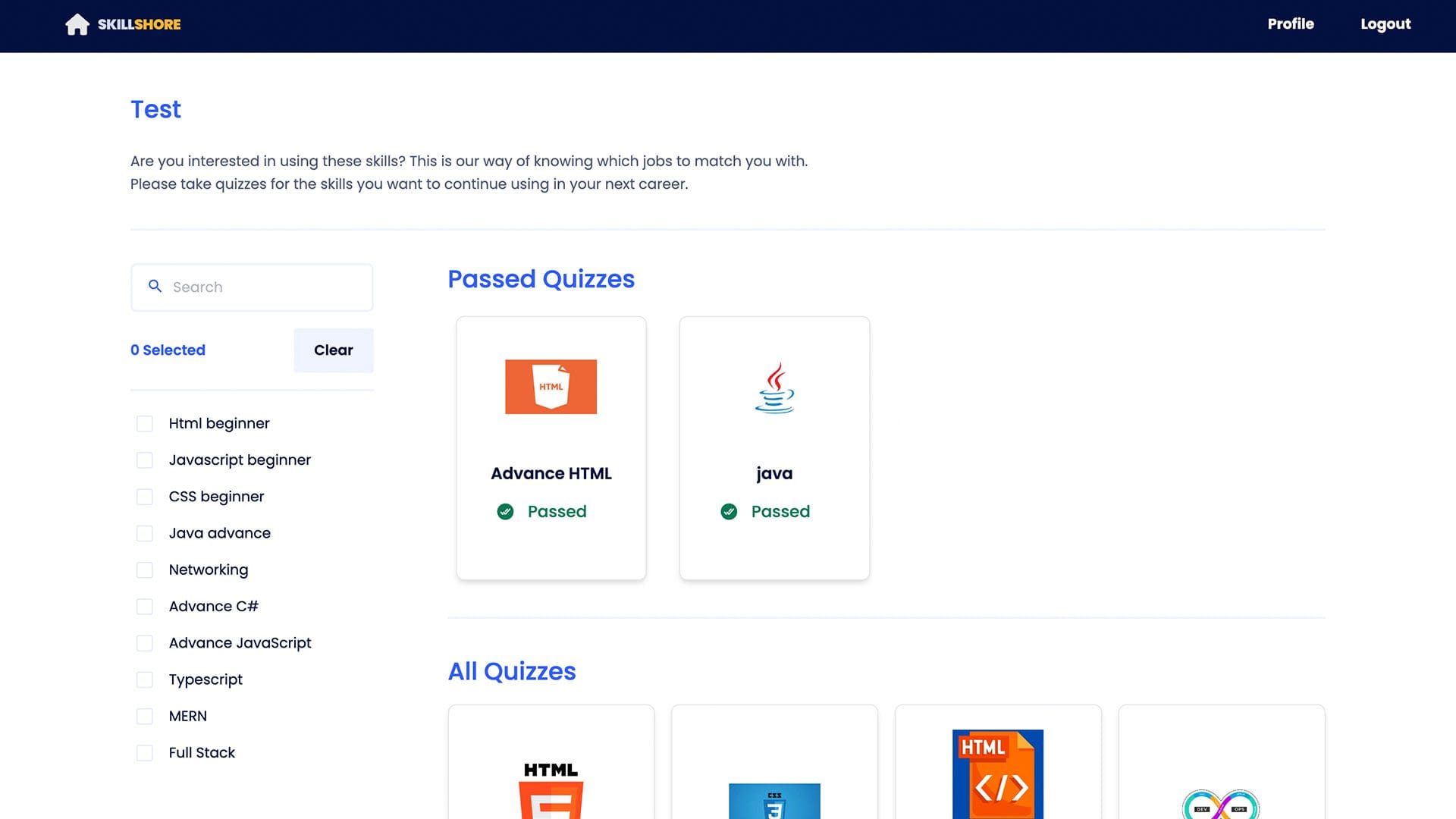


AI Development
AI Agents Guide: Build smarter solutions without complexity
Learn how to leverage effective AI agents and their architectures and how Proshore’s offshore expertise accelerates growth through enterprise-grade solutions.
Book a call Talk to our CTO, Babish, to talk AI and see if our future-ready offshore teams are a fit for you.
In 2024, AI agents were the buzzword across industries, not just tech. Today, they are slowly becoming a business necessity. But for tech firms racing to build MVPs or scale operations, complexity remains the enemy. At Proshore, we too have started helping our clients implement AI agents, and one truth stands out: success lies in simplicity.
This guide strips away the jargon to explain:
- What AI agents actually are (and aren’t).
- When startups should use them (and when to avoid overengineering).
- How to build agents that deliver value fast, using patterns that work.
Plus, learn how Proshore’s offshore development teams in Nepal help startups launch smarter AI-integrated products without blowing budgets.
What Are AI Agents? (No, They’re Not ChatGPT)
AI agents are autonomous systems that perceive, reason, act, and learn with minimal human intervention. Unlike basic automation or LLM-powered chatbots, AI agents can:
- Perceive their environment (via data, APIs, or user inputs).
- Reason using LLMs or machine learning.
- Act through tools like code execution or API calls.
- Learn from feedback loops.
Here are the key distinctions between:
Traditional Automation
Follows fixed rules.
Handles repetitive tasks.
Requires manual updates.
AI Agents
Adapts to new data.
Solves open-ended problems.
Learns autonomously.
Example: A Proshore-built e-commerce agent that analyzes real-time sales data → predicts demand spikes → adjusts pricing without human input.
When to Use Agents (and When to Avoid Them)
AI agents, despite being cutting-edge, are not always necessary. Any new tech comes with its own set of problems, so sometimes proven methods could be better (for now).
Use Agents When
✅ Tasks require adaptability, like customer support resolving unique complaints.
✅ Decisions rely on real-time data. E.g., fraud detection.
✅ You need human-like reasoning at scale. E.g., personalized marketing.
Avoid Agents When
❌ Tasks are repetitive and predictable – traditional automation suffices.
❌ Latency is critical – agents add processing steps.
❌ Budgets are tight – start with single LLM calls + retrieval.
Rule of thumb
If a human needs less than 5 minutes to decide, use automation. If the situation requires reasoning, use agents.

[gravityform id="20" title="true" ]
Building Blocks: Keep It Lean, Keep It Functional
Forget complex frameworks. Effective agents need just three components:
1
Augmented LLM Core
Base Model: Claude 3.5 Sonnet, GPT-4, or open-source alternatives.
Add:
- Tools (APIs, databases).
- Memory (short-term context retention).
- Retrieval (company-specific data).
Pro Tip: Use pre-built modules to skip 80% of setup time.
2
Workflows Over Frameworks
Pattern Best For Proshore Example Prompt Chaining Multi-step tasks like write → edit Marketing copy generation to localization Routing Classifying inputs Sorting customer queries into sales/support pipelines Orchestrator Complex problem-solving Coding agents that edit multiple files 3
Transparent Tool Design
Agents fail when tools are poorly documented. Follow our ACI (Agent-Computer Interface) rules:
Clarity: Describe tools like teaching a junior developer.
Poka-Yoke: Design error-proof parameters, e.g. require absolute file paths.
Test Relentlessly: Run 50+ scenarios before deployment.
Why Proshore? Offshore AI Expertise Without Compromise
Agents aren’t about replacing humans—they’re about augmenting your team’s capabilities. With Proshore as your offshore partner, you gain the technical depth to deploy AI strategically, ensuring every agent solves real business problems.
For tech firms and scaleups, Proshore delivers:
- Cost Efficiency: 50-60% savings vs. in-house European/North-American/Australian teams.
- Breadth of Experience: Over 15 years in offshore software development + multiple AI deployments across eCommerce, healthcare, fintech and SaaS.
- Speed: Launch MVP agents within time-to-market using our pre-built modules.